July 31, 2026
When Capital Intensity Meets Economic Reality: Understanding Mining Asset Write-Downs
Few forces reshape investor confidence in the mining sector as swiftly as a large-scale asset impairment. The mechanics are deceptively simple on the surface: an asset's expected future cash flows, when discounted back to present value, no longer justify the number sitting on the balance sheet. But beneath that accounting correction lies a far more complex story about project execution, macroeconomic timing, geological ambition, and the structural challenges of bringing next-generation iron ore operations to life.
The Fortescue Iron Bridge impairment charge has become one of the most closely examined write-down events in recent Australian mining history, not because impairments are unusual, but because of their scale, their repetition, and what they reveal about the economics of magnetite development at industrial scale.
When big ASX news breaks, our subscribers know first
What an Impairment Charge Actually Measures
Under AASB 136 and its international equivalent IAS 36, companies are required to test assets for impairment whenever indicators suggest the carrying value may not be recoverable. The test compares the asset's carrying amount (what is recorded on the balance sheet) against its recoverable amount (the higher of fair value less costs of disposal, or value in use).
Value in use is typically calculated using a discounted cash flow model, projecting the asset's future earnings and discounting them back to today's dollars using a rate that reflects current risk and borrowing conditions. When that present value falls short of the carrying amount, the difference must be recognised as an impairment loss.
Key distinctions investors should understand:
- A pre-tax impairment charge represents the gross reduction in asset value before any tax shield effect is applied
- The post-tax figure is smaller because deferred tax assets partially offset the write-down's impact on net profit
- Neither figure represents a cash outflow; the company does not physically lose money at the moment of recognition
- However, the write-down permanently reduces shareholders' equity and resets the asset's depreciation base going forward
Furthermore, understanding cut-off grade economics is essential context here, as the threshold at which ore becomes economically viable underpins many of the assumptions embedded in these valuations.
An impairment charge is fundamentally a confession that the original valuation assumptions were too optimistic. Whether caused by market shifts, execution failures, or macroeconomic headwinds, the write-down realigns the balance sheet with economic reality as it stands today, not as it was envisioned at project sanction.
Iron Bridge: A Magnetite Project in a Hematite Company's World
To understand why the Fortescue Iron Bridge impairment charge carries such weight, it is essential to grasp what makes magnetite fundamentally different from the hematite ore that built Fortescue's empire in the Pilbara. Understanding iron ore types and deposits provides important context for why these two ore varieties demand such different capital and processing approaches.
Hematite ore, the backbone of conventional Australian iron ore exports, can often be processed simply by crushing and screening before being shipped as direct-shipping ore (DSO). Its iron content typically ranges between 56% and 62% Fe, with relatively low processing requirements.
Magnetite ore, by contrast, requires a multi-stage beneficiation process:
- Primary and secondary crushing to reduce rock size
- Grinding circuits that reduce ore to fine particles, often below 45 microns
- Magnetic separation stages that exploit the ore's natural magnetic properties to concentrate iron
- Filtering and drying to produce a high-grade concentrate product
- Pelletising or direct sale of concentrate depending on end-market requirements
Iron Bridge was designed to produce a concentrate grading approximately 67% Fe, placing it firmly in the premium segment of the global seaborne iron ore market. That premium grade is the project's central commercial justification, but achieving it consistently at nameplate throughput rates has proven far more difficult than anticipated.
Capital Cost Trajectory: A Study in Escalation
The financial history of Iron Bridge's construction costs illustrates a pattern common to greenfield magnetite projects globally:
| Milestone | Estimated Capital Cost |
|---|---|
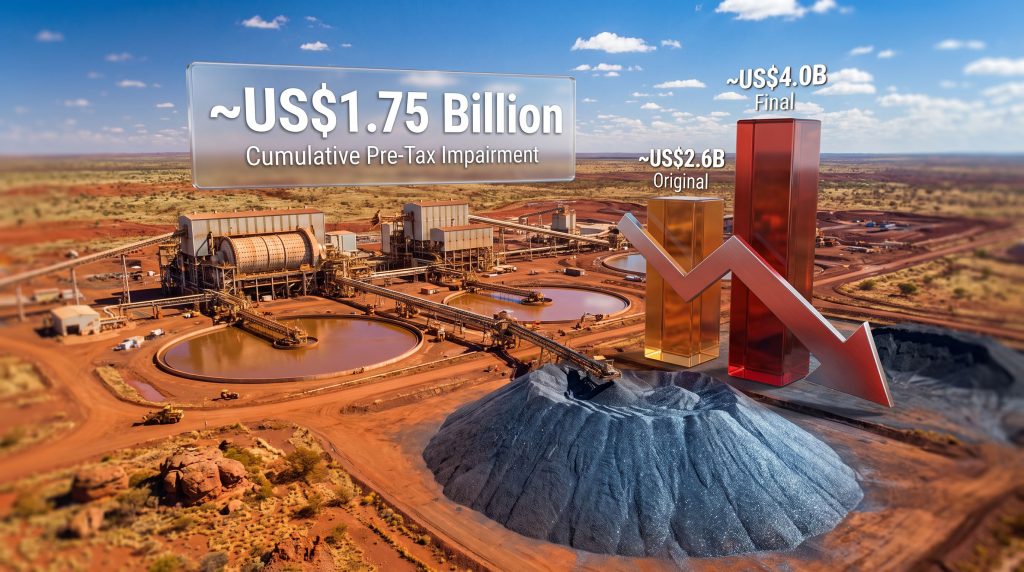
| Original project sanction estimate | ~US$2.6 billion |
| Revised estimate (mid-construction) | ~US$3.8 billion |
| Final revised capital estimate | ~US$4.0 billion |
| Total cost overrun from original |
A 54% cost overrun on a project of this scale is not simply a budgeting failure. It reflects the structural reality that magnetite processing infrastructure is among the most capital-intensive in the mining industry, combining elements of hard rock mining, mineral processing, and specialised magnetic separation technology that few contractors have deep experience delivering at scale in remote Australian environments.
Two Impairments, One Asset: The Write-Down Chronology
The repetition of the Fortescue Iron Bridge impairment charge across two distinct periods is perhaps more revealing than either event in isolation. Fortescue's profit dropped significantly when the first write-down was announced in August 2023, underscoring the real-world financial consequences of these accounting adjustments.
| Impairment Event | Pre-Tax Charge | Post-Tax Charge | Primary Trigger |
|---|---|---|---|
| FY2023 write-down | US$1.0 billion | US$726 million | Ramp-up delays + cost inflation |
| 2026 write-down | US$750 million | ~US$525 million | Ongoing delays + revised outlook |
| Cumulative total | ~US$1.75 billion | ~US$1.25 billion | Structural project underperformance |
The 2026 charge of approximately A$1.1 billion (US$750 million pre-tax) represents roughly 18.75% of the project's revised US$4.0 billion capital cost, written down within a relatively narrow operational window. That proportion is striking, and it signals that the gap between design assumptions and operational reality has not closed materially since the first write-down was recorded.
The Mechanics of How a Ramp-Up Delay Triggers a Write-Down
The pathway from production underperformance to balance sheet impairment follows a logical but damaging sequence:
- The project misses planned throughput rates during the commissioning and ramp-up phase
- Near-term revenue forecasts are revised downward to reflect actual rather than modelled production volumes
- Macro interest rate conditions push the discount rate applied to future cash flows higher, compressing present values further
- The combined effect of lower near-term revenues and a higher discount rate reduces the recoverable amount below the carrying value
- The accounting standards require the shortfall to be recognised immediately as an impairment charge
- Statutory net profit falls for the reporting period; net assets on the balance sheet are permanently reduced
What makes magnetite projects disproportionately exposed to this mechanism is their front-loaded capital structure. Unlike hematite operations where revenue can begin flowing relatively quickly from simpler processing, magnetite projects require the entire beneficiation circuit to function correctly before concentrate can be sold. A partial ramp-up generates disproportionately little revenue relative to the capital already deployed.
The Macroeconomic Environment That Compounded Iron Bridge's Challenges
It would be misleading to attribute Iron Bridge's impairment events solely to project-specific execution failures. The broader economic environment from 2022 onwards created a hostile backdrop for any capital-intensive resource project. Indeed, the broader China steel and iron ore market also contributed headwinds, as shifting demand signals from China's steel sector introduced further uncertainty into long-run revenue assumptions.
Several macro forces converged to erode the project's economics:
- Construction cost inflation: Post-pandemic supply chain disruptions drove up the cost of steel, specialised equipment, and engineered components across all Australian resource projects
- Pilbara labour market tightness: Competition for skilled workers in remote Western Australia pushed labour costs to levels that outpaced national inflation benchmarks
- Interest rate tightening cycle (2022-2024): Central bank rate increases across Australia and globally raised the discount rates applied in asset valuation models, compressing the present value of long-dated cash flows
- Iron ore price volatility: Fluctuations in the premium that high-grade magnetite concentrate commands over standard benchmark fines created uncertainty in the long-run revenue assumptions embedded in DCF models
- Supply chain disruption for specialised equipment: Magnetic separation equipment, HPGR (high pressure grinding roll) circuits, and fine-grinding mills involve long lead times and limited global manufacturing capacity
When higher discount rates combine with lower near-term production assumptions, the mathematical outcome for long-dated mining assets is severe. A 1-2 percentage point increase in the discount rate, applied to a project with decades of projected cash flows, can eliminate hundreds of millions of dollars in calculated recoverable value without any change to the physical asset itself.
What Repeated Impairments Signal to Sophisticated Investors
Experienced mining sector analysts typically adjust for non-cash impairment charges when calculating a company's underlying earnings per share or EBITDA. In that framework, a single impairment event can be absorbed within a narrative of operational adjustment. However, a second material write-down on the same asset within a few years introduces more difficult questions.
Repeated impairments on a single project raise several concerns:
- Original project economics: Were the initial capital cost and production rate assumptions adequately stress-tested against realistic construction and ramp-up scenarios?
- Execution capability: Does the repeat impairment reflect systemic challenges in delivering complex mineral processing infrastructure, rather than a single adverse external event?
- DCF model reliability: If two successive independent valuations have required significant downward revision, what confidence can be placed in forward-looking cash flow projections?
- Capital allocation discipline: Resources committed to Iron Bridge are capital that was not deployed elsewhere; the opportunity cost of a prolonged and underperforming ramp-up is material
For income-focused investors, the interaction between statutory profit (reduced by the write-down) and dividend sustainability deserves careful attention. While impairments do not affect operating cash flow directly, sustained capital commitments to a challenging project can constrain free cash flow available for distributions.
The next major ASX story will hit our subscribers first
The Green Steel Thesis: Why Iron Bridge Still Has a Strategic Case
Despite the financial turbulence, the long-term strategic rationale for high-grade magnetite concentrate has not fundamentally weakened. In fact, the structural shift toward lower-carbon steelmaking may strengthen the commercial case for assets like Iron Bridge over a 20-30 year horizon.
The dominant decarbonisation pathway for the global steel industry centres on direct reduced iron (DRI) combined with electric arc furnace (EAF) steelmaking. This process replaces coking coal with hydrogen or natural gas as the reducing agent. Consequently, advances in hydrogen iron ore reduction technology are increasingly relevant to the long-term value proposition of premium magnetite concentrate assets like Iron Bridge.
This process requires iron feed material of significantly higher purity than conventional blast furnace operations tolerate. Specifically, DRI-EAF steelmaking typically requires iron ore feed with:
- Iron content above 65% Fe, ideally closer to 67% Fe
- Very low levels of silica, alumina, phosphorus, and sulphur (collectively known as gangue minerals or impurities)
- Consistent particle size distribution appropriate for the reduction reactor
Iron Bridge's target concentrate specification of approximately 67% Fe with low impurities positions it directly within the feed quality window required by DRI-EAF steelmakers. Furthermore, the broader push toward green iron production across the industry means that as steel producers globally invest in decarbonisation infrastructure, demand for this grade of material is structurally expected to increase.
Three Scenarios for Iron Bridge's Trajectory
| Scenario | Description | Key Condition |
|---|---|---|
| Successful stabilisation | Ramp-up achieves nameplate capacity; project generates positive long-run returns | Sustained operational execution improvement |
| Sustained underperformance | Throughput remains below target; further write-downs remain possible | Persistent technical or market challenges |
| Strategic restructure or divestment | Asset sold, joint-ventured, or restructured to reduce balance sheet exposure | Capital reallocation pressure outweighs strategic rationale |
The sunk cost fallacy is a genuine risk in mining board decisions: continuing to invest in a challenged asset because of capital already deployed, rather than on the merits of forward-looking economics. Disciplined capital allocation frameworks should evaluate Iron Bridge's future purely on its incremental economics from today, not on the billions already committed.
Lessons for the Broader Magnetite Sector
Iron Bridge is not an isolated case study. Magnetite projects globally have consistently delivered longer ramp-up timelines and higher capital costs than initial estimates suggested. The reasons are systemic:
- Fine-grinding circuits operating at industrial scale involve engineering complexity that laboratory and pilot-scale testing consistently underestimates
- Magnetic separation performance is sensitive to ore variability across different parts of a deposit, requiring continuous process adjustment as mining fronts advance
- Achieving consistent concentrate quality at high throughput rates simultaneously is materially harder than achieving either metric in isolation
- Remote construction environments amplify every cost and schedule risk through logistics, workforce accommodation, and supply chain dependencies
For investors evaluating magnetite development companies, the Iron Bridge experience reinforces several due diligence principles:
- Apply a conservative capital cost contingency of at least 20-30% above feasibility study estimates for greenfield magnetite projects
- Scrutinise ramp-up schedules for realism, particularly the assumptions around grinding circuit availability and magnetic separation recovery rates
- Assess the prevailing discount rate environment at the time of investment, recognising that rate cycles can materially shift the present value of long-dated projects
- Distinguish between the long-term demand thesis (which may be sound) and near-term execution risk (which can destroy value even in structurally attractive markets)
Disclaimer: This article is intended for informational purposes only and does not constitute financial advice. Past impairment events and historical capital cost data should not be relied upon as indicators of future project performance. Readers should conduct independent due diligence and consult a licensed financial adviser before making investment decisions.
Frequently Asked Questions: Fortescue Iron Bridge Impairment Charge
What is the Fortescue Iron Bridge impairment charge?
The Fortescue Iron Bridge impairment charge refers to non-cash accounting write-downs applied to the carrying value of Fortescue's Iron Bridge magnetite project in the Pilbara region of Western Australia. Two separate impairment events have been recorded: a US$1.0 billion pre-tax charge in FY2023 and a further US$750 million pre-tax charge (approximately A$1.1 billion) flagged in 2026, bringing the cumulative pre-tax total to approximately US$1.75 billion.
Why did Iron Bridge require an impairment?
The write-downs reflect a combination of ramp-up delays, construction cost overruns exceeding 54% above original estimates, rising global interest rates increasing the discount rates used in asset valuations, supply chain disruptions affecting specialised processing equipment, and revised production outlooks that reduced the estimated recoverable value below the balance sheet carrying amount.
Does the impairment mean Iron Bridge will be shut down?
Not necessarily. An impairment charge is an accounting adjustment rather than an operational shutdown decision. The project continues to operate. The long-term strategic case for high-grade magnetite concentrate as a preferred feedstock for green steel production via DRI-EAF technology remains a key rationale for continued operation, provided forward-looking economics justify ongoing investment.
How does the impairment affect Fortescue's earnings?
The charge reduces statutory net profit for the relevant reporting period and permanently reduces net assets on the balance sheet. However, it does not reduce operating cash flow. Analysts typically exclude non-cash impairment charges when calculating underlying earnings, though repeated write-downs on a single asset do introduce questions about original project economics and capital cost guidance reliability.
What is the total capital cost of Iron Bridge?
The revised capital cost reached approximately US$4.0 billion, up from an original project sanction estimate of around US$2.6 billion, representing a cost overrun of roughly US$1.4 billion or approximately 54% above the initial figure.
For ongoing coverage of Fortescue's Iron Bridge project and broader developments across the Australian magnetite and iron ore sector, The Australian Mining Review at australianminingreview.com.au provides regular reporting on project updates, operational performance, and strategic direction across Australian resource operations.
Want to Identify the Next Major ASX Mineral Discovery Before the Broader Market?
Discovery Alert's proprietary Discovery IQ model delivers real-time alerts on significant ASX mineral discoveries, cutting through complex geological and financial data to surface actionable investment opportunities the moment they are announced — explore historic discoveries and their returns to understand what early positioning can mean, then begin your 14-day free trial at Discovery Alert to gain a genuine market-leading edge.