July 31, 2026
The Infrastructure Chokepoint That Makes Port Hedland Irreplaceable
When analysts assess sovereign risk in commodity supply chains, they typically focus on geopolitical flashpoints, regulatory instability, or resource nationalism. Rarely does the conversation begin with a labour dispute at a single port. Yet the BHP Port Hedland iron-ore workers strike scheduled for August 8 and 9, 2026 has forced exactly that reassessment, exposing how concentrated the world's iron-ore supply chain has become and how vulnerable it is to disruption at a single geographic node.
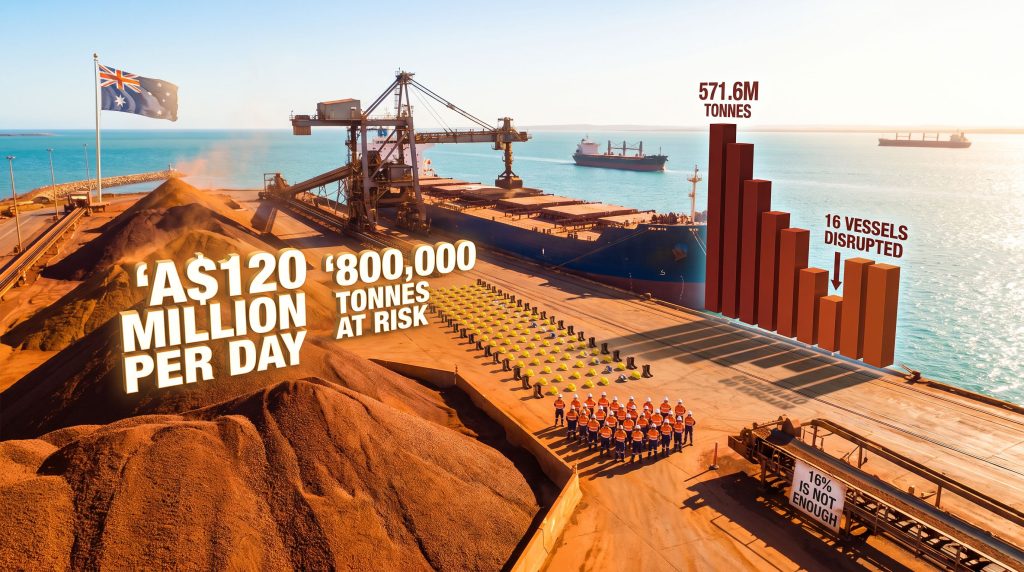
Port Hedland is not simply a large port. It is the largest bulk commodity export terminal on the planet, and its operational continuity underpins steel production schedules across China, Japan, South Korea, and beyond. In the year ending June 2026, the port shipped 571.6 million tonnes of iron-ore, representing approximately 75% of total Pilbara iron-ore exports during that period. Three of Australia's most significant iron-ore producers — BHP, Fortescue, and Hancock Prospecting — all route their product through the same infrastructure. That shared dependency is precisely what transforms a workplace grievance into a global commodity event.
When big ASX news breaks, our subscribers know first
What the Numbers Actually Mean for Global Steel Supply
To understand the stakes, it helps to translate the volume figures into economic terms that resonate beyond the port gates. Furthermore, understanding the iron ore demand outlook provides essential context for why a disruption of this scale carries such significant weight across global markets.
| Metric | Figure |
|---|---|
| Annual port throughput (year to June 2026) | 571.6 million tonnes |
| Share of Pilbara iron-ore exports | ~75% |
| Daily export value at risk (BHP operations) | |
| Estimated tonnage affected per day (Aug 8-9) | ~800,000 tonnes |
| Vessel loadings expected to be disrupted | ~16 shipments |
| Workers participating in August action | ~150 |
| Workers covered by contested enterprise agreement | ~450 operators and maintenance workers |
BHP's position as the world's third-largest iron-ore producer amplifies these figures further. The company reported record annual iron-ore output in the weeks immediately before the dispute escalated, meaning any sustained disruption would subtract from an already-stretched production baseline rather than from surplus inventory buffers.
Understanding the Enterprise Agreement at the Heart of the Dispute
Why This Is Not Simply a Wage Argument
Framing the BHP Port Hedland iron-ore workers strike purely as a pay dispute misses the structural dimension that makes this negotiation particularly complex. After more than seven months of enterprise bargaining between BHP and union representatives, the core disagreement has moved well beyond headline wage percentages.
BHP has tabled a 16% pay increase over the life of the four-year enterprise agreement. On its face, that figure is not negligible. However, the Combined BHP Ports Unions, representing approximately 450 operators and maintenance workers through three affiliated bodies — including the Western Mine Workers Alliance, the Electrical Trades Union (ETU), and the Australian Manufacturing Workers Union (AMWU) — argues that the offer fails to address the foundational question of how pay and conditions are structured and protected.
The workers' grievances cluster around several interconnected issues:
- Conditions premium: Pilbara operations involve sustained exposure to extreme heat, remote isolation from family, and extended roster cycles that metropolitan benchmarks simply do not capture.
- Enforceable protections: Unions are seeking contractual guarantees that cannot be quietly eroded over the life of a multi-year agreement through classification shifts or roster restructuring.
- Career progression clarity: Ambiguous classification structures have historically made it difficult for workers to navigate advancement pathways, effectively capping earning potential.
- Real take-home pay: An electrical trades worker highlighted that achieving meaningful take-home pay under current arrangements requires working every weekend across a four-week continuous cycle, meaning the gross wage figure masks the actual conditions required to earn it.
"The dispute is not simply about a percentage increase. Workers are contesting the fundamental framework under which pay and conditions are set, seeking enforceable protections that cannot be eroded over the life of a multi-year agreement."
The High-Voltage Wildcard
A dimension of the dispute that receives less attention is the separate enterprise agreement being negotiated by high-voltage and power workers. This cohort is not covered by the primary four-year agreement and is pursuing its own bargaining outcome. These workers are also planning a 12-hour stoppage on August 9, running parallel to the main work stoppage.
Their inclusion creates a compounding operational risk: if both groups are simultaneously inactive, the port's capacity to maintain basic electrical infrastructure and loading systems is materially compromised, even if other workers remain on site.
A Chronology of Escalation: From Historic Precedent to Planned Stoppages
The July 2026 Strike: Breaking a 25-Year Pattern
The August 8 and 9 action does not exist in isolation. It follows a significant precedent set on July 16, 2026, when workers staged an eight-hour stoppage between 2pm and 10pm AWST. That action was described as the first protected industrial action at the Port Hedland export terminal in more than 25 years, making it one of the most consequential labour events in Western Australian mining in a generation.
Crucially, that stoppage did not bring exports to a complete halt. At least one loaded vessel departed port during the action, and BHP maintained that contingency protocols kept operations running safely. This detail matters for market interpretation: a partial stoppage demonstrates organisational resilience but also reveals that contingency measures have limits as the duration and intensity of action increases.
The August Action: A Step-Change in Severity
The planned August 8 and 9 stoppages represent a deliberate escalation in both scope and coordination. The sequence of planned actions is as follows:
- August 8, 2026: A 24-hour ban on ship loading, targeting the commercial throughput function of the terminal without necessarily halting all physical operations.
- August 9, 2026 (from 05:30 AWST / 21:30 GMT August 8): A full 24-hour work stoppage at the Port Hedland Bulk Export Terminal, eliminating the operational buffer that limited the impact of the July action.
- August 9, 2026: A concurrent 12-hour stoppage by high-voltage and power workers under their separate enterprise agreement.
The last opportunity to avert this action was a negotiating session scheduled for Tuesday, August 5, following the most recent meeting between BHP and union representatives on July 28. Consequently, unions have been loading up for further strikes as BHP battles to keep iron-ore moving through the terminal.
How Iron-Ore Markets Are Pricing the Risk
Short-Term Floor, Long-Term Uncertainty
Iron-ore prices had already declined to a one-year low in the days immediately preceding the strike announcement, reflecting broader demand-side concerns linked to Chinese steel sector conditions. The threatened BHP Port Hedland iron-ore workers strike placed a temporary floor under further price weakness, as traders began pricing a near-term supply disruption premium into spot and forward contracts.
Barrenjoey analyst Glyn Lawcock, based in Sydney, assessed the two-day stoppage as representing approximately 800,000 tonnes per day of affected iron-ore shipments. His conclusion was that BHP should be capable of recovering this volume across its full annual production cycle, given the record output trajectory reported just weeks earlier.
However, Lawcock introduced an important qualification: markets are currently treating this as a contained, recoverable event, but a shift toward sustained or recurring stoppages would require a fundamental reassessment of near-term supply assumptions. The distinction between an isolated industrial episode and a structural pattern of disruption is the variable that separates a manageable commodity event from a genuine price catalyst.
"Markets are currently pricing this as a contained, recoverable event. A shift to sustained or escalating industrial action would require a fundamental reassessment of near-term iron-ore supply assumptions." — Barrenjoey, Glyn Lawcock, Sydney, July 2026
The Fortescue Contagion Question
An underappreciated dimension of the broader risk profile is the potential for industrial action to spread beyond BHP's workforce. Fortescue CEO Dino Otranto acknowledged on an analyst call on July 31, 2026 that the company was not immune to similar pressures, while expressing confidence that Fortescue's internal workplace culture would serve as a buffer.
The significance of this acknowledgement should not be underestimated. Because BHP, Fortescue, and Hancock Prospecting all share Port Hedland's infrastructure, any escalation of industrial tension at the port level — rather than at a single operator level — would create a systemic disruption that no individual operator's contingency planning could fully absorb. In addition, the broader China steel and iron ore market conditions mean that steel producers are already navigating a challenging demand environment, making supply reliability all the more critical.
The Legislative Backdrop: How 2022 Changed the Rules of Engagement
A Structural Shift in Bargaining Power
The conditions enabling the current dispute did not emerge spontaneously. The Australian Labor government's 2022 industrial relations reforms fundamentally altered the bargaining environment across the resources sector, with consequences that are now playing out in real time at Port Hedland.
The key changes expanded union capabilities in three specific ways:
- The ability to negotiate enterprise agreements covering multiple employers simultaneously, increasing collective leverage.
- Enhanced scope to request flexible working arrangements, shifting the negotiating agenda beyond base wages.
- Access to protected action provisions that facilitate industry-wide strike coordination, rather than confining industrial action to individual enterprise disputes.
These reforms gave organised labour in the Pilbara significantly more structural power than it possessed in the pre-2022 bargaining environment. The July 2026 strike — the first protected action at Port Hedland in over 25 years — was a direct product of that empowerment.
Why the Pilbara Is the Front Line
The Pilbara is not merely a geographic region. It is the highest-value, highest-intensity labour environment in Australian mining, and arguably one of the most demanding industrial workplaces anywhere in the world. Temperatures regularly exceed 45 degrees Celsius during summer months. Fly-in fly-out rosters separate workers from their families for weeks at a time. Career advancement structures in the sector have historically been opaque.
This combination of physical hardship, social dislocation, and structural ambiguity creates a workforce with legitimate grievances that extend well beyond what standard metropolitan enterprise agreement frameworks are designed to address. If the BHP enterprise agreement is renegotiated with genuinely enforceable protections, it would establish a new benchmark that other Pilbara operators — including Fortescue and Rio Tinto — would face pressure to match in their own subsequent bargaining rounds.
The next major ASX story will hit our subscribers first
BHP's Position and the Path to Resolution
Operational Resilience and Contingency Planning
BHP has characterised the planned stoppages as disappointing while affirming its commitment to reaching a fair agreement. The company confirmed contingency plans are in place to maintain safe operations during any work stoppage, a position consistent with its response to the July action. Its 16% pay offer remains formally on the table.
The question of whether BHP can absorb the volume shortfall is more nuanced than headline production figures suggest. The 800,000 tonnes per day affected by the August 8 and 9 action is recoverable across an annual cycle. However, recovery assumes:
- No further stoppages in the weeks and months following.
- Continued operational efficiency at full capacity once workers return.
- No secondary disruptions triggered by Fortescue or Hancock Prospecting workforce sentiment.
Each of these assumptions becomes less reliable if the dispute extends beyond an isolated two-day event.
What a Negotiated Outcome Might Look Like
A resolution that satisfies both parties would likely require BHP to move beyond a simple wage percentage and engage with the structural demands around classification clarity and enforceable condition protections. Potential resolution frameworks could include:
- A phased wage structure linking future increases to clearly defined productivity benchmarks.
- Explicit classification and career progression schedules embedded in the agreement rather than subject to managerial discretion.
- Formal heat and roster condition standards with enforceable remedies for non-compliance.
The enterprise agreement outcome will function as a de facto industry standard for the Pilbara, making BHP's negotiating position not just an internal cost management question but a sector-wide precedent-setting exercise.
Investment and Sovereign Risk: The Longer View
For investors and steel producers monitoring the situation, the immediate volume impact is secondary to what a pattern of recurring industrial action would signal about Australia's reliability as a stable supply source. Furthermore, the global iron ore tariff impact and Australia's resource export challenges are already weighing on sentiment across the sector.
Australia's iron-ore sector has historically marketed itself on the basis of operational consistency and rule-of-law predictability, differentiating it from higher-risk jurisdictions. A sustained pattern of port-level stoppages at the world's largest iron-ore export terminal would challenge that narrative, potentially accelerating supply diversification planning among steel producers in China, Japan, and South Korea.
The Onslow iron logistics update demonstrates that alternative export infrastructure is being developed across Western Australia, though it remains far from matching Port Hedland's capacity or operational maturity. For now, the outcome of the current negotiations will be watched closely by commodity traders, steel manufacturers, and investors in Australian resource equities alike. What begins as a workplace dispute over roster conditions and classification structures carries implications that extend well beyond Port Hedland's loading berths.
This article contains forward-looking assessments and market analysis for informational purposes only. It does not constitute financial or investment advice. Readers should conduct their own research and consult qualified advisers before making investment decisions.
Want to Stay Ahead of ASX Mineral Discoveries That Could Reshape Commodity Markets?
Discovery Alert's proprietary Discovery IQ model delivers real-time alerts on significant ASX mineral discoveries, transforming complex mineral data into clear, actionable insights for investors at every level of experience — explore historic discovery returns on Discovery Alert's dedicated discoveries page to understand the scale of opportunity, then begin your 14-day free trial to position yourself ahead of the broader market.