July 10, 2026
Why the ASX 200's Commodity Dependency Is Both Its Greatest Weakness and Its Greatest Strength
Few developed market indices carry the same structural exposure to raw material prices as Australia's ASX 200. While technology-heavy benchmarks like the Nasdaq respond primarily to earnings multiples and interest rate expectations, ASX 200 miners rescue market on copper rally conditions time and again, demonstrating the index's unique character. When copper moves 14% in a single session, the ripple effect across the materials sector is powerful enough to determine whether the entire index closes in positive or negative territory, regardless of what is happening in healthcare, technology, or energy.
This is not a design flaw. It is a reflection of Australia's geological endowment and the dominant role resource companies play in the country's corporate landscape. Understanding how and why this dynamic plays out requires looking beyond the day's price movements to the structural forces that make copper, in particular, the single most consequential commodity for Australian equity investors right now.
When big ASX news breaks, our subscribers know first
Copper's Expanding Role: From Industrial Metal to Energy Transition Linchpin
Why Copper Carries More Weight Than Iron Ore
For decades, iron ore was the commodity that moved Australian markets. Its fortunes were tied almost exclusively to Chinese steel production, which meant the ASX materials sector effectively functioned as a leveraged proxy on Chinese infrastructure spending. However, copper has begun to displace iron ore as the more complex and arguably more powerful market signal, for reasons that extend well beyond traditional industrial demand.
Copper is uniquely exposed to two simultaneous demand cycles: the conventional economic cycle and the structural energy transition cycle. This dual mandate means its price can be driven higher by Chinese manufacturing activity, American construction data, and the global buildout of electric vehicles, renewable energy grids, and artificial intelligence infrastructure all at once. Furthermore, the copper supply crunch continues to intensify, adding further upward pressure on prices.
Consider the demand intensity differences across technologies:
- A conventional internal combustion engine vehicle uses approximately 20kg of copper
- A battery electric vehicle requires roughly 83kg, representing more than four times the copper intensity
- A single offshore wind turbine can require up to 9,500kg of copper for its generator, cabling, and transformer systems
- Utility-scale solar farms use approximately 5.5 tonnes of copper per megawatt of installed capacity
- Large-format AI data centres, which rely on copper for power distribution, signal transmission, and liquid cooling infrastructure, are emerging as a significant and underappreciated new demand vector
"The convergence of electrification, digitalisation, and decarbonisation means copper demand is being pulled simultaneously from multiple directions that historically never overlapped. This is structurally different from any previous copper cycle."
The Supply Side Constraint That Amplifies Every Price Move
What makes copper price rallies particularly significant for ASX miners is the structural tightness on the supply side. New copper deposits are becoming harder to discover, deeper to mine, and lower in grade than historical averages. The global average copper ore grade has declined from roughly 1.6% in the 1990s to below 0.6% in many major producing nations today, meaning miners must process substantially more rock to produce the same volume of refined copper.
The development timeline from greenfield discovery to first production typically spans 10 to 15 years, incorporating exploration, feasibility studies, environmental approvals, financing, and construction. Consequently, the supply response to any price signal is inherently delayed, which amplifies price volatility and rewards companies with already-producing copper assets or projects close to development.
Session Breakdown: How ASX 200 Miners Rescued the Market
The Index Closes Up Despite a Toxic Macro Backdrop
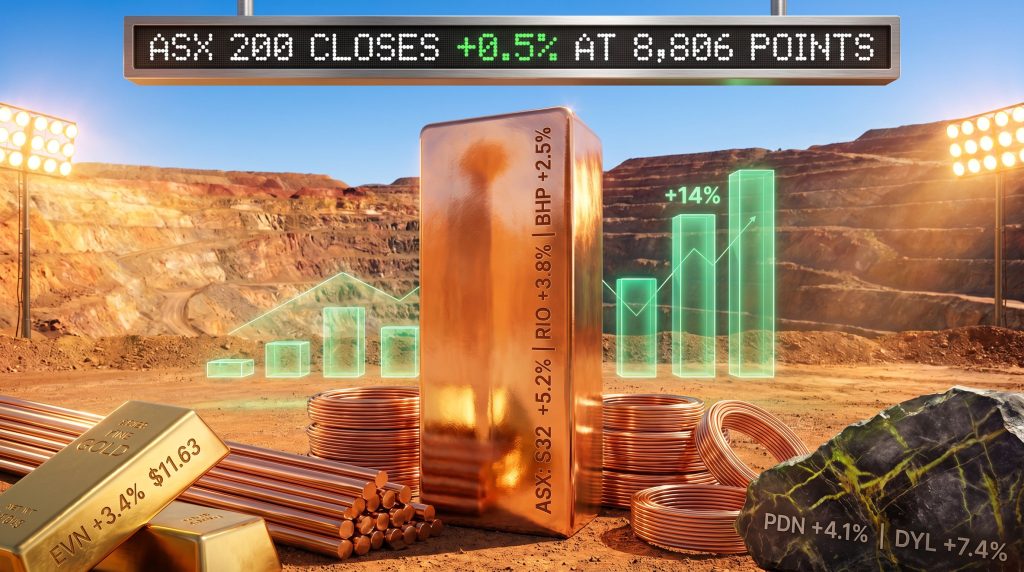
The session in focus saw the ASX 200 close up 43.5 points, or 0.5%, at 8,806 points, ending a four-day losing streak in circumstances that would typically favour further declines. The macro environment during the week included renewed Middle East airstrikes, the collapse of a fragile ceasefire, and the reimposition of US oil sanctions on Iran. These developments raised genuine concerns about the security of commodity flows through the Strait of Hormuz, a chokepoint through which approximately 21% of global liquefied natural gas and significant volumes of oil transit daily.
Despite this backdrop, the ASX 200 finished the week down only 0.5%, a result that reflects the countervailing force of the materials sector's copper-driven rally. According to market analysts, the copper surge was instrumental in driving miners to near-record territory.
| Sector | Direction | Primary Driver |
|---|---|---|
| Materials | Up | Copper and gold price strength |
| Financials | Up | Major bank stability, rate expectations |
| Real Estate | Up | Yield-sensitive recovery |
| Energy | Down | Flat oil prices despite geopolitical risk |
| Healthcare | Down | Cyclical rotation out of defensives |
| Technology | Down | Risk-off sentiment in growth stocks |
The Copper Catalyst: A 14% Move and Its ASX Consequences
A 14% surge in copper prices provided the fuel for the materials sector's outperformance. Moves of this magnitude are rare and typically reflect a confluence of factors: short covering by speculative traders, a reassessment of demand forecasts by large institutional buyers, or supply disruption signals from major producing regions such as Chile, Peru, or the Democratic Republic of Congo. Indeed, the recent copper price rally has been partly attributed to tariff-related concerns reshaping global trade flows.
ASX-listed copper-exposed stocks and their session performance:
- South32 (ASX: S32): +5.2%, the standout mover among diversified miners
- Rio Tinto (ASX: RIO): +3.8% to $164.49
- BHP (ASX: BHP): +2.5% to $58.28
- Sandfire Resources (ASX: SFR): +3.8% to $18.83, with an additional company-specific catalyst
"A 14% move in a major industrial commodity within a single session is a low-frequency, high-impact event. Its effect on ASX miner valuations is immediate because equity markets reprice forward earnings expectations in real time based on spot commodity prices."
Beyond Copper: Gold, Uranium, and Banks Add to the Recovery
Gold Miners Benefit From Inflation Repricing
The same geopolitical pressures that weighed on sentiment also triggered an inflation repricing that supported gold. When investors factor in higher-for-longer oil prices and supply chain risks, gold safe-haven demand becomes considerably more attractive as a purchasing power hedge. Evolution Mining (ASX: EVN) captured this dynamic, rising 3.4% to $11.63.
Gold's relationship with copper during periods of geopolitical uncertainty is worth noting: the two metals can move in the same direction for fundamentally different reasons, with copper driven by demand optimism and gold driven by risk aversion. When both rally simultaneously, it tends to generate outsized gains for the ASX materials sector as a whole.
Uranium Stocks Respond to a Bilateral Export Agreement
Uranium stocks received a discrete, company-relevant catalyst in the form of a finalised bilateral arrangement between Australia and India covering long-term uranium export arrangements. In addition, the broader uranium market trends suggest India's civilian nuclear expansion program represents one of the largest pipeline sources of new uranium demand globally over the coming two decades.
- Paladin Energy (ASX: PDN): +4.1% to $10.06
- Deep Yellow (ASX: DYL): +7.4% to $1.44, reflecting greater leverage to uranium sentiment
Major Banks Provide Steady Ballast
Australia's four major banks contributed to the financials sector's recovery, posting measured but consistent gains that provided stability to the index.
| Bank | ASX Code | Session Move | Closing Price |
|---|---|---|---|
| National Australia Bank | NAB | +0.8% | $39.61 |
| Westpac | WBC | +0.9% | $36.54 |
| ANZ | ANZ | +0.8% | $36.05 |
| Commonwealth Bank | CBA | +0.5% | $168.86 |
The banking sector's resilience is analytically significant. It suggests institutional capital was rotating into yield-bearing financials rather than fleeing to cash, indicating a measured rather than panic-driven response to the week's geopolitical events.
Sectors That Fell: Understanding the Rotation Logic
Energy Stocks Caught in a Paradox
The energy sector presented an unusual situation: elevated geopolitical risk in the Middle East would ordinarily be expected to push oil prices sharply higher, benefiting producers. Instead, oil prices remained flat, stranding energy stocks without a price catalyst while also denying them the insurance of being defensive.
- Santos (ASX: STO): -0.4% to $7.62
- Woodside Energy (ASX: WDS): -0.9% to $29.05
- Beach Energy (ASX: BPT): +0.6% to $0.88, a minor exception
Healthcare Experiences Classic Rotation Selling
Pro Medicus (ASX: PME) fell 6.3% to $197.07, ending a remarkable 33% monthly run. CSL (ASX: CSL) lost 2.1% to $122.89. These moves are consistent with a well-documented portfolio rebalancing pattern: when cyclical sectors produce strong returns, institutional investors reduce positions in lower-beta defensive stocks to fund new allocations, regardless of the underlying fundamentals of those defensive companies.
"PME's 6.3% decline after a 33% monthly gain reflects rational profit-taking behaviour rather than any fundamental deterioration. Recognising this distinction is critical for investors assessing whether a pullback represents an opportunity or a warning."
Company-Level Highlights: Where Stock Picking Outperformed Sector Exposure
Bravura Solutions: An Earnings Upgrade That Overshadowed the Sector Rally
Bravura Solutions (ASX: BVS) delivered the session's most impressive individual performance, surging 15.1% to $2.36 after upgrading its FY2026 earnings guidance to $77 million, compared to its previous guidance range of $69 million to $73 million. This represents an upgrade of approximately 5.5% to 11.6% above the top end of prior guidance, a meaningful step-up that signals genuine operational leverage rather than incremental improvement.
Key implications for investors:
- Earnings guidance upgrades of this magnitude typically reflect improved revenue visibility, cost discipline, or both
- The scale of BVS's single-session gain exceeded every copper-exposed miner on the same day, demonstrating that company-specific catalysts can outperform even powerful sector-wide commodity moves
- Technology and software businesses with recurring revenue models can deliver guidance upgrades with high earnings quality, which markets tend to reward with premium multiples
Sandfire Resources: Mine Life Extension Deepens Asset Value
Sandfire Resources (ASX: SFR) added 3.8% to $18.83 following confirmation that the planned mine life of its Black Butte copper project in Montana, USA has been extended to 12 years following a maiden ore reserve declaration for the Lowry deposit. For investors considering copper investment strategies, mine life extensions of this kind are precisely the type of catalyst worth monitoring closely.
Why mine life extensions matter to investors:
- A longer mine life directly increases a project's net present value (NPV), as future cash flows are extended over more years
- A maiden ore reserve under JORC or equivalent international reporting standards is an independently verified milestone that improves the project's bankability with lenders and institutional investors
- Operating in a politically stable jurisdiction like the United States reduces sovereign risk compared to many copper-producing nations
- The 12-year mine life provides long-term revenue visibility that supports more predictable capital allocation and dividend planning
The next major ASX story will hit our subscribers first
Bull and Bear Cases for Copper: A Framework for ASX Investors
The Structural Bull Case
The long-term demand argument for copper rests on the convergence of multiple independently powerful demand drivers. Each of the following trends would, on its own, represent meaningful demand growth. Together, they represent a structural demand shift of a scale not previously seen in copper market history:
- EV adoption acceleration across North America, Europe, and China
- AI infrastructure expansion, with data centre copper intensity growing in line with compute capacity
- Renewable energy grid buildout, requiring copper for generation, transmission, and storage
- Urbanisation in South and Southeast Asia, driving baseline construction and industrial demand
- Mine supply constraints, with declining ore grades and multi-decade development timelines limiting the supply response
The Cyclical Bear Case
Despite the structural tailwinds, copper markets remain subject to cyclical forces that can produce sharp near-term reversals:
- Chinese demand softness has historically been the most powerful near-term headwind; when Chinese fabricators reduce buying, spot prices can fall sharply regardless of structural trends
- US dollar strength reduces the purchasing power of non-US buyers of dollar-denominated copper, compressing demand
- Inventory overhang at Chinese warehouses monitored by the Shanghai Futures Exchange can signal periods of destocking that temporarily suppress physical buying
- Mining cost inflation, partially driven by elevated energy prices, compresses margins even when copper prices rise
The Week Ahead: Catalysts That Could Extend or Reverse the Rally
US Earnings Season Takes Centre Stage
The ramp-up of the US second-quarter earnings season represents the next significant binary event for global risk sentiment. Key reporting milestones include major US banks, whose results will test whether a recent 16% run-up in US financial stocks is supported by hard earnings numbers. Tech stocks boosting Wall Street have also been a notable feature of recent sessions, adding another layer of complexity to near-term market direction.
US megacap technology results, due the following week, arrive with elevated expectations of approximately 50% second-quarter earnings growth, a figure that underpins a substantial portion of S&P 500 aggregate earnings forecasts. Whether these expectations are met, exceeded, or disappointed will have material implications for global risk appetite and, by extension, commodity market sentiment.
Australian Data Points and Company Updates to Monitor
| Data Release or Event | ASX Relevance |
|---|---|
| Australian inflation expectations | Informs RBA rate path and AUD direction |
| Consumer sentiment survey | Leading indicator for domestic cyclicals |
| Business confidence figures | Signals capex and resource demand outlook |
| US Federal Reserve Chair testimony | Forward guidance on US rates affects AUD/USD |
| Rio Tinto operational update | Copper production volumes closely watched |
| BHP quarterly production report | Copper and iron ore volumes key metrics |
| Evolution Mining update | Gold production and cost guidance |
| Alcoa Q2 results | Aluminium market health indicator |
FAQ: ASX 200 Miners, Copper Rallies, and Market Structure
Why does the ASX 200 respond so strongly to copper price movements?
The ASX 200 is structurally overweight toward resource and financial companies relative to most other developed market indices. This means a 14% move in copper can generate percentage gains in major miners that are large enough in absolute dollar terms to offset losses across multiple other sectors simultaneously, lifting the entire index even when the majority of its constituent sectors are declining.
What is a maiden ore reserve and why does it matter for a copper project?
A maiden ore reserve is the first formal, independently audited estimate of the tonnage and grade of economically extractable mineral material at a specific deposit, reported under internationally recognised standards such as the JORC Code in Australia. It is a critical commercial milestone because it is the threshold above which lenders and institutional investors typically begin to treat a project as bankable, meaning it can attract debt financing for development. For Sandfire's Black Butte project, the declaration of a maiden reserve for the Lowry deposit underpins the extended 12-year mine life.
Can the current copper rally be sustained, or is a pullback likely?
Copper markets operate across two distinct time horizons simultaneously. In the near term, a 14% single-session price move typically attracts profit-taking and mean-reversion pressure. Over a multi-year horizon, however, the structural demand case is supported by EV adoption, energy transition infrastructure, AI data centre expansion, and supply constraints from declining ore grades and long development timelines. Investors should monitor Chinese fabricator purchasing activity and Shanghai Futures Exchange warehouse inventory levels as the most reliable near-term indicators of physical demand momentum.
How does geopolitical risk in the Middle East affect ASX mining stocks specifically?
The effect operates through two competing channels. Elevated geopolitical risk raises energy input costs for mining operations, because diesel, electricity, and explosives represent significant cost components for large-scale mining. This compresses margins. Simultaneously, geopolitical risk drives inflation expectations higher, which historically supports gold prices and, indirectly, copper as a hard asset hedge. The net effect on ASX miners in any given session depends on which channel is dominant.
This article is general in nature and does not constitute financial product advice. Readers should seek independent financial advice before making any investment decisions. All share price movements and financial figures referenced relate to the specific trading session discussed and may not reflect current market conditions.
Want to Capitalise on the Next Major Copper Discovery Before the Market Moves?
Discovery Alert's proprietary Discovery IQ model delivers real-time alerts on significant ASX mineral discoveries — instantly translating complex resource data into actionable insights for both short-term traders and long-term investors. Explore historic examples of major mineral discoveries and their exceptional returns, then begin your 14-day free trial at Discovery Alert to position yourself ahead of the next copper, gold, or uranium announcement on the ASX.