May 14, 2026
When Sector Composition Matters More Than Index Direction
Most investors instinctively scan Wall Street's closing performance before assessing the Australian morning session. Yet this instinct, however logical it seems, regularly produces misleading conclusions. The structural reality of the ASX 200 market open lower scenario goes far beyond simple sentiment transfer from New York to Sydney. Understanding why a domestic index can decline on the same morning that the Nasdaq surges requires a more precise analytical framework, one built on sector composition, commodity flows, and the timing mechanics of how overnight information gets priced into Australian equities before the opening bell.
The ASX 200's unique weighting, dominated by financials, materials, and energy rather than technology, means it inhabits a fundamentally different risk universe to the indices most retail investors follow on international news feeds. When this distinction is overlooked, investors misread the signal embedded in a bearish open as either more alarming or more irrelevant than it actually is. For broader context on how commodity pressure shapes domestic index behaviour, the ASX commodity pressure dynamics explored in recent analysis are particularly instructive.
When big ASX news breaks, our subscribers know first
How ASX SPI Futures Translate Overnight Noise Into Opening Prices
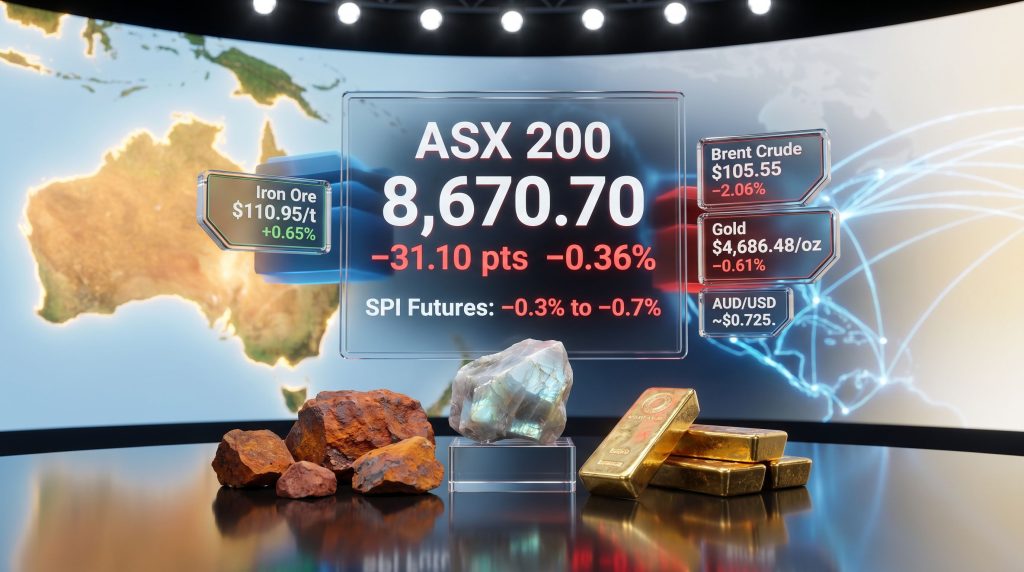
The ASX SPI 200 futures contract operates continuously on the ASX 24 platform during hours when the domestic cash market is closed. The arithmetic is straightforward: the difference between the futures price and the previous day's cash market close provides a directional signal for where the index is likely to open. With the most recent ASX 200 close sitting at 8,670.70 points, representing a fall of 31.10 points or 0.36%, and SPI futures signalling a further decline of approximately 0.3% to 0.7%, the cumulative pressure on Australian equities is building across consecutive sessions.
What makes this signal particularly worth analysing is that it now coincides with a new 20-day low for the index. In technical analysis, a 20-day low reflects sustained selling pressure sufficient to breach short-term support levels, though it does not confirm a longer-term trend reversal without supporting evidence from volume data and fundamental catalysts. The more important question for investors is whether today's ASX 200 market open lower reflects temporary sentiment re-pricing or a deeper repricing of earnings and growth expectations.
| Metric | Current Reading |
|---|---|
| ASX 200 Recent Close | 8,670.70 pts |
| Point Change | –31.10 pts |
| Percentage Change | –0.36% |
| SPI Futures Indication | ~–0.3% to –0.7% |
| 20-Day Technical Signal | New 20-day low |
| AUD/USD | ~US$0.725 |
A lower ASX 200 open does not automatically reflect deteriorating domestic fundamentals. It can be driven entirely by offshore commodity repricing, currency shifts, or sector-specific news that circulates while Australian markets remain closed.
Wall Street's Split Verdict and Why the Nasdaq Rally Doesn't Help
Overnight in the United States, the session delivered a classic divergence between growth and value. The Nasdaq climbed 1.2%, driven by technology sector momentum, while the S&P 500 added 0.6%. On the surface, this reads as a constructive session. However, the Dow Jones edged down 0.15%, and it is the Dow's composition, weighted toward industrials, financials, and traditional consumer stocks, that most closely mirrors the sector profile of ASX 200 constituents.
The critical insight here involves understanding what drove the Nasdaq's gain. Technology-led rallies are fuelled by valuation re-rating in semiconductor, software, and digital services companies. None of these forces have a direct earnings transmission mechanism into BHP's iron ore volumes, Commonwealth Bank's mortgage book, or Santos's LNG production. The composition mismatch between the indices is not a minor footnote but a structurally important distinction that repeatedly catches investors off guard. Furthermore, ASX trading insights consistently highlight this divergence as a recurring source of misinterpretation among retail investors.
The Energy Price Overhang
Beneath the surface of Wall Street's tech-led rally, energy economics continue to apply pressure across multiple sectors simultaneously. Brent Crude fell 2.06% to US$105.55 per barrel, which creates a dual-signal environment for Australian equities. For ASX-listed oil and gas producers, the decline compresses revenue expectations directly. For airlines and logistics companies, the fall offers limited relief given that jet fuel prices remain at extraordinary levels following the escalation of Middle East tensions.
According to reporting by The Market Online, Air New Zealand (ASX: AIZ) confirmed that jet fuel prices had been trading between approximately US$160 and US$230 per barrel over the ten weeks prior to May 14, 2026, compared to a pre-conflict range of around US$85 to US$90 per barrel. That represents a price escalation of between 78% and 155% in a matter of weeks, a cost shock of extraordinary scale for carriers that typically spend 25–35% of their operating budget on fuel. This is a sector-specific headwind that no Wall Street rally can offset.
Natural gas futures moved in the opposite direction, rising 0.88% to US$2.8681, adding further complexity to the energy cost picture for businesses with significant gas consumption exposure.
The Commodity Scorecard
| Commodity | Price (USD) | Movement |
|---|---|---|
| Brent Crude | $105.55/barrel | –2.06% |
| Iron Ore | $110.95/tonne | +0.65% |
| Gold | $4,686.48/oz | –0.61% |
| Natural Gas Futures | $2.8681 | +0.88% |
Iron ore's modest gain of 0.65% to US$110.95 per tonne provides limited but real support for ASX materials heavyweights. In addition, understanding iron ore price trends in the context of demand signals from China remains essential for assessing where major miners are headed. Gold's 0.61% decline to US$4,686.48 per ounce reduces upward momentum for precious metals producers within the index. Taken together, the commodity picture is neither catastrophic nor supportive — it is simply mixed, which in the context of the broader macro environment translates into cautious positioning rather than confident buying.
Domestic Credit Conditions: The RBA's Rate Hikes Begin to Bite
While offshore signals set the tone, domestic data is now providing independent confirmation of a cooling cycle. According to the Australian Bureau of Statistics (ABS), the number of new home loans fell 6.2% to 139,794 in the March quarter of 2026. Dr Mish Tan, ABS Head of Finance Statistics, confirmed that declines were recorded across all borrower categories during the quarter, following the strong growth seen throughout 2025 and subsequent cash rate increases implemented in February and March 2026.
Importantly, Dr Tan also noted that despite the quarterly fall, total new home loans remain 8.6% higher compared to the same quarter one year earlier, signalling that the current trend represents a moderation from elevated levels rather than a structural collapse in credit demand.
Why does this matter for equity markets? The answer lies in index weighting. Australia's big four banks, collectively among the highest-weighted constituents in the ASX 200, derive a significant portion of their earnings from residential mortgage origination and the net interest margins on their loan books. When loan volumes decline and rate uncertainty clouds the forward outlook for spreads, earnings forecasts for financial sector constituents face downward pressure.
The Federal Budget's impact on the preceding session had already triggered a notable sell-off in bank stocks, and the ABS housing credit data adds a fundamental layer beneath that sentiment-driven move.
The housing credit slowdown matters not just as an economic signal but as a direct earnings headwind for the financial sector constituents that carry significant weighting in the ASX 200. A sustained decline in new loan volumes compresses net interest margin expectations and dividend growth forecasts simultaneously.
Upcoming inflation data represents the next key domestic catalyst on investor radars. Markets are pricing in the possibility that persistent inflation could delay further RBA rate relief, with broad-based pre-data caution now visible across consumer staples, healthcare, retail, and resources sectors.
Which Sectors Face the Most Pressure at Today's Open
Understanding a lower ASX 200 market open requires mapping macro pressures to specific sector exposures. The current environment creates differentiated headwinds across the index's major constituents.
Financials
The big four banks remain exposed to a compound pressure: declining home loan origination reduces fee revenue and balance sheet growth, while rate cycle uncertainty complicates net interest margin forecasting. The recent Federal Budget prompted a concentrated sell-off in bank stocks, and the ABS credit data now provides a fundamental dimension to what began as a policy-driven sentiment reaction. Investors are also reassessing whether current dividend yields remain attractive relative to risk-free rate alternatives in a higher-for-longer rate environment.
Energy
For ASX-listed oil and gas producers, the 2.06% overnight fall in Brent Crude reduces near-term revenue expectations. The aviation sub-sector faces the most acute pressure, with the jet fuel price escalation documented by Air New Zealand representing a quantifiable margin compression that will flow through to earnings guidance. Energy infrastructure and geothermal development, as illustrated by Mercury's commitment of NZ$75 million to geothermal appraisal drilling near Taupō as part of a broader NZ$1 billion investment platform, represents a longer-duration theme less sensitive to short-term commodity price swings.
Materials and Mining
Iron ore's modest overnight gain provides a partial floor for major miners such as BHP and Rio Tinto, both of which carry significant index weighting. Furthermore, the dynamics of China steel and iron ore markets continue to shape the forward demand outlook for these heavyweights. Gold's retreat moderately pressures precious metals producers within the ASX 200. The sector's net position is broadly neutral, with selective support from iron ore offset by softness in precious metals.
Consumer and Retail
Discretionary spending faces pressure from two directions simultaneously. Household energy costs and elevated mortgage repayments are compressing consumer budgets, reducing the capacity for non-essential spending. Simultaneously, retailers face input cost inflation driven by elevated transport and energy costs on the supply side. The resulting squeeze on margins from both directions makes consumer-facing stocks particularly vulnerable in the current environment.
| Market Condition | Sectors Under Pressure | Relative Defensive Exposure |
|---|---|---|
| Energy price spike | Airlines, retail, consumer discretionary | Utilities, energy producers |
| Rate uncertainty | Financials, REITs, growth stocks | Resources, healthcare |
| Commodity price weakness | Materials, miners | Domestic consumer staples |
| Broad risk-off sentiment | All cyclicals | Gold, cash, defensive yield |
Rare Earths: Why a Geopolitical Supply Chain Story Is Reshaping Resources
One of the most structurally significant developments embedded within Thursday's market narrative is the rare earths story unfolding at the intersection of geopolitics and supply chain security. Reuters reported that Australia and the United States are expected to release a coordinated plan aimed at strengthening rare earth supply chains, a development that positions Australia as a critical link in the Western world's effort to reduce dependence on Chinese-controlled processing and export infrastructure.
This matters because rare earths are not a single commodity but a group of 17 chemically similar elements, including neodymium, praseodymium, dysprosium, and terbium, that are essential to the manufacturing of permanent magnets used in electric vehicles, wind turbines, defence systems, and advanced electronics. The separation and processing of these elements is technically complex and currently dominated by Chinese industrial capacity.
Western nations have been acutely aware of this concentration risk for years, but geopolitical tensions have dramatically accelerated the urgency of developing alternative supply chains. Australia's rare earth endowment, which spans projects at various stages of development across Western Australia and the Northern Territory, positions the country as a potential long-term beneficiary of this restructuring. Arafura Rare Earths (ASX: ARU) recently confirmed a binding offtake term sheet with Traxys North America, reflecting concrete commercial progress in translating strategic positioning into actual supply agreements.
The rare earths narrative is not a short-term trading story. It represents a multi-year supply chain restructuring driven by geopolitical competition, defence procurement requirements, and accelerating demand from clean energy and advanced technology applications. The complexity of rare earth separation chemistry means that building processing capacity from scratch takes years, not months.
Why Rare Earth Chemistry Creates Durable Supply Barriers
A point rarely understood outside the sector is that mining rare earths and processing rare earths are fundamentally different industrial challenges. Rare earth elements occur together in ore deposits, typically in minerals such as bastnäsite, monazite, and xenotime, and separating individual elements from the mixed concentrate requires highly specialised solvent extraction chemistry.
China invested decades in developing this processing expertise, which is why the country controls an estimated 85–90% of global rare earth processing capacity despite not holding a proportionally dominant share of global reserves. This processing bottleneck means that even if new mines are brought into production outside China, the refined materials required for magnet manufacturing cannot reach end users without either Chinese processing or significant capital investment in Western separation facilities.
Nations and companies seeking to build genuine supply chain independence must address both the mining and processing stages, a requirement that substantially raises the capital intensity and timeline for any alternative supply solution.
| Factor | Market Implication |
|---|---|
| Australia-US supply coordination | Positive for domestic rare earth developers |
| China export restrictions continuing | Supports pricing premium for non-Chinese supply |
| Potential US-China rare earths truce | Near-term uncertainty; could compress spot prices if resolved |
| Long-term EV and defence demand | Structural demand floor regardless of short-term diplomacy |
| Processing capacity bottleneck | Durable competitive moat for integrated mine-to-magnet producers |
The next major ASX story will hit our subscribers first
What the Australian Dollar Is Telling Investors
The AUD/USD rate of approximately US$0.725 provides a secondary confirmation of current market sentiment. A softer Australian dollar typically provides a partial tailwind for resource exporters whose revenues are denominated in US dollars but whose costs are largely in Australian dollars, effectively increasing the local currency value of each tonne of iron ore or ounce of gold sold.
However, a weaker currency also signals reduced international appetite for Australian-dollar-denominated assets, and in the context of the current session, the currency reading is consistent with a market pricing in both domestic rate uncertainty and global growth caution. The currency level does not amplify the bearish case dramatically but provides a coherent backdrop to the risk-off positioning visible across futures markets and sector-level sentiment. Investors seeking a real-time view of how this plays out across individual stocks can monitor live equity market prices as the session unfolds.
A Framework for Reading a Bearish ASX Market Open
Single-session declines of between 0.3% and 0.7% sit firmly within the category of noise when assessed in isolation. The more analytically useful exercise is identifying why the open is lower and whether those reasons connect to genuine earnings deterioration or merely to sentiment repricing and technical repositioning.
A structured approach to interpreting any lower ASX 200 market open involves working through the following sequence:
- Assess the SPI futures magnitude — moves below 0.5% typically represent sentiment adjustment; moves exceeding 1.0% warrant deeper analysis of fundamental catalysts
- Identify which Wall Street indices moved and why — technology-led Nasdaq rallies rarely translate into ASX materials and financial sector strength
- Cross-reference the three primary commodity signals — iron ore, gold, and crude oil provide the most direct overnight read for ASX sector direction
- Monitor AUD/USD direction — currency movement provides secondary confirmation of risk appetite and foreign capital flow tendencies
- Assess scheduled domestic data releases — ABS statistics, RBA communications, and inflation prints can override offshore sentiment entirely, as the housing credit data demonstrates today
Short-Term Weakness vs. Structural Deterioration
The distinction between a technically driven open and a fundamentally driven deterioration is where most retail investors lose analytical precision. A 20-day low is a meaningful technical signal, but it requires corroborating evidence in the form of earnings downgrades, rising credit spreads, or sustained commodity price weakness before it qualifies as a structural trend reversal rather than a short-term repositioning.
What today's session reflects is a convergence of multiple headwinds operating simultaneously: domestic credit cooling, persistent energy cost pressure, pre-data inflation caution, and an offshore session that provided no meaningful positive spillover for the ASX's heaviest-weighted sectors. None of these factors alone would constitute a structural alarm. The more important monitoring task for the sessions ahead is whether incoming inflation data confirms the RBA's caution or challenges it, and whether iron ore sustains its current level above US$110 per tonne.
FAQ: ASX 200 Market Open Lower
Why does the ASX 200 sometimes open lower even when Wall Street rose overnight?
The ASX 200 has a materially different sector composition to US indices. A Nasdaq rally driven by technology stocks does not automatically lift Australian financials, miners, or energy companies, which dominate the local index. Commodity price movements, currency shifts, and domestic data releases can also override positive offshore leads entirely.
What does a 20-day low in the ASX 200 indicate technically?
A new 20-day low signals that recent selling pressure has been sustained enough to breach short-term support levels. Technical analysts treat this as a bearish momentum signal, but it does not confirm a longer-term trend without corroborating volume data and fundamental catalysts.
How do SPI futures predict the ASX 200 open?
The ASX SPI 200 futures contract trades on ASX 24 outside regular market hours. The difference between the overnight futures price and the previous day's close provides a directional estimate for where the cash market will open. A futures reading of 24 points below the prior close, for instance, suggests the index will open approximately 24 points lower.
Does a lower AUD/USD help or hurt the ASX 200?
The answer depends on sector exposure. A weaker Australian dollar benefits resource exporters whose revenues are priced in US dollars, but it also signals reduced foreign investor appetite for Australian-dollar-denominated assets and weaker domestic purchasing power, which weighs on consumer and financial stocks.
What role does iron ore play in the ASX 200's daily direction?
Iron ore is one of Australia's largest export commodities, and major miners such as BHP and Rio Tinto carry significant ASX 200 weighting. Overnight movements in iron ore spot prices directly influence the opening valuations of these heavyweights and, by extension, the broader index.
The material in this article is for informational purposes only and should not be treated as investment advice. Readers are encouraged to conduct their own research and consult with a certified financial adviser before making any investment decisions. Market data and commodity prices referenced reflect conditions as reported on May 14, 2026, and are subject to change. Forecasts, projections, and analytical frameworks presented here involve uncertainty and should not be relied upon as guarantees of future performance.
Want To Stay Ahead of Significant ASX Mineral Discoveries Before the Broader Market Reacts?
While navigating sector rotations, commodity price swings, and bearish market opens, Discovery Alert's proprietary Discovery IQ model delivers real-time notifications on significant ASX mineral discoveries, instantly translating complex data into actionable investment insights — explore the historic returns major discoveries have generated and begin a 14-day free trial to secure a market-leading edge before the next major discovery is announced.