May 14, 2026
Europe's Aluminium Import Dependency Is No Longer a Background Risk
For most of the past three decades, the structural fragility of Europe's primary aluminium supply chain sat quietly in the background of industrial planning discussions. Cheap imports from the Gulf, competitive Russian supply, and stable LME pricing made domestic smelter economics difficult to justify. That calculus has changed rapidly, and the Rio Tinto backed Finland aluminium project is now one of the most closely watched responses to conditions forcing manufacturers, policymakers, and investors to reassess assumptions unchallenged since the mid-1990s.
The convergence of geopolitical disruption, accelerating decarbonisation mandates, and a 30-year absence of new primary smelting investment in continental Europe has created a moment that projects like Arctial were built for. Furthermore, European supply chain resilience has become an urgent policy priority rather than a long-term aspiration.
When big ASX news breaks, our subscribers know first
The Structural Vulnerability Behind Europe's Import Dependency
Europe's total aluminium production reached 7.1 million tonnes in 2025, according to the International Aluminium Institute. On the surface, this appears to be a meaningful industrial base. The reality beneath that figure is considerably more complex.
Of that 7.1 million tonnes, approximately 3.9 million tonnes originated from Russian-based operations, specifically RUSAL. Strip out Russian production and continental European primary smelting capacity falls to roughly 3.2 million tonnes per year — a number that has remained largely unchanged for over three decades. No significant new primary aluminium smelter has been built in continental Europe since the mid-1990s.
This stagnation reflects a sustained period in which imported primary aluminium was cheaper and more readily available than domestically produced material. The import gap has been filled by a network of supply relationships that are now proving structurally fragile.
According to Trade Data Monitor data cited by AL Circle, Europe imported approximately 1.2 million tonnes of primary and alloyed aluminium from the Middle East and Egypt in 2025 alone, representing roughly 20 percent of total European aluminium imports. This concentration of supply from a single geopolitical region has become one of European industry's most visible vulnerabilities. Concerns around European raw materials supply have consequently intensified across industrial and policy circles.
"The absence of new primary smelting investment in continental Europe for over 30 years was not an oversight. It was a rational economic response to the conditions of that era. What has changed is not the economics of smelting, but the price of supply dependency."
The current disruption to Gulf export routes illustrates precisely what happens when that dependency is stressed. The scale of the European supply gap, the absence of domestic spare capacity, and the sudden unavailability of import alternatives have combined to produce premium conditions not seen in recent memory.
What the Rio Tinto-Backed Finland Aluminium Project Actually Proposes
The Arctial project, backed by Rio Tinto and a consortium of international partners, is the first proposed primary aluminium development in continental Europe in more than 30 years. The facility would be located in Kokkola and Kronoby, Finland, targeting annual production of 550,000 to 610,000 tonnes of low-carbon primary aluminium.
At full capacity, this output would represent approximately a 20 percent increase in continental European primary aluminium production relative to 2025 levels, as confirmed by the project's chief commercial officer Maxime Vandersmissen at the CRU World Aluminium Conference in London.
The project's consortium structure reflects the capital intensity and technical complexity of greenfield primary smelter development. Each partner contributes a specific competency that would be difficult for any single entity to replicate independently:
| Partner | Role |
|---|---|
| Rio Tinto | Strategic partner and proprietary AP60 smelting technology |
| Vargas (Sweden) | Investment lead |
| Mitsubishi Corporation | Capital investment and aluminium sector expertise |
| Fortum | Carbon-free electricity supply |
| Finnish Industry Investment (TESI) | State-backed financial participation |
| ABB | Electrification and automation feasibility |
| Siemens Financial Services | Project financing |
This multi-partner architecture is itself a signal. Primary aluminium smelters are among the most capital-intensive industrial facilities built in modern economies, requiring long-duration offtake commitments, reliable baseload energy, and access to specialised process technology. Distributing these requirements across a consortium reduces individual exposure while aligning expertise with execution risk.
Rio Tinto's role extends beyond financial participation. The company is providing its proprietary AP60 smelting technology, which forms the operational core of the project's low-carbon production model. This aligns with broader metals decarbonisation efforts gaining momentum across the global primary metals sector.
AP60 Technology: What It Is and Why Its Deployment Matters
A First Outside North America
AP60 is Rio Tinto's high-efficiency electrolytic reduction cell system, commercially proven at its operations in Jonquière, Quebec, Canada. The Arctial project would represent the first deployment of AP60 technology outside of North America, a milestone that carries both technical and commercial significance.
Electrolytic reduction cells are the operational heart of any primary aluminium smelter. The Hall-Héroult process, which underpins all commercial primary aluminium production, uses electrical current to reduce alumina into aluminium metal within cells containing molten cryolite. Cell design efficiency, measured in kilowatt-hours consumed per kilogram of aluminium produced, is the primary determinant of both production cost and carbon intensity.
AP60 cells are designed to operate at higher current densities than older generation cell technology, enabling greater output per unit of installed capacity with lower specific energy consumption. This efficiency gain becomes commercially transformative when combined with carbon-free electricity input, because it reduces both the cost base and the lifecycle carbon intensity of the metal produced simultaneously. Rio Tinto low-carbon technology has been advancing steadily across multiple metals categories, and the Arctial deployment represents a further extension of that strategy.
Why Carbon-Free Electricity Is the Other Half of the Equation
Rio Tinto's AP60 technology addresses the conversion efficiency side of the equation. Fortum, the Finnish state-controlled energy company, addresses the input energy side. Fortum operates a generation portfolio that includes both hydroelectric and nuclear capacity, producing near-zero operational carbon electricity at scale.
The combination of AP60 cell efficiency and carbon-free Nordic electricity positions Arctial's output to achieve lifecycle carbon intensity significantly below global average primary aluminium production. For context, coal-powered smelters in certain Asian markets produce primary aluminium with carbon intensities exceeding 15 kilograms of CO2 equivalent per kilogram of aluminium. Nordic hydroelectric-powered smelters can achieve figures below 2 kilograms of CO2 equivalent per kilogram — a differential that is becoming economically material under the EU's Carbon Border Adjustment Mechanism.
"The commercial case for low-carbon primary aluminium in Europe is no longer purely environmental. CBAM creates a direct financial penalty for high-carbon imported aluminium, meaning downstream manufacturers face tangible cost consequences for sourcing from carbon-intensive origins. Domestic low-carbon production addresses this compliance cost directly."
This CBAM dimension is arguably the most durable structural support for Arctial's economics, independent of short-term premium volatility driven by geopolitical disruption.
How Middle East Disruptions Have Transformed European Premium Markets
The Strait of Hormuz Effect
The conflict involving Iran that escalated in late February 2026 introduced a supply shock to European aluminium markets that exposed the depth of the import dependency described above. The Middle East accounts for approximately 9 percent of global aluminium supply, with annual production capacity of around 7 million tonnes across Gulf state producers including Emirates Global Aluminium, Alba in Bahrain, and Ma'aden in Saudi Arabia.
Disruption to bulk shipping through the Strait of Hormuz constrained the export of finished and semi-finished aluminium from these producers to European buyers. The resulting tightening of supply in a market with no domestic spare capacity to absorb the shortfall drove aluminium premiums sharply higher.
Premium Escalation: The Numbers in Context
The scale of the premium movement has been significant enough to alter the investment economics of projects that were previously marginal:
| Premium Metric | Pre-Conflict Level | Current Level (May 2026) | Change |
|---|---|---|---|
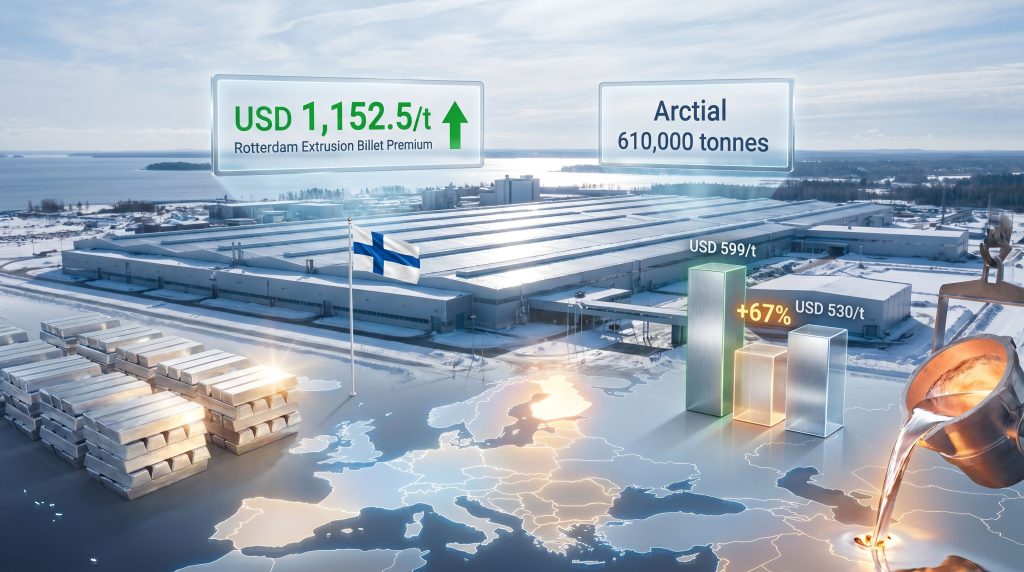
| European duty-paid premium | ~USD 358/t | USD 599/t | +67% |
| Rotterdam extrusion billet premium | ~USD 530/t | USD 1,152.5/t | +117% |
| Middle East share of global capacity | ~9% | Disrupted | Constrained |
| Europe's Middle East and Egypt imports | ~1.2M tonnes/yr | Reduced | Constrained |
The Rotterdam extrusion billet premium of USD 1,152.5 per tonne is particularly notable. Extrusion billet is the feedstock form used by the downstream aluminium processing industry to produce profiles for construction, automotive, and industrial applications. A doubling of billet premiums creates severe margin pressure for European extruders, incentivising them to seek supply commitments from domestic producers in a way that strengthens long-term offtake visibility for projects like Arctial.
The broader market implication noted by AL Circle is that if disruptions persist, global aluminium prices could be pushed above USD 4,000 per tonne through 2027 — a level that would further improve the economics of new primary smelting investment while creating significant cost headwinds for downstream manufacturing.
Project Timeline: From Feasibility to First Metal
The Critical Path to 2029
Arctial's development roadmap currently sits in the pre-final investment decision phase. The major milestones between the present and first production are:
-
Regulatory and environmental permitting in Finland — Finland's permitting framework for large industrial projects involves Environmental Impact Assessment requirements, municipal approvals, and national environmental ministry sign-off, typically requiring 18 to 36 months in Nordic jurisdictions.
-
Offtake agreement finalisation — Securing long-duration supply commitments from European downstream manufacturers is necessary to underpin project financing. The current elevated premium environment creates incentive for downstream buyers to lock in domestic supply.
-
Project financing close — With Siemens Financial Services and TESI already engaged, the financing structure is partially assembled, but full close requires completion of upstream permitting and offtake work.
-
Final Investment Decision (FID) — Targeted for 2027, this represents the go/no-go gate for construction commencement.
-
Construction and commissioning — Following FID, the project targets first hot metal production in the second half of 2029, implying an approximately 2.5-year construction and commissioning schedule.
What Could Alter the Timeline
Several variables could shift this schedule in either direction:
- Permitting acceleration: Political prioritisation of industrial supply security in Finland could streamline regulatory timelines.
- Financing market conditions: Post-2022 interest rate normalisation has improved the outlook for long-duration infrastructure financing, though rates remain higher than the ultra-low cost era.
- Geopolitical normalisation: If Middle East supply routes stabilise before FID, premium levels may retreat, potentially affecting the urgency of offtake commitment from downstream buyers.
- Technology transfer complexity: Deploying AP60 outside Quebec for the first time introduces engineering and procurement risk that could extend pre-FID preparation timelines.
The next major ASX story will hit our subscribers first
Finland's Strategic Fit for Green Aluminium Manufacturing
Why Kokkola Rather Than Elsewhere
Finland's selection as the Arctial project location reflects a convergence of industrial and energy advantages that are difficult to replicate elsewhere in the EU. The key factors include:
- Carbon-free electricity access through Fortum's hydro and nuclear generation portfolio, providing the low-emission energy input required for genuine low-carbon aluminium production.
- Existing industrial infrastructure in Kokkola, which hosts one of Northern Europe's largest chemical and industrial clusters, reducing greenfield site development costs.
- Baltic Sea shipping access enabling efficient export of finished aluminium to European manufacturing centres.
- EU regulatory stability providing the policy predictability required for long-duration industrial investment decisions.
- Proximity to Nordic aluminium value chains including downstream processing operations in Scandinavia and the Baltic states.
If the Arctial project proceeds successfully, it could establish Kokkola as a reference site for green industrial manufacturing in the Nordic-Baltic region, potentially catalysing additional investment in aluminium processing and adjacent industries. Indeed, among the world's aluminium industry leaders, this kind of large-scale greenfield commitment in Europe remains exceptionally rare.
Can Arctial Realistically Close Europe's Supply Gap?
Modelling the Numbers Honestly
At full capacity of approximately 610,000 tonnes per year, Arctial would represent a meaningful but incomplete response to Europe's import dependency. The arithmetic is straightforward:
- Europe's 2025 primary aluminium output: 7.1 million tonnes total (including Russian operations)
- Continental European production ex-Russia: approximately 3.2 million tonnes
- Arctial's projected contribution: up to 610,000 tonnes
- Proportional increase in continental European capacity: approximately 19 percent uplift
- Middle East and Egypt import volume: approximately 1.2 million tonnes per year
- Arctial as a proportion of that import volume: approximately 50 percent coverage
The conclusion is that Arctial would materially reduce but not eliminate European dependence on Middle Eastern and North African aluminium supply. Europe's total import requirement is large enough that a single project, however substantial, cannot achieve supply sovereignty on its own.
Three Scenarios for European Aluminium Supply Through 2030
Scenario A: Arctial Proceeds on Schedule
FID is confirmed in 2027, construction proceeds on the 2.5-year schedule, and first metal arrives in H2 2029. European primary production capacity increases by approximately 8.5 percent relative to 2025 total output. Premium conditions moderate as domestic supply grows, but the structural supply gap remains partially open, sustaining long-term offtake economics.
Scenario B: Delayed FID and Prolonged Supply Tightness
Permitting or financing complications push the FID beyond 2027 and first metal beyond 2030. European premiums remain structurally elevated through the late 2020s, accelerating secondary aluminium adoption among downstream manufacturers unable to secure primary supply commitments. However, the delay ultimately strengthens the economic case for FID when it eventually occurs.
Scenario C: Geopolitical Normalisation Before Project Completion
Middle East shipping routes stabilise, Gulf producers resume normal export volumes to Europe, and premium levels retreat from current highs. The structural case for Arctial remains intact on CBAM compliance grounds and supply sovereignty logic, but near-term urgency from downstream buyers diminishes. Long-term investor commitment is consequently sustained by EU industrial policy frameworks rather than immediate market pressure.
Disclaimer: These scenarios are illustrative projections based on publicly available information and current market conditions. They do not constitute investment advice. Readers should conduct their own due diligence and seek independent financial advice before making investment decisions related to aluminium markets or companies mentioned in this article.
Aluminium's Role in the European Energy Transition
Why This Project Is About More Than Metal
Primary aluminium is not simply an industrial commodity. It is a critical material input for the technologies driving Europe's energy transition. Electric vehicles require approximately 170 kilograms of aluminium per vehicle on average, compared with roughly 130 kilograms for internal combustion engine vehicles. Solar panel mounting structures, wind turbine components, and high-voltage transmission infrastructure all depend on aluminium supply chains.
European manufacturers sourcing aluminium for energy transition applications face a compounding compliance challenge. CBAM penalises the use of high-carbon imported aluminium, effectively increasing the cost of sourcing from coal or gas-powered smelters in Asia, Russia, or elsewhere. At the same time, the volume requirements for energy transition manufacturing are growing, creating a structural demand for low-carbon primary aluminium that is predictable, long-duration, and EU-compliant in origin.
Arctial's production profile directly addresses this intersection. Its output, certified as low-carbon through the combination of AP60 efficiency and Fortum's carbon-free electricity, would enter the market precisely as European manufacturers face the greatest pressure to demonstrate carbon-compliant supply chains.
Frequently Asked Questions: Arctial and the Rio Tinto-Backed Finland Aluminium Project
What is the Arctial aluminium project?
Arctial is a proposed primary aluminium smelter located in Kokkola and Kronoby, Finland, backed by Rio Tinto and a consortium of international partners. The facility is designed to produce up to 610,000 tonnes of low-carbon primary aluminium annually using Rio Tinto's AP60 smelting technology and carbon-free electricity from Fortum.
When will the Arctial smelter produce its first metal?
The project is targeting first hot metal production in the second half of 2029, contingent on a final investment decision expected in 2027.
Why is Finland the chosen location for this project?
Finland provides access to carbon-free electricity through Fortum, established industrial infrastructure in Kokkola, EU regulatory stability, and proximity to European manufacturing markets — collectively creating the conditions required for viable low-carbon smelter operations.
How much will Arctial increase European aluminium production?
At full capacity, Arctial's output of approximately 610,000 tonnes per year represents a roughly 20 percent increase in continental European primary aluminium production relative to 2025 levels.
What is AP60 smelting technology?
AP60 is Rio Tinto's proprietary high-efficiency aluminium reduction cell system, commercially proven at its Jonquière operations in Quebec, Canada. The Arctial project would represent its first deployment outside North America.
How have Middle East supply disruptions affected European aluminium prices?
Conflict-related constraints on bulk shipping through the Strait of Hormuz have reduced Gulf producer aluminium exports to Europe. The European duty-paid premium has risen 67 percent to USD 599 per tonne, while the Rotterdam extrusion billet premium has increased by approximately 117 percent to USD 1,152.5 per tonne since late February 2026.
Key Takeaways: Why This Moment Matters for European Industrial Strategy
The Rio Tinto backed Finland aluminium project is arriving at a moment when the three dominant pressures on European aluminium supply are simultaneously at their most intense. Import dependency built over three decades of cheap-import economics is now exposed by geopolitical disruption. Decarbonisation mandates enforced through CBAM are progressively penalising high-carbon imported supply. Furthermore, the energy transition is generating demand growth in aluminium-intensive sectors that cannot easily be met from import alternatives under current market conditions.
Several structural observations define the investment case and the project's broader significance:
- The first primary smelter development in continental Europe in over 30 years marks a fundamental shift in European industrial strategy.
- Rio Tinto's AP60 technology is being deployed outside North America for the first time, a technical milestone reflecting confidence in the project's engineering viability.
- Even at full capacity, Arctial addresses approximately half of Europe's Middle East and Egypt import volume, making it a necessary but not sufficient response to supply sovereignty objectives.
- The 2027 FID remains the pivotal decision gate, with current premium conditions and CBAM compliance imperatives aligned to support a positive outcome.
- Finland's energy and industrial profile makes it the most viable location within the EU for this type of investment, and a successful Arctial project could catalyse additional green industrial development across the Nordic-Baltic region.
For European downstream manufacturers, investors in industrial infrastructure, and policymakers tracking critical materials supply chains, the progression of the Rio Tinto backed Finland aluminium project through its remaining pre-FID milestones will be one of the most consequential industrial development stories of the late 2020s.
Want to Stay Ahead of the Next Major Minerals Discovery?
While Europe's aluminium supply chain undergoes its most significant structural shift in three decades, Discovery Alert's proprietary Discovery IQ model is scanning the ASX daily to identify high-potential mineral discoveries the moment they are announced — explore historic discoveries and their returns or start your 14-day free trial to position yourself ahead of the broader market.