May 14, 2026
The Hidden Mineral Holding the Battery Economy Together
Few materials have attracted as much geopolitical attention in recent years as graphite, yet it remains one of the least understood components in the clean energy transition. While lithium and cobalt dominate headlines, the reality is that a standard lithium-ion battery contains more graphite by weight than any other active material. Approximately 50% of the active anode material in an EV battery is natural or synthetic graphite, making it structurally indispensable to every vehicle rolling off an electrified production line.
What makes this dependency so consequential is the near-total concentration of graphite supply in a single country. China not only dominates raw graphite mining but controls the downstream processing infrastructure required to convert mined flake graphite into battery-grade material. BloombergNEF projects that China will maintain its position as the world's dominant graphite supplier through 2050, even as Western governments invest heavily in domestic alternatives. The reason this grip is so difficult to break comes down to two technical processes that are expensive, energy-intensive, and difficult to replicate outside established Chinese industrial clusters: spheroidization and graphitization.
Spheroidization reshapes irregular flake graphite particles into smooth spheres capable of efficiently intercalating lithium ions within a battery anode. Graphitization subjects carbon material to temperatures exceeding 2,500 degrees Celsius to crystallise its atomic structure, unlocking the electrical conductivity required for high-performance battery applications. Both processes demand enormous energy inputs and highly specialised equipment. According to BloombergNEF, new market entrants face a fundamental structural challenge in competing with China's scale advantages across these processes, with the high energy and chemical costs creating a cost floor that Western producers must bridge through alternative means.
Against this backdrop, BloombergNEF forecasts a technical global graphite shortage emerging by 2032, driven by accelerating lithium-ion battery demand. This projected supply gap has created an urgent imperative for non-Chinese producers to develop commercial-scale operations within the current decade, before demand structurally outpaces available supply.
When big ASX news breaks, our subscribers know first
The Nouveau Monde Graphite Quebec Project: Building a Western Alternative
The Nouveau Monde Graphite Quebec project represents one of the most advanced attempts by a non-Chinese developer to establish a fully integrated graphite supply chain capable of competing in the global battery materials market. Rather than functioning as a simple mining operation, Nouveau Monde Graphite (NMG) has structured its business across three vertically integrated stages: natural flake graphite extraction, flake concentrate production, and conversion into battery-grade active anode material.
This end-to-end integration is strategically significant. Most mining companies sell raw or partially processed material, capturing only a fraction of the value chain. By controlling production from the open pit through to finished battery-grade spherical graphite, NMG positions itself to capture margins at each processing stage while offering EV battery manufacturers a simplified, traceable sourcing pathway that bypasses Chinese intermediaries entirely.
The project's integrated value chain operates across three distinct facilities:
| Stage | Location | Function |
|---|---|---|
| Open-pit mining | Saint-Michel-des-Saints, QC | Natural flake graphite extraction |
| Concentrator facility | Near Matawinie mine site | Flake graphite concentration |
| Battery materials plant | Bécancour, QC | Active anode material production |
Each stage builds on the previous, creating a supply chain architecture that is deliberately designed to reduce North America's dependence on Chinese graphite imports while offering a premium, low-carbon product to battery manufacturers operating under increasingly stringent Scope 3 emissions reporting requirements.
Where the Nouveau Monde Graphite Quebec Project Sits on the Map
Mine Matawinie: The Core Extraction Asset
The flagship asset of the Nouveau Monde Graphite Quebec project is the Matawinie open-pit mine, located in Saint-Michel-des-Saints, Quebec, roughly 160 kilometres north of Montreal. The open-pit configuration is operationally significant: it enables lower per-tonne extraction costs compared to underground mining, supports large-scale equipment deployment, and allows for efficient waste rock management protocols.
The mine has received environmental authorisation from the Quebec government following a rigorous review process anchored by a 905-page Environmental Impact Study completed in 2019 and prepared by engineering firm SNC-Lavalin. That study covered the full range of potential environmental interactions, including hydrology, biodiversity impacts, and the socioeconomic effects on surrounding communities. The comprehensive nature of this study was instrumental in securing regulatory approval and provides an ongoing compliance framework for site operations.
One of the most commercially important geographic advantages at Matawinie is its proximity to Quebec's clean hydroelectric power grid. By operating on hydropower rather than coal or natural gas, NMG's graphite carries a significantly lower carbon intensity than Chinese-produced equivalents. This is not merely an environmental credential; it is increasingly a commercial differentiator, as EV manufacturers face growing pressure to document and reduce the embedded carbon footprint of every battery component they source.
The Bécancour Battery Materials Plant
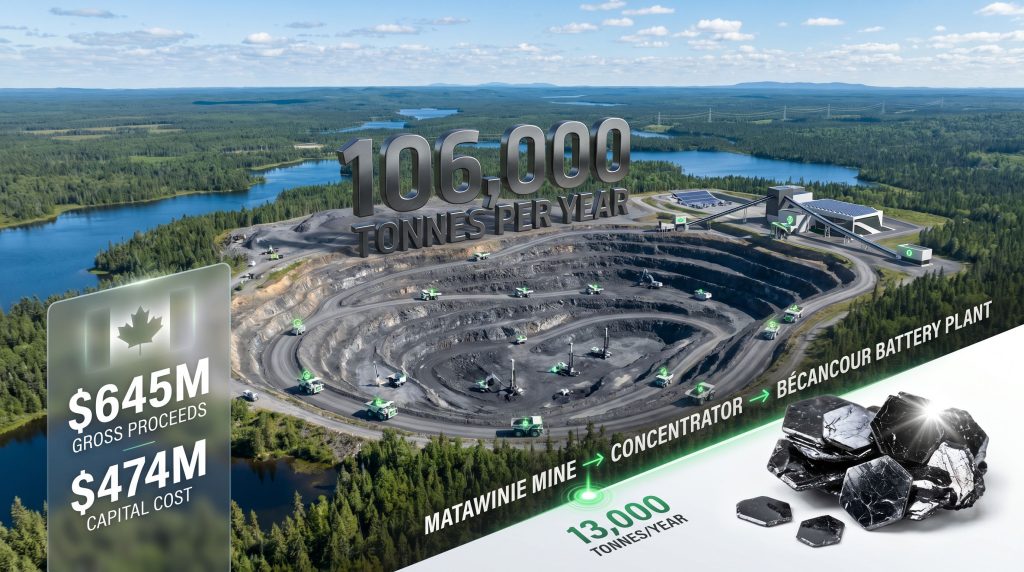
Approximately 150 kilometres from the Matawinie mine, NMG's Bécancour battery materials plant serves as the downstream conversion facility, transforming flake graphite concentrate into high-purity spherical graphite for lithium-ion battery anodes. The facility's revised production target stands at 13,000 metric tonnes per year of active anode material, a figure that was reduced by approximately 70% from original plans following shifts in EV market demand dynamics.
The choice of Bécancour as the location for this facility is itself strategically deliberate. The industrial city sits at the heart of Quebec's emerging battery materials corridor, where General Motors and Rio Tinto Group-backed Nemaska Lithium are already constructing EV battery-component plants. This co-location creates supply chain efficiencies, shared infrastructure opportunities, and positions NMG within an industrial ecosystem increasingly recognised as a North American battery materials hub.
The Uatnan Mining Project: Long-Term Reserve Pipeline
Beyond Matawinie, NMG wholly owns the Uatnan Mining Project in Quebec's Côte-Nord region. Uatnan has been identified as one of the world's largest natural graphite deposits, with preliminary economic assessments indicating potential annual concentrate production of approximately 500,000 tonnes. Furthermore, while the project is currently in Phase 3 expansion planning following positive technical and economic viability assessments, it represents a substantial long-term reserve base that gives NMG a scalable resource platform as Western graphite demand accelerates through the 2030s and beyond.
The $645 Million Capital Architecture Powering the Project
Financing a vertically integrated critical minerals project at commercial scale requires a capital structure sophisticated enough to absorb construction risk while providing sufficient revenue certainty to satisfy institutional lenders. NMG's ~$645 million gross financing package, approved by shareholders in May 2026, addresses this challenge through a multi-layered combination of government-backed debt, strategic private investment, and public equity.
| Financing Source | Type | Amount |
|---|---|---|
| Export Development Canada + Canada Infrastructure Bank | Debt financing | $335 million USD |
| Canada Growth Fund + Investissement Québec + Eni SpA | Private placement | $213 million |
| Bought deal public offering | Equity | $96.5 million |
| Total | ~$645 million |
The $335 million debt commitment from Export Development Canada and the Canada Infrastructure Bank represents a direct federal financial stake in the project's success, reflecting the Canadian government's assessment that domestic graphite supply infrastructure serves national industrial and strategic interests.
Beyond the debt tranche, the Canadian government has provided a revenue certainty mechanism that fundamentally underpins the project's bankability: a commitment to purchase 30,000 metric tonnes of graphite concentrate per year at a fixed price, representing approximately one-third of the Matawinie concentrator's projected annual output. Fixed-price offtake agreements of this nature are critical for securing project finance because they provide a predictable revenue floor that lenders can model against debt service obligations.
On the private investment side, Italian energy company Eni SpA has taken a position in the private placement alongside the Canada Growth Fund and Investissement Québec, and has signed a letter of intent for potential offtake of graphite concentrate or active anode material from the Bécancour plant. Japanese trading conglomerate Mitsui and Co. is among NMG's largest shareholders, adding Japanese industrial supply chain credibility and a strategic link to Asian battery manufacturing networks. The involvement of these industrial players alongside government institutions signals the project's perceived strategic importance across multiple national jurisdictions.
Capital cost estimates for the Matawinie mine and concentrator stand at approximately $474 million, with construction teams already mobilised on site as of May 2026 and more than 50% of total capital expenditures secured through executed contracts. A prior equity raise in April 2026 secured approximately $297 million USD, advancing Phase 2 detailed engineering and further de-risking the construction schedule.
Production Targets, Offtake Commitments, and Economic Impact
What the Mine and Concentrator Will Produce
The Phase 2 Matawinie open-pit mine is designed to produce approximately 106,000 tonnes per year of flake graphite concentrate at nameplate capacity, with commissioning targeted by the end of 2028. Of that output:
- 30,000 tonnes per year is committed to the Canadian government under a fixed-price offtake agreement
- A further portion is subject to a commercial supply agreement with commodity trader Traxys
- The remaining volume is available for additional commercial offtake arrangements as they are negotiated
This diversified offtake structure provides NMG with a stable revenue base anchored by government procurement while preserving commercial flexibility to capture upside from spot market dynamics or additional long-term agreements.
Bécancour's Revised Anode Material Target
The Bécancour plant's revised output target of 13,000 metric tonnes per year of active anode material reflects both a recalibration to current EV market conditions and a deliberate strategic consolidation. The entirety of the Bécancour facility's production is committed to Panasonic Holdings Corp. under a scaled offtake framework, directing 100% of output to a single high-quality industrial customer with established battery manufacturing credentials.
While concentrating all Bécancour production with one customer reduces commercial flexibility, it provides production planning certainty and eliminates the marketing costs and risks associated with managing multiple customer relationships during the facility's initial operating years.
Broader Economic Footprint
The project's total investment attracted is projected at approximately $1.8 billion CAD, with direct and indirect employment estimated at more than 1,000 positions. These figures position the Nouveau Monde Graphite Quebec project as a meaningful contributor to Quebec's emerging identity as a critical minerals and clean energy manufacturing jurisdiction. In addition, rising critical minerals demand across the energy transition continues to strengthen the strategic case for projects of this scale.
Navigating Setbacks: How NMG Adapted to a Shifting Market
When Anchor Customers Retreated
The commercial trajectory of the Nouveau Monde Graphite Quebec project has not followed a straight line. The broader automotive industry's recalibration of EV production timelines created direct consequences for NMG's original commercial structure. General Motors withdrew from the project entirely, removing a major anchor customer from what had been the original financing and offtake framework. Panasonic Holdings Corp. subsequently scaled back its offtake commitment, triggering the ~70% reduction in Bécancour's planned production capacity.
These setbacks illustrate a critical risk factor for any critical mineral developer whose commercial model is built around the EV sector: end-market demand cycles can move faster than project development timelines, and concentration in a single downstream market creates structural vulnerability.
Strategic Pivots That Strengthened the Model
NMG's response to these market shifts was to deliberately expand the commercial addressable market for its graphite concentrate beyond EV battery applications. CEO Eric Desaulniers has been explicit about the company's shift toward a more diversified commercial approach, one no longer reliant on a single market that can change rapidly. Two demand verticals have been specifically identified as growth targets:
- Grid-scale energy storage: As battery storage expansion accelerates to support renewable energy integration, demand for graphite anode material is expanding beyond the automotive sector into stationary storage applications
- Steelmaking as a recarburizer: Graphite has long-established industrial applications in metallurgical processes, providing a demand base that is structurally less cyclical than EV adoption curves
This multi-sector exposure strategy reduces the project's sensitivity to any single end market and provides a more resilient commercial foundation as the global graphite market matures.
The next major ASX story will hit our subscribers first
Sustainability Credentials and Environmental Considerations
The Carbon Neutrality Argument
Quebec's hydroelectric power grid provides NMG with a genuine and verifiable competitive advantage on carbon intensity. By powering both the Matawinie mine and the Bécancour processing facility on hydroelectricity rather than fossil fuels, NMG positions its graphite as among the lowest-carbon-intensity natural graphite produced anywhere globally. This matters commercially because EV manufacturers operating under mandatory Scope 3 emissions reporting frameworks must account for the embedded carbon in every battery component they procure. Traceable, low-carbon Canadian graphite commands a sustainability premium that Chinese supply chains, which typically rely on coal-powered processing, cannot easily replicate.
NMG's sustainable mining design principles extend beyond energy sourcing to include:
- Full electrification of open-pit mining equipment and vehicle fleets
- Integrated water management systems designed to protect the Matawinie watershed
- Co-disposal of mining residues to minimise surface disturbance
- Progressive site restoration protocols embedded throughout the mine's operational life cycle
- Biodiversity protection measures informed by the 2019 Environmental Impact Study
However, it is worth noting that innovations elsewhere in the supply chain, such as Vianode's recycled graphite product, are also emerging as complementary pathways for reducing the carbon footprint of battery anode materials.
Acknowledging Local Opposition
Not all stakeholders in the Matawinie region have embraced the project. Documented opposition from local citizen groups has raised concerns about the project's potential impacts on the region's ecosystems, water quality, and landscape character. These concerns are a legitimate risk factor that NMG must manage actively throughout the construction and operational phases.
Transparent and ongoing stakeholder engagement, combined with strict adherence to environmental commitments established in the 905-page impact study, will be critical to maintaining the project's social licence to operate. The gap between institutional approval and community acceptance remains a material project risk that investors should monitor.
Scenario Analysis: Three Possible Trajectories
| Scenario | Key Assumptions | Outcome |
|---|---|---|
| Base Case | EV demand recovers moderately; Panasonic offtake maintained; government support sustained | Matawinie reaches nameplate capacity by 2029; Bécancour operates at revised 13,000 tpa |
| Upside Case | EV demand accelerates; new offtake agreements secured in energy storage and steelmaking; Uatnan development advances | NMG becomes North America's leading integrated graphite supplier by early 2030s |
| Downside Case | Prolonged EV demand weakness; Chinese graphite prices remain suppressed; financing costs escalate | Project delays; potential further production target revisions at Bécancour |
The downside scenario deserves particular attention for investors. Chinese graphite producers benefit from integrated processing ecosystems, lower energy costs, and decades of accumulated technical expertise that create a structural cost advantage likely to persist for years. Consequently, if Chinese producers respond to Western market entry by reducing export prices, Western projects operating at higher unit costs face margin compression that government offtake agreements can partially, but not fully, offset. The broader battery raw materials market dynamics in 2025 and beyond will therefore play a decisive role in determining which scenario unfolds.
Key Project Metrics at a Glance
| Metric | Detail |
|---|---|
| Mine location | Saint-Michel-des-Saints, Quebec |
| Processing location | Bécancour, Quebec |
| Flake graphite output (Phase 2) | ~106,000 tonnes per year |
| Active anode material output | 13,000 tonnes per year |
| Total project financing | ~$645 million gross proceeds |
| Capital cost estimate | ~$474 million |
| Commissioning target | End of 2028 |
| Government offtake commitment | 30,000 tonnes/year at fixed price |
| Key strategic investors | EDC, CIB, Canada Growth Fund, Eni SpA, Mitsui and Co. |
| Projected total investment attracted | ~$1.8 billion CAD |
| Jobs created | 1,000+ |
| Energy source | Quebec clean hydropower |
Frequently Asked Questions: Nouveau Monde Graphite Quebec Project
What will the Matawinie mine produce, and when?
The Phase 2 open-pit mine is designed to produce approximately 106,000 tonnes per year of flake graphite concentrate, with commissioning targeted by the end of 2028. Construction teams were already mobilised on site as of May 2026, with more than half of capital expenditures secured through executed contracts.
How does the Bécancour facility fit into the overall supply chain?
Flake graphite concentrate from Matawinie is transported approximately 150 kilometres to the Bécancour battery materials plant, where it is processed into high-purity spherical graphite for lithium-ion battery anodes. Furthermore, the entire revised output of 13,000 metric tonnes per year is committed to Panasonic Holdings Corp.
Why is graphite so important for electric vehicles?
Natural graphite is the dominant material in lithium-ion battery anodes, comprising approximately 50% of the active anode material by weight in a standard EV battery. It functions as the host material for lithium ions during charging and discharging cycles, making its quality, purity, and particle morphology critical to battery performance, longevity, and safety.
What is spheroidization, and why does it matter?
Spheroidization is the process of mechanically reshaping irregular natural graphite flakes into smooth spherical particles. This step is essential because spherical particles pack more densely and consistently within an anode, improving lithium-ion intercalation efficiency and battery performance. The process requires specialised milling equipment and generates significant fine particle waste, typically around 60–70% of the input material, which affects overall processing economics.
Does the project have environmental approval?
Yes. The Matawinie mine received environmental authorisation from the Quebec government following a comprehensive review process, underpinned by a 905-page Environmental Impact Study completed in 2019 by SNC-Lavalin. However, local community concerns in the Matawinie region represent an ongoing stakeholder management obligation. For additional context on NMG's broader operations, the company publishes further detail on its environmental and operational commitments.
Who are the key financial backers?
The project's financing structure includes Export Development Canada and the Canada Infrastructure Bank ($335 million in debt), the Canada Growth Fund, Investissement Québec, and Eni SpA ($213 million private placement), and a bought deal public offering ($96.5 million). Mitsui and Co. is among NMG's largest shareholders.
This article is intended for informational purposes only and does not constitute financial or investment advice. The Nouveau Monde Graphite Quebec project involves forward-looking statements, production forecasts, and commercial projections that are subject to material risks, uncertainties, and changes in market conditions. Readers should conduct independent research and consult qualified financial advisors before making any investment decisions.
Want to Be First When the Next Major Graphite Discovery Hits the ASX?
Discovery Alert's proprietary Discovery IQ model scans ASX announcements in real time, instantly identifying significant mineral discoveries across graphite and more than 30 other commodities — converting complex data into clear, actionable investment insights. Explore historic examples of major mineral discoveries and their market returns, then begin your 14-day free trial to position yourself ahead of the broader market.