
June 5, 2026
The Hidden Trap Destroying Capital in ASX Junior Mining Markets
Every few years, a genuinely exceptional mineral discovery reshapes how investors perceive an entire geological province. The ore body is real, the grades are extraordinary, and the discoverer's share price reflects a transformation in value that is entirely justified. Then something predictable happens. Within days, every explorer holding tenure within a roughly 50-kilometre radius begins climbing on the back of nothing more than a shared postcode. This is the nearology cycle, and understanding why ASX nearology prospects fail is one of the most practically useful skills an ASX resources investor can develop.
The term nearology has become embedded in the vocabulary of Australian resources markets precisely because the pattern repeats so reliably. It is not a market anomaly. It is a structural feature of how junior explorers are priced during exploration booms, driven by a combination of retail investor psychology, low barriers to tenure acquisition, and the seductive but flawed logic that geological systems replicate themselves across provinces.
When big ASX news breaks, our subscribers know first
What Nearology Actually Means and Why the ASX Is Uniquely Vulnerable
The Core Mechanics of Proximity-Driven Speculation
At its simplest, a nearology play is an ASX-listed explorer that receives a material share price re-rating based primarily on its geographic proximity to a major discovery, rather than on any independent evidence of mineralisation on its own ground. The underlying investment thesis is intuitive: if the same geological province produced one world-class orebody, perhaps the mineral system extends regionally and neighbouring tenure holders are sitting on the next discovery.
Geologists tend to treat this reasoning with significant scepticism, and for good reason. Geological systems are not uniformly distributed across a province. They are products of highly specific local conditions involving pressure, temperature, fluid chemistry, structural architecture, and timing. A shared regional geology does not imply a shared mineral system, and a shared mineral system does not imply equivalent grade, scale, or continuity.
The ASX creates particularly fertile conditions for nearology speculation to take hold. Furthermore, several structural factors converge:
- A very large population of sub-$20 million market capitalisation explorers with minimal revenue, making them extraordinarily sensitive to sentiment shifts
- High retail investor participation in the small-cap exploration sector, which amplifies momentum and delays rational repricing
- Low barriers to tenure acquisition, meaning companies can rapidly position themselves in a newly hot province with minimal upfront capital
- ASX continuous disclosure obligations that create a constant flow of announcement-driven price catalysts, rewarding news generation regardless of underlying geological merit
The result is a market where proximity can be monetised in the short term, creating powerful incentives for companies to acquire ground near major discoveries and announce it loudly, even when the geological case for equivalence is thin. Understanding mineral exploration fundamentals is therefore essential before committing capital to any proximity-driven play.
The Psychology Behind the Trade
Why Investors Keep Falling for the Same Pattern
Understanding why nearology booms persist across commodity cycles, provinces, and decades requires examining the cognitive architecture of speculative investing. The logic of a nearology play is structurally seductive because it mimics the reasoning pattern that has worked before. When a major discovery is confirmed, the brain registers a powerful signal: this province is fertile, this geology works, this commodity is in demand. The availability of a recent dramatic success makes similar outcomes feel more probable than they actually are.
This is compounded by the way momentum-driven price action creates its own perceived validation. When DevEx Resources, Caspin Resources, and Western Yilgarn all surge following Chalice Mining's Julimar palladium-nickel-copper discovery, the rising prices look like the market has identified genuine value. In practice, the prices often reflect sentiment rather than substance.
The market regularly conflates a shared postcode with a shared orebody. These are not the same thing, and the distinction between them is the difference between a trading event and a genuine investment.
The most dangerous cognitive error in nearology investing is the transition from tactical to strategic. A 20% intraday gain triggered by an MoU announcement is a real financial outcome for an investor who enters and exits quickly. The catastrophic error is treating that momentum event as evidence of long-term fundamental value and holding through the inevitable reversion. Stocks Down Under has specifically identified this as one of the most costly and recurring mistakes in ASX resources investing, noting that nearology can create real short-term opportunities but rarely creates the kind of long-term re-rating that transforms a sub-$10 million company into a multi-billion dollar operation unless the underlying geology supports an actual mine.
The Commercial Filters That Separate a Discovery from a Mine
Why Geology Is Only the Opening Chapter
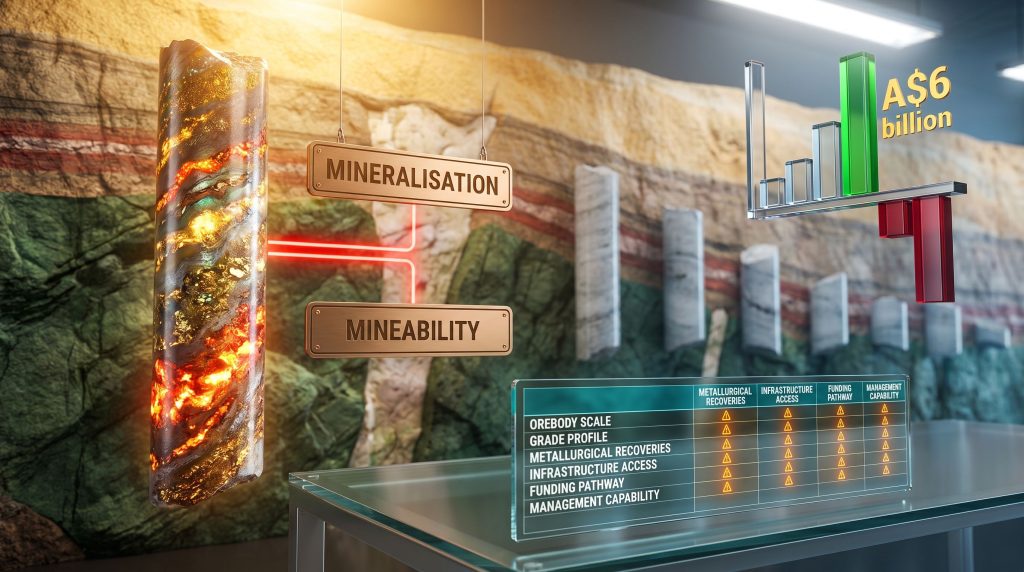
The most important conceptual shift an investor can make when evaluating ASX nearology prospects is understanding that the commercial journey from drill hit to operating mine involves a sequence of filters, each of which can independently eliminate an otherwise interesting geological occurrence. Proximity speaks only to the first and least demanding of these filters. It says nothing about the remaining five.
| Commercial Filter | What It Measures | Why It Matters |
|---|---|---|
| Orebody Scale | Total resource tonnage and spatial continuity | Determines mine life and capital justification |
| Grade Profile | Head grade and grade distribution | Directly drives revenue per tonne processed |
| Metallurgical Recoveries | Processing efficiency and complexity | Affects operating costs and product marketability |
| Infrastructure Access | Power, water, roads, port proximity | Can add hundreds of millions to development capital |
| Funding Pathway | Balance sheet strength, offtake potential | Determines whether development can be financed |
| Management Capability | Track record in project delivery | Execution risk is frequently underestimated |
The tier-one discoveries that trigger nearology booms are exceptional precisely because they satisfy all six filters simultaneously. This is statistically rare. The nearology plays that follow are re-rated almost exclusively on geology, while the five remaining filters are ignored during the speculative surge. As Stocks Down Under has observed, geology is only the opening chapter, and a commercial mine requires scale, grade, metallurgy, continuity, infrastructure, and economics working together.
A critical distinction that the market consistently under-prices is the difference between mineralisation and mineability. Mineralisation simply means metal-bearing material has been confirmed by drilling. Mineability is an entirely different question: can that material be extracted and processed at a profit, given its grade, geometry, metallurgical character, distance from infrastructure, and the prevailing funding environment? The gap between these two concepts is where most ASX nearology prospects fail. In addition, understanding cut-off grade significance helps investors assess whether reported mineralisation is economically meaningful or simply present in trace quantities.
Five ASX Nearology Cycles and What They Actually Delivered
Case Study 1: The West Yilgarn Palladium-Nickel-Copper Rush (Post-2020)
Chalice Mining's Julimar discovery fundamentally redefined perceptions of the West Yilgarn region by confirming a high-grade palladium-nickel-copper intrusive system on the outskirts of Perth. The discovery was genuinely exceptional, representing a category of deposit that had not previously been recognised in the province.
The market response was immediate. DevEx Resources, Caspin Resources, and Western Yilgarn all experienced sharp re-ratings on the basis of their nearby tenure. A staking rush followed across the broader region. The geological logic was sound in its framing but flawed in its execution: the West Yilgarn clearly had intrusive potential, but that potential was not uniformly distributed.
What the nearology plays delivered was geophysical anomalies and isolated mineralised intercepts. Galileo Mining's subsequent Callisto discovery represented the closest regional parallel, demonstrating that Julimar was not a geological singularity. Even Callisto, however, faces the full suite of commercial development challenges including difficult funding conditions and commodity-price headwinds. No neighbouring explorer has yet demonstrated the combination of resource scale, metallurgical simplicity, and development economics that would justify a sustained long-term re-rating.
Case Study 2: The Mallina Basin Gold Frenzy (Post-2020)
De Grey Mining's Hemi discovery in the Pilbara revealed a style of intrusive gold mineralisation that had not been recognised in the region at scale, triggering one of the most intense gold exploration booms in recent Australian history. The company was ultimately acquired for more than A$6 billion, a valuation that reflected the discovery's genuine commercial quality.
The Mallina Basin became intensely explored territory. Kairos Minerals, Novo Resources, and Artemis Resources all surged as investors extrapolated Hemi's success across the broader region. Some recorded encouraging drilling intercepts. None delivered a discovery of equivalent scale, continuity, or development potential.
The lesson embedded in this cycle extends beyond geology. Hemi succeeded because it brought together scale, continuity, metallurgical simplicity, and a clear development pathway. The nearby explorers had access to the same regional rocks but not the same specific geological conditions that produced Hemi's exceptional orebody geometry. A discovery is a geological event. A mine is a financial, engineering, and logistical achievement. These two outcomes are separated by a distance the market routinely underestimates during exploration booms. Consequently, interpreting drill results accurately is crucial before drawing conclusions about a project's true potential.
Case Study 3: The Doolgunna Copper-Gold VMS Rush (Post-2009)
Sandfire Resources' DeGrussa discovery in 2009 established a new benchmark for Australian copper discovery by confirming a transformational high-grade copper-gold volcanic-hosted massive sulphide (VMS) system in the Doolgunna region of Western Australia. The discovery was commercially exceptional, combining high-grade copper-gold mineralisation with development simplicity and favourable commodity pricing during a strong copper cycle.
Dozens of junior explorers rapidly acquired surrounding tenure. Conductive anomalies were identified and drilled across the region in pursuit of analogous VMS systems. Sulphide intersections were reported across multiple projects. Yet none produced anything commercially comparable to DeGrussa.
This cycle introduced what may be the most important technical distinction in nearology analysis: the gap between the presence of sulphides and the presence of an economic orebody. VMS systems are not rare in the Doolgunna region. What is rare is a VMS system with the grade, geometry, and processing characteristics that translate into a financially viable operation. The market priced nearby explorers as though sulphide presence was equivalent to discovery. The geology said otherwise.
Case Study 4: The Fraser Range Nickel-Copper Mania (Post-2012)
The discovery of the Nova-Bollinger nickel-copper sulphide system in the Fraser Range of Western Australia by Sirius Resources in 2012 triggered what is widely regarded as one of the most significant exploration manias in ASX history. Companies including Legend Mining, Galileo Mining, and Windward Resources attracted enormous speculative inflows. Exploration technology was deployed across the belt at an unprecedented pace, and conductive targets were drilled at a rate rarely seen in Australian nickel exploration.
The outcome represents the most quantifiably clear example of ASX nearology prospects failing to deliver. Despite multi-year, multi-company drilling campaigns across the belt:
- Multiple explorers identified mafic-ultramafic intrusions consistent with potential nickel-copper sulphide host rocks
- Some companies intersected nickel-copper sulphide mineralisation
- Zero JORC-compliant mineral resources equivalent to Nova-Bollinger were established across the broader exploration rush
Nova-Bollinger worked because it delivered the full package: grade, continuity, geometry, and development potential converging in a single geological setting. The Fraser Range clearly hosts the right rocks. It does not host multiple Novas. The Fraser Range cycle remains the definitive quantitative proof that nearology booms produce more losers than winners, measured by the most objective standard available: JORC Resource definition.
Case Study 5: The West Arunta Niobium Province (Post-2023)
WA1 Resources' Luni carbonatite-hosted niobium discovery in the West Arunta region of Western Australia in 2023 represents the most instructive live case study currently available, precisely because the cycle is still in progress. The discovery prompted immediate speculation that an entirely new Australian critical minerals province had been identified, drawing both retail and institutional attention to niobium as a commodity.
Encounter Resources, Nimy Resources, and other companies with carbonatite tenure or niobium exposure were re-rated sharply. Some neighbouring explorers subsequently identified carbonatite systems and reported pathfinder mineralisation. The critical commercial questions, however, remain unresolved.
This cycle introduces an additional layer of technical complexity that distinguishes it from previous nearology booms. Carbonatites vary enormously in their mineralogical character. A large-tonnage carbonatite system is not automatically a viable niobium project. If the niobium mineralogy is complex, processing costs are prohibitive, or the grade distribution does not support economic extraction at a remote location, the system has no commercial value regardless of its physical scale.
Carbonatites can be enormous in physical size while remaining economically inert. The market is still working through the distinction between a carbonatite that hosts niobium and a carbonatite that hosts economic niobium.
The West Arunta cycle is a real-time demonstration of how nearology speculation precedes commercial validation and why investors who enter before that validation is achieved carry substantially more risk than the share price movements suggest.
Why These Booms Follow an Identical Three-Phase Pattern
The Predictable Architecture of Nearology Cycles
Across five commodities, five provinces, and more than fifteen years of ASX history, the structural pattern of nearology cycles is strikingly consistent:
- Phase 1: Discovery Confirmation – A tier-one discovery is announced; the discoverer is re-rated dramatically and justifiably; regional geology is reassessed
- Phase 2: Proximity Surge – Neighbouring explorers re-rate on adjacency alone; retail and momentum capital drives short-term price action; tenure acquisition accelerates
- Phase 3: Fundamental Reversion – Drill results from neighbouring explorers fail to match the original discovery; capital rotates out; share prices retrace toward pre-boom levels
The timing of Phase 3 varies. In some cycles it takes months; in others it takes years as explorers continue releasing results that maintain enough speculative interest to delay the reversion. The direction, however, is consistent across every case study examined.
The Disclosure Incentive Problem
ASX continuous disclosure obligations, while designed to protect investors through transparency, can inadvertently amplify nearology speculation. Companies are required to announce material developments, and tenure acquisitions, MoU signings, and early-stage geophysical results in proximity to a major discovery all qualify as potentially material. Each announcement generates a price catalyst regardless of underlying geological merit.
A company that signs an MoU to acquire ground adjacent to a major discovery may rise 20% on the day of announcement. The announcement is technically compliant and commercially premature simultaneously. Investors who mistake the compliance-driven news flow for a fundamental signal are systematically disadvantaged.
The next major ASX story will hit our subscribers first
A Practical Framework for Evaluating ASX Nearology Plays
The Five Questions Every Investor Should Ask Before Buying
Before assigning any long-term investment value to a nearology play, disciplined investors should work through the following sequential questions:
-
Does the neighbouring ground share the same host geological architecture, not just the same province? Regional proximity is not geological equivalence. Investors should seek evidence of the same intrusive body, structural corridor, or mineralising system, not merely a nearby address.
-
Has the company identified mineralisation or merely anomalies? Geophysical anomalies and soil geochemistry are exploration hypotheses. Only drill-confirmed mineralisation advances an investment thesis.
-
If mineralisation has been intersected, does it demonstrate the scale and continuity required for resource definition? Isolated high-grade intervals are not equivalent to a coherent orebody. JORC Resource definition requires demonstrated continuity across multiple drill sections.
-
What is the realistic development pathway and can the company fund it? Assess cash position, burn rate, and access to capital markets. Many nearology plays exhaust their treasury before reaching resource definition.
-
Does management have the capability to execute a discovery-to-development pathway? Geological competence and project delivery capability are not the same skill set. Track record matters. Furthermore, understanding grade, permitting and mining economics provides important context for evaluating whether a project has genuine long-term viability.
Nearology vs. Genuine Regional Potential: A Comparison Framework
| Characteristic | Nearology Play (High Risk) | Genuine Regional Prospect (Lower Risk) |
|---|---|---|
| Basis for re-rating | Geographic proximity to discovery | Independent geological evidence |
| Mineralisation status | Anomalies or isolated intercepts | Drill-confirmed, continuous mineralisation |
| Resource definition | No JORC Resource | Resource definition in progress or achieved |
| Management track record | Limited or unrelated | Demonstrated discovery/development history |
| Funding position | Sub-$5m cash, high burn rate | Adequately funded for next 18+ months |
| Commodity price sensitivity | Extreme, leveraged to sentiment | Moderate, underpinned by project economics |
What Genuine Long-Term Value Creation Actually Requires
The Rare Convergence That Defines Tier-One Discoveries
The discoveries that trigger nearology booms share four attributes that distinguish them from the interesting geological occurrences that follow in their wake:
- Exceptional grade: Significantly above the economic threshold for the commodity in question, providing margin resilience across commodity price cycles
- Orebody scale: Sufficient resource tonnage to support a multi-decade mine life and justify the capital intensity of development
- Metallurgical simplicity: Processing characteristics that allow efficient and cost-effective extraction without prohibitive complexity
- Development optionality: Infrastructure proximity, a viable permitting pathway, and accessible financing structures
The statistical rarity of this convergence is not accidental. It reflects the geological reality that the conditions required to produce a commercially exceptional deposit are specific, localised, and non-repeating. This is precisely why tier-one discoveries command the valuations they do: they are genuinely scarce outcomes in a geological universe that produces far more near-misses than world-class orebodies.
The consistency of outcomes across the five cycles examined, spanning palladium-nickel-copper, gold, copper-gold, nickel-copper, and niobium, points to a fundamental truth about mineral systems. Exceptional deposits are exceptional precisely because the conditions that created them are rare and localised. Proximity cannot manufacture those conditions. Enthusiasm cannot replace them. Share prices, however temporarily elevated, eventually reflect that reality. A definitive feasibility study ultimately separates genuine commercial prospects from those that were little more than proximity-driven speculation.
Frequently Asked Questions About ASX Nearology Investing
What does nearology mean in ASX investing?
Nearology refers to the practice of investing in ASX-listed explorers based primarily on their geographic proximity to a major mineral discovery, on the assumption that the same geological system extends onto their ground. While proximity can represent a legitimate early-stage exploration hypothesis, it does not guarantee equivalent mineralisation. Nearology-driven re-ratings frequently reverse once drilling results fail to replicate the original discovery's grade, scale, or continuity.
Can nearology plays ever create genuine long-term shareholder value?
Regional discoveries do occasionally emerge from exploration booms triggered by a major find. These cases are statistically rare, and the key differentiator is always independent geological merit rather than proximity. Companies that succeed in the aftermath of a major discovery do so because their own ground hosts a coherent mineral system, not because they are nearby. Galileo Mining's Callisto discovery in the West Yilgarn represents the closest example in recent cycles, though it still faces substantial commercial development hurdles.
What is the difference between mineralisation and mineability?
Mineralisation means that metal-bearing material has been confirmed by drilling. Mineability is the technical and economic capacity to extract that material at a profit, accounting for grade, scale, metallurgy, infrastructure access, and the financing environment. This gap between the two concepts is the central risk in nearology investing, and it is the gap that the market consistently fails to price correctly during exploration booms.
How can I tell whether a nearology play has genuine geological merit?
Look for independent geological reports that assess how the company's tenure relates to the specific structural or intrusive architecture of the original discovery, not just the regional geology. Drill results demonstrating mineralisation continuity across multiple sections are more meaningful than isolated high-grade intercepts. Management commentary that engages specifically with how their ground relates to the mineralising system, rather than simply to the province, is a positive signal.
Why do ASX nearology booms keep repeating if they almost always fail?
The combination of short-term price action rewarding proximity, low barriers to tenure acquisition, continuous disclosure requirements that generate news flow, and the powerful psychological seductiveness of proximity-based reasoning creates a structural incentive for nearology cycles to repeat. As Stocks Down Under has noted, investors will continue to chase the next major discovery. The challenge is recognising that tier-one discoveries are rare precisely because the conditions that create them are uncommon, localised, and not replicable simply by holding nearby ground.
General information only. This article does not constitute financial advice. Past performance of exploration cycles is not indicative of future outcomes. Investors should conduct their own research and consider seeking independent financial advice before making investment decisions. Further perspectives on ASX nearology prospects are available at Stocks Down Under.
Want to Identify Genuine ASX Mineral Discoveries Before the Broader Market Does?
Discovery Alert's proprietary Discovery IQ model delivers real-time alerts on significant ASX mineral discoveries, instantly cutting through the noise of proximity-driven speculation to highlight opportunities with genuine geological and commercial merit — the kind that have historically generated returns like those seen with De Grey Mining and WA1 Resources, as showcased on Discovery Alert's dedicated discoveries page. Begin your 14-day free trial at Discovery Alert today and position yourself ahead of the market.