May 14, 2026
When Policy Becomes Economics: Understanding the Architecture Behind Germany's Hydrogen Transport Mandate
Across most of Europe's recent energy transition history, hydrogen targets have existed in the comfortable space of political intention rather than legal obligation. Governments announced ambitious goals, industry responded with feasibility studies, and timelines stretched comfortably into future decades. That model has now fundamentally changed in the continent's largest economy. The Germany hydrogen transport mandate, formalised through the transposition of the EU's Renewable Energy Directive III into national law on 8 May 2026, represents something qualitatively different from everything that preceded it: a shift from aspiration to enforceable compliance, complete with financial penalties capable of reshaping the entire economics of fuel supply.
Understanding why this matters requires examining not just the policy itself, but the economic architecture it creates and the structural realities that make domestic compliance virtually impossible at the volumes required. Furthermore, the broader implications for critical minerals and energy security add another layer of strategic importance to this legislative development.
When big ASX news breaks, our subscribers know first
What Germany's RED III Transposition Actually Changes
The Renewable Energy Directive III, adopted at the EU level in 2024, establishes minimum targets for renewable energy deployment across member states. What makes Germany's national implementation particularly significant is the decision to exceed those EU minimums at every point along the trajectory, while also extending binding targets well beyond the 2030 horizon that Brussels itself has left unaddressed.
Under Germany's framework, fuel suppliers operating in the transport sector must source increasing volumes of hydrogen as RFNBOs, which stands for Renewable Fuels of Non-Biological Origin. These are hydrogen or hydrogen-derived fuels produced exclusively through electrolysis powered by renewable electricity. The classification is consequential because it is narrow by design.
Critically, only RFNBO-certified hydrogen satisfies Germany's transport quota obligations. Biomass-derived alternatives, renewable energy certificate matching, and financial offsets do not qualify. The mandate requires physical, traceable supply chains, not accounting solutions.
This specificity eliminates the kind of compliance flexibility that characterised earlier European energy targets, where certificate markets and statistical transfers between member states allowed significant creative accounting. Germany's transport mandate closes those avenues deliberately. In addition, this policy sits firmly within the broader context of critical materials for the green transition, where supply chain integrity is increasingly non-negotiable.
How Germany's RFNBO Quotas Stack Up Against EU Minimums
The phased escalation built into Germany's mandate creates an increasingly demanding compliance environment across a compressed timeframe.
A Phased Escalation Structure With Legally Binding Force
The trajectory begins modestly but accelerates sharply:
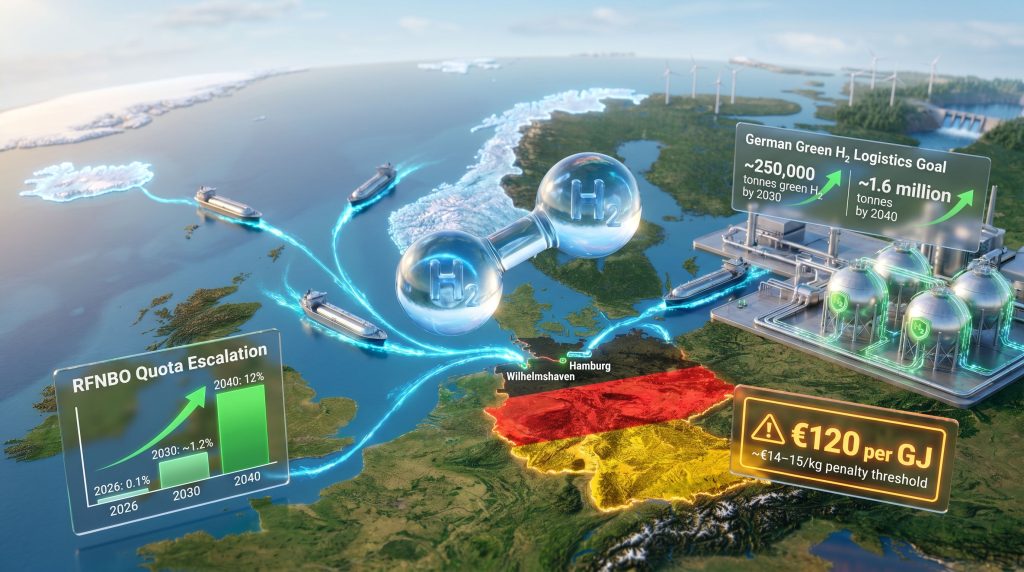
- 2026: 0.1% of total transport energy must be RFNBO-certified, establishing an immediate compliance obligation
- 2030: Approximately 1.2% of transport fuel, exceeding the EU RED III minimum threshold of 1%
- 2040: Rising to 10% of all transport fuel, extending well beyond any EU-mandated target horizon
The EU itself has set no binding RFNBO transport targets beyond 2030, making Germany's extended roadmap a legislative outlier on the global stage. BloombergNEF estimates cited in connection with the policy suggest these quotas could generate demand for approximately 250,000 tonnes of green hydrogen annually in Germany by 2030, rising to around 1.6 million tonnes per year by 2040.
Germany vs. EU: RFNBO Transport Mandate Comparison
| Policy Horizon | EU RED III Minimum | Germany National Mandate |
|---|---|---|
| 2026 | No formal floor | 0.1% of transport energy |
| 2030 | 1% of transport fuel | ~1.2% of transport fuel |
| 2040 | No binding target set | 10% of transport fuel |
| Est. Annual Volume (2030) | Variable by member state | ~250,000 tonnes green H₂ |
| Est. Annual Volume (2040) | Not mandated | ~1.6 million tonnes green H₂ |
Sources: Proactive Investors (May 2026); BloombergNEF estimates as cited in industry analysis; EU RED III legislative text
The Financial Penalty Structure: Where Policy Meets Price Signals
The mandate's enforcement mechanism transforms compliance from a reputational consideration into a hard financial calculation. Fuel suppliers who fall short of their RFNBO obligations face penalties of €120 per gigajoule of non-compliant fuel volume.
The Economics of the Penalty Structure
Converting this penalty into hydrogen price equivalents reveals its true significance. Based on hydrogen's energy content of approximately 141.8 megajoules per kilogram, the €120/GJ penalty translates to an effective floor price of roughly €14 to €15 per kilogram of hydrogen. Any compliant supply chain capable of delivering certified hydrogen below this threshold becomes commercially attractive by regulatory design rather than by market preference.
This is not a subtle incentive. It is a structural repricing of compliance risk.
The penalty-implied price of €14-15/kg fundamentally alters the supplier decision framework. Non-compliance is not merely a reputational risk or a minor financial inconvenience. At scale, penalty costs dwarf the cost of securing compliant supply chains, even at current green hydrogen price levels.
Adding further pressure on conventional grey hydrogen suppliers, analysis from Longspur Research indicates that Germany's existing greenhouse gas reduction quota framework could impose an additional compliance burden of approximately €4.5/kg on grey hydrogen. This stacks on top of the penalty exposure, progressively eroding the economic case for non-compliance or for grey hydrogen alternatives.
How the Penalty Structure Reshapes Supplier Behaviour
The binary nature of outcomes under this structure is worth emphasising:
- Fuel distributors who secure verified RFNBO supply chains absorb a known cost and achieve compliance
- Those who do not face open-ended penalty accumulation that escalates as quota percentages rise each year
- The structure heavily rewards early contracting with logistics providers capable of demonstrating traceable physical delivery
This incentive design explains why the mandate's commercial impact is likely to be felt years before the 2030 milestone, as suppliers move to lock in supply agreements well ahead of escalating obligations.
Why Domestic Production Cannot Close the Gap
Germany's ambition on paper collides with a structural reality on the ground: the country cannot produce sufficient RFNBO-certified hydrogen domestically to meet its own mandated volumes at competitive prices.
Structural Barriers to Domestic Production Sufficiency
Three compounding constraints explain this gap:
- Grid electricity costs: Germany's industrial electricity prices sit materially above those available in regions with abundant hydroelectric or wind resources. Since electrolysis efficiency is relatively constant across geographies, input electricity cost is the primary driver of green hydrogen production economics.
- Grid connection bottlenecks: Expanding electrolyser capacity requires proportional renewable electricity generation capacity and reliable grid infrastructure. Germany's existing grid faces persistent congestion challenges that cannot be resolved through electrolyser deployment alone.
- Capital deployment timelines: Industrial-scale electrolyser projects typically require four to six years from planning through permitting to commercial operation. The 2030 compliance window is already tight enough that projects not currently in advanced development are unlikely to contribute meaningfully to quota satisfaction.
Estimates suggest Germany may need to import approximately 100,000 tonnes of green hydrogen per annum from 2030 to bridge the gap between domestic production capacity and mandated volumes. Even this figure assumes reasonably optimistic domestic output scenarios. Total mandate-driven demand of around 250,000 tonnes annually implies that imports will need to cover a substantial portion of supply requirements from the outset of the decade.
The Hidden Infrastructure Bottleneck
Beyond production economics, a second constraint affects the most widely discussed import pathway. Ammonia is commonly proposed as a hydrogen carrier for long-distance maritime transport, as it can be liquefied and shipped using established maritime infrastructure. However, using ammonia as a hydrogen import vector requires reconversion infrastructure at the destination port.
Ammonia cracker facilities, which convert ammonia back into usable hydrogen, remain significantly underdeveloped across German port infrastructure.
The ammonia pathway's appeal as a long-haul carrier conceals a critical last-mile problem. Without adequate cracker capacity at German ports, upstream ammonia supply cannot be converted into the hydrogen that end-users and fuel suppliers actually need. This bottleneck constrains the entire pathway's near-term viability regardless of how much ammonia production capacity exists upstream.
Competing Import Pathways and Their Trade-Offs
The limitations of ammonia-based transport have elevated interest in alternative logistics models, each carrying different cost structures, infrastructure requirements, and efficiency profiles.
Pathway Comparison: Ammonia vs. Liquid Hydrogen vs. Compressed Gas
| Transport Pathway | Conversion at Origin | Reconversion Required | Best Route Length | Key Infrastructure Dependency |
|---|---|---|---|---|
| Ammonia (NH₃) | Yes | Yes (cracker facilities) | Long-haul intercontinental | Ammonia cracker capacity |
| Liquid Hydrogen (LH₂) | Yes (liquefaction) | No (direct use) | Medium to long-haul | Cryogenic terminals |
| Compressed Gaseous H₂ | No | No | Short to medium regional | Pressure vessel carriers |
The compressed hydrogen pathway is notable for what it avoids rather than what it requires. By skipping both conversion at the production site and reconversion at the destination, it eliminates the energy losses embedded in ammonia's dual-transformation process. The trade-off is vessel capacity, as compressed gas carriers transport lower volumes per voyage than ammonia tankers, making route length and shipping frequency critical variables in the economics.
For shorter regional routes, however, this trade-off can be favourable. Fewer voyages are required to maintain supply continuity, compressed hydrogen avoids cracker dependency, and the logistics chain from renewable electricity through electrolysis to delivered hydrogen is shorter and more transparent — which matters directly for RFNBO traceability requirements.
The next major ASX story will hit our subscribers first
Why Nordic-to-Germany Routes Are Gaining Strategic Attention
Northern Europe, particularly Norway and Iceland, possesses renewable electricity resources that produce green hydrogen at costs structurally below those achievable in central European markets. Abundant hydroelectric capacity provides stable, low-cost baseload power that can support high-utilisation electrolysis operations, a critical factor in hydrogen production economics where capital costs are fixed and output depends on operating hours.
The Regional Supply Chain Advantage
Several factors combine to make Nordic supply routes commercially attractive for Germany's hydrogen import requirement:
- Electricity cost advantage: Nordic renewable power prices, particularly hydroelectric baseload, compare favourably against German grid tariffs, supporting lower production costs at the electrolyser level
- Shipping distance: Maritime distances between Nordic ports and Germany's North Sea terminals are substantially shorter than intercontinental routes from Australia, Chile, or the Middle East and North Africa region, reducing transport costs and delivery times
- Traceability compliance: RFNBO certification rules require an unbroken chain of custody from renewable electricity generation through electrolysis to final delivery. Shorter, regionally contained supply chains are inherently easier to document and certify than multi-stage intercontinental routes
- No cracker dependency: Compressed hydrogen delivered directly avoids ammonia reconversion entirely, eliminating a bottleneck that affects the dominant alternative import pathway
Delivered costs from Nordic compressed hydrogen supply routes are estimated at approximately €7 per kilogram, depending on electricity pricing and vessel utilisation assumptions. At this level, Nordic-sourced hydrogen sits materially below the penalty-implied price threshold of €14-15/kg, creating a viable commercial margin for compliant supply well within the regulatory price structure.
What RFNBO Traceability Requirements Mean in Practice
The physical delivery mandate embedded in Germany's RFNBO framework carries practical implications that are not always appreciated. Unlike earlier renewable energy frameworks that allowed renewable energy certificates to be traded across borders independently of physical commodity flows, Germany's transport mandate requires that the hydrogen delivered to fuel suppliers can be traced back through the supply chain to specific renewable electricity generation.
This requirement structurally advantages supply chains with fewer intermediary steps and cleaner documentation trails. It also creates a significant compliance risk for suppliers who rely on complex multi-party arrangements where provenance documentation may be difficult to maintain across jurisdictions.
Germany's Mandate Within Europe's Broader Decarbonisation Investment Cycle
Germany's RED III transposition does not exist in isolation. The policy coincides with broader European investment momentum that is reshaping infrastructure priorities across the continent. Approximately €5 billion in newly announced European funding directed at carbon capture and storage infrastructure reinforces the industrial decarbonisation investment thesis, though this represents a broader European programme rather than Germany-specific or project-specific allocation.
The European Hydrogen Bank's auction mechanisms are progressively reducing the production cost differential between green and grey hydrogen across European markets, while Germany's penalty structure simultaneously raises the economic floor for grey hydrogen compliance. Consequently, renewable energy solutions that were once considered aspirational are now being pulled forward by binding legal frameworks.
Germany's decision to exceed EU minimums and extend binding targets through 2040 also provides a legislative template that other member states are watching closely. The Netherlands, Belgium, and France are each reported to be evaluating analogous RFNBO frameworks for their transport sectors, though specific quota levels and timelines have not been formalised in those markets.
The UK, operating independently post-Brexit, is developing parallel hydrogen transport obligation mechanisms that could create an additional demand signal for Nordic and European producers. Australia, Chile, and MENA-region hydrogen project developers are increasingly orienting export strategy toward European compliance demand, recognising that the Germany hydrogen transport mandate creates durable, legally enforceable offtake requirements rather than the speculative market growth that characterised earlier hydrogen trade discussions.
Green hydrogen investment activity is consequently accelerating across multiple geographies in direct response to the demand certainty that Germany's legislative framework now provides. Furthermore, understanding the energy transition in mining and broader industrial sectors helps contextualise why Germany's policy architecture is being studied so carefully by investors and policymakers alike.
Frequently Asked Questions: Germany's Hydrogen Transport Mandate
What does RED III mean for Germany's fuel suppliers?
Germany's transposition of RED III into national law legally obliges fuel suppliers operating in Germany's transport sector to incorporate rising proportions of RFNBO-certified hydrogen into their fuel mix. Starting from 0.1% in 2026, the requirement escalates to approximately 1.2% by 2030 and 10% by 2040. Suppliers who fail to meet these quotas face financial penalties of €120 per gigajoule of non-compliant fuel volume.
What is an RFNBO and how does it differ from other green fuels?
An RFNBO is hydrogen or a hydrogen-derived fuel produced through electrolysis powered exclusively by renewable electricity, such as wind or solar. Unlike biofuels sourced from organic matter, RFNBOs must originate from non-biological renewable energy sources. This distinction is critical because only RFNBO-certified hydrogen satisfies Germany's transport quota requirements. Biomass pathways, certificate matching, and financial offset mechanisms do not qualify.
How much green hydrogen will Germany need to import by 2030?
Based on current domestic production projections, Germany is estimated to require approximately 100,000 tonnes of imported green hydrogen per annum by 2030. Total mandate-driven demand is projected at approximately 250,000 tonnes annually by 2030, rising to around 1.6 million tonnes by 2040. Domestic production constraints, including high electricity costs and grid limitations, are expected to prevent Germany from closing this gap through internal supply alone.
Why is ammonia cracking a bottleneck for hydrogen imports?
Ammonia is one of the most widely discussed hydrogen carrier molecules for maritime shipping because it can be liquefied using established infrastructure. However, importing hydrogen via ammonia requires cracking facilities at the destination to reconvert ammonia back into usable hydrogen gas. Germany's current ammonia cracker capacity is insufficient to handle projected import volumes, creating a structural bottleneck that limits the ammonia pathway's near-term viability even when upstream supply is available.
What is the penalty for not meeting Germany's hydrogen transport quota?
Fuel suppliers who fail to satisfy RFNBO transport quotas face penalties of €120 per gigajoule of non-compliant fuel. Based on hydrogen's energy content, this translates to an effective price equivalent of approximately €14 to €15 per kilogram, establishing a powerful economic incentive for suppliers to secure compliant hydrogen volumes well ahead of escalating quota deadlines. Industry analysis, including commentary from Gasworld, has highlighted how these penalty structures are already influencing long-term supply contracting behaviour.
Key Takeaways at a Glance
- Legislative status: Germany's RED III transposition became national law on 8 May 2026, creating binding RFNBO obligations for transport fuel suppliers immediately
- Quota trajectory: 0.1% in 2026, rising to approximately 1.2% by 2030 and 10% by 2040, exceeding EU minimums at every interval
- Projected demand: Approximately 250,000 tonnes of green hydrogen annually by 2030 and around 1.6 million tonnes by 2040
- Import dependency: Germany is estimated to require approximately 100,000 tonnes per annum of imported green hydrogen from 2030
- Penalty structure: €120/GJ for non-compliance, implying an effective hydrogen price floor of approximately €14-15/kg
- Grey hydrogen burden: Analysis from Longspur Research suggests an additional approximately €4.5/kg compliance cost burden on grey hydrogen under existing greenhouse gas reduction quota frameworks
- Infrastructure bottleneck: Ammonia cracker shortfalls constrain the dominant proposed import pathway's near-term capacity
- Nordic corridor economics: Regional Nordic-to-Germany shipping routes carry estimated delivered costs of approximately €7/kg, sitting well below the penalty-implied price threshold
- Broader investment context: Approximately €5 billion in European CCS funding reinforces the wider industrial decarbonisation investment environment
This article is intended for informational purposes only and does not constitute financial or investment advice. Projections, estimates, and forecasts referenced throughout are drawn from third-party industry sources and involve inherent uncertainty. Readers should conduct their own independent research and seek professional advice before making any investment decisions.
Want to Stay Ahead of the Critical Minerals and Energy Transition Opportunities Driving Europe's Green Hydrogen Surge?
As Germany's binding hydrogen transport mandate reshapes global supply chains and accelerates demand for the critical minerals underpinning electrolysis infrastructure, Discovery Alert's proprietary Discovery IQ model delivers real-time ASX mineral discovery alerts — instantly identifying actionable opportunities before the broader market reacts. Explore how historic mineral discoveries have generated substantial returns and begin your 14-day free trial today to position yourself at the forefront of the energy transition investment cycle.