June 25, 2026
The Economics of Sovereign Gas: Why Domestic-First Models Are Rewriting African Energy Strategy
Across the African continent, a fundamental recalibration is underway in how nations think about their hydrocarbon endowments. For decades, the prevailing logic was straightforward: international oil companies bring capital, technology, and market access, and host nations receive royalties, taxes, and employment. That arrangement is fracturing. A growing number of resource-rich African governments are concluding that the extraction-and-export model delivers insufficient downstream value, and they are restructuring their energy sectors accordingly.
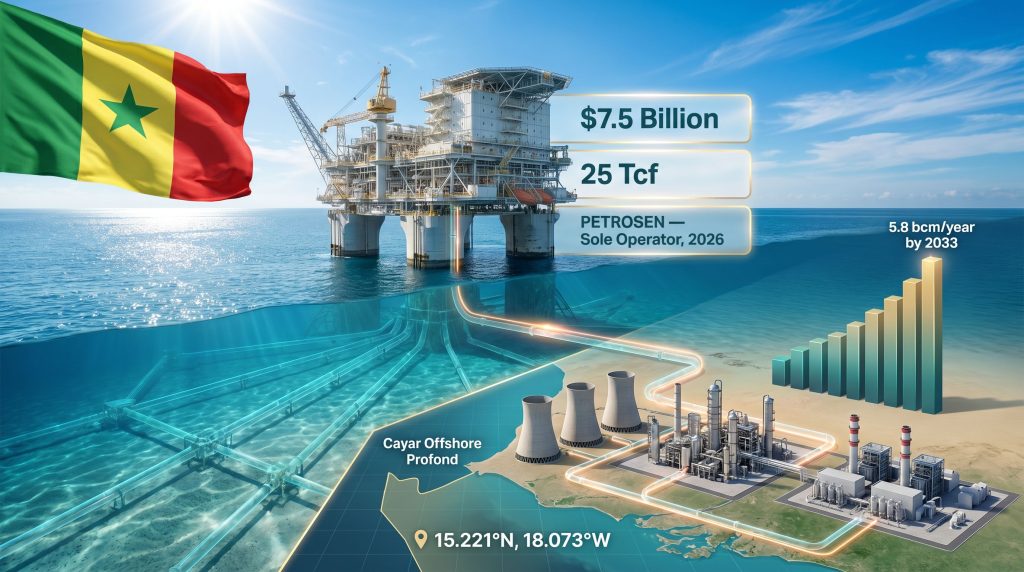
The Senegal Yakaar-Teranga gas development represents one of the most analytically instructive examples of this structural shift. With approximately 25 trillion cubic feet (Tcf) of estimated recoverable reserves, equivalent to roughly 708 billion cubic meters (bcm), the field in the ultra-deepwater Cayar Offshore Profond block is not simply a gas discovery. It has become the centrepiece of a broader industrial development thesis, one in which gas is treated as a manufacturing feedstock and energy security instrument rather than a commodity for export.
What makes the Senegal Yakaar-Teranga gas development particularly significant is not just its reserve scale, but the circumstances under which state ownership has been consolidated, the financing architecture being assembled, and the industrial ambition embedded in its two-phase development plan totalling $7.5 billion.
When big ASX news breaks, our subscribers know first
From Discovery to State Control: The Ownership Evolution of Yakaar-Teranga
The field's journey from exploration asset to sovereign development project spans roughly a decade and involves two major international oil company exits, each for distinct reasons.
Kosmos Energy originally discovered the Yakaar-Teranga resource approximately ten years before the current development phase, positioning it alongside the Grand Tortue Ahmeyim gas deposit as a foundation asset for Senegal's emergence as a hydrocarbon producer. BP subsequently entered as a major partner, holding a 60% operating stake with aspirations centred on LNG market implications and a production start targeted around 2028.
The BP exit in 2023 was not a commercial failure in the conventional sense. It was a strategic misalignment made irreconcilable by diverging monetization philosophies. BP prioritised LNG exports to international markets. The Senegalese government insisted that domestic gas supply for power generation and industrial development had to be the primary use case. That disagreement could not be bridged commercially, and BP departed.
Kosmos Energy expanded its stake to approximately 90% following BP's exit, with PETROSEN retaining 10%. However, Kosmos carried approximately $3 billion in reported debt at the time and faced stalled commercial pathways without a clear route to project sanctioning. Kosmos's contract was set to expire in July 2026. On April 23, 2026, Prime Minister Ousmane Sonko announced the company's withdrawal without financial compensation, and a ministerial order transferred the exploration license exclusively to PETROSEN.
The decision to transfer Kosmos Energy's license to PETROSEN without financial compensation introduces a reputational signal for future foreign investment in Senegalese upstream assets. How Senegal manages this perception will be critical to attracting the development finance institution and bond market capital required to fund Phase 1.
This sequence of events positions the Senegal Yakaar-Teranga gas development as analytically distinct from other African resource nationalisation episodes. It was not driven by commodity price opportunism or political crisis. Rather, it was the end result of a prolonged strategic disagreement about what gas should be used for, and by whom.
A $7.5 Billion Two-Phase Capital Deployment Plan
The development architecture announced by Mouhamadou Diop, chief executive officer of PETROSEN's trading arm, at a Dakar industry event in May 2026 separates the project into two distinct capital phases with fundamentally different objectives.
Phase 1: Upstream Domestic Supply Infrastructure (~$2.5 Billion)
Phase 1 targets the construction of upstream gas production infrastructure capable of delivering approximately 300 million cubic feet of gas per day (MMcf/d) to the domestic Senegalese market. The primary application is gas-to-power generation, aimed at alleviating the chronic electricity access deficits that constrain both household welfare and industrial competitiveness across the country.
The targeted production start for Phase 1 is approximately 2027, subject to financing closure, Front-End Engineering and Design (FEED) completion, and subsea infrastructure development timelines. Full-capacity production across the broader project is projected to reach approximately 5.8 bcm per year by 2033.
Phase 2: Downstream Industrial Buildout (~$5 Billion)
Phase 2 represents the more ambitious and transformative component of the plan. The $5 billion allocation funds a downstream industrial value chain encompassing:
- Fertilizer manufacturing to support domestic and regional agricultural productivity
- Petrochemical processing to create locally produced chemical feedstocks
- Steel production to reduce dependence on imported construction materials
- Cement output to support Senegal's infrastructure development pipeline
This downstream integration is what distinguishes the Senegal Yakaar-Teranga gas development from a conventional upstream gas project. Rather than treating gas purely as an energy commodity, the model converts the field into an industrial platform. The logic aligns with Senegal's Plan Sénégal Emergent national development framework, which targets economic diversification and value-added manufacturing as pillars of long-term growth. Furthermore, this approach reflects a broader shift in energy transition solutions being adopted across resource-rich nations.
Capital Structure and Financing Pathways
Without a major international oil company on the shareholder register, PETROSEN must assemble a non-traditional capital stack. Diop outlined a financing approach premised on multiple complementary instruments.
| Financing Mechanism | Role in Capital Structure | Risk Profile |
|---|---|---|
| Regional Bond Markets | Sovereign and quasi-sovereign debt issuance | Medium, dependent on credit ratings |
| Development Finance Institutions (DFIs) | Concessional lending and blended finance | Lower, policy-aligned mandates |
| Diaspora-Linked Capital Instruments | Retail and institutional diaspora bonds | Emerging, requires regulatory frameworks |
| Offtake-Backed Project Debt | 15 to 20 year structured supply contracts | Lower, investment-grade eligible if structured correctly |
A particularly important insight concerns the role of long-duration offtake agreements. As Diop noted, properly structured supply contracts spanning 15 to 20 years can support project debt of investment-grade quality. This is not a novel concept in project finance, however its application in a context where the project operator is a national oil company with limited ultra-deepwater operating history makes the structuring challenge considerably more complex. The creditworthiness of the offtakers, the enforceability of supply contracts under Senegalese commercial law, and the currency denomination of revenues and debt obligations will all materially affect the achievable credit rating for any project-level debt instrument.
The Fiscal Case: Dismantling a $1 Billion Annual Subsidy Burden
Perhaps the most compelling near-term economic argument for the project is its potential impact on Senegal's energy subsidy architecture. The country currently allocates approximately $1 billion per year in energy subsidies, a fiscal burden that constrains the government's capacity to invest in health, education, and infrastructure. This challenge sits at the core of Senegal's broader energy security strategy.
This subsidy bill is driven primarily by dependence on imported refined petroleum products. Senegal produces crude oil through its offshore Sangomar field, which commenced production in 2024, yet paradoxically remains a net importer of refined fuels. As Diop noted at the Dakar event, the country produces oil but continues to rely on external sources for refined petroleum products. This structural gap between upstream production and downstream refining capacity is a defining feature of many African oil producers, and it is precisely what the Yakaar-Teranga industrialisation model seeks to address.
A hypothetical subsidy reduction pathway, premised on Phase 1 reaching full domestic gas supply capacity by 2029 to 2030, suggests the following sequential impacts:
- Domestically produced gas increasingly substitutes for imported liquid fuels in power generation, reducing the volume of imports requiring subsidy support
- Gas-to-power generation expands available electricity supply, reducing load shedding and the implicit economic cost of power unreliability
- As domestic gas production displaces fuel imports, subsidy expenditure decreases, potentially by 40 to 60% of the current annual bill under optimistic pricing reform scenarios
- Freed fiscal resources become available for reinvestment into PETROSEN's exploration mandate or broader public investment
These projections are contingent on pricing policy reform. If domestic gas is sold to power utilities at subsidised rates rather than cost-reflective prices, the fiscal relief may be substantially lower than the headline figures suggest. This represents a critical policy design challenge that will determine how much of the theoretical fiscal dividend actually materialises.
Can PETROSEN Operate an Ultra-Deepwater Field Without IOC Support?
The most substantive operational question surrounding the project concerns PETROSEN's capacity to execute as sole operator of a technically demanding ultra-deepwater asset.
PETROSEN's offshore operational credentials were established through the Sangomar oil development, which began production in 2024. However, Sangomar differs from Yakaar-Teranga in several material respects:
- Sangomar is an oil field, not a gas field requiring distinct processing and infrastructure
- Sangomar targets export markets, whereas Yakaar-Teranga prioritises domestic supply with associated onshore distribution requirements
- The technical complexity of ultra-deepwater gas development at the Cayar Offshore Profond block exceeds the operational parameters of Sangomar
Ultra-deepwater gas development typically requires subsea wells with sophisticated blowout prevention systems, subsea umbilical and riser assemblies, and either a dedicated floating production platform or a subsea-to-shore pipeline solution. The engineering, procurement, construction, and installation (EPCI) contracts for such infrastructure are typically managed by a small number of specialised international contractors. PETROSEN will likely need to engage these contractors not merely as service providers but as technical partners with sufficient project management integration to compensate for gaps in PETROSEN's internal ultra-deepwater expertise.
The more pragmatic model involves selective technical service agreements, sometimes structured as Technical Assistance Contracts (TACs), that preserve PETROSEN's nominal operational control while accessing international expertise for specific high-complexity workstreams such as FEED, subsea system design, and commissioning. This preserves the sovereign development objective without requiring PETROSEN to independently develop all technical capabilities from scratch.
Three Development Scenarios Through 2033
| Scenario | Key Assumptions | Projected Outcome by 2033 |
|---|---|---|
| Accelerated State Development | DFI financing secured by 2027; FEED completed on schedule; offtake contracts signed | Full Phase 1 production; subsidy bill reduced by approximately 50% |
| Delayed but Sovereign | Financing timeline extends; minor technical delays encountered | Phase 1 production by 2031; partial subsidy relief achieved |
| Stalled Development | Financing gaps persist; technical execution challenges emerge; geopolitical friction | Production delayed beyond 2033; subsidy burden largely unchanged |
The central risk in the accelerated scenario is financing speed. Development finance institutions typically operate on longer approval timelines than commercial banks, and diaspora bond issuance requires regulatory frameworks that may not yet be fully developed in Senegal's capital markets. Bond market access is also sensitive to sovereign credit ratings and investor appetite for frontier market infrastructure bonds in a global interest rate environment that has historically been challenging for longer-duration emerging market debt.
Yakaar-Teranga Within Senegal's Three-Pillar Energy Architecture
One of the less commonly discussed aspects of the Senegal Yakaar-Teranga gas development is how it completes a coherent three-pillar energy strategy rather than existing as an isolated project. In addition, this architecture directly responds to the continent's growing green transition demands by anchoring industrialisation in domestically produced energy.
The three pillars are:
- Sangomar (offshore oil field): Established upstream production capability from 2024, generating export revenues and building PETROSEN's operational track record
- Grand Tortue Ahmeyim (GTA) (joint Senegal-Mauritania LNG development): Provides an LNG export pathway and international gas market exposure, albeit with a history of development delays
- Yakaar-Teranga (ultra-deepwater domestic gas and industrial development): Completes the architecture by addressing domestic energy security, power generation, and downstream industrialisation simultaneously
This three-pillar logic positions Senegal differently from other African gas producers that have concentrated exclusively on LNG export monetisation. Mozambique's Rovuma LNG project, for instance, has faced prolonged disruption due to force majeure declarations and security challenges, with TotalEnergies suspending operations following insurgent activity in Cabo Delgado. Tanzania's Block 1 and 4 LNG aspirations have been mired in protracted host government negotiations for years.
| Country | Key Asset | IOC Status | State Strategy | Current Status |
|---|---|---|---|---|
| Senegal | Yakaar-Teranga | BP exited 2023; Kosmos exited 2026 | Domestic gas-to-industry plus LNG | PETROSEN sole operator from 2026 |
| Mozambique | Rovuma LNG | TotalEnergies suspended | LNG export-first | Force majeure declared; stalled |
| Tanzania | Block 1 and 4 LNG | Multiple IOCs | State-led LNG | Protracted negotiation phase |
| Nigeria | Various blocks | Partial IOC divestments | Domestic supply mandate | Mixed execution outcomes |
Senegal's approach attempts to sidestep the vulnerabilities of export-dependent models by anchoring the project's commercial rationale in domestic demand, which is both more controllable and more politically defensible than international commodity markets.
The next major ASX story will hit our subscribers first
The IOC Retreat From African Frontier Gas: A Structural Industry Trend
The project does not exist in isolation. It is one expression of a broader structural trend in which major international oil companies have been recalibrating their exposure to frontier African gas assets since approximately 2020. Consequently, understanding the geopolitical resource strategy at play helps contextualise why sovereign development models are gaining traction.
Several converging pressures explain this retrenchment:
- Energy transition portfolio pressure: Supermajors facing investor ESG scrutiny have prioritised capital allocation toward lower-carbon assets or higher-return conventional projects, reducing appetite for long-duration frontier development
- LNG market uncertainty: Demand projections for LNG, particularly in European markets after Russia's invasion of Ukraine, have become more complex, with near-term demand spikes potentially masking longer-term structural decline in some consumer markets
- Host government policy evolution: Increasingly assertive resource nationalism across Sub-Saharan Africa has raised the political risk premium for IOC capital, particularly where domestic supply mandates conflict with export-first business models
- Financing environment: Rising global interest rates through 2022 to 2024 increased the cost of project finance debt, compressing returns on capital-intensive frontier gas developments
The net effect is that national oil companies like PETROSEN are inheriting development responsibilities for significant assets that IOCs no longer wish to hold. This creates genuine opportunity, but also genuine risk. NOCs typically operate with different capital structures, governance frameworks, and technical capability profiles than the IOCs they are replacing. The success or failure of this transition will have consequences not just for Senegal, but for the broader model of sovereign resource development across the continent.
Disclaimer: This article contains forward-looking projections regarding production timelines, subsidy reduction estimates, and financing scenarios. These projections are based on statements made by PETROSEN representatives and analytical modelling disclosed at industry events. They are subject to material uncertainty and should not be construed as investment advice. Actual outcomes may differ significantly from any projection or scenario presented.
Frequently Asked Questions: Senegal Yakaar-Teranga Gas Development
What is the Yakaar-Teranga gas field and where is it located?
Yakaar-Teranga is an ultra-deepwater offshore natural gas field situated in Senegal's Cayar Offshore Profond block. With estimated recoverable reserves of approximately 25 Tcf (708 bcm), it ranks among the most significant gas discoveries in West Africa's recent exploration history and forms a central pillar of Senegal's long-term domestic energy strategy.
How much will the total development cost?
The total development cost is estimated at approximately $7.5 billion, structured across two phases. Phase 1, targeting domestic gas supply infrastructure, is estimated at roughly $2.5 billion. Phase 2, covering downstream industrial development including fertilizer, petrochemical, steel, and cement manufacturing, is estimated at approximately $5 billion. For further context, Bloomberg's coverage of the project outlines the government's broader fiscal ambitions tied to this investment.
Who currently operates Yakaar-Teranga?
Following a ministerial order issued on April 23, 2026, the exploration license was transferred exclusively to PETROSEN, Senegal's state-owned national oil company. Both BP, which exited in 2023, and Kosmos Energy, which withdrew in 2026 without financial compensation, no longer hold any interest in the development.
Why did BP exit the project?
BP's 2023 departure stemmed from an irreconcilable strategic disagreement with the Senegalese government. BP sought to monetise the field primarily through LNG exports to international markets, while Senegal insisted that domestic gas supply for power generation and industrial development must be the primary application. This divergence made continued partnership commercially unviable for BP.
How will PETROSEN finance a $7.5 billion development without a major IOC partner?
PETROSEN's financing strategy is expected to draw on regional bond markets, development finance institution lending, diaspora capital instruments, and long-duration offtake-backed project debt. Supply contracts of 15 to 20 years in duration, structured with creditworthy domestic offtakers, are considered capable of supporting investment-grade project financing at the development level.
What is the expected impact on Senegal's energy subsidies?
Senegal currently allocates approximately $1 billion annually in energy subsidies. Successful domestic gas development at scale could materially reduce this burden by enabling indigenous gas-to-power generation and displacing imported refined fuels. Modelled estimates suggest a subsidy reduction of 40 to 60% of current annual expenditure under scenarios where pricing policy reform accompanies production ramp-up.
When is Phase 1 production expected to begin?
Phase 1 production is targeted to commence around 2027, subject to financing closure, FEED completion, and subsea infrastructure development. Full-capacity production across the broader Yakaar-Teranga project is projected at approximately 5.8 bcm per year by 2033. World Oil's reporting on the project's development timeline provides additional detail on the engineering and commercial milestones required to achieve this target.
Want to Stay Ahead of the Next Major African Resource Discovery?
Discovery Alert's proprietary Discovery IQ model delivers real-time alerts on significant ASX mineral discoveries, instantly translating complex resource data into actionable investment insights for both short-term traders and long-term investors — explore historic discoveries and their returns to understand the scale of opportunity, then begin your 14-day free trial to position yourself ahead of the broader market.