
May 14, 2026
The Regulatory Fault Line Beneath Brazil's Amazon Canopy
Across Latin America's resource-rich territories, few investment environments carry as much legal complexity as the intersection of conservation law, federal prosecution, and mineral extraction in Brazil. The country holds an extraordinary paradox: it is simultaneously one of the world's most biodiverse nations and one of its most mineral-endowed. Where those two realities overlap, as they do with mounting urgency in Amapá state, the result is a collision of institutional forces that commodity markets, project developers, and environmental analysts are watching with increasing concern.
The question of suspension of mining in Amapá national forest has moved from a regional environmental debate into a central test case for how Brazilian federal institutions resolve the contradiction between resource ambition and ecological stewardship. Understanding what is actually at stake requires moving well beyond the headlines. Furthermore, this case sits within a rapidly shifting geopolitical mining landscape that is reshaping how governments and investors approach protected resource zones globally.
When big ASX news breaks, our subscribers know first
What Makes the Amapá National Forest Legally and Ecologically Distinct
How National Forests Differ From Other Protected Zones in Brazilian Law
Brazil's protected area system operates across several distinct legal categories, and the distinctions matter enormously when it comes to resource extraction. National forests, known domestically as Florestas Nacionais or FLONAs, fall under a classification that permits some forms of sustainable use, including regulated timber harvesting and, under specific circumstances, mineral research. This places them in a fundamentally different legal position from strict conservation units such as Biological Reserves or National Parks, where extractive activities are categorically prohibited.
However, permissible use within a FLONA does not mean unrestricted access. Mineral extraction requires licensing through the National Mining Agency (ANM), environmental licensing from IBAMA, and in many cases, consultation processes with affected communities. When those procedural requirements are not met, or when extraction exceeds what the management plan authorises, federal prosecutors gain grounds to challenge operations directly.
The Role of Federal Prosecutors in Environmental Enforcement Actions
Brazil's Ministério Público Federal (MPF) operates with a degree of institutional independence that distinguishes it from prosecutorial bodies in many other jurisdictions. Federal prosecutors can initiate legal challenges against both private actors and government agencies, and they are empowered to request judicial suspension of activities they determine to be causing irreparable environmental harm, without necessarily waiting for a formal regulatory finding.
This prosecutorial architecture means that mining companies operating in protected zones face a dual layer of legal exposure. Regulatory compliance with the ANM and IBAMA does not automatically insulate a project from MPF action if prosecutors conclude that broader environmental obligations are being violated.
What a Prosecutorial Suspension Request Actually Triggers Under Brazilian Law
A critical misconception surrounds what happens the moment federal prosecutors file a suspension request. The filing itself does not immediately cease operations. Instead, it initiates a judicial review process in which a federal court evaluates the evidentiary basis for the claim, hears responses from the relevant parties, and determines whether an emergency injunction is warranted. This process can extend across months or even years, during which the legal status of the mining activity remains actively contested.
The operational and financial risk during this period is substantial. Project financing agreements may contain force majeure or regulatory risk clauses that are triggered by pending litigation, lender confidence can erode even before a court decision is reached, and insurance coverage may become more expensive or conditional.
The Amapá Region: Mineral Wealth at the Edge of Protected Forest
Geographic Scope, Biodiversity Value, and Indigenous Proximity
The Amapá National Forest covers an extensive area of the Brazilian state of Amapá, situated in the far northeast of the Amazon basin. The region is characterised by high rainfall, intact primary forest cover across large portions of its territory, and significant proximity to both Indigenous territories and Quilombola communities. This demographic geography is not incidental to the legal dispute; it directly activates consultation requirements under ILO Convention 169, to which Brazil is a signatory.
The biodiversity value of the area is considerable. The intact forest ecosystems of Amapá support watersheds that feed into river systems critical to both local communities and broader hydrological function across the northern Amazon. Scientific literature on Amazon forest hydrology consistently identifies the region's forest cover as essential to maintaining the moisture cycling that sustains rainfall patterns across a far wider geographic area. Consequently, questions around natural capital in mining operations have become increasingly central to how regulators and prosecutors frame their enforcement rationale.
Mineral Wealth Beneath the Canopy: Gold, Copper, and Associated Deposits
What draws extractive interest to the region is the geological profile beneath the forest floor. The Guiana Shield, the ancient geological formation underlying much of Amapá and the neighbouring states, hosts significant gold and copper mineralisation. These formations have been explored intermittently for decades, and some areas carry historical production records that confirm commercial-grade concentrations.
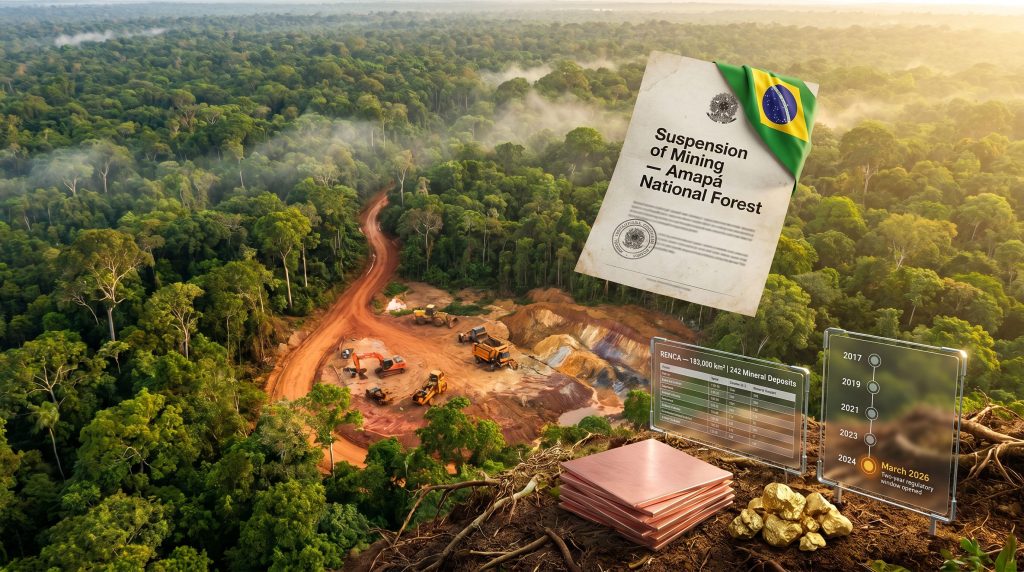
The strategic overlap with the RENCA zone, the National Reserve of Copper and Associated Minerals straddling the Amapá and Pará border, amplifies the significance of any individual enforcement action. RENCA encompasses roughly 183,000 km² of Amazon rainforest and is estimated to contain approximately 242 distinct mineral deposits, making it arguably the most contested resource corridor in South America. Regulatory actions in adjacent protected zones like the Amapá National Forest therefore carry implications that extend well beyond their immediate footprint.
A History of Policy Reversals: Why No Mining Ban in Brazil Is Permanent
Brazil's track record on Amazon mining restrictions illustrates why stability cannot be assumed even when legal prohibitions appear firmly established. The 2017 episode involving RENCA remains the most instructive precedent. A Brazilian court suspended the government's decision to open the RENCA zone for commercial mineral exploration, after Presidential Decree No. 9147 had dissolved protections that existed since 1984. The decision prompted an immediate and intense backlash from environmental organisations, international governments, and Brazilian civil society. Within approximately 30 days, the decree was revoked under public pressure, restoring the restrictions, but crucially, without addressing the underlying legislative appetite for opening the zone to extraction.
| Policy Event | Year | Outcome |
|---|---|---|
| Decree No. 9147 opens RENCA for exploration | 2017 | Revoked within approximately 30 days |
| Mining ban reinstated across RENCA zones | 2017 | Maintained but legally fragile |
| Bill 191/2020 on Indigenous land mining | 2020 | Ongoing legislative debate |
| Senate Resolution 14/2022 on Amazon extraction | 2022 | Passed, signalling federal appetite for resource development |
| Supreme Court ruling on Indigenous mining rights | March 2026 | Two-year congressional regulation window opened |
The RENCA episode illustrates a structural fragility in Brazil's conservation regime: executive instruments that create protections can be undone by the same mechanism, and political windows can shift rapidly. Senate Resolution 14/2022, which expressed congressional support for mineral development in Amazon territories, signals that the legislative branch continues to view the region's resources as underutilised, even as enforcement actions escalate.
What Triggered the Prosecutorial Action in 2026
Environmental Compliance Failures and the Role of Regulatory Agencies
Prosecutorial suspension requests of this nature rarely emerge without a documented compliance failure preceding them. Federal prosecutors typically build their evidentiary case by reviewing IBAMA monitoring reports, ANM permit records, and field inspection data before filing. Common triggers include evidence of unlicensed extraction, operations extending beyond the spatial boundaries of approved concessions, failure to conduct required environmental monitoring, or spillover activity from illegal garimpo operations that creates cover for formally licensed entities to expand their footprint.
The distinction between illegal artisanal gold mining, known in Brazil as garimpo, and formally licensed industrial extraction is often blurrier in practice than it appears on paper. Illegal miners frequently operate in the buffer zones of protected areas, and their activity can degrade ecological conditions in ways that complicate the baseline assessments required for formal licensing. When prosecutors observe this dynamic, they may challenge both the illegal activity and the adequacy of oversight being applied to adjacent licensed operations.
How the Tapajós APA Parallel Illuminates the Pattern
The suspension of mining in Amapá national forest does not exist in isolation. A structurally similar prosecutorial challenge has been underway in the Tapajós Environmental Protection Area in Pará state, where the ANM has faced legal scrutiny over permits issued within or adjacent to protected zones. These parallel cases suggest that federal prosecutors across multiple jurisdictions are coordinating or at least converging on a shared enforcement posture toward Amazon protected areas in 2026.
If the Amapá suspension request results in a judicially sustained injunction, it could establish evidentiary and procedural precedent that prosecutors in Pará, Roraima, and Amazonas state cite in subsequent filings, potentially placing dozens of active concessions under heightened legal scrutiny within a compressed timeframe.
The Environmental Stakes: What Mining Infrastructure Actually Does to Forest Ecosystems
Why Roads Matter More Than Mine Sites
One of the least appreciated dynamics in Amazon resource extraction is that the mine itself is rarely the primary driver of ecological damage. Research on secondary deforestation in Amazon buffer zones consistently identifies road infrastructure as the dominant vector of forest loss. A mining access road opened through primary forest creates a linear corridor that enables subsequent agricultural encroachment, illegal logging, and further informal settlement far beyond the original extraction zone.
This deforestation multiplier effect means that the environmental impact of a single mine approval in a protected area cannot be calculated by examining the footprint of the pit alone. The full accounting must include the network of roads, power infrastructure, and service corridors that accompany industrial-scale extraction, each of which functions as an incursion point for additional forest clearing. In addition, a broader crackdown on illegal mining in Indigenous lands highlights how road networks created for formal operations routinely enable informal encroachment.
Watershed Risk and Hydrological Integrity
Amapá's river systems contribute to one of the most hydrologically important watersheds on Earth. Mining operations that disturb riparian zones, introduce sediment loads into river systems, or alter drainage patterns carry risk that extends across community water supplies, fisheries, and the broader moisture cycling function that intact Amazon forest provides.
For regulators and prosecutors evaluating whether to seek suspension of mining activities, watershed disruption constitutes one of the strongest grounds for arguing irreparable harm, the legal threshold typically required to obtain an emergency injunction.
The next major ASX story will hit our subscribers first
How the March 2026 Supreme Court Ruling Changes the Legal Environment
Brazil's Supreme Court issued a significant ruling in March 2026 addressing the conditions under which mining can occur in or adjacent to Indigenous territories. The decision authorised a framework for regulated access subject to strict conditions, but its implications for cases like the Amapá National Forest are more complex than they might initially appear.
| Supreme Court Condition (March 2026) | Implication for the Amapá Forest Case |
|---|---|
| Mining capped at 1% of any Indigenous territory | Does not apply directly to national forests |
| Mandatory environmental impact studies required | Strengthens prosecutors' evidentiary arguments |
| ILO Convention 169 consultations mandated | Adds procedural burden to any licensing pathway |
| Two-year congressional regulation window established | Creates policy uncertainty across all Amazon zones |
The ruling does not directly govern what happens inside a national forest, but it strengthens the procedural toolkit that prosecutors can deploy. The mandatory environmental impact study requirement, combined with ILO Convention 169 consultation obligations that apply wherever Indigenous communities are in proximity, creates additional grounds for challenging permits that were issued without fully satisfying those conditions. Furthermore, issues around mining rights and Indigenous consultation have increasingly shaped comparable legal frameworks in other jurisdictions, offering instructive parallels for how this process may unfold.
What Regulatory Uncertainty Means for Investors and Concession Holders
Operational Risk During Contested Legal Status
When a prosecutorial suspension request is pending, concession holders face a period of operational uncertainty that carries tangible financial consequences. Lenders with exposure to the project may trigger enhanced monitoring clauses. Insurers may reassess coverage terms. Equity investors face valuation discount pressure as the probability of operational continuity becomes probabilistic rather than assured.
For junior mining companies in particular, which often carry limited balance sheet capacity to absorb prolonged legal uncertainty, a pending suspension request can impair the ability to raise additional capital, extend timelines, or progress toward production decisions. The practical effect of a prosecutorial filing can therefore be economically significant long before any court reaches a decision.
ESG Frameworks and the Cost of Amazon Exposure
International capital markets have progressively incorporated environmental, social, and governance screening into investment and lending decisions. Projects carrying Amazon regulatory risk, particularly those involving protected forest areas and Indigenous community proximity, face increasing scrutiny from institutional investors applying ESG criteria.
This dynamic does not simply affect ethics-oriented funds; it is now mainstream across sovereign wealth funds, pension managers, and development finance institutions whose participation is often essential for large-scale mining finance in Brazil. The mining sustainability transformation underway globally means that ESG exposure in Amazon zones is increasingly treated as a material financial risk rather than a reputational footnote.
Brazil's Structural Paradox: Enforcement Escalating as Liberalisation Advances
The deepest tension in Brazil's 2026 Amazon mining landscape is not simply between conservation and extraction. It is an institutional contradiction in which federal prosecutors are escalating enforcement actions at the same time that congressional majorities are advancing legislation to open previously restricted territories. These forces do not cancel each other out; they compound uncertainty in ways that are structurally damaging to long-term investment confidence.
For commodity markets dependent on Brazilian copper and gold supply, this regulatory paradox carries pricing implications. The rising critical minerals demand driven by the global energy transition makes supply disruption risk in a region with the geological profile of Amapá and RENCA particularly acute. As long as enforcement mechanisms retain institutional independence, every major project in an Amazon protected zone carries a non-trivial probability of legal challenge that must be priced into supply forecasts and project valuations.
Brazil's mining sector faces a structural paradox in which federal prosecutors are escalating enforcement actions against extraction in protected zones at the same time that Congress is advancing legislation to open previously restricted territories. This regulatory contradiction creates compounding uncertainty for project developers, lenders, and commodity markets dependent on Brazilian supply.
Frequently Asked Questions: Suspension of Mining in Amapá National Forest
What is the Amapá National Forest and is mining currently permitted there?
The Amapá National Forest is a federally designated protected area in Brazil's northernmost state. As a FLONA, it permits regulated sustainable use activities, but mineral extraction requires specific licensing from both the ANM and IBAMA, and must conform to the area's approved management plan.
Who has the legal authority to suspend mining operations in a Brazilian national forest?
Federal courts hold the authority to suspend operations via injunction. However, the Ministério Público Federal can request such suspensions, and their filing initiates the judicial process through which a court evaluates whether emergency relief is warranted.
What is the difference between a prosecutorial suspension request and a court-ordered injunction?
A prosecutorial request is a legal filing asking a court to act. A court-ordered injunction is the actual judicial instrument that compels cessation of activity. The former triggers the process; the latter is the enforcement outcome, and achieving it requires a court to find sufficient grounds for emergency intervention.
How long does a mining suspension review typically take in Brazil's federal court system?
Timelines vary considerably depending on the complexity of the case, the court's docket, and whether emergency interim measures are requested. Reviews can take anywhere from several months to multiple years, with interim decisions possible at various stages.
Does the March 2026 Supreme Court ruling on Indigenous lands affect the Amapá National Forest case?
Not directly, as the ruling specifically addressed Indigenous territories rather than national forests. However, the procedural requirements it established, particularly mandatory environmental studies and ILO Convention 169 consultations, strengthen the evidentiary and procedural framework that prosecutors can reference in challenges involving areas where Indigenous communities are proximate.
What commodities are most at risk from mining restrictions in the Amapá region?
Gold and copper are the primary commodities associated with mineral concessions in the Amapá and broader RENCA corridor. Copper cathode production with export relevance is particularly tied to this region's longer-term development pipeline.
How does illegal garimpo mining complicate formal enforcement in protected Amazon zones?
Illegal artisanal mining creates conditions that blur the line between formally licensed and unlicensed activity, degrades the environmental baseline required for legitimate licensing assessments, and provides a pathway for exploitation that can absorb displaced activity when formal operations are restricted. Enforcement against both categories simultaneously presents significant logistical and institutional challenges for IBAMA and federal prosecutors.
Key Takeaways for Investors and Industry Participants
- Federal prosecutors in Brazil are deploying environmental enforcement mechanisms with increasing frequency and coordination across Amazon protected zones in 2026.
- The Amapá case reflects a structural institutional tension between conservation mandates embedded in federal prosecutorial practice and resource extraction ambitions embedded in Brazil's legislative agenda.
- Commodity supply chains tied to Brazilian copper and gold face compounding regulatory risk from both formal enforcement actions and the disruptive spillover effects of illegal mining encroachment.
- The March 2026 Supreme Court ruling introduces procedural requirements that strengthen the evidentiary basis for prosecutorial challenges to mining licences across the Amazon region.
- Investors and project developers operating in or adjacent to Amazon protected zones should treat prosecutorial suspension requests as meaningful leading indicators of broader licensing vulnerability rather than routine procedural events.
- ESG screening by international capital markets is materially affecting the financing environment for Amazon mining projects, creating a second layer of commercial risk beyond direct legal exposure.
Disclaimer: This article is intended for informational purposes only and does not constitute legal, financial, or investment advice. Regulatory environments and legal proceedings in Brazil are subject to change, and readers should seek qualified professional guidance before making decisions based on the information presented here. References to potential scenarios and market outcomes are speculative in nature and do not represent guaranteed forecasts.
Want to Stay Ahead of Major Mineral Discoveries Before the Broader Market Reacts?
While Brazil's regulatory complexity illustrates the risks embedded in protected-zone extraction, the ASX continues to surface significant mineral discoveries across gold, copper, and critical minerals — and Discovery Alert's proprietary Discovery IQ model delivers real-time alerts the moment those discoveries are announced, turning complex geological data into actionable investment insights. Explore how historic ASX discoveries have generated substantial returns by visiting Discovery Alert's dedicated discoveries page, and begin your 14-day free trial today to position yourself ahead of the market.