June 10, 2026
The Fiscal Architecture Underneath Australia's Climate Promises
When governments announce emissions targets, the numbers that matter most are rarely found in climate policy documents. They live in budget line items, tax expenditure statements, and the quiet architecture of who pays what, and who gets refunded. Understanding a nation's true energy trajectory requires looking past the rhetoric of net zero commitments and examining the structural fiscal choices that either accelerate or obstruct them. The debate around Australia energy transition and fossil fuel subsidies makes this tension impossible to ignore.
Australia's 2026 Federal Budget, unveiled on 12 May 2026, presents exactly this kind of analytical opportunity. At first glance, it contains genuine transition commitments: funding for sustainable aviation fuel, electric vehicle infrastructure, fleet electrification, and AI-accelerated renewable energy approvals. Look further, and a more complicated picture emerges — one where the scale of ongoing support for fossil fuel consumption dwarfs the investment in low-carbon alternatives by a ratio that would be difficult to describe as a transition economy in earnest.
This is not a uniquely Australian problem. It is, however, a particularly vivid example of the tension between stated climate ambition and embedded fiscal structure that defines energy security and transition in most advanced economies right now.
When big ASX news breaks, our subscribers know first
Australia Energy Transition and Fossil Fuel Subsidies: The Scale Disparity
Before examining what the 2026 budget allocates to energy transition programmes, it is essential to understand the baseline against which those allocations must be measured. Australia's fossil fuel subsidy regime is substantial, and its scale is not contested by any credible independent research body, even if the precise figure varies by methodology.
What the Data Actually Shows
Multiple independent organisations have tracked Australian fossil fuel subsidies, each applying different frameworks to define what qualifies as a subsidy. Despite methodological variation, the directional conclusion is consistent: annual support for fossil fuels is large, growing, and significantly outpacing transition investment.
| Source | Annual Estimate (AUD) | Year-on-Year Change | Primary Driver |
|---|---|---|---|
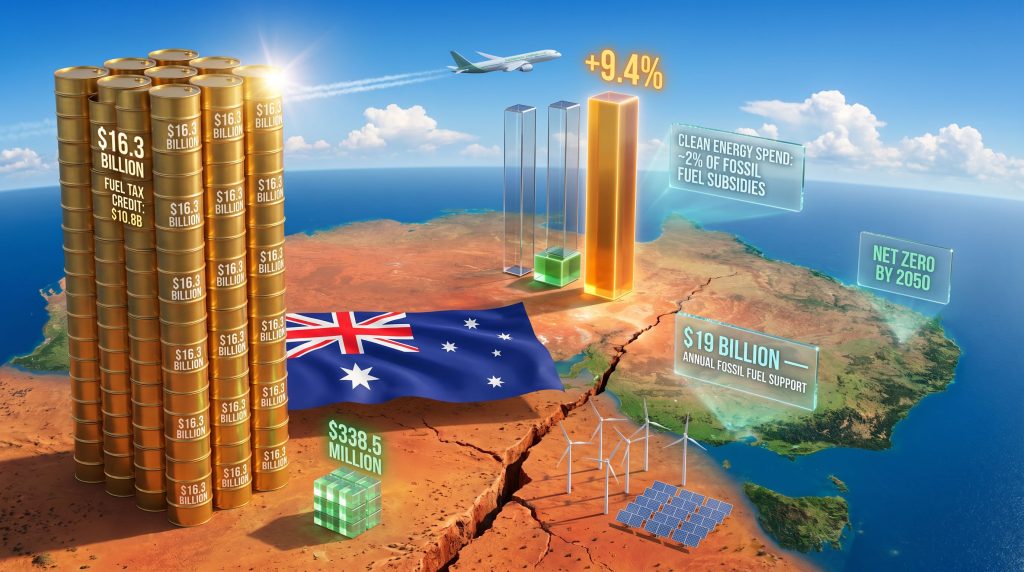
| Australia Institute | $16.3 billion | +9.4% | Fuel Tax Credit Scheme ($10.8B) |
| Climate Council | $19 billion | Maintained | Fuel credits + foregone gas tax revenue |
| Australian Conservation Foundation | $11B+ ($40B+ since 2019-20) | Ongoing growth | Tax breaks, fuel credits, gas projects |
| Productivity Commission | $14.5 billion (2023-24) | Baseline reference | Broad fossil fuel support mechanisms |
Structural Observation: Every independent methodology arrives at a figure in the tens of billions. The variation between estimates reflects definitional differences, not disagreement about the order of magnitude. At the lower bound, Australia spends more than twice as much supporting fossil fuels as it does on comparable social programmes growing at comparable rates.
The Fuel Tax Credit Scheme is the dominant mechanism driving these figures. It functions as a fuel excise refund on diesel used in off-road settings, with the mining and resources sector representing the primary beneficiary. Key characteristics include:
- The scheme cost Australian taxpayers an estimated $10.8 billion in 2025-26 alone
- This represents 60–70% of total annual fossil fuel subsidy value depending on the measurement framework used
- Diesel consumption in Australia has continued to rise year-on-year, meaning the scheme's cost trajectory runs counter to any structural decarbonisation effort
- Despite G20 nations pledging to phase out inefficient fossil fuel subsidies as far back as 2016, Australia's scheme has expanded, not contracted
For broader context, the OECD reported that its member nations collectively spent over $500 billion on fossil fuel subsidies in 2023. The International Monetary Fund's broader accounting, which incorporates implicit subsidies such as unpriced carbon emissions and environmental damage, placed global fossil fuel support at approximately $7 trillion in 2022. Within that global landscape, Australia's subsidy regime is not an outlier in design, but it is notable for its continued growth at a time when transition pressures are intensifying.
What the 2026 Budget Actually Funds: A Line-Item Comparison
The 2026-27 Federal Budget contains several energy and transition-related allocations. Placed in a table alongside the fossil fuel support baseline, the proportional scale becomes immediately apparent.
| Budget Item | Allocation (AUD) | Primary Purpose |
|---|---|---|
| Consumer energy transition initiatives | $143 million | Household and business electrification |
| EV charging infrastructure (regional) | $40 million | Expanding regional EV network access |
| Australia Post fleet electrification | $40.5 million | Fleet transition completed by 2026-27 |
| AI-driven environmental approvals | $105 million | Accelerating renewable energy approvals |
| Nature Positive agency establishment | $250 million (over 2 years) | New national environmental protection body |
| Australian Fuel Security and Resilience package | $10 billion | Diesel supply continuity for mining and processing |
The combined identifiable clean energy and transition spending across these initiatives totals approximately $338.5 million, compared to an estimated $19 billion in annual fossil fuel subsidies maintained within the same budget framework. That produces a spending ratio of roughly 1 to 56 in favour of fossil fuel support.
Analytical Note: This comparison involves some definitional complexity. The Nature Positive agency is primarily an environmental governance body rather than a clean energy investment. The AI-driven approvals programme is a regulatory process tool. Depending on classification methodology, the pure clean energy figure may be lower than $338.5 million. Either way, the structural imbalance is not materially affected by these distinctions.
The Nature Positive Contradiction
Central to the Albanese government's environmental agenda is the Nature Positive policy, anchored by a new national environmental protection agency scheduled to launch on 1 July 2026, staffed by approximately 700 employees and funded by a $250 million two-year commitment.
The establishment of this agency is a genuine institutional development. However, it sits in direct tension with a simultaneously issued directive requiring the Department of Climate Change, Energy, the Environment and Water to deliver $2.2 billion in savings over 14 years. This creates a structural contradiction: building new environmental governance capacity at the institutional level while systematically reducing the departmental resourcing that underpins environmental oversight across the broader portfolio.
Annika Reynolds, National Climate Policy Advisor at the Australian Conservation Foundation, characterised the broader budget approach as one that redirects public money toward coal, oil, and gas interests while environmental funding faces long-term contraction, describing it as a budget of thinly veiled fossil fuel subsidies.
Geopolitical Pressure and the Fuel Security Rationale
It would be intellectually incomplete to analyse the 2026 budget without acknowledging the genuine near-term pressures shaping its energy policy settings. Geopolitical instability across the Middle East has introduced significant volatility into global energy markets, directly affecting Australia's fuel import costs and contributing to inflationary pressure that the Treasury projects will reach 5% in the near term.
Against this backdrop, the Australian Fuel Security and Resilience package emerges not purely as fossil fuel advocacy, but as a response to a specific and documented supply risk. Furthermore, Australia's resource and energy exports remain deeply intertwined with these fiscal settings, making reform politically complex. The package is designed to address the supply risk through:
- Safeguarding diesel supply continuity for mining and processing operations, which underpin export revenue
- Temporary reductions in fuel excise to provide short-term household and business cost relief
- Positioning fuel security as a national resilience priority linked to defence, healthcare, and infrastructure capacity
Amy Lomas, Chief Economist at PwC Australia, described the government's approach as an attempt to address structural economic reform imperatives while simultaneously managing the near-term energy shocks arising from Middle East conflict dynamics.
The Minerals Council of Australia, through CEO Tania Constable, framed the mining sector's fiscal stability as directly connected to public service funding, arguing that a stronger mining sector generates greater capacity to fund Medicare, education, defence, and infrastructure. The government's decision to leave mining tax settings unchanged in the 2026-27 budget was characterised as standing behind Australia's largest taxpaying industry during a period of global uncertainty.
Is Fuel Security Incompatible With Transition Acceleration?
The core policy debate embedded in the 2026 budget is whether fuel security and transition acceleration are genuinely in tension, or whether that framing serves to delay structural reform. Several observations complicate the binary:
- Energy sovereignty is achievable through domestic renewables, not only through secured fossil fuel supply chains. A nation that generates electricity domestically from sun, wind, and storage is structurally less exposed to Middle East supply disruptions than one reliant on imported diesel.
- The fuel security package addresses a real short-term vulnerability but does so in a way that reinforces, rather than reduces, the structural dependency that created the vulnerability.
- The 1:56 spending ratio between clean energy transition and fossil fuel support suggests that even accepting the legitimacy of short-term fuel security concerns, the investment balance is not calibrated for a trajectory toward the government's own net zero commitments.
Sustainable Aviation Fuel: A Genuine Transition Signal?
Among the more substantive low-carbon commitments in the 2026 budget is the positioning of sustainable aviation fuel as a strategic priority. The policy package includes a low-carbon liquid fuel demand mechanism designed to stimulate domestic SAF production, alongside the Cleaner Fuels Programme aimed at reducing Australia's exposure to imported liquid fuel markets.
Scott Charlton, CEO of Sydney Airport, described the SAF policy package as an ambitious set of measures representing a once-in-a-generation opportunity to build Australian sovereign capability in fuel production and reduce reliance on imported liquid fuels.
The strategic logic behind SAF investment extends well beyond aviation decarbonisation. In addition, the broader potential of renewable energy solutions in the energy mix continues to reinforce why diversifying away from liquid fossil fuels is strategically sound. Domestic SAF development would:
- Establish refining and biofuel production capacity that reduces import dependency across multiple fuel categories
- Create cross-sector economic linkages with agricultural feedstock producers, waste processing industries, and advanced manufacturing
- Address Australia's strategic vulnerability in liquid fuel supply, which the fuel security package acknowledges but does not structurally resolve
- Generate export potential in a global SAF market that the International Air Transport Association projects will require massive scaling over the coming decade
Critics, however, note that SAF investment remains modest in absolute terms relative to the ongoing scale of fossil fuel subsidies maintained in the same budget cycle. The strategic framing is credible; the resource allocation is not yet proportionate to that framing.
Regulatory Bottlenecks and the AI Approvals Initiative
One of the less-discussed constraints on Australia's renewable energy buildout is not funding, but process. Australia currently faces significant delays in approving renewable energy infrastructure, with thousands of kilometres of transmission lines and approximately 26,000 homes affected by slow environmental approval timelines.
The budget's $105 million allocation for AI-driven approvals tools is intended to address this bottleneck by accelerating the processing of environmental assessments for renewable energy projects and housing developments. The Minerals Council of Australia has expressed support for more efficient approvals processes as critical to both energy supply security and broader economic stability.
The effectiveness of this investment, however, depends on a factor the budget appears to undermine simultaneously: departmental resourcing. Deploying AI tools within an environment where the responsible department is being directed to deliver $2.2 billion in savings over 14 years raises legitimate questions about whether the analytical and oversight capacity exists to utilise those tools effectively.
Structural Risk: Digital approvals acceleration and departmental budget contraction are not complementary policy levers. AI tools require qualified staff to manage, interpret, and apply their outputs within a legal and regulatory framework. Resourcing reductions in the relevant department may neutralise the intended efficiency gains of the technology investment.
The next major ASX story will hit our subscribers first
The Long-Term Cost of Fiscal Inertia
The opportunity cost framing of Australia's fossil fuel subsidy regime is significant, and deserves direct examination. Consequently, understanding where the mining decarbonisation benefits might eventually flow becomes all the more pressing in this context.
- The $16.3 billion annual Australia Institute estimate is equivalent to approximately 10% of Australia's annual defence budget, contextualising the scale of the commitment to incumbent energy industries
- At the current +9.4% year-on-year growth rate of fossil fuel subsidies, the cumulative cost over a decade would exceed $200 billion without structural reform
- Australia has committed to a 43% reduction in emissions by 2030 and net zero by 2050. The continued growth of fossil fuel subsidies, rising diesel consumption, and regulatory delays affecting renewables collectively create compounding structural obstacles to meeting those targets
- YouGov polling data cited by transition advocacy groups indicates that a majority of Australians favour expanding renewable energy and electric vehicle adoption as the primary mechanism for improving energy security, a stated public preference that sits in tension with the fiscal architecture of the 2026 budget
Frequently Asked Questions
How much does Australia spend on fossil fuel subsidies annually?
Estimates from credible independent bodies range from $14.5 billion to $19 billion per year, depending on methodology. The most widely cited figure for 2025-26 is $16.3 billion from the Australia Institute, with the Fuel Tax Credit Scheme representing the largest single component at approximately $10.8 billion. The Climate Council's broader accounting, which includes foregone gas tax revenue, produces an estimate of $19 billion annually.
What is the Fuel Tax Credit Scheme?
The Fuel Tax Credit Scheme refunds fuel excise paid on diesel used in off-road applications, with the mining sector as the primary beneficiary. It is the dominant mechanism through which fossil fuel subsidies flow in Australia and has grown consistently year-on-year despite government emissions commitments.
How does clean energy spending compare to fossil fuel subsidies in the 2026 budget?
Identifiable clean energy and transition spending totals approximately $338.5 million, compared to an estimated $19 billion in annual fossil fuel subsidies, producing a ratio of approximately 1:56.
Is Australia on track to meet its net zero targets?
Australia has committed to a 43% emissions reduction by 2030 and net zero by 2050. The continued expansion of fossil fuel subsidies, rising diesel consumption, Western Australia's climate targets coming under pressure, and the structural imbalance in transition versus fossil fuel spending raise substantive questions about the pace of change required to meet these targets. Furthermore, growing critical minerals demand for clean energy technologies adds urgency to resolving this structural contradiction.
Three Structural Shifts Needed for Policy Coherence
The 2026 budget reflects genuine short-term pressure management: fuel inflation driven by geopolitical disruption, regional employment tied to mining operations, and the fiscal dependency of public services on resources sector tax contributions. These are real constraints. However, they do not fully explain a spending ratio of 1:56 between transition investment and fossil fuel support.
For the Australia energy transition and fossil fuel subsidies debate to resolve toward genuine policy coherence, three structural shifts appear necessary:
- Subsidy reallocation at meaningful scale. Redirecting even a fraction of the $16–19 billion annual fossil fuel subsidy base toward grid infrastructure, storage, and clean energy manufacturing would represent the highest-impact fiscal lever available. Marginal transition allocations in the hundreds of millions cannot compete structurally with subsidies in the tens of billions.
- Regulatory capacity investment that is not simultaneously undermined. Accelerating renewable energy approvals through AI tools requires a well-resourced department to operationalise those tools. A $105 million technology investment combined with a $2.2 billion departmental savings directive is not a coherent policy package.
- Reframing energy sovereignty around domestic generation. The strategic case for fuel security is legitimate. But energy sovereignty built on secured diesel imports addresses symptoms rather than the underlying structural vulnerability. A domestic renewable energy base, by definition, eliminates exposure to Middle East supply disruptions, not simply reduces it.
The 2026 Federal Budget is not a transition budget with some fossil fuel legacy. It is, structurally, a fossil fuel budget with transition features attached. The distinction matters, because fiscal architecture shapes investment trajectories over decades, not just budget cycles.
This article is informational in nature and does not constitute financial or investment advice. Subsidy estimates cited reflect independent research methodologies and may vary from official government figures. Readers are encouraged to consult primary sources including Australian Government Budget Papers 2026-27 and independent research from the Australia Institute and Climate Council for detailed quantitative analysis.
Want to Stay Ahead of the ASX's Most Significant Mineral Discoveries?
As Australia's fiscal architecture continues to shape the trajectory of its energy and resources sector, Discovery Alert's proprietary Discovery IQ model delivers real-time alerts on significant ASX mineral discoveries — instantly converting complex data across 30+ commodities into clear, actionable insights for investors at every level. Explore historic discoveries and their extraordinary returns, then begin your 14-day free trial to position yourself ahead of the broader market.