
May 13, 2026
When Military Technology Becomes the Market Variable Nobody Is Pricing
The most dangerous blind spots in financial markets rarely come from information that is hidden. They come from information that is visible but inconvenient, reframed as noise until the cost of ignoring it becomes impossible to absorb. In mid-2026, a specific version of this dynamic is playing out across equities, commodities, and bond markets in ways that experienced macro strategists are finding deeply unsettling — and David Woo on US China proxy war in the Middle East has become one of the most structurally grounded analytical frameworks for making sense of it.
The conventional analytical lens applied to the current Middle East conflict treats it as a bilateral military engagement with a negotiated resolution somewhere on the horizon. That framing, however, is increasingly difficult to defend when you examine who is supplying what to whom, and what each party's strategic interests actually require.
David Woo, founder of David Woo Unbound and former head of global rates, foreign exchange, and emerging markets strategy at Bank of America, has been advancing a specific and structurally grounded thesis. The conflict unfolding in the Middle East is not primarily a regional war. It is the first 21st-century proxy confrontation between US and Chinese military ecosystems, with a third-party nation serving as the operational theatre.
That distinction carries enormous implications for how investors should think about resolution timelines, energy prices, inflation, and the reliability of official communications from Washington. Furthermore, the broader US-China trade war impact on global markets provides critical context for understanding why this conflict extends well beyond the Middle East.
When big ASX news breaks, our subscribers know first
The Proxy War Framework and Why It Changes the Calculus
What Makes This Different From a Bilateral Conflict
Cold War-era proxy wars shared a defining characteristic: they persisted far beyond what either primary actor would have tolerated in a direct engagement. Vietnam, Angola, and Afghanistan all demonstrated that when superpower interests are embedded in a third-party conflict, the resolution logic fundamentally changes. Diplomatic exits that would be available to two sovereign parties become structurally blocked by the asymmetric stakes of each superpower.
The current Middle East conflict fits this pattern with concerning precision. Iran has now been engaged in an active military confrontation with combined US and Israeli forces for more than eight weeks. The fact that it remains a viable fighting force through that period is not explained by indigenous military capability alone.
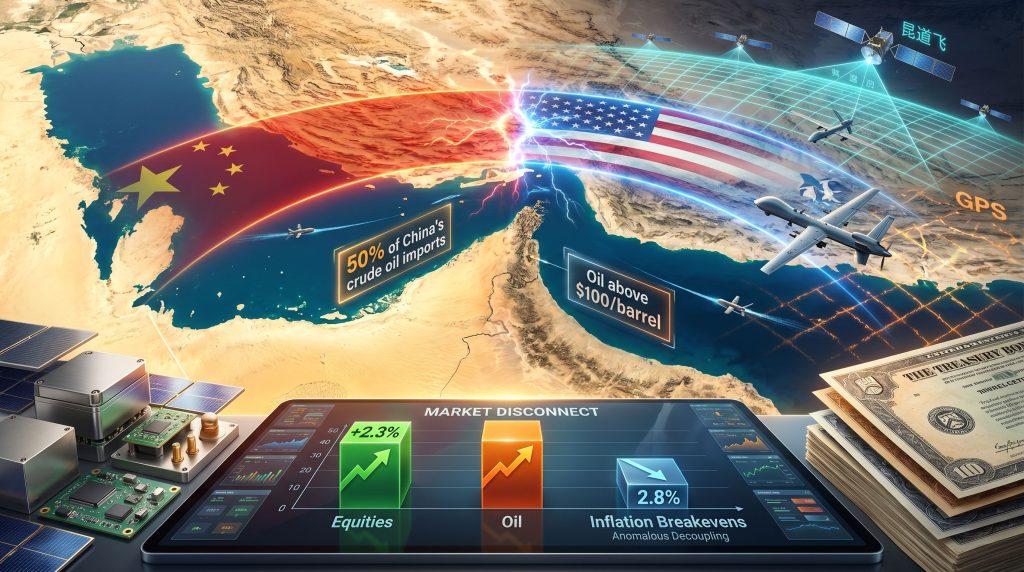
Woo's analysis points to a specific operational mechanism: shortly before the conflict escalated, Iran migrated its missile and drone guidance systems away from US GPS infrastructure and onto China's BeiDou satellite navigation system. This is not a minor technical footnote. BeiDou's civilian signal operates independently of US-controlled infrastructure, and its military-grade signal offers meaningfully different electronic warfare characteristics than GPS.
The transition materially reduced the effectiveness of US and Israeli jamming operations against Iranian drone and missile platforms, producing a qualitative improvement in strike accuracy that independent satellite imagery has corroborated. In October 2024, a report from the US-China Economic and Security Review Commission explicitly flagged BeiDou's growing military significance and its potential deployment in adversary systems as a strategic concern for US electronic warfare doctrine.
The Satellite Imagery Credibility Gap
A notable evidentiary development emerged when a major US media outlet reviewed video footage released by Iranian sources claiming successful strikes on US bases across the region, then cross-referenced that footage against imagery provided by European commercial satellite operators. The conclusion was that the Iranian visual claims were consistent with the satellite evidence, creating a direct contradiction with Pentagon denials.
The significance here extends beyond any single incident. European satellite operators function outside US information management frameworks. Their imagery constitutes independent verification that cannot be easily dismissed. For markets that have been pricing the conflict on the assumption that US official communications reflect operational reality, this intelligence asymmetry creates a risk pricing problem that has not yet been resolved.
"When public statements from a major military power are systematically contradicted by independent satellite evidence, the reliability of all official communications about conflict progress becomes structurally compromised. Markets that price on official narratives are therefore exposed to a systematic mispricing risk."
The BeiDou Factor: Chinese Technology as a Force Multiplier
Understanding the Navigation System Transition
China's BeiDou Navigation Satellite System reached full global operational coverage in 2020, providing a complete alternative to US GPS that Beijing controls entirely. Unlike GPS, BeiDou was engineered from inception with military signal separation that limits foreign interference, and its most recent generation provides positioning accuracy comparable to, and in some scenarios exceeding, GPS civilian signals.
For a military actor previously dependent on GPS, the transition to BeiDou represents a removal of a critical vulnerability. US and allied jamming systems designed to degrade GPS-dependent guidance have limited effectiveness against BeiDou-integrated platforms. The operational consequences of this shift are substantial.
| Capability Domain | Pre-Conflict Status | Current Status | Strategic Implication |
|---|---|---|---|
| Navigation Systems | US GPS-dependent | Chinese BeiDou-integrated | Jamming vulnerability substantially reduced |
| Drone Accuracy | Low-to-moderate precision | High precision strikes | Expanded and credible strike envelope |
| Missile Guidance | Limited effectiveness | Enhanced targeting | Credible threat extended to naval assets |
| Electronic Warfare | Nascent capability | Actively advancing | Network exposure risks increased |
Why Neither Side Can Back Down
The proxy war framework explains the structural impasse in a way that the bilateral conflict framework cannot. China's strategic interest in the conflict is not ideological. It is mathematical. Approximately 50% of China's crude oil imports transit through the Strait of Hormuz. US control or effective denial of that chokepoint represents one of the few remaining leverage mechanisms Washington can deploy against Chinese economic expansion without triggering a direct military confrontation.
Conversely, if the United States is perceived to have been militarily outmanoeuvred and withdraws, China is positioned to step into the vacuum as the dominant security guarantor for Gulf states. Saudi Arabia and the UAE would then face a binary strategic choice: align with Chinese security architecture, or operate without reliable external guarantees. That transition would carry profound implications for petrodollar recycling flows, US Treasury demand, and the architecture of dollar-denominated global finance. The Trump critical mineral strategy further complicates these dynamics, as control over critical supply chains intersects directly with Gulf state alignment decisions.
"The Strait of Hormuz is not merely an energy transit corridor. It functions as the physical expression of US forward power projection across the Indo-Pacific energy supply chain. A strategic defeat there would not be recoverable through tactical adjustments."
The Summit Without Deliverables: Reading Diplomatic Optics Correctly
What Each Side Actually Needs
Woo's analysis of the Trump China summit framework identifies a structural negotiating gap that photo opportunities cannot bridge. The US position requires Chinese pressure on Iran to accept an off-ramp and stand down. The Chinese position requires something specific in return, and the specific items on Beijing's list are precisely the items Washington cannot concede.
China's most pressing requests fall into three categories:
- Restoration of access to advanced AI semiconductors and cutting-edge chip manufacturing equipment, currently restricted under US export control regulations
- Substantial reduction of tariffs on Chinese electric vehicles (currently approximately 100%), solar panels, and lithium battery exports
- Recognition of Chinese technological equivalence in strategic industrial sectors
None of these are deliverable within the current US political environment. AI chip export controls represent one of the few remaining areas where the US maintains a meaningful asymmetric advantage over China. The CHIPS and Science Act of 2022 and subsequent Commerce Department export regulations have established a bipartisan consensus around restricting China's access to leading-edge semiconductor technology that no single administration can unilaterally reverse.
The 2017 Precedent and the Trust Deficit
There is a specific historical sequence that shapes Beijing's current posture toward US diplomatic overtures. In October 2017, Trump's first presidential visit to China was accompanied by an extraordinary ceremonial reception, including access to the Forbidden City for a state dinner that had not previously been extended to any visiting foreign head of state.
Within two months of that visit, Washington launched its first major trade war offensive against China. The institutional memory of that sequence within Chinese strategic circles means that public expressions of warmth and cordiality are now assessed as potential precursors to economic aggression rather than signals of genuine partnership.
For markets interpreting summit optics as evidence of conflict resolution, this historical pattern constitutes a significant analytical warning. The most likely summit outcome is a staged display of cordiality masking an unresolved ultimatum. Market rallies driven by summit optimism in this context represent potential structural selling opportunities rather than confirmation of de-escalation.
What Markets Are Getting Wrong in 2026
The Pricing Anomaly That Should Not Exist
Conventional macroeconomic relationships produce a specific expectation: when oil prices rise significantly above baseline levels due to geopolitical disruption, inflation expectations should follow, with bond yields and oil prices moving in the same direction. This relationship, however, has broken down in a way that is historically anomalous.
Oil prices remain elevated above $100 per barrel, yet 2-year US inflation breakeven rates have compressed toward yearly lows near 2.8%. Bond yields and oil prices have decoupled. The market is, in effect, treating the oil price elevation as temporary and non-inflationary, pricing in either rapid conflict resolution or a central bank capacity to absorb the shock.
Both assumptions are empirically questionable, and the convergence of institutional macro traders abandoning war-related positioning after sustained losses has created a self-reinforcing dynamic where the conflict is being treated as analytically irrelevant. For a deeper understanding of these forces, the oil geopolitics analysis for 2025 provides essential background on how supply and demand dynamics interact with geopolitical risk.
"Oil is trading on geopolitics. But inflation expectations have disconnected from oil entirely. That divergence is not a sign of market sophistication. It is a sign that a major risk has been systematically priced out of financial assets."
The Strategic Petroleum Reserve Problem
An issue receiving insufficient analytical attention is the state of global strategic oil reserves. The buffer established at the conflict's onset has been drawn down substantially. Current trajectory modelling suggests this buffer could be exhausted within a matter of weeks, and critically, this dynamic is not contingent on resumed active fighting.
The arithmetic of supply creates upward oil price pressure regardless of ceasefire status. Even under a scenario where hostilities fully pause, the reserve depletion trajectory means oil market conditions will tighten as inventory buffers disappear. The scale of the supply challenge was underscored by reports that the Trump administration was reportedly discussing the possibility of drilling for oil under US military bases — a measure that would take years to produce meaningful supply even if pursued aggressively.
| Market Signal | Official Narrative | Structural Reality |
|---|---|---|
| Oil price | Temporary spike, resolution imminent | Supply buffer near exhaustion regardless of ceasefire |
| Inflation expectations | Contained and declining toward year lows | Lagging indicator of energy passthrough into core prices |
| Equity markets | AI productivity boom driving organic growth | Geopolitical risk systematically excluded from valuations |
| Diplomatic progress | Deal achievable after summit | Structural negotiating gap remains fundamentally unbridged |
The Trump Political Economy Paradox
There is a structural contradiction embedded in the current US political and market dynamic that Woo identifies with particular precision. Sustaining the military operation requires maintaining domestic political capital, which in turn requires equity markets to remain elevated. A 20% stock market decline would effectively destroy the political capacity to continue the operation.
Simultaneously, the only reliably market-supportive signal available to the administration is suggesting the conflict is approaching resolution. This creates a systematic information asymmetry where presidential communications are optimised for market management rather than strategic transparency. Markets that take these communications at face value are therefore exposed to a structural mispricing risk that compounds over time.
The AI Dimension: When Capability Becomes a Regulatory Problem
Why the Most Powerful Model May Be Bearish for Tech
The release of Anthropic's Claude system, referred to in analytical circles as a genuinely frontier model architecture rather than an incremental improvement, has generated substantial bullish momentum in AI-exposed equities. The market interpretation has been straightforwardly positive: more capable AI means more productivity, more revenue, higher valuations.
Woo, however, advances a structurally contrarian reading. The more capable the model, the more dangerous its potential misuse becomes, and the more likely regulatory intervention becomes. Claude's particular strength in identifying network vulnerabilities represents an exponential upgrade to offensive cyber capabilities. A model that can systematically identify exploitable weaknesses across financial systems, energy infrastructure, and transport networks is not simply a productivity tool — it is a dual-use national security concern of the first order.
This concern is not abstract. The US Treasury Secretary and Federal Reserve Chairman jointly communicated to major bank CEOs in mid-2026 that frontier AI systems capable of vulnerability identification would substantially amplify the danger posed by cyber attackers, potentially to a transformative degree. You can explore David Woo's detailed breakdown of these themes on YouTube, where he expands on the intersection of AI risk, geopolitics, and market mispricing.
The Regulatory Overhang
The White House declined Anthropic's reported request to expand Claude's user base from 50 to 120 authorised users, citing national security concerns. The administration is reportedly considering requiring government clearance as a precondition for any future advanced AI model release.
JD Vance has reportedly taken a leading role in assessing the national security implications of frontier model deployment, reflecting a senior-level political commitment to restricting access that goes beyond routine regulatory caution. The commercial implications of this trajectory are significant.
If the most capable AI systems are restricted to a small number of government-authorised users, the revenue generation model that justifies current AI sector valuations becomes structurally incoherent. Frontier models that cannot be commercially deployed at scale cannot generate the returns priced into AI-exposed equities.
"Markets have priced AI as a productivity revolution with unconstrained commercial upside. The emerging regulatory framework suggests the most capable systems may be treated as dual-use national security assets with access restrictions that directly undermine monetisation assumptions."
The next major ASX story will hit our subscribers first
Gold's Unusual Behaviour and the Real Yield Mechanism
Why the Classic Safe-Haven Trade Has Stalled
In a conventional geopolitical risk environment, gold and oil prices should move directionally together. The current environment, nonetheless, shows the opposite. As oil prices have risen on supply disruption fears, gold has underperformed. Understanding gold safe-haven dynamics in this context reveals why the classic relationship between geopolitical risk and gold pricing has structurally broken down in 2026.
The primary driver is real yield dynamics. Real yield is calculated as nominal bond yield minus inflation expectations. When real yields on 10-year Treasury Inflation-Protected Securities (TIPS) rise toward 2%, the opportunity cost of holding non-yielding gold increases substantially.
The mechanism operates as follows:
- Elevated oil prices raise headline inflation expectations initially
- Strong equity markets signal economic resilience, pushing nominal bond yields higher
- Nominal yield increases outpace inflation expectation increases, pushing real yields up
- Rising real yields increase the opportunity cost of holding gold
- Gold underperforms despite the geopolitical environment that would historically support it
Woo also identifies a secondary factor: Middle Eastern sovereign wealth funds and oil-producing nations that have been unable to export freely during the conflict may be liquidating gold positions to manage revenue shortfalls, adding marginal selling pressure at a time when the structural safe-haven bid is already weakened.
What Would Reignite a Gold Bull Market
Three structural scenarios could reverse gold's underperformance:
- AI bubble deflation: A sharp equity market correction would trigger aggressive Federal Reserve rate cuts, dollar weakness, and a flight to non-correlated assets. If the AI regulatory and commercial model concerns outlined above materialise, this scenario becomes less speculative.
- Stagflationary policy dilemma: Sustained high oil prices eventually feed through to core inflation, forcing the Fed into a scenario where rate cuts become necessary despite elevated prices. This removes the real yield support for bonds and restores gold's relative attractiveness.
- Accelerated de-dollarisation: If geopolitical realignment accelerates reserve diversification away from US Treasuries, central bank gold demand could resume at scale. Woo notes that this dynamic, which drove visible gold accumulation through 2024 and 2025, has moderated in 2026 and is not currently reflected in price action.
Scenario Analysis: Three Paths and Their Market Implications
Scenario 1: Diplomatic Breakthrough (Low Probability)
For a genuine breakthrough to occur, China would need to accept meaningful concessions in exchange for pressuring Iran toward a ceasefire. The structural negotiating gap outlined above makes this scenario low probability. The conditions would require the US to offer something substantive on AI chips, trade tariffs, or technology access — none of which the current domestic political environment permits.
Market impact if this scenario materialises: sharp equity rally, oil price compression toward the $70–80 range, gold selloff, dollar strengthening, and AI sector relief rally on reduced geopolitical risk premium.
Scenario 2: Prolonged Stalemate (Base Case)
Neither side achieves decisive advantage. The conflict continues at moderate intensity while diplomatic communications maintain the appearance of progress. Oil prices remain elevated, strategic reserve depletion continues, and inflation passthrough into core prices gradually accelerates.
Market impact: sustained oil price elevation, gradual inflationary passthrough, increasing equity volatility as the gap between priced reality and structural reality narrows, and bond market repricing as real inflation expectations catch up to oil price levels. For further context on how this macro environment is developing, David Woo's podcast on Iran and the gold safe-haven debate provides a detailed exploration of these structural pressures.
Scenario 3: Escalation Event (Tail Risk With Rising Probability)
A significant military incident — such as destruction of a naval asset, attempted closure of the Strait of Hormuz, or direct US-Iran engagement at scale — forces a binary response. Markets have systematically discounted this probability for more than eight weeks, meaning the position adjustment required if escalation materialises would be abrupt.
Market impact: oil price spike potentially toward $130–150 per barrel, global equity selloff, safe-haven flows into yen and Swiss franc (not necessarily gold, given the real yield dynamic), and significant outperformance in defence sector equities. The underpricing of this tail scenario may represent the most structurally significant market mispricing currently in play.
Frequently Asked Questions
Is the Middle East conflict officially classified as a US-China proxy war?
Neither Washington nor Beijing has publicly characterised the conflict using this terminology. The proxy war framing is an analytical construct derived from observable patterns: Chinese satellite navigation technology enabling Iranian military operations, US forces directly engaged with Iranian assets, and both superpowers' core strategic interests structurally opposed within the same operational theatre. The absence of official acknowledgment is itself analytically significant, as neither party benefits from escalating the rhetorical framing.
How does China benefit from supporting Iran without direct military involvement?
China's strategic calculus involves several simultaneous objectives: testing military technology against US systems in real combat conditions, preventing US strategic dominance over the Strait of Hormuz through which approximately half of Chinese oil imports transit, accumulating real-world performance data on BeiDou-integrated weapons systems, and positioning itself as a credible alternative security guarantor for Gulf states should US military credibility be damaged.
Why haven't elevated oil prices translated into higher inflation expectations?
Markets appear to be treating the oil price elevation as temporary and conflict-specific rather than structural. The 2-year US inflation breakeven near 2.8% despite oil above $100 suggests investors are pricing either a rapid conflict resolution or that central banks can absorb the inflationary impact without meaningful economic disruption. Both assumptions carry significant downside risk if the conflict persists beyond consensus timeline expectations.
What is the BeiDou satellite system and why does it matter militarily?
BeiDou is China's sovereign satellite navigation system, achieving full global operational coverage in 2020. It functions as a complete alternative to US GPS that Beijing controls entirely. Its military-grade signal provides jamming resistance characteristics specifically engineered to function in contested electromagnetic environments where adversaries are actively attempting disruption. Iran's migration to BeiDou for missile and drone guidance removed a critical vulnerability that US and Israeli electronic warfare capabilities had previously been designed to exploit.
What would need to happen for gold to resume its safe-haven role?
Gold's underperformance is primarily a function of elevated real yields making inflation-protected bonds genuinely attractive on a post-inflation return basis. Reversal requires either a significant equity market correction triggering aggressive Fed rate cuts, a stagflationary scenario where the Fed cuts despite elevated inflation, or a material acceleration of central bank reserve de-dollarisation at a scale that creates sustained demand-side pressure on gold prices.
Key Takeaways for Sophisticated Investors
- The proxy war framework fundamentally changes resolution timeline expectations. Superpower-backed confrontations do not resolve on bilateral diplomatic schedules, and markets pricing a near-term exit are exposed to systematic mispricing.
- Oil price risk is not contingent on resumed fighting. Strategic reserve depletion creates supply tightening pressure regardless of ceasefire status, with the buffer potentially exhausted within weeks.
- AI regulatory risk is structurally underpriced. Government intervention in frontier model deployment could fundamentally alter AI sector monetisation assumptions in ways that current valuations do not reflect.
- Gold requires real yield compression, not just geopolitical tension. The necessary condition for a gold breakout is a shift in the real yield environment, not merely an escalation of conflict intensity.
- Diplomatic optics should not be confused with structural resolution. Summit-driven market rallies in this environment may represent selling opportunities rather than confirmation of genuine de-escalation, particularly given the historical precedent of 2017 and the current structural negotiating gap.
- Presidential market communications are optimised for political management, not strategic transparency. The structural incentive to talk markets higher while sustaining military operations creates a systematic information asymmetry that careful investors should discount appropriately.
This article presents analytical frameworks and market commentary for informational purposes only. It does not constitute financial advice. All market projections, geopolitical assessments, and scenario analyses involve significant uncertainty. Investors should conduct independent research and consult qualified financial professionals before making any investment decisions. Forward-looking statements involve assumptions that may not materialise.
Want to Stay Ahead of the Next Major Market-Moving Discovery?
While macro forces like proxy conflicts, oil supply shocks, and AI regulatory risk reshape global investment landscapes, Discovery Alert's proprietary Discovery IQ model cuts through the complexity by delivering real-time alerts on significant ASX mineral discoveries — transforming raw data across 30+ commodities into immediately actionable insights for traders and long-term investors alike. Explore historic discoveries and their market returns to understand what's possible, then begin your 14-day free trial at Discovery Alert to position yourself ahead of the market.