
May 13, 2026
The Hidden Fault Lines in Africa's Most Resilient Growth Story
When commodity supercycles intersect with geopolitical realignment, the economic map of the world gets redrawn in ways that conventional forecasting models rarely anticipate. The current global environment, shaped by escalating trade disruptions, a fractured Middle Eastern supply corridor, and an accelerating race to control critical minerals supply chains, is doing exactly that. In the middle of this reshaping, sub-Saharan Africa growth outlook amid global headwinds is emerging as one of the few regions where growth momentum is not only holding but being reinforced by structural forces that were largely absent in previous cycles.
Understanding why this is happening, and more importantly how long it can last, requires moving beyond headline growth numbers and examining the fault lines running beneath the surface.
When big ASX news breaks, our subscribers know first
Sub-Saharan Africa Growth Outlook Amid Global Headwinds: What the Numbers Actually Reveal
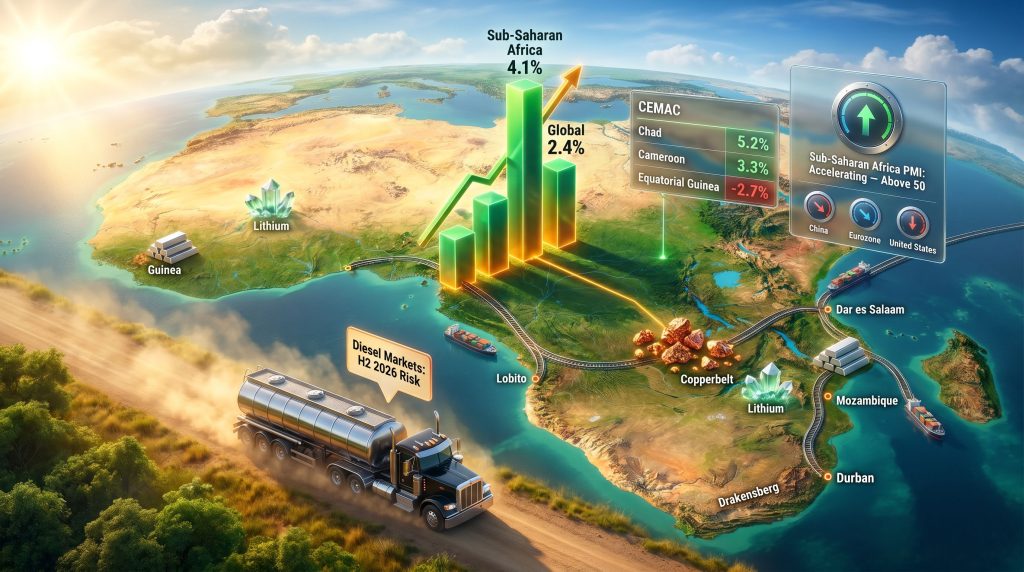
The aggregate picture is striking. While global GDP growth has been revised down to 2.4% for 2026, a reduction of 50 basis points from the previously projected 2.9%, sub-Saharan Africa is forecast to expand at 4.1% in 2026 and 3.8% in 2027, according to analysis presented by S&P Global Market Intelligence at the Definitive Risk Conference in Johannesburg on May 12, 2026.
That differential — 4.1% versus 2.4% — represents a regional growth premium of approximately 71% above the global average. In an environment where most of the world is struggling with inflationary pressure, tightening fiscal conditions, and supply chain disruption, this divergence carries real analytical weight. The World Bank's latest regional assessment similarly acknowledges that growth is holding, whilst cautioning that downside risks are mounting.
| Region | 2026 Growth Forecast | Prior Forecast | Revision |
|---|---|---|---|
| Global Average | 2.4% | 2.9% | −0.5 pp |
| Sub-Saharan Africa | 4.1% | 4.4–4.5% | −0.3–0.4 pp |
| Middle East and North Africa | ~Halved | Prior estimate | Severe downgrade |
| CEMAC Region | 3.0% | 3.3% | −0.3 pp |
However, context matters. While 4.1% sounds impressive in relative terms, development economists broadly identify 7% as the minimum sustained growth rate necessary to generate meaningful poverty reduction and productive employment absorption in lower-income economies with high population growth rates. At 4.1%, sub-Saharan Africa is growing faster than most of the world, but not fast enough to decisively close structural gaps in welfare, infrastructure, and job creation. Regional inflation projected at 4.8% in 2026 further compresses real purchasing power gains, meaning the effective economic improvement experienced by households falls well short of the headline number.
The Critical Minerals Supercycle: Rewriting Africa's Investment Architecture
The single most consequential force shaping the sub-Saharan Africa growth outlook amid global headwinds is the acceleration in critical minerals demand, specifically copper, aluminium, and lithium. This is not simply a commodity price story. It represents a fundamental restructuring of global supply chain strategy, driven by geopolitical imperatives that are unlikely to reverse regardless of short-term market fluctuations.
S&P Global Market Intelligence's analysis identifies capital accumulation as a primary growth contributor for sub-Saharan African economies, anchored by an unprecedented global race to secure critical mineral and rare earth supply chains that are not dependent on Chinese-controlled extraction networks. Both the United States and Gulf Cooperation Council nations are actively funding mining production enhancements across the continent with this strategic objective explicitly in view.
The downstream effects of this investment cycle are operating through three reinforcing mechanisms:
- Direct capital inflows into mining and extraction operations, creating immediate employment and fiscal revenue effects
- Infrastructure co-development at a scale that S&P Global describes as genuinely without historical precedent, with rail and port development across the continent outpacing anything seen in the region's modern economic history
- Supply chain diversification dynamics that are embedding sub-Saharan Africa into new trade relationships with both North American and Gulf economies, reducing dependence on any single trading partner
This third point deserves particular attention. The strategic dimension of current investment means it carries a degree of geopolitical durability that purely market-driven commodity cycles do not. Furthermore, when energy security minerals are the primary motivation for investment, price corrections alone are unlikely to trigger the capital flight that historically devastated commodity-dependent African economies during downturns.
Oil Exporters and Agricultural Buffers: The Two Supporting Pillars
Beyond the critical minerals story, two additional structural factors are sustaining regional momentum.
Petro-exporters including Angola, Nigeria, and Congo-Brazzaville occupy an advantaged position in the current environment. Elevated global oil prices are simultaneously strengthening fiscal revenues, supporting currency stability, and providing a growth buffer that partially offsets demand compression affecting non-resource-dependent nations.
Agriculture provides a less discussed but equally important cushion. Approximately 40% of sub-Saharan Africa's economic output is directly linked to agricultural activity, making the quality of growing seasons a material macroeconomic variable. A strong 2025 agricultural season has delivered tangible benefits across the region, reducing food import dependency, supporting rural household incomes, and helping offset the inflationary pressure from more expensive imported energy inputs.
The interaction between these two pillars and the critical minerals investment cycle creates a multi-layered resilience buffer that was largely absent during previous global downturns that hit the region severely.
What the PMI Data Is Really Saying About Regional Momentum
Leading indicators are corroborating the positive growth narrative, but with important caveats that investors and policymakers should not overlook.
The aggregate Purchasing Managers' Index output reading for sub-Saharan Africa remained robust through the first quarter of 2026 and accelerated further into April — a pattern that stands in sharp contrast to declining PMI trends across the world's largest economies.
| Economy/Region | PMI Trend (Q1 to April 2026) | Position vs. 50-Point Neutral |
|---|---|---|
| Sub-Saharan Africa (aggregate) | Accelerating | Above 50, expansionary |
| China | Declining | Above 50, marginally |
| Eurozone | Declining | Above 50, marginally |
| United States | Declining | Above 50, marginally |
S&P Global Market Intelligence notes that while all major global PMIs remain above the neutral 50-point expansionary threshold, the directional divergence between sub-Saharan Africa's accelerating reading and the declining momentum in China, the Eurozone, and the United States represents a meaningful signal of structural differentiation, not a temporary statistical artifact.
However, a critical nuance is buried within the sub-index data. The PMI input and output price components for sub-Saharan Africa are themselves accelerating, signalling that cost pressures are building within the productive economy even as output expands. This creates a difficult policy tension: the region cannot simply maintain accommodative conditions without risking further inflationary entrenchment, yet tightening monetary stances risks choking off the very growth momentum that makes the region's performance distinctive.
The Diesel Crisis: An Underappreciated Threat to Intra-African Trade
Whilst much analytical attention has focused on the headline impact of Strait of Hormuz disruptions, the diesel supply shock emerging from these events represents a more immediately actionable threat to sub-Saharan Africa's internal economic connectivity.
A global drop in diesel exports first appeared in data from March 2026 and worsened through April. Critically, this is not a localised or South African issue. It is a global supply rebalancing problem with disproportionate implications for sub-Saharan Africa specifically, because the vast majority of intra-African trade moves by road and rail — both of which are diesel-dependent transport modes.
S&P Global Market Intelligence has characterised this dynamic explicitly as a continent-wide concern, noting that diesel pressure is expected to intensify through the second half of 2026 as global supply chains continue their realignment process, with insufficient supply available to meet total demand across all competing markets.
| Traded Good Category | Diesel Supply Vulnerability |
|---|---|
| Mining and metals transport | High |
| Agricultural produce logistics | High |
| Fertiliser distribution | High |
| Chemical and industrial inputs | Medium-High |
| Refined fuel re-exports | Medium |
The knock-on effects extend well beyond transport costs. Refined fuels, chemicals, fertilisers, vegetable products, metals, and mining goods all move through supply chains that are vulnerable to diesel scarcity-driven price escalation. Consequently, when energy product availability is constrained, the repricing effect cascades upstream and downstream through entire supply networks.
The Strait of Hormuz: Mapping Direct and Indirect Transmission Channels
The cessation of trade through the Strait of Hormuz, through which approximately one-fifth of global oil shipments pass, has produced cascading economic effects reaching sub-Saharan Africa through multiple distinct pathways.
Direct transmission channels include:
- Disruption to GCC export flows of oil, refined fuels, liquefied natural gas, fertilisers, and industrial gases including helium
- Severe compression of MENA regional growth, which S&P Global notes has been roughly halved from prior projections
- Infrastructure damage in conflict-affected zones constraining medium-term production recovery
Indirect transmission channels include:
- Rising maritime shipping costs inflating import prices across the continent
- Reduced tourist arrivals from conflict-adjacent and disrupted travel markets
- Remittance flow pressure affecting diaspora-dependent household economies
A less intuitive but analytically critical point raised by S&P Global: the consumer-side impact of lower global commodity prices feeding through weakened exchange rates into higher domestic inflation is a more significant near-term risk to sub-Saharan African households than the direct disruption of trade through the Strait itself. The currency depreciation-to-inflation transmission channel deserves far greater attention than it typically receives in regional economic commentary.
Country-Level Vulnerability: A Risk-Stratified Framework
The sub-Saharan Africa growth outlook amid global headwinds is not a uniform story. Outcomes diverge dramatically based on each economy's resource endowment, fiscal position, energy import dependency, and structural economic composition. Indeed, African mining finance trends are increasingly bifurcating capital flows between resource-advantaged and resource-constrained nations.
Structurally advantaged economies include oil exporters with active foreign investment pipelines and critical mineral-rich nations benefiting from the current investment cycle. Angola, Nigeria, and Congo-Brazzaville represent the clearest examples.
Moderately exposed economies include diversified exporters with manageable debt levels, credible monetary frameworks, and some buffer from strong 2025 agricultural performance.
Highly vulnerable economies face a compounding set of pressures:
- Fuel-importing nations confronting direct cost-push inflation from diesel and refined fuel scarcity
- Tourism-dependent economies experiencing reduced arrivals linked to global travel disruption persisting into the second half of 2026
- Fragile and low-income states with limited fiscal capacity to deploy targeted household protection measures
CEMAC: A Microcosm of Intra-Regional Divergence
The Central African Economic and Monetary Community region illustrates how dramatically growth trajectories can diverge even within a shared currency framework.
| Country | 2026 Growth Forecast | Key Driver |
|---|---|---|
| Chad | 5.2% | Oil production recovery |
| Cameroon | 3.3% (revised from 4.1%) | Reduced external demand |
| Equatorial Guinea | -2.7% (contraction) | Structural oil decline |
| CEMAC Average | 3.0% (revised from 3.3%) | Aggregate downgrade |
Equatorial Guinea's contraction is a particularly instructive data point. It reflects not a cyclical shock but a structural depletion trajectory for its oil reserves — a warning for commodity-dependent economies that fail to diversify during periods of resource revenue strength.
The next major ASX story will hit our subscribers first
Why 2027 May Be the Harder Year
S&P Global Market Intelligence has flagged that whilst 2026 growth remains resilient, the cumulative weight of current disruptions will become more visible in 2027. Three specific risk vectors are building toward next year.
First, a potential El Niño event in 2026-2027 could severely compress agricultural output across the region. Given that agriculture accounts for approximately 40% of regional economic output, a meaningful yield reduction carries direct implications for wholesale prices, retail inflation, and rural household incomes at a scale that would materially alter the 2027 growth picture.
Second, fertiliser scarcity is operating with a lagged effect. Fertiliser remained available through mid-2026 but at significantly elevated prices due to supply disruptions, leading to anticipated reductions in application rates during the current growing season. Lower fertiliser use translates directly into reduced crop yields in 2026-2027, feeding food inflation into the following calendar year. This is a slow-moving but highly predictable risk that policymakers can act on now.
Third, the consumer inflation accumulation effect. The lag between currency depreciation events, import price adjustment, and household budget stress means that even if commodity prices stabilise from current levels, the inflationary wave already in motion will continue building pressure on consumers through 2027. The IMF's regional economic outlook reinforces this concern, noting that Africa faces mounting risks precisely as its growth gains take hold.
Policy Priorities: Four Pillars for Protecting Growth Momentum
Multilateral economic assessments have converged on a coherent set of near-term policy imperatives for regional governments. These are not abstract recommendations but operationally specific actions that address the identified transmission channels. Furthermore, the mining geopolitics shaping investment flows mean that policy credibility is now directly linked to a country's ability to attract strategic capital.
Pillar 1: Monetary credibility
- Anchor inflation expectations through transparent and consistent central bank communication
- Resist premature monetary easing that could accelerate currency depreciation and amplify imported inflation
Pillar 2: Targeted social protection
- Deploy fiscally efficient support mechanisms for households most exposed to rising food and energy costs
- Protect vulnerable population groups without expanding structurally unsustainable deficit positions
Pillar 3: Structural economic diversification
- Accelerate diversification away from single-commodity dependence
- Invest in value-added processing of critical minerals to capture greater supply chain margin domestically
Pillar 4: Fiscal buffer expansion
- Build foreign exchange reserves during periods of commodity price strength
- Reduce external debt vulnerability through proactive liability management, particularly given current tight external borrowing conditions
Frequently Asked Questions: Sub-Saharan Africa Growth Outlook 2026-2027
What is sub-Saharan Africa's GDP growth forecast for 2026?
The region is projected to grow at approximately 4.1% in 2026, marginally below earlier projections of 4.4–4.5%, but significantly outperforming the global average of 2.4%, according to S&P Global Market Intelligence analysis.
Why is sub-Saharan Africa growing faster than the global average?
Regional growth is anchored by surging critical mineral demand, elevated oil prices benefiting major exporters, strong 2025 agricultural output, and an unprecedented infrastructure investment cycle driven by strategic US and GCC supply chain objectives.
What is the single biggest risk to sub-Saharan Africa's economy through 2027?
The most consequential near-term risk is the diesel supply shortage affecting intra-African trade logistics. On the consumer side, the currency depreciation channel feeding imported inflation represents the most direct and underappreciated threat to household welfare.
How does sub-Saharan Africa's PMI compare to global readings?
The regional aggregate PMI accelerated through Q1 and into April 2026, contrasting sharply with declining PMI trends in China, the Eurozone, and the United States. All major economies remain in expansionary territory above the 50-point threshold, but the directional divergence is significant.
Will 2027 be more challenging than 2026 for the region?
Current institutional assessments suggest the cumulative impact of present disruptions will be more visible in 2027, with El Niño risk, fertiliser-driven yield compression, and sustained consumer inflation pressure all building toward greater difficulty in the following year.
Which sub-Saharan African economies are most at risk?
Fuel-importing nations, tourism-dependent economies, and fragile states face the greatest compound vulnerability. Equatorial Guinea is already contracting due to structural oil decline, whilst non-resource-dependent economies face mounting cost-push pressure from energy scarcity.
Resilience With Conditions: The Honest Assessment
Sub-Saharan Africa's 2026 growth performance reflects genuine structural factors rather than a statistical mirage. The convergence of critical mineral demand, geopolitically motivated infrastructure investment, and agricultural output buffers has created a resilience framework that was meaningfully absent during previous global downturns.
However, the diesel crisis, fertiliser scarcity lag, consumer inflation accumulation, and the potential 2027 El Niño event form a compounding risk sequence that demands active policy responses rather than passive reliance on current buffers. The sub-Saharan Africa growth outlook amid global headwinds is therefore not a story of inevitable success. It is, in conclusion, a story of conditional resilience — where the outcome over the next 24 months will be determined as much by policy choices as by external commodity dynamics.
This article draws on analysis presented by S&P Global Market Intelligence at the Definitive Risk Conference, Johannesburg, May 12, 2026, as reported by Creamer Media's Mining Weekly. Forward-looking statements and growth forecasts represent institutional projections at a specific point in time and are subject to revision as global conditions evolve. This article does not constitute financial or investment advice.
Want to Know Which ASX Miners Are Best Positioned to Capitalise on Africa's Critical Minerals Boom?
Discovery Alert's proprietary Discovery IQ model delivers real-time alerts the moment significant mineral discoveries hit the ASX, instantly translating complex geological and commodity data into actionable investment insights — precisely the kind of edge that matters when strategic capital is racing to secure critical mineral supply chains. Explore historic examples of major discovery returns to understand the scale of opportunity, then start your 14-day free trial at Discovery Alert to position yourself ahead of the market.