August 8, 2026
The Economics of Belonging: How Africa Is Rewriting Its Investment Relationship With the World
For decades, the dominant framework governing economic engagement between Western powers and African nations operated on a fundamentally asymmetric logic: capital and expertise flowed southward in the form of aid, while commodities moved northward in raw, unprocessed form. That architecture is cracking. Across the continent, a new generation of policymakers and private sector actors are demanding a different arrangement around France Africa investment sectors, one built on co-ownership, industrial participation, and genuine bilateral value creation.
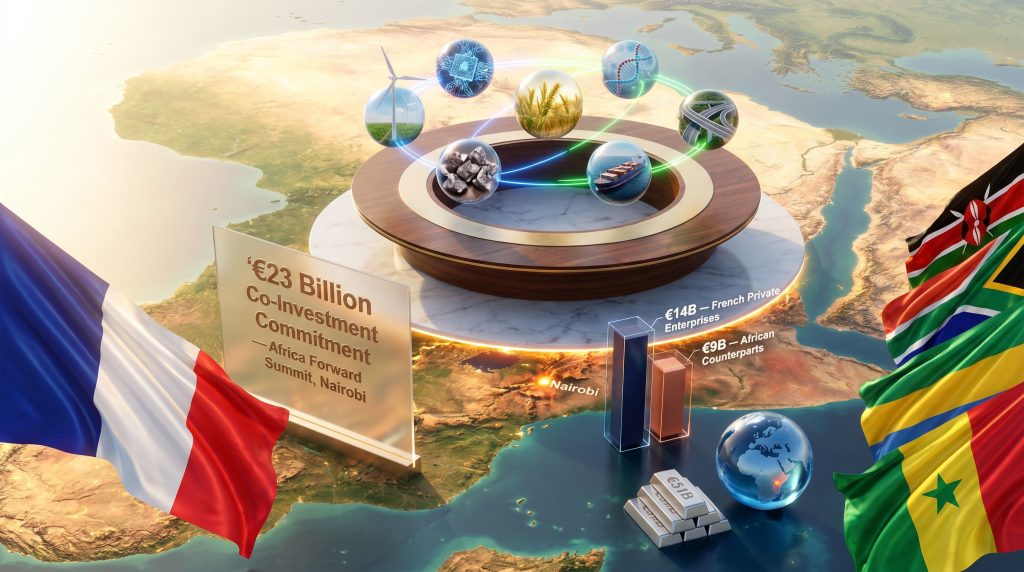
The 2026 Africa Forward Summit in Nairobi, which brought together French President Emmanuel Macron and a broad coalition of African heads of state, crystallised this shift into formal commitments. The resulting declaration, backed by an estimated €23 billion (~$27 billion) in pledged investment, signals something more consequential than a funding announcement. It represents a structural repositioning of the terms under which France and Africa choose to engage commercially.
Critically, this is not an aid package. Approximately €14 billion of the total commitment originates from French private enterprises, with African counterparts contributing a further €9 billion, producing a 61/39 split that reflects genuine bilateral commercial architecture rather than one-directional capital deployment. The distinction matters enormously for how both sides account for risk, returns, and strategic ownership.
When big ASX news breaks, our subscribers know first
France's Existing Economic Footprint: Understanding the Starting Point
Before examining where the new capital will flow, it is worth establishing the commercial baseline from which the 2026 investment surge is launching. France is not entering African markets as a newcomer.
| Metric | Estimated Figure |
|---|---|
| French subsidiaries operating in Africa | 4,400+ |
| Total French investment stock in Africa | €51 billion |
| Jobs supported by French firms continent-wide | 500,000+ |
| Bilateral trade volume (2024) | €65 billion |
| French firms operating in Kenya | 140+ |
| Jobs supported by French firms in Kenya | 36,000+ |
| France's ranking as investor in Kenya | 5th largest |
This infrastructure of existing relationships, corporate entities, and employment networks is not a footnote to the 2026 announcement. It is the scaffolding upon which new commitments will be executed. Layering fresh capital onto established operational networks reduces the execution risk that historically undermines summit declarations and accelerates the timeline from pledge to deployed capital.
Kenya's role as summit host reflects this dynamic clearly. With over 140 French firms and 36,000 jobs already embedded in the Kenyan economy, France ranks as the country's fifth largest investor. This is an economy that France already understands operationally, not one it is approaching for the first time.
From Aid Architecture to Industrial Partnership: What the Nairobi Declaration Actually Signals
The Nairobi Declaration is notable not just for its financial commitments but for the economic philosophy embedded in its language. Repeated invocations of co-investment, local value addition, strategic autonomy, and private-sector mobilisation are not ceremonial phrasing. They reflect a deliberate effort by African governments to reframe their negotiating position in global economic relationships.
The conceptual break from prior engagement models is visible across several structural dimensions:
-
Co-investment over aid: Both parties committed capital, moving away from donor-recipient logic toward shared commercial risk.
-
Value-chain integration: Investment emphasis falls on local processing, manufacturing, and beneficiation rather than the extraction of unprocessed raw materials.
-
Digital and resource sovereignty: African governments explicitly asserted ownership over natural resources and digital infrastructure as non-negotiable negotiating positions.
-
Private capital as primary mechanism: Blended finance structures, risk guarantees, and public-private partnerships are positioned as the dominant delivery model, not state-to-state transfers.
-
AfCFTA linkage: All major investment sectors are explicitly tied to the African Continental Free Trade Area framework, using continental market integration as the demand-side justification for large-scale manufacturing investment.
The declaration's strategic significance lies in its insistence that Africa participate in the value generated from its own resources, not merely in the extraction of those resources for processing elsewhere.
The 7 France Africa Investment Sectors Shaping the Next Decade
The Nairobi Declaration identified seven priority sectors as the commercial centrepieces of the France-Africa partnership. Each represents a distinct investment thesis with its own risk profile, demand drivers, and long-term return potential.
Sector 1: Renewable Energy and Green Industrialisation
Africa's electricity access deficit is one of the most significant structural economic constraints on the continent. Approximately 600 million people still lack reliable electricity, according to the International Finance Corporation, a figure that simultaneously represents a development failure and an investable opportunity of multi-decade duration.
The energy investment framework targets a diversified technology portfolio rather than a single solution:
- Solar and wind generation capacity expansion
- Hydropower and geothermal development (particularly relevant to East Africa's geological endowment)
- Green hydrogen production systems targeted at industrial applications
- Waste-to-energy conversion infrastructure for urban centres
- Nuclear energy development pathways for baseload generation
- Regional energy grid interconnection to enable cross-border electricity trade
Concrete deal activity is already underway within this framework:
| Deal | Value | Details |
|---|---|---|
| Meridian Wind Project (Kenya) | €225 million | French-backed renewable energy development |
| Transnet Mineral Logistics (South Africa) | €300 million loan | Decarbonisation of mineral supply chain logistics |
| IFC-EDF Solar Partnership | $40 million | Off-grid solar expansion targeting underserved markets |
What distinguishes the 2026 energy agenda from previous investment cycles is its manufacturing ambition. Furthermore, the declaration's most strategically significant energy commitment involves building local manufacturing value chains for clean energy components, positioning African economies as producers of the hardware required for the global energy transition minerals supply chain, not merely consumers of it.
Investment Thesis: African renewable energy is transitioning from a development finance story into a commercially viable asset class, driven by falling technology costs, growing domestic demand, AfCFTA market scale, and green industrialisation mandates that create durable policy tailwinds for long-duration infrastructure returns.
A lesser-discussed but strategically important dimension involves East Africa's geothermal resources. Kenya's Rift Valley holds some of the world's most productive geothermal geology, with the Olkaria geothermal complex already generating over 800 MW. French energy expertise in geothermal development represents a natural alignment of technical capability with continental geological endowment that remains underleveraged relative to its potential.
Sector 2: Artificial Intelligence and Digital Infrastructure
The Nairobi Summit was notable for hosting the first Heads of State-level discussions on AI governance at a France-Africa forum. This represents a significant institutional evolution: AI policy is no longer being treated as a technical matter for ministries of technology but as a sovereignty issue requiring executive engagement.
The investment framework targets several interconnected digital infrastructure priorities:
- Broadband network expansion across underserved regions
- Regional data centre construction and cloud infrastructure development
- Compute capacity for AI workloads, addressing Africa's current near-total dependency on foreign cloud infrastructure
- African-language AI model development using locally generated datasets
- Locally hosted and governed data systems that keep economic value on the continent
- Cybersecurity infrastructure to address growing state and non-state threat exposure
The digital sovereignty concern driving much of this agenda is not theoretical. Africa currently generates enormous volumes of commercially valuable data through mobile payments, agricultural monitoring, health records, and logistics systems. The infrastructure processing and monetising this data is predominantly hosted outside the continent, meaning the economic value created from African digital activity largely accrues elsewhere.
Speculative Perspective: As generative AI capabilities become increasingly embedded in economic productivity, nations that lack domestic compute infrastructure and locally trained models may face compounding disadvantages in both productivity growth and data security. Africa's window to establish sovereign digital infrastructure before foreign dependency becomes structurally locked in may be narrower than current policy timelines assume.
Private capital target areas within the digital sector include fintech infrastructure, digital health platforms, climate technology applications, and AI-enabled agricultural monitoring. These are not frontier bets but established growth markets with demonstrated demand and measurable unit economics.
Sector 3: Agriculture and Agro-Processing
Agriculture sits at the intersection of Africa's most pressing structural vulnerabilities. The continent's farming sector faces a convergence of compounding pressures that simultaneously create urgency and investable opportunity:
- Food inflation driven by import dependency, currency volatility, and disrupted global supply chains
- Climate shocks increasingly disrupting growing seasons across sub-Saharan and Sahelian regions
- Fertiliser supply instability exposed severely by post-2022 global supply chain disruptions following the Russia-Ukraine conflict
- Commodity export concentration limiting economic diversification and trapping value at the raw material stage
The declaration's agricultural agenda reframes farming as an industrialisation vehicle rather than a subsistence or food security domain. Priority investment areas reflect this orientation:
- Agro-processing facilities and cold-chain logistics networks enabling value-added exports
- Fertiliser supply chain localisation reducing import dependency
- Precision agriculture and climate-smart farming technologies
- Integrated agricultural value chains aligned with AfCFTA market access
- Youth-focused agricultural financing addressing generational transition in farming
- Agri-fintech tools expanding smallholder access to credit, insurance, and market information
- Rural industrial development clusters anchoring agro-processing capacity in production regions
The core investment thesis in agriculture centres on manufactured export diversification. Africa currently exports raw cocoa but imports chocolate, ships raw cotton but buys finished textiles, and grows coffee but purchases roasted and packaged product. Closing this processing gap represents both a commercial opportunity and a structural economic upgrade.
Sector 4: Healthcare Manufacturing and Pharmaceutical Production
The COVID-19 pandemic delivered a stark lesson about Africa's healthcare structural vulnerability: at the moment of greatest global need, the continent's near-total dependence on imported vaccines, medicines, diagnostics, and medical equipment left it systematically under-supplied and last in line.
The France-Africa declaration addresses this through a health sovereignty framework that treats local manufacturing as a strategic imperative, not merely a development aspiration. Key institutional anchors supporting this agenda include:
- Africa CDC (Africa Centres for Disease Control and Prevention): Central coordination body for regional health manufacturing partnerships
- African Medicines Agency (AMA): Regulatory harmonisation body enabling cross-border pharmaceutical market development, which is critical for creating the demand scale manufacturers require
- African Pooled Procurement Mechanism: Collective purchasing infrastructure designed to aggregate demand signals across national markets
Why the Pooled Procurement Mechanism Matters to Investors: Healthcare manufacturing investment in Africa has historically been constrained by demand fragmentation. Individual national markets are often too small to justify large capital expenditure in pharmaceutical or vaccine manufacturing. By aggregating purchasing power across the continent, the Pooled Procurement Mechanism creates the demand scale necessary to make large manufacturing investments financially viable, fundamentally changing the investment case.
Investment priorities include regional vaccine manufacturing, pharmaceutical production for essential medicines, diagnostic equipment, and technology transfer agreements with European pharmaceutical partners. France's established pharmaceutical industry creates natural partnership potential that other competing nations lack.
Sector 5: Critical Minerals and Local Beneficiation
Africa holds some of the world's most strategically significant mineral reserves at a moment when critical minerals demand for battery metals, semiconductor inputs, and clean energy materials is accelerating dramatically. This coincidence of geological endowment and technological transition has transformed African mineral policy from a domestic economic question into a major geopolitical flashpoint.
French corporate presence in African mining is already substantial:
| Company | Countries of Operation | Mineral Focus |
|---|---|---|
| Eramet | Gabon, Senegal | Manganese, mineral sands |
| Orano | Niger, Botswana | Uranium |
| Voltalia | Multiple African markets | Renewables for mining operations |
The declaration's most commercially significant commitment in this sector centres on local processing and beneficiation linked to mineral extraction. The historical pattern of African mineral wealth being exported as unprocessed ore for value addition in consuming nations is explicitly targeted for disruption. Key policy commitments include:
- Asserting resource sovereignty as a non-negotiable framework for new mineral agreements
- Expanding domestic refining and beneficiation capacity to retain processing value locally
- Building Made-in-Africa supply chains for battery and clean energy components
- Reducing structural economic dependency on pure extraction models
A critical and underappreciated dimension of the critical minerals discussion involves the geology of African deposits relative to competing global sources. African manganese deposits, particularly those in South Africa's Kalahari Basin, represent some of the world's highest-grade reserves. Similarly, the Democratic Republic of Congo holds an estimated 70% of global cobalt reserves. These are not marginal resources. They are irreplaceable inputs for the electric vehicle and battery storage industries, giving African nations a structural negotiating advantage they are increasingly willing to exercise.
The geopolitical competition for these resources is intensifying. Furthermore, the critical minerals surge in demand from China's established dominance in African mineral supply chains, built through two decades of infrastructure-for-resources agreements, is now being challenged by French, American, and European Union actors seeking supply chain diversification.
| Dimension | France (2026 Framework) | China (BRI Model) | United States (Prosper Africa) |
|---|---|---|---|
| Primary instrument | Private sector co-investment | State-directed lending | Trade facilitation and DFI |
| Mineral strategy | Beneficiation partnerships | Long-term offtake agreements | Supply chain security focus |
| Governance emphasis | AfCFTA integration, sovereignty | Infrastructure-for-resources | Democratic governance conditions |
| AI/Digital approach | Sovereignty and governance frameworks | Infrastructure deployment | Startup ecosystem support |
| Scale of commitment | €23 billion (2026 summit) | Historically $40B+ annually | Variable by administration |
Sector 6: Maritime Trade and the Blue Economy
Africa's coastline extends over 30,000 kilometres, yet the continent's maritime economic contribution remains substantially below its geographic potential. The blue economy represents one of the most underanalysed investment frontiers in the France-Africa framework, with multiple compounding value drivers that extend well beyond shipping logistics.
Investment target areas include:
- Port infrastructure modernisation and maritime logistics capacity expansion
- Coastal economic zone development and industrial clustering
- Renewable marine energy generation, including offshore wind potential
- Shipping decarbonisation technologies aligned with IMO 2030 and 2050 targets
- Sustainable fisheries management addressing chronic overexploitation
- Blue carbon ecosystem preservation and monetisation through voluntary carbon markets
The security dimension of the blue economy receives explicit attention in the declaration. As African trade routes carry increasing volumes of global commerce, maritime security cooperation targeting counter-piracy operations, illegal fishing enforcement, and human trafficking interdiction becomes a prerequisite for the commercial viability of blue economy investment.
The €700 million CMA CGM agreement for Mombasa's container terminal provides the most concrete commercial anchor within this sector, demonstrating private sector appetite for large-scale maritime infrastructure investment when the policy environment and deal structure are appropriately configured.
An underappreciated element of the blue economy opportunity involves illegal, unreported, and unregulated (IUU) fishing. African nations lose an estimated $10 billion annually to IUU fishing, according to various research estimates, representing both a regulatory failure and a resource that improved maritime governance could redirect toward domestic economic benefit.
Sector 7: Infrastructure and Regional Trade Integration
Physical and digital infrastructure functions as the connective tissue that determines whether sectoral investments in energy, agriculture, minerals, and healthcare generate compounding economic returns or remain isolated value pockets.
Infrastructure investment priorities within the declaration include:
- Transport corridors connecting landlocked economies to coastal port access
- Energy transmission infrastructure enabling regional grid interconnection
- Digital backbone networks supporting data flows and e-commerce
- Urban infrastructure supporting industrial cluster development around economic zones
The AfCFTA framework provides the strategic rationale underpinning all infrastructure investment. By creating a single continental market of over 1.4 billion people, AfCFTA generates the demand scale necessary to justify manufacturing, processing, and logistics investments that would be commercially unviable within individual national markets. Key financing mechanisms supporting this agenda include:
- Blended finance structures combining concessional and commercial capital
- Risk-sharing instruments designed to attract private sector participation at viable return thresholds
- Public-private partnerships for large-scale infrastructure delivery
- The €100 million cross-financing operation between BOAD (West African Development Bank) and Proparco (French development finance institution) as an institutional anchor demonstrating bilateral commitment
Reality Check: Despite the ambition and scale of summit commitments, the history of African development declarations cautions against premature optimism. Translation of pledged capital into deployed projects depends on political stability across partner nations, regulatory reform progress, debt sustainability constraints in high-leverage economies, and governments' demonstrated capacity to structure bankable projects at sufficient scale and speed to absorb committed capital within announced timelines.
The Structural Barriers That Will Determine Success or Failure
Summit declarations are necessary but not sufficient conditions for investment outcomes. The gap between announced capital and deployed capital in African markets has historically been substantial, and the 2026 framework faces a specific constellation of risks that investors and policymakers must account for. In addition, the African mining finance landscape and the European supply chain strategy both point to the same structural conclusion: execution capacity matters as much as capital availability.
| Risk Category | Specific Challenges | Most Affected Sectors |
|---|---|---|
| Political stability | Coup risk, governance transitions, policy reversals | All sectors |
| Regulatory environment | Inconsistent frameworks, bureaucratic delays | Mining, energy, digital |
| Debt sustainability | High sovereign debt limiting co-investment capacity | Infrastructure, energy |
| Currency risk | Exchange rate volatility compressing real returns | All sectors |
| Geopolitical competition | Chinese, Russian, US counter-positioning | Minerals, digital, energy |
| Local capacity constraints | Skills gaps, shallow local supply chains | Manufacturing, healthcare, AI |
Frequently Asked Questions: France Africa Investment Sectors
What triggered France's move away from aid-based engagement with Africa?
Several forces converged simultaneously: growing African resistance to traditional aid conditionality, intensifying Chinese and Russian economic competition for continental influence, France's own supply chain security concerns around critical minerals and energy inputs, and the demonstrated commercial maturity of African consumer and production markets.
Which African countries are the primary beneficiaries of the 2026 framework?
Kenya served as the summit host and is positioned as a gateway to East African markets, with France ranking as its fifth-largest investor. The framework spans the continent, with significant activity concentrated in South Africa for minerals and energy, Gabon and Senegal for mining, and West African markets more broadly.
How does the €23 billion break down between parties?
Approximately €14 billion originates from French private enterprises and €9 billion from African counterparts. This structure reflects a genuine bilateral commercial architecture rather than one-directional capital deployment.
What role does AfCFTA play in making these investments viable?
AfCFTA functions as the market integration backbone for the entire investment strategy. By creating a single continental market, it provides the demand scale necessary to justify large manufacturing, processing, and infrastructure investments that would be commercially unviable if limited to individual national markets.
Is France's renewed engagement primarily commercial or geopolitical?
Both dimensions are explicitly present and reinforcing. The commercial rationale is genuine given Africa's growing consumer class, mineral wealth, and renewable energy potential. France's push to invest is simultaneously a response to the erosion of its traditional influence in Francophone Africa and a competitive repositioning against China, Russia, and the United States across a continent whose strategic importance is accelerating.
The next major ASX story will hit our subscribers first
At a Glance: France Africa Investment Sectors Summary
| Sector | Core Opportunity | Primary Risk | Key Indicator |
|---|---|---|---|
| Renewable Energy | 600M without electricity; green industrialisation | Grid infrastructure gaps | €225M Meridian wind deal |
| AI and Digital | First-mover in African AI governance | Digital dependency lock-in | First Heads of State AI summit |
| Agriculture | Agro-processing value capture | Climate shocks, fertiliser supply | AfCFTA market integration |
| Healthcare Manufacturing | Post-pandemic health sovereignty | Demand fragmentation | African Pooled Procurement Mechanism |
| Critical Minerals | EV and battery supply chain positioning | Resource nationalism | Eramet and Orano operations |
| Maritime and Blue Economy | 30,000km coastline underdeveloped | Piracy, IUU fishing | €700M CMA CGM Mombasa deal |
| Infrastructure and Trade | AfCFTA enablement across all sectors | Political stability and debt | €100M BOAD-Proparco cross-financing |
This article is intended for informational purposes only and does not constitute financial, investment, or legal advice. Figures cited reflect reported commitments and estimates as of the 2026 Africa Forward Summit in Nairobi and should be independently verified before being relied upon for investment decisions. Forward-looking statements and projections involve uncertainty and are subject to material change.
Want to Track the Next Major Mineral Discovery Emerging From Africa's Critical Minerals Boom?
As France and African nations commit billions to critical minerals beneficiation and clean energy supply chains, the race to identify the next transformative ASX discovery is accelerating — Discovery Alert's proprietary Discovery IQ model delivers real-time alerts the moment significant mineral discoveries are announced on the ASX, turning complex geological data into actionable investment insights. Explore historic discoveries and their returns to understand the scale of opportunity, then begin your 14-day free trial at Discovery Alert to position yourself ahead of the market.