May 13, 2026
The Hidden Economics of Mining Equipment: Why Aftermarket Services Are Reshaping Heavy Industry
Capital equipment spending in mining is cyclical by nature, rising and falling with commodity prices, project pipelines, and investor sentiment. But beneath those cycles, a quieter structural shift has been unfolding for over a decade: the growing dominance of aftermarket services as a proportion of total mining equipment revenue. For original equipment manufacturers with established installed bases, this shift represents something more durable than a single commodity cycle. It represents a fundamental repricing of long-term commercial relationships with mine operators.
Understanding this dynamic is central to interpreting recent order data from FLSmidth, the Danish mining and cement technology group whose pumps, cyclones and valves (PC&V) division has become one of the more closely watched indicators of fluid handling demand across global processing circuits. FLSmidth pumps and services orders have emerged as a key metric for analysts tracking structural trends in mining equipment expenditure.
When big ASX news breaks, our subscribers know first
Why Service Revenue Has Become the Anchor of Mining Equipment Business Models
For most of the twentieth century, mining equipment manufacturers competed primarily on capital equipment sales. Project pipelines drove revenue, and the aftermarket was treated as supplementary income. That logic has largely inverted. Operators facing cost pressure, depleting ore grades, and the complexity of processing lower-quality feedstocks are placing far greater emphasis on maximising utilisation from existing infrastructure rather than commissioning new capacity.
This operating philosophy translates directly into demand for structured maintenance programmes, fast-turnaround rebuild services, and spare parts availability. For manufacturers with deep installed bases, it creates a recurring revenue stream that is less exposed to the boom-bust dynamics of greenfield project investment. Furthermore, commodity price cycles have reinforced this dynamic by demonstrating how quickly capital spending can contract during downturns.
Several structural factors are amplifying this trend in 2026:
- Ore grade decline across major copper and gold deposits is forcing operators to process larger volumes of material per unit of product, increasing mechanical stress on fluid handling circuits
- Energy cost sensitivity is elevating interest in pump efficiency upgrades and preventive maintenance programmes that reduce unit operating costs
- Labour availability constraints in remote mining regions make OEM service contracts commercially attractive as a risk management tool
- ESG reporting requirements are driving closer attention to equipment emissions profiles and energy consumption, favouring technology providers with documented efficiency credentials
FLSmidth Pumps and Services Orders: Breaking Down Q1 2026 Performance
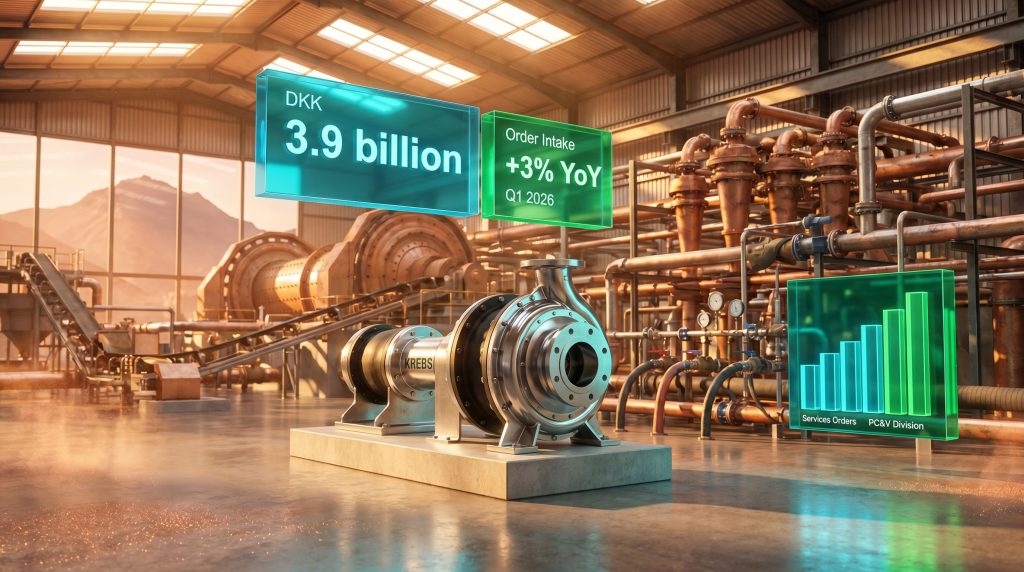
Total order intake for FLSmidth reached DKK 3.9 billion (approximately US$611 million) in the March 2026 quarter, representing a 3% increase compared to the equivalent period in 2025. The headline growth figure is modest, but the composition of that growth carries more analytical weight than the top-line number alone.
Two divisions drove the positive momentum: the services segment and the PC&V division encompassing pumps, cyclones and valves. Both recorded strong order intake, with the PC&V division benefiting in part from upstream OEM partnerships that embed FLSmidth's fluid handling products into larger processing plant packages. According to FLSmidth's Q1 2026 interim financial report, both the Service and PC&V businesses delivered strong organic order intake growth, underpinning confidence in the forward pipeline.
Understanding the Order-to-Revenue Disconnect
One of the more technically important aspects of this quarterly result is the divergence between order intake and reported revenue. Revenue declined during the March 2026 quarter even as orders grew. For observers unfamiliar with how mining equipment revenue recognition works, this can appear contradictory.
In reality, it reflects a structural feature of capital-intensive project cycles. The table below illustrates the contrast between what the order intake and revenue data signal independently versus what they mean when read together:
| Indicator | Short-Term Reading | Medium-Term Implication |
|---|---|---|
| Revenue decline (Q1 2026) | Appears negative | Likely reflects timing of project milestones, not demand loss |
| Order intake +3% YoY | Positive | Builds forward revenue pipeline |
| Services order growth | Positive | Recurring, high-margin revenue stream development |
| PC&V order growth | Positive | Downstream pull-through from OEM relationships |
| Greenfield project wins | Positive | Multi-year revenue anchor contracts |
Large capital equipment orders, such as those involving SAG mills, ball mills, and complete concentrator packages, are not recognised as revenue at the point of contract signing. Revenue flows progressively through engineering phases, equipment manufacturing, and delivery milestones, a process that can span anywhere from twelve to thirty-six months depending on project complexity.
A quarterly revenue decline in this context does not indicate commercial deterioration. It may simply reflect the timing of milestone completions relative to a growing forward book.
This order-to-revenue lag is one of the most systematically misread metrics in mining equipment analysis. Quarter-on-quarter revenue movement tells you about the past. Order intake tells you about the next two to four years.
The Service Division: More Than a Supporting Act
Context from prior quarters helps frame the current services performance. In Q3 2025, organic service order growth reached 10% year-on-year when adjusted for currency movements and portfolio changes. Over the nine months to September 2025, year-to-date service order intake showed 1% organic growth against the same period in 2024. The Q1 2026 result extends this trajectory, confirming that demand for fluid handling maintenance, rebuilds, and service contracts has not been a transient phenomenon.
This matters for understanding business model durability. Services revenue in mining equipment tends to carry higher margins than capital equipment sales, owing to lower material costs, established logistical infrastructure, and the pricing power that comes with deep technical knowledge of installed equipment. An OEM servicing its own installed base faces limited competition at the point of renewal, particularly when proprietary tooling, parts specifications, or software integration is involved.
How FLSmidth's PC&V Division Generates Structural Order Flow
The pumps, cyclones and valves division occupies a specific and strategically important position within mineral processing circuits. Slurry handling is not a peripheral function; it is the connective tissue that links every stage of a processing plant, from primary crushing and grinding through to flotation and tailings management. The copper processing technology employed across these circuits has grown increasingly sophisticated, placing greater demands on fluid handling equipment.
What Slurry Pump Technology Actually Does in a Processing Circuit
For readers less familiar with mineral processing engineering, understanding the role of slurry pumps clarifies why this equipment category attracts recurring service demand. Unlike clean water pumps, slurry pump equipment handles abrasive, high-density mixtures of finely ground rock, water, and chemical reagents. These conditions impose extreme mechanical wear on internal pump components, particularly the liners, impellers, and wet end parts.
The wear rate depends on several variables:
- Slurry density (the ratio of solids to liquid, typically measured as percentage solids by weight)
- Particle hardness (silica, for example, is far more abrasive than softer sulphide minerals)
- Particle size distribution (coarser particles accelerate liner wear geometrically)
- Pump speed and flow velocity (higher speeds increase abrasive impact energy)
- Chemical environment (acidic or alkaline conditions degrade metallurgical components independently of abrasion)
In a large copper concentrator processing coarse, silica-bearing ore, pump wear components may require replacement on cycles as short as a few weeks for the most heavily loaded duties. This creates a dense, predictable schedule of parts consumption and rebuild activity that underpins aftermarket demand regardless of commodity prices.
KREBS Technology and the Energy Efficiency Differentiator
FLSmidth's KREBS slurry pump line has been positioned consistently on the basis of hydraulic efficiency in high-abrasion applications. This is commercially significant beyond pure performance metrics. In a large copper concentrator, slurry pumping can account for a meaningful share of total plant energy consumption. A pump that delivers comparable throughput at lower energy consumption translates directly into operating cost reduction and improved performance against Scope 1 and Scope 2 emissions targets.
The KREBS Quick Release system represents a specific proprietary design feature with direct maintenance economics implications. By reducing the time required to change out worn pump internals, this technology compresses the maintenance window and reduces both labour cost and lost production time per intervention. In high-throughput operations where downtime costs are substantial, this difference in changeout speed is not a marginal benefit.
OEM Partnership Dynamics and Pull-Through Demand
One of the more nuanced aspects of the PC&V division's order growth is the role of upstream OEM relationships in generating pull-through demand. When a major processing plant package is sold by a primary OEM, the associated pumps, cyclones, and valves that will handle slurry throughout that plant are typically specified into the package.
FLSmidth's PC&V products being included in those upstream specifications means that a concentrator contract win by a third-party OEM can translate into a PC&V order for FLSmidth, without requiring a direct competitive tender. This embedded specification model has important commercial characteristics:
- It reduces price-based competition at the point of equipment selection
- It creates a long-term service relationship anchored to proprietary equipment
- It generates repeat parts and rebuild revenue across the full operational life of the plant, commonly spanning fifteen to twenty-five years
- It builds geographic and customer-specific installed base density that reinforces service network efficiency
The South American Copper Concentrator Order: What It Reveals About Investment Trends
In Q4 2025, FLSmidth secured a DKK 405 million order (approximately US$58–60 million) for a greenfield copper concentrator project in South America. The scope included comminution technologies — specifically crushers, SAG mills, ball mills, and cyclones — with equipment delivery scheduled across 2027.
This order warrants analysis beyond its headline value. It is a greenfield project, meaning it involves a brand-new processing facility rather than an upgrade or expansion of an existing operation. Greenfield concentrators are typically more engineering-intensive than brownfield work, require more extensive design integration, and carry higher project risk — factors that are generally reflected in higher margins for equipment suppliers.
Why South America Remains the Core of Global Copper Processing Investment
South America, and specifically the Andean copper belt spanning Chile and Peru, represents the most concentrated zone of copper processing infrastructure globally. Chile alone regularly ranks as the world's largest copper producer, accounting for roughly a quarter of global mine supply according to USGS Mineral Commodity Summaries data. Peru typically ranks in the top three, making the combined Andean region a dominant force in global copper output.
The ongoing copper supply crunch has sharpened investment focus on new concentrator development in this region, driven by several converging pressures. New concentrator investment is not purely driven by new mine discoveries; it also reflects:
- The need to process lower-grade ore bodies as higher-grade material within established deposits is depleted
- Expansions to existing operations to capitalise on copper price strength driven by energy transition demand
- Development of porphyry copper deposits requiring high-throughput, large-scale concentrator circuits by design
Porphyry copper deposits, which dominate South American production, are characterised by large tonnage but relatively low head grades, often in the range of 0.3% to 0.8% copper. Processing these deposits profitably requires extremely high-volume throughput, which drives demand for large, energy-efficient comminution and pumping circuits.
A single large concentrator project of this type creates a long-term anchor relationship for the equipment supplier. Post-commissioning service demand — spanning spare parts, scheduled rebuilds, and technical support — can extend across the full productive life of the operation. The DKK 405 million capital order is therefore not just a one-time revenue event; it represents the establishment of a multi-decade commercial relationship.
Broader Industry Forces Feeding FLSmidth Pumps and Services Orders
The Critical Minerals Processing Build-Out
Global copper demand projections tied to the energy transition — particularly electric vehicle manufacturing and grid infrastructure investment — have sustained capital investment in processing capacity at a level that might otherwise be moderated by broader economic uncertainty. The critical minerals demand outlook tied to decarbonisation targets has consistently underpinned long-term investment decisions in processing infrastructure, even during periods of near-term price softness.
This context matters for interpreting FLSmidth's order pipeline. Demand for processing equipment and associated services is not purely a function of current commodity prices but increasingly reflects long-term infrastructure investment decisions anchored to decarbonisation targets.
Ore Grade Decline as a Hidden Service Demand Driver
One of the less widely discussed drivers of slurry pump service demand is the global trend of declining ore grades in established mining districts. As higher-grade ore near the surface or in accessible underground zones is depleted, mines increasingly process larger volumes of lower-grade material to maintain metal production rates. This increases the total throughput of processing plants, which in turn accelerates equipment wear and shortens maintenance intervals.
Industry data tracking average copper ore grades mined globally shows a long-term declining trend spanning several decades. The practical implication is that the intensity of wear on fluid handling circuits is increasing per tonne of copper produced, even without growth in total metal output. This is a structural tailwind for aftermarket services that does not require new mine development to materialise.
ESG Pressure as a Procurement Criterion
Mining operators increasingly face scrutiny from investors, regulators, and communities regarding energy consumption and emissions. The mining decarbonisation benefits associated with more energy-efficient equipment are consequently becoming embedded in procurement criteria rather than remaining a secondary consideration. Pumping circuits are among the most energy-intensive elements of a mineral processing plant, making pump efficiency a genuine ESG reporting consideration rather than merely an engineering preference.
Equipment providers that can demonstrate measurable energy savings per unit of throughput gain a procurement advantage that has expanded beyond purely economic criteria. This dynamic is particularly relevant in jurisdictions where carbon pricing or emissions intensity targets apply to mining operations, and where procurement decisions are increasingly subject to sustainability governance frameworks.
The next major ASX story will hit our subscribers first
Key Takeaways for Understanding the Mining Equipment Services Cycle
- FLSmidth pumps and services orders grew 3% to DKK 3.9 billion in Q1 2026, driven by services division momentum and PC&V order strength
- The divergence between growing orders and declining revenue is a structural feature of capital equipment revenue recognition, not a commercial red flag
- Organic service order growth of 10% in Q3 2025 confirms that aftermarket demand is a sustained rather than episodic trend
- Upstream OEM integration creates pull-through demand for PC&V products and establishes long-term service relationships at the point of original equipment specification
- The DKK 405 million South American copper concentrator win provides forward revenue visibility into 2027 and anchors a multi-decade service relationship
- Declining ore grades globally are increasing throughput volumes and wear rates in processing circuits, creating structural support for fluid handling service demand independent of new mine construction
- ESG and energy efficiency considerations are becoming procurement criteria in equipment selection, strengthening the competitive position of technology providers with documented efficiency credentials
This article is intended for informational purposes only and does not constitute financial or investment advice. All financial figures referenced reflect publicly reported data. Readers should conduct independent research and consult qualified advisers before making investment decisions based on any content contained herein.
Want to Spot the Next Major Mineral Discovery Before the Market Moves?
Discovery Alert's proprietary Discovery IQ model delivers real-time alerts on significant ASX mineral discoveries, transforming complex mineral data into clear, actionable insights for investors at every level — explore the historic returns major discoveries have generated and begin your 14-day free trial today to position yourself ahead of the market.