June 27, 2026
The Two-Speed Economy at the Top of the World
For most of modern economic history, the Arctic has been treated as a liability rather than an asset. Extreme weather, prohibitive logistics, sparse population, and complex sovereignty arrangements kept institutional capital focused elsewhere. Yet something fundamental has shifted in the calculus of global resource competition. The convergence of accelerating climate change, Western supply chain vulnerability, and intensifying U.S.-China strategic rivalry has redrawn the map of investable territory. Nowhere is this reorientation more visible than in Greenland, where a territory of 57,000 people has become one of the most closely watched investment destinations on the planet.
Understanding the Greenland opportunity requires separating two distinct economic systems operating on radically different timelines. The first is a tourism economy capable of generating returns within years. The second is a resource extraction economy requiring decades of capital commitment, regulatory navigation, and infrastructure development before meaningful cash flows materialise. Conflating these two systems is the most common analytical error in current commentary on Trump Greenland investment and tourism activity.
When big ASX news breaks, our subscribers know first
Why Greenland Has Become the World's Most Strategically Watched Territory
The Shift From Remote Territory to Global Investment Flashpoint
Greenland's transformation from geographic curiosity to institutional priority did not happen overnight. U.S. interest in the territory dates to the mid-nineteenth century, resurfaced during World War II when the United States established military bases there, and re-emerged publicly in 2019 when the Trump administration's acquisition proposal was formally rejected by both Danish and Greenlandic governments. What changed between 2019 and the present is not Greenland's resource base, which has always been geologically confirmed, but the urgency attached to accessing it.
The combination of U.S.-China competition for critical minerals, the rapid opening of Arctic shipping routes due to ice retreat, and the Western world's recognition that rare earth supply chains run dangerously through Chinese processing infrastructure has elevated Greenland from a geopolitical talking point to a bankable investment thesis. When U.S. President Donald Trump reiterated acquisition rhetoric in early 2026, institutional investors and export credit agencies did not dismiss it as noise. They treated it as a signal that political will behind Greenland access had reached a qualitatively different level.
Peder Lundquist, Chief Executive of Denmark's Export and Investment Fund (EIFO), articulated this shift with institutional precision. According to reporting by Reuters via Kitco News, Lundquist assessed that investor behaviour had measurably changed, describing a different sense of urgency among capital allocators compared to prior periods of Greenland interest. This is a significant statement from someone whose organisation is responsible for deploying public capital into Greenlandic projects, not merely commenting on them from the sidelines.
Greenland's Resource Profile: Confirmed Geology, Incomplete Infrastructure
The gap between Greenland's resource potential and its production reality is not a geological question. It is an infrastructure, governance, and commercial viability question. Furthermore, the territory's mineral endowment is substantial and diversified:
| Resource Category | Estimated Scale | Global Significance |
|---|---|---|
| Rare earth elements | Significant confirmed deposits including Tanbreez | Critical for technology and defence manufacturing |
| Graphite | GreenRoc project (EU-designated critical asset) | Strategic for battery supply chains |
| Gold | Active exploration underway via Amaroq and others | Emerging frontier mining activity |
| Oil and gas | Significant offshore shelf potential | Long-term strategic energy asset |
| Population base | ~57,000 residents | Politically active electorate with environmental priorities |
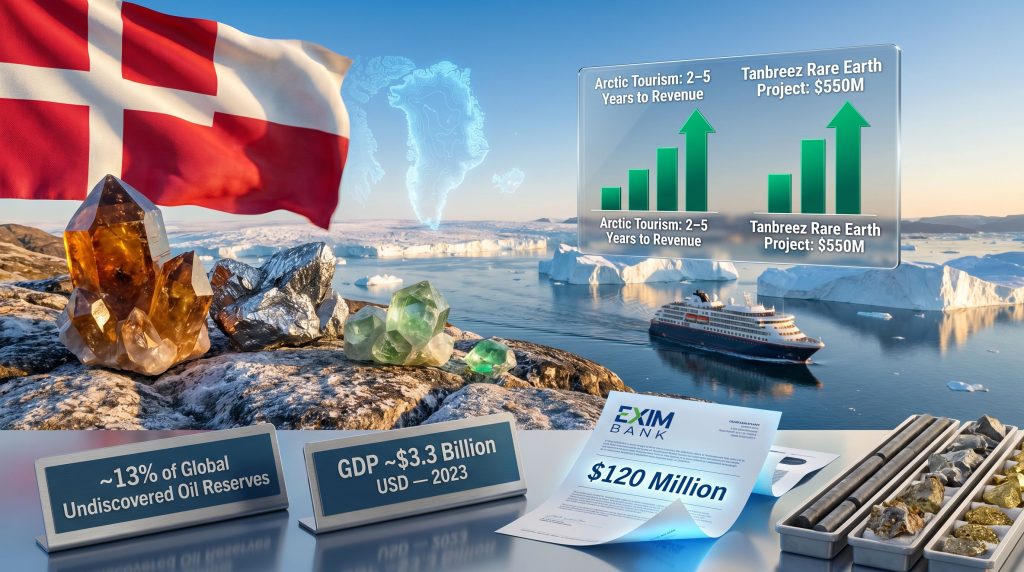
| 2023 GDP | ~$3.3 billion USD | Single major mining project equivalent to ~17% of GDP |
The resource wealth beneath Greenland's ice is not theoretical. The practical constraints are infrastructure deficits, environmental governance requirements, and the commercial viability thresholds that separate confirmed geology from producing mines.
What the Trump Greenland Investment Push Actually Means for Capital Markets
Political Declarations Do Not Equal Bankable Projects, With One Critical Exception
Geopolitical attention rarely translates directly into investable capital flows. Declarations of strategic interest, however emphatic, do not by themselves create the financial architecture required to move projects from feasibility to production. What makes the current Greenland moment different from prior political cycles is the visible mobilisation of institutional capital mechanisms alongside the rhetoric. The broader Greenland critical minerals race illustrates precisely how intertwined political signals and capital deployment have become.
Export credit agencies occupy a structurally important position in this dynamic. They are not commercial banks optimising for short-term returns, nor are they purely political instruments. They deploy public capital under commercial disciplines, which means they can bridge the gap between political intent and private investment thresholds. EIFO's active participation in Greenlandic deal origination, feasibility funding, and equipment financing is therefore a leading indicator of genuine capital deployment rather than speculative positioning.
The reported signal from the U.S. Export-Import Bank regarding a potential loan facility connected to the Tanbreez rare earth project adds a second institutional layer to this dynamic. If confirmed, this would represent U.S. sovereign capital directly engaged in Greenlandic resource development, a qualitative escalation from political statements to financial commitment.
The Two-Speed Investment Landscape: Tourism vs. Mining
The most strategically important insight from EIFO's current posture is the explicit prioritisation of tourism over mining as a near-term capital deployment vehicle. Lundquist stated, as reported by Reuters via Kitco News, that the organisation believes there is a faster path to local value creation in tourism than in raw materials, and that while raw materials carry long-term and solid value creation, it unfolds over decades.
This institutional framing creates a clear capital allocation hierarchy:
| Dimension | Arctic Tourism | Large-Scale Mining |
|---|---|---|
| Time to first revenue | 2 to 5 years | 10 to 20+ years |
| Capital intensity | Low to moderate | Very high ($550M+ per major project) |
| Environmental risk profile | Moderate and manageable | High with intensive regulatory scrutiny |
| Political sensitivity | Low | High |
| Local employment impact | Near-term | Significantly delayed |
| Dependency on sovereign guarantees | Low | High and potentially prerequisite |
| EU and U.S. strategic alignment | Moderate | Critical |
Arctic Tourism in Greenland: The Fastest Path to Economic Returns
Structural Underservice of a High-Demand Experience Economy
Greenland's tourism sector has been constrained not by lack of demand but by physical capacity limitations during peak summer months. The territory's combination of dramatic fjord scenery, accessible iceberg fields, Arctic wildlife, and relative proximity to European and North American markets creates a compelling value proposition. The bottleneck has consistently been infrastructure: accommodation, harbour access, transport connectivity, and visitor distribution networks.
The Ilulissat corridor on Greenland's west coast represents the highest-priority development zone within this context. An international airport is under development for the area, a project that will materially expand the territory's ability to receive direct long-haul visitors rather than relying entirely on cruise ship arrivals or domestic aviation connections. Nearby Disko Bay, with its dense concentration of Arctic wildlife and iceberg scenery, functions as the natural anchor for cruise tourism in the region.
EIFO is currently funding a feasibility analysis examining harbour capacity expansion, feeder transport infrastructure, and strategies for distributing visitor flows across surrounding communities to reduce environmental and social concentration pressure. This infrastructure-first approach reflects an understanding that tourism scaling requires systems investment, not isolated facility development.
Climate Change as an Unlikely Tourism Catalyst
One of the more counterintuitive dynamics in Greenland's tourism development is the role of accelerating Arctic warming. As ice retreat opens previously inaccessible fjords, bays, and coastal routes, the navigable season for cruise vessels and expedition tourism extends. New destinations that were logistically constrained a decade ago are becoming accessible to smaller expedition vessels and adventure tourism operators.
This does not eliminate environmental sensitivity concerns. However, it introduces a paradox: the same climate dynamics that make Greenland's landscapes more accessible also threaten the ecological integrity that makes them worth visiting. Sustainable tourism development requires managing this tension explicitly, which is precisely why Greenland's environmental governance baseline is positioned as non-negotiable by its own government.
How Viable Is Large-Scale Mining in Greenland Right Now?
The Commercial Viability Gap: Why Mines Need Political Architecture
The most technically significant insight from EIFO's assessment of Greenland's mining sector is the explicit identification of a commercial viability threshold that current market conditions do not meet for large-scale projects. Lundquist, as reported by Reuters via Kitco News, stated that large-scale extraction is not commercially viable without public-sector guarantees, and that achieving mining at meaningful scale requires political backing of some kind.
The specific mechanism discussed involves minimum price guarantees on extracted materials. This is a familiar instrument in strategic minerals policy: a government or multilateral institution commits to purchasing extracted material at a floor price, eliminating the commodity price risk that prevents private capital from committing to decade-long development timelines. Without this mechanism, the risk-adjusted return on large-scale Greenlandic mining does not meet institutional investment thresholds.
Potential sources for such guarantees include:
- The European Union, through its critical minerals strategy and commitment to doubling financial support for Greenland
- The Danish government, operating as both a regulatory authority and a potential capital backstop
- The U.S. Export-Import Bank, which has reportedly signalled interest in a loan facility connected to the Tanbreez rare earth project
The Tanbreez and GreenRoc Projects: What Institutional Designation Reveals
The Tanbreez rare earth deposit in southern Greenland represents one of the largest known rare earth concentrations globally. An estimated development cost in the range of $550 million would represent approximately 17% of Greenland's entire annual economic output, illustrating the scale mismatch between project requirements and the territory's existing economic infrastructure. This is precisely why external capital architecture, whether from the EU, the United States, or Denmark, is not optional but prerequisite.
The GreenRoc graphite project carries a different but equally significant credential. The European Union's decision to classify GreenRoc as a critical supply asset represents multilateral institutional validation of Greenland's strategic mineral importance that exists entirely independent of U.S. political positioning. For investors evaluating Greenland's mining sector, EU critical minerals designation signals that European institutional capital has a structural mandate to engage with these projects.
Private Capital Already Moving: Early Movers and Near-Term Transactions
While large-scale extraction remains constrained, smaller-scale deal flow is accelerating in measurable ways. EIFO has projected three to five new transactions in Greenland during 2026 alone. Among the most immediately concrete is the evaluation of a financing facility for Suliaq, a subsidiary of gold miner Amaroq Minerals. The transaction, estimated between $20 million and $35 million, would fund procurement of specialised Arctic mining equipment that is currently scarce or unavailable within Greenland's existing supply chains.
KoBold Metals, backed by prominent technology investors including Bill Gates and Jeff Bezos, has positioned itself as an early-mover in Greenland's mineral exploration space, signalling that sophisticated private capital views the territory's long-term resource thesis as credible despite near-term development constraints.
Near-term deal flow in Greenland is not theoretical. Export credit commitments, EU designations, and private capital positioning from well-resourced exploration firms indicate that capital is transitioning from rhetoric to deployment, even if large-scale production remains a decade or more away.
What Greenland's Environmental Constraints Mean for Investment Timelines
A Non-Negotiable Governance Baseline
Greenland's environmental standards are not a negotiating variable. Greenlandic Prime Minister Jens-Frederik Nielsen stated publicly, as reported by Reuters via Kitco News, that high environmental standards are simply how Greenland operates because the population lives off the natural environment, lives off the sea, and that this reality will not change regardless of how much rare earth mineral wealth the territory holds. This framing positions environmental governance as a cultural and economic foundation, not a regulatory posture subject to external pressure.
The practical significance for investors is substantial. Any project development model that assumes environmental standards can be streamlined or bypassed under geopolitical pressure is mispricing the actual risk landscape. Greenland's population of 57,000 residents has consistently elected leaders aligned with environmental protection, and the Prime Minister's statement reflects rather than creates this political reality.
The Dual-Approval Dynamic: Greenland and Denmark
Large-scale resource projects in Greenland operate under a layered regulatory framework. Greenland's self-governing institutions control land use and resource development policy, while Danish regulatory frameworks apply additional environmental oversight. This dual-approval structure means that even projects with strong commercial sponsors and political backing face sequential rather than parallel regulatory processes, extending timelines beyond what single-jurisdiction projects would require.
Denmark has also demonstrated willingness to intervene in foreign investment decisions involving Greenlandic infrastructure, including blocking financing proposals from non-aligned parties in response to strategic concerns. Consequently, this positions Denmark simultaneously as a potential capital backstop and a regulatory gatekeeper, a dual role that creates both facilitation pathways and procedural friction for external investors.
The next major ASX story will hit our subscribers first
How Does Greenland Fit Into the Broader U.S.-China Arctic Competition?
Strategic Minerals as Proxy Competition
The Western world's dependence on Chinese processing infrastructure for rare earth elements is well-documented. China controls a dominant share of global rare earth processing capacity, and the technology and defence manufacturing sectors of the United States, European Union, and allied nations have recognised this as a structural vulnerability. For instance, Greenland election and critical minerals dynamics reveal how deeply this resource security question has penetrated domestic Greenlandic politics. Greenland's rare earth deposits represent one of the most geographically accessible alternative sources available to Western supply chain architects.
This creates a dynamic where Greenland is not simply an investment destination but a geopolitical instrument. According to analysis from the Center for Strategic and International Studies, the territory's rare earth potential is directly tied to broader Arctic security considerations that extend well beyond commercial mining activity. The U.S. framing of resource access as a national security imperative rather than a commercial opportunity redefines the financial architecture available to support development, including mechanisms like Export-Import Bank financing that would not apply to purely commercial ventures.
Comparative Geopolitical Positioning
| Actor | Primary Interest | Current Status | Key Constraint |
|---|---|---|---|
| United States | Rare earths, strategic location, Arctic routes | Active through private capital and potential EXIM financing | Danish and Greenlandic sovereignty |
| European Union | Critical minerals supply chain security | Active with doubled financial support commitment | Environmental conditionality |
| China | Infrastructure influence and resource access | Effectively blocked from airport infrastructure | U.S. and Danish opposition |
| Russia | Arctic route dominance | Indirect through naval presence | No direct investment role confirmed |
| Denmark | Sovereignty, environmental governance | Active as regulatory gatekeeper and potential capital provider | Balancing U.S. pressure with local interests |
China's interest in Greenland's infrastructure, evidenced by financing proposals for airport development that were subsequently rejected under U.S. diplomatic pressure, reveals the territory's strategic valuation from Beijing's perspective. The fact that China pursued infrastructure access rather than direct resource equity reflects an understanding that logistics control often provides more durable strategic leverage than resource ownership.
What Is the Realistic Investment Outlook for Greenland Through 2030?
Near-Term Catalysts: 2026 to 2028
The most immediately verifiable forward-looking indicators are:
- EIFO's projected pipeline of three to five new transactions in 2026, representing concrete institutional commitment from Denmark's official export credit agency
- The Suliaq equipment financing evaluation ($20 million to $35 million), serving as a bellwether for Arctic mining capital deployment at manageable scale
- International airport completion at Ilulissat, which will measurably expand visitor throughput and anchor further tourism infrastructure investment
- EU critical minerals designation for GreenRoc graphite, which creates a structural mandate for European institutional capital engagement
Scenario Analysis: Three Development Pathways
Scenario A: Tourism-Led Growth (Higher Probability, Shorter Timeline)
Infrastructure investment in Ilulissat and Disko Bay proceeds on current trajectories. Tourism revenue begins scaling within three to five years of airport completion. Environmental standards are maintained throughout. Mining activity remains limited to smaller-scale operations like Suliaq. This scenario requires the least political architecture and carries the most reliable return timeline.
Scenario B: Dual-Track Development (Moderate Probability, Medium Timeline)
Tourism infrastructure matures while selective mining projects reach production through EU and Danish capital support. GreenRoc graphite and potentially the Suliaq gold operation generate operating cash flows. Large-scale rare earth extraction remains in development phases pending price guarantee mechanisms. This scenario requires functional EU critical minerals financing and Danish regulatory progression.
Scenario C: Strategic Resource Acceleration (Lower Probability, Requires Full Political Architecture)
U.S. Export-Import Bank financing, EU minimum price guarantees, and Danish sovereign backing combine to unlock large-scale rare earth extraction. Tanbreez approaches financial close. Greenland becomes a material contributor to Western critical minerals supply chains before 2030. As noted by the Lowy Institute, this pathway hinges on sustained geopolitical alignment between key Western actors over an extended period. This scenario requires simultaneous alignment of multiple sovereign capital providers and compressed regulatory timelines.
The Structural Constants That Every Scenario Must Price
Regardless of which development pathway materialises, three structural features remain constant across all scenarios:
-
Environmental governance is a permanent filter, not a temporary obstacle. Projects that cannot satisfy Greenland's self-governance environmental standards and Danish regulatory requirements will not advance regardless of geopolitical urgency.
-
Tourism generates faster returns than mining in every plausible scenario. EIFO's capital allocation priorities reflect this reality, and investors should structure their expectations accordingly.
-
Sovereign capital is a prerequisite for large-scale mining, not a supplement. Commercial viability at the scale of a $550 million rare earth project in a $3.3 billion economy requires political architecture that market mechanisms alone cannot provide.
This article is intended for informational purposes only and does not constitute financial, investment, or legal advice. Projections, scenario analyses, and forward-looking assessments involve inherent uncertainty. Readers should conduct independent due diligence and consult qualified advisers before making investment decisions related to any markets, companies, or projects referenced herein.
Want To Stay Ahead of the Next Major Mineral Discovery Before the Market Catches On?
Discovery Alert's proprietary Discovery IQ model delivers real-time alerts on significant ASX mineral discoveries, transforming complex mineral data into actionable investment insights for both short-term traders and long-term investors — explore the historic returns major discoveries have generated and begin your 14-day free trial at Discovery Alert to position yourself ahead of the broader market.