June 18, 2026
When Commodity Prices Write Monetary Policy: Reading Australia's Inflation Architecture
Across modern economic history, the most dangerous inflation episodes have rarely announced themselves clearly. They tend to begin with a single supply disruption, get dismissed as temporary, and then embed themselves into wage expectations and business pricing behaviour before central banks fully acknowledge the scale of the problem. Australia in 2026 is navigating exactly this kind of environment, where the original catalyst has long since evolved into something far more durable and structurally challenging than initial forecasts suggested.
Understanding how this matters for ASX investors requires looking beyond the headline CPI number and examining the transmission mechanisms that connect global energy markets to domestic price pressure, and ultimately to the investment case for ASX energy and gold stocks if CPI stays hot.
When big ASX news breaks, our subscribers know first
The Structural Architecture of Sticky Australian Inflation
Why This Inflation Cycle Behaves Differently From Post-Pandemic Normalisation
The post-COVID inflation spike that dominated 2021 and 2022 was primarily a demand-pull phenomenon. Fiscal stimulus flooded household balance sheets, supply chains were simultaneously constrained, and goods prices surged as spending patterns shifted. That kind of inflation responds reasonably well to monetary tightening because rate hikes cool purchasing power directly.
What Australia faces now is structurally different. The current inflation regime is being fed by cost-push dynamics rooted in physical commodity supply constraints rather than excess domestic demand. When LNG export capacity is physically damaged and crude oil transit routes are partially restricted, raising interest rates cannot increase the supply of either. The RBA finds itself in the uncomfortable position of applying a demand-side tool to a supply-side problem.
Three interlocking forces are sustaining price pressure above the RBA's 2-3% target band:
- Geopolitical energy supply disruptions feeding directly into domestic fuel and freight costs
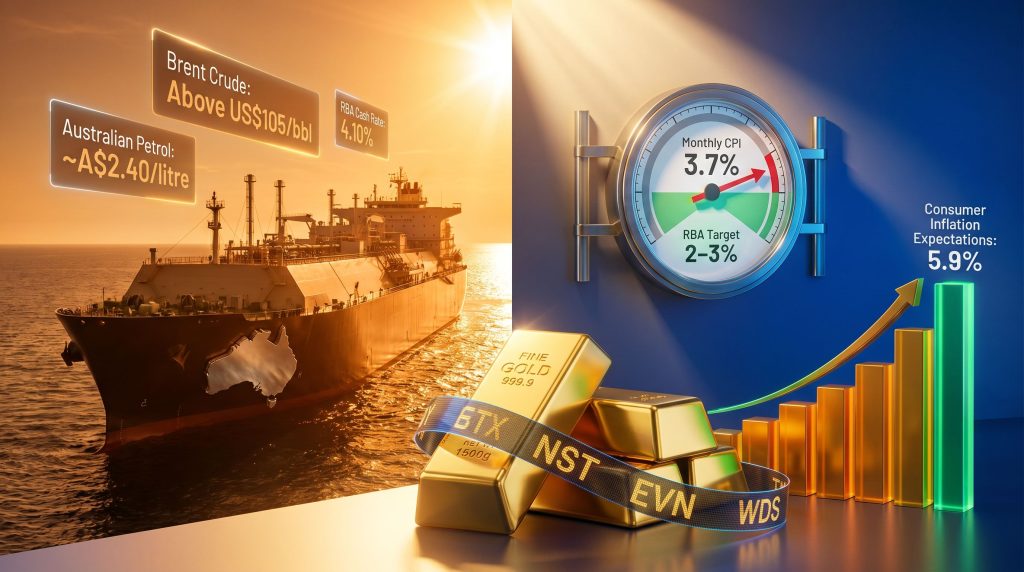
- Wage growth acceleration driven by consumer inflation expectations running at 5.9%, the highest reading since late 2022, which creates rational incentives for workers to seek nominal compensation above the prevailing inflation rate
- Cost transmission across non-energy categories as freight, food logistics, and manufacturing inputs absorb elevated energy costs
The self-reinforcing nature of this cycle is what distinguishes it from transitory price movements. When households genuinely expect 5.9% inflation, bargaining behaviour changes, pricing strategies shift, and the expectation itself begins to drive outcomes independent of the original supply shock. Furthermore, how much of a threat inflation poses to long-term economic stability depends heavily on whether central banks can anchor those expectations before they become entrenched.
Key Inflation Indicators Shaping the Investment Landscape
| Indicator | Current Level | RBA Target | Investment Significance |
|---|---|---|---|
| Monthly CPI (March 2026) | 3.7% | 2–3% | Persistently above midpoint by 1.2pp |
| Consumer Inflation Expectations | 5.9% | — | Highest since late 2022; feedback risk |
| RBA Cash Rate | 4.10% | — | Third hike increasingly probable |
| Brent Crude Price | Above US$105/bbl | — | Primary CPI transmission driver |
| Australian Petrol Price | ~A$2.40/litre | — | Direct cost-push on households |
| Real Cash Rate (approx.) | ~0.4% | — | Still low in real terms; limits bond attractiveness |
The real cash rate sitting at approximately 0.4% (nominal 4.10% minus 3.7% CPI) is a critical and often overlooked figure. When the inflation-adjusted return on cash remains this compressed, the fundamental case for commodity and real asset exposure remains structurally intact even as nominal rates rise.
What a Hot CPI Print Means for the RBA and Broader Markets
The Policy Trap That Energy-Driven Inflation Creates
The RBA has already delivered two consecutive rate increases in 2026, taking the cash rate from 3.60% to its current level of 4.10%. Each hike adds approximately 20-25 basis points to variable mortgage rates across the major lenders within weeks, meaning Australian households with variable rate loans have already absorbed meaningful increases in their monthly repayment obligations.
A third hike in May would represent an escalation in the tightening cycle that carries real consequences for consumption, business lending, and the broader economic growth trajectory. The complication is that the RBA faces a genuine policy asymmetry:
- Rate hikes are effective against demand-driven inflation by increasing borrowing costs and suppressing spending
- Rate hikes are far less effective against supply-side cost shocks driven by oil and LNG price dynamics
- The risk of overtightening involves destroying productive demand without resolving the fundamental supply constraint, potentially creating stagflationary conditions
This asymmetry is precisely why sectors that are direct revenue beneficiaries of the same commodity prices driving inflation become strategically attractive. Furthermore, the oil price rally observed in recent months has reinforced just how directly commodity price movements can compound domestic inflationary pressure. The forces pressuring the RBA to act are simultaneously expanding the earnings base of energy producers.
Scenario Framework: Three CPI Outcomes and Their Market Implications
| Scenario | CPI Result | RBA Response | ASX Energy View | ASX Gold View |
|---|---|---|---|---|
| Hot Print | Above 3.7% | May hike highly likely | Strong upside; revenue thesis confirmed | Inflation hedge demand rises; supports recovery |
| In-Line Print | ~3.7% | Hike remains on the table | Neutral to positive | Steady; underlying bid maintained |
| Soft Surprise | Below 3.5% | Third hike delayed | Short-term pullback likely | Temporary dip as hedge demand eases |
Markets that efficiently price a hot CPI outcome will front-run the result. Institutional capital repositioning typically begins in the days before major data releases, compressing the entry window for investors who wait for confirmation. The asymmetry of early positioning is most compelling when observable leading indicators, including fuel prices, energy expectations, and supply constraints, already point toward a specific outcome.
The overnight index swap market and ASX 30-day bank bill futures provide real-time probability estimates for the May rate decision, and these forward pricing mechanisms tend to move rapidly once CPI data is published. Investors relying on post-print positioning routinely face a compressed entry window precisely because the market's reaction function is well-understood in advance. For broader context, the ASX 200 response to inflation shocks and rising rate-hike odds has illustrated just how swiftly sentiment can shift across sectors.
The Global Supply Shock Rewriting Australian LNG Economics
How Middle Eastern Disruptions Created a Durable Asian Supply Gap
Qatar ranks among the world's two or three largest LNG exporters by volume, accounting for a substantial share of the approximately 400 million tonnes of LNG traded globally each year. A reported 17% reduction in Qatar's LNG export capacity, stemming from conflict-related infrastructure disruption with recovery timelines estimated at three to five years, has removed a meaningful volume from global gas markets at exactly the point when Asian demand remains structurally anchored.
Simultaneous disruption to crude oil flows through the Strait of Hormuz during the quarter amplified the price shock across both oil and gas markets, with Brent crude sustaining levels above US$105 per barrel. The combined effect on Australian domestic fuel prices has been direct and visible: petrol at approximately A$2.40 per litre creates immediate pass-through into freight costs, food logistics, and manufacturing inputs. The global LNG supply outlook makes clear that these disruptions are unlikely to resolve quickly, given the structural damage to export infrastructure.
The transmission chain from global supply disruption to domestic CPI runs as follows:
- Middle East conflict curtails LNG and crude oil export capacity
- Global spot prices for LNG and Brent crude rise sharply
- Australian retail petrol prices climb to ~A$2.40 per litre
- Freight operators, food producers, and manufacturers absorb higher fuel input costs
- Those costs are passed forward to consumers through goods and services pricing
- Monthly CPI rises above the RBA's 2-3% target corridor
- The RBA faces compounding pressure to continue tightening monetary policy
Why Australian LNG Producers Occupy a Structurally Advantaged Position
Australia's LNG export infrastructure is geographically positioned closer to the primary Asian demand centres than Middle Eastern alternatives. Transit time from Northwest Shelf facilities to major Japanese, Korean, and Chinese import terminals is approximately 10-14 days, compared with 20-25 days from the Persian Gulf. This logistics advantage is not merely a cost factor; it also reduces supply chain vulnerability to the same Hormuz disruptions affecting Qatari exports.
Three structural factors make the current environment particularly favourable for Australian LNG producers:
- Long-term Asian contracts with major utilities in Japan, South Korea, and China, typically indexed to Brent crude pricing (at approximately 0.12-0.15 times the Brent price plus a fixed component), provide direct revenue participation in the commodity price rally
- Spot market participation, which now accounts for a growing share of total LNG trade, allows producers to capture elevated prices above contracted volumes
- Compressed global supply, with Qatar's capacity constrained for potentially five years, creates a durable demand gap that cannot be resolved through short-term market forces
This combination makes the current LNG export environment distinct from cyclical commodity price spikes. The structural nature of the supply gap means that even if Brent crude were to moderate from current levels, the underlying tightness in LNG markets would likely persist well into the late 2020s.
ASX Energy Stocks: Direct Beneficiaries of the Inflation Thesis
The Conceptual Case for Energy Stocks as Inflation Hedges
Labelling ASX energy producers as oil-price plays understates their strategic role in an inflation-conscious portfolio. When fuel and gas costs are the primary mechanism driving CPI above target, energy producers are simultaneously generating revenue from the exact same price movements that erode the purchasing power of cash, bonds, and fixed-income instruments. This creates a genuine inflation hedge with an active earnings engine, rather than simply a defensive store of value.
In periods where real interest rates remain compressed, as they currently do at approximately 0.4%, the opportunity cost of holding commodity-linked equities versus cash or short-duration bonds is minimal. The asymmetric upside from further commodity price appreciation, combined with strong operating cash flows already visible in Q1 2026 results, makes the risk-reward profile for large-cap ASX energy names compelling.
Woodside Energy (ASX: WDS): Scale, Diversification, and LNG Infrastructure Leverage
Woodside Energy is Australia's largest publicly listed energy producer by market capitalisation, with a current value of approximately A$44.56 billion. Its integrated portfolio spans LNG exports from Pluto and Karratha facilities in Western Australia, oil production from Scarborough and offshore assets, and early-stage clean energy partnerships in green hydrogen and industrial decarbonisation.
The company's established long-term supply contracts with Japanese, Korean, and Chinese utilities place it directly in the pathway of incremental demand created by Qatar's capacity reduction. Post-merger balance sheet strength provides the financial flexibility to sustain dividends throughout commodity price cycles, reinforcing its appeal to income-focused investors alongside growth-oriented positioning.
Santos (ASX: STO): Operational Discipline and Near-Term Production Catalysts
Santos operates one of the most geographically diversified natural gas and LNG portfolios on the ASX, with producing assets spanning Papua New Guinea, the Northern Territory, Western Australia, and the Alaskan North Slope. Its market capitalisation of approximately A$21.79 billion reflects this breadth of exposure across multiple LNG supply chains.
Several factors distinguish the Santos investment case in the current environment:
- Q1 2026 capital expenditure declined 29% year-on-year, demonstrating cost discipline without sacrificing production volumes
- The Pikka project in Alaska is approaching first oil delivery, providing a near-term production catalyst independent of Middle Eastern supply dynamics
- Papua New Guinea LNG exports directly serve the same Asian markets experiencing supply tightness from Qatar's capacity loss
ASX Energy Sector Comparative Overview
| Company | ASX Code | Market Cap (approx.) | Primary Exposure | Inflation Sensitivity |
|---|---|---|---|---|
| Woodside Energy | WDS | A$44.56B | LNG, Oil | High |
| Santos | STO | A$21.79B | Natural Gas, LNG | High |
| Karoon Energy | KAR | A$1.33B | Oil and Gas Exploration | Moderate to High |
| Origin Energy | ORG | Large Cap | Gas, Electricity | Moderate |
| Ampol | ALD | Large Cap | Fuel Refining and Retail | Moderate |
ASX Gold Stocks: Analysing the Selloff Through a Fundamental Lens
Why Conventional Rate-Hike Logic Undervalues Gold in This Environment
The standard framework suggests that rising nominal interest rates are negative for gold, since higher-yielding cash and bond alternatives increase the opportunity cost of holding a non-yielding metal. This logic holds in environments where real interest rates are meaningfully positive, meaning the nominal rate materially exceeds the prevailing inflation rate.
Australia's current real cash rate of approximately 0.4% does not meet that threshold. When the nominal return available on cash is barely keeping pace with inflation, gold's role as a purchasing power preserver remains substantially intact. The relevant metric for gold investors is not the absolute level of the cash rate, but whether that rate is generating a meaningful real return above inflation.
Consequently, gold as a strategic investment becomes increasingly compelling when real rates stay compressed, as they do at present. A persistently hot CPI environment actually reinforces gold's fundamental appeal through two channels:
- Higher spot gold prices in USD terms as global safe-haven demand rises amid inflationary uncertainty
- A weaker Australian dollar, which typically accompanies domestic inflationary pressure and policy uncertainty, amplifying the AUD-denominated gold price received per ounce by Australian producers
This dual effect can materially expand producer margins even when operating costs are simultaneously rising, creating a revenue tailwind that partially or fully offsets the cost pressures affecting all mining operations.
Northern Star Resources (ASX: NST): Separating Sentiment Selloff From Fundamental Deterioration
Northern Star has declined approximately 30% from its March 2026 peak, driven by two concurrent pressures: operational guidance reductions at its Kalgoorlie Consolidated Gold Mines (KCGM) and Jundee operations in Western Australia, and a broader sentiment shift as US Federal Reserve rate-cut expectations were recalibrated.
The critical analytical distinction for investors is whether this decline reflects genuine deterioration in mine economics, or primarily a macro sentiment repricing that has temporarily detached the share price from underlying asset quality.
Several fundamental data points support the view that the selloff is disproportionate to operational realities:
- Northern Star delivered strong free cash flow in its most recent quarter despite the guidance revisions
- Management initiated a material share buyback program, signalling internal confidence in the valuation
- KCGM, located in Kalgoorlie and one of the world's largest open-pit gold operations, and the Yandal belt assets retain long mine lives and Tier 1 operational scale
Market capitalisation for Northern Star ranges between approximately A$19.54 billion and A$26.89 billion depending on gold price assumptions, reflecting the significant earnings leverage that gold equities carry to spot price movements. This leverage amplifies both downside during sentiment-driven selloffs and upside when the inflation hedge narrative reasserts itself. Understanding how gold prices affect miners is therefore essential for interpreting whether current valuations represent dislocation or fair value.
Evolution Mining (ASX: EVN): Reserve Longevity as a Competitive Advantage
Evolution Mining's standout characteristic in the current environment is the Cowal mine in central New South Wales, which carries an extended mine life through 2042. In an industry where reserve depletion is a persistent concern and exploration success uncertain, a producing asset with 16-plus years of remaining life at current processing rates provides exceptional long-duration cash flow visibility.
This reserve longevity creates a structural advantage for investors who want gold equity exposure without the near-term production cliff risk that affects many mid-tier producers. Evolution's Australian-focused asset portfolio also eliminates the sovereign risk premiums that attach to producers operating in jurisdictions with less stable regulatory or fiscal frameworks.
Market capitalisation has ranged between A$9.69 billion and A$26.19 billion, a range that illustrates the extraordinary leverage gold equity valuations carry to spot price cycles, and the material upside available when gold prices reassert their inflation-hedge function.
Broader ASX Gold Sector Snapshot
| Company | ASX Code | Market Cap Range | Key Asset | Notable Characteristic |
|---|---|---|---|---|
| Northern Star Resources | NST | A$19.54B–A$26.89B | KCGM, Yandal | Share buyback initiated; Tier 1 assets |
| Evolution Mining | EVN | A$9.69B–A$26.19B | Cowal (life to 2042) | Exceptional reserve duration |
| Newmont Corporation | NEM | A$8.29B–A$162.10B | Boddington, Tanami | Fully unhedged to spot gold |
| Ramelius Resources | RMS | ~A$7.03B | WA operations | Established mid-tier producer |
| Perseus Mining | PRU | ~A$3.56B | West Africa | Growth-oriented profile |
| De Grey Mining | DEG | ~A$3.28B | Hemi, WA | Pre-production developer with significant resource |
Gold ETFs: Managing Operational Risk While Maintaining Inflation Hedge Exposure
For investors who want gold price exposure without accepting mine-specific operational risk, ASX-listed gold ETFs provide a liquid and cost-effective alternative. Global X Physical Gold (ASX: GOLD), which holds approximately A$6 billion in assets under management, tracks the Australian dollar gold price directly by holding physical metal in custody.
The fundamental trade-off between ETF and equity exposure is worth understanding clearly:
- Gold ETFs eliminate mine-specific risks including production guidance changes, geological surprises, cost blowouts, and management execution failures, while tracking the inflation-hedge characteristics of physical gold
- Gold equities provide earnings leverage to the gold price, meaning producer margins expand disproportionately as spot prices rise, amplifying returns beyond what the metal price alone would generate
The optimal allocation between these two instruments depends on an investor's risk tolerance, time horizon, and view on operational execution at specific companies. Indeed, gold in volatile markets has historically demonstrated that the ETF versus equity decision becomes particularly consequential during periods of sharp macro uncertainty.
The next major ASX story will hit our subscribers first
Portfolio Construction in a Persistent Inflation Environment
Frameworks for Different Investor Profiles
A persistent CPI environment above the RBA's target band does not create a uniform investment thesis across all portfolios. The appropriate response varies meaningfully based on return objectives, risk tolerance, and portfolio composition:
- Growth-oriented investors will find the strongest near-term revenue leverage in large-cap ASX energy producers, where commodity price exposure is direct, cash flows are already strong, and dividends provide an income component alongside capital appreciation potential
- Defensive or income-focused investors may find gold miners at post-selloff valuations offer a more appropriate balance between inflation protection and capital recovery potential as macro sentiment normalises
- Balanced portfolios benefit from holding both sectors simultaneously, since energy stocks benefit from the inflationary forces themselves while gold stocks provide protection against the monetary policy uncertainty those same forces generate
Key Risk Factors Across Both Sectors
| Risk Factor | Impact on Energy Stocks | Impact on Gold Stocks |
|---|---|---|
| Soft CPI print | Short-term price pullback | Temporary dip as inflation hedge demand eases |
| Rapid Middle East conflict resolution | LNG and crude price normalisation | Reduced safe-haven and hedge demand |
| RBA pauses rate cycle | Mixed demand outlook | Lower rates can support gold valuations |
| Sharp AUD appreciation | Reduces AUD-denominated commodity revenues | Reduces AUD gold price received per ounce |
| Additional operational guidance cuts | Company-specific downside risk | Partially priced in at current levels for NST |
Sectors That Tend to Underperform When CPI Stays Elevated
Understanding the winners also requires clarity on which ASX sectors face structural headwinds in a sticky inflation regime:
- Consumer discretionary stocks face direct pressure as household purchasing power erodes and higher mortgage costs reduce discretionary spending budgets
- Real estate investment trusts (REITs) are doubly pressured by rising rates compressing property valuations and increasing financing costs on leveraged balance sheets
- Technology growth stocks with long-duration earnings streams are discounted more heavily as higher rates reduce the present value of future cash flows
- Utilities face mixed outcomes, as regulated revenue structures may prevent rapid cost pass-through even as input costs rise
Frequently Asked Questions: ASX Energy and Gold in a High-CPI Regime
What happens to ASX gold stocks when Australian CPI remains elevated?
Persistently high CPI tends to reinforce gold's appeal through two simultaneous channels. First, elevated domestic inflation typically places downward pressure on the Australian dollar as the RBA's ability to fully tighten without damaging growth becomes questioned by currency markets. A weaker AUD directly increases the Australian dollar-denominated gold price that local producers receive per ounce. Second, global gold demand as a store of value tends to rise when inflation proves durable across major economies, supporting the underlying USD spot price. Both forces can expand producer margins even when operating cost inflation is simultaneously rising.
Are ASX energy stocks genuinely effective as inflation hedges?
The inflation-hedge logic for ASX energy producers is arguably more direct than for any other sector. The commodity prices driving CPI elevation, primarily fuel and gas costs, are precisely the revenue sources for producers such as Woodside and Santos. This means that the same price movements eroding household purchasing power are simultaneously expanding the operating margins and cash generation of energy companies. The hedge relationship is not indirect or correlational; it is mechanically linked through the commodity price itself.
How does the RBA cash rate affect ASX gold stocks?
The relationship is more nuanced than the conventional narrative suggests. Rising nominal rates create short-term headwinds for gold by improving the relative yield available on cash and bond instruments. However, this headwind only becomes structurally significant when real interest rates, meaning the cash rate minus prevailing inflation, become meaningfully positive. With the current real rate at approximately 0.4%, the hurdle for cash to outperform gold as an inflation preserver remains low. The critical variable for gold investors is not the absolute nominal rate, but whether that rate is generating a genuine real return above inflation.
What distinguishes gold equity exposure from gold ETF exposure on the ASX?
Gold equities provide leveraged exposure because rising gold prices expand producer margins disproportionately, amplifying earnings and share price returns beyond the metal price move itself. This leverage also works in reverse during gold price declines. Gold ETFs such as ASX: GOLD track the physical metal price directly, removing mine-specific operational risks including production disruptions, cost overruns, and geological uncertainty, while preserving the inflation-hedge function of the underlying asset. The choice between the two depends primarily on risk appetite and whether an investor wishes to pay for earnings leverage alongside commodity exposure.
Which ASX sectors typically struggle most when inflation persists?
The most vulnerable sectors in a sustained high-CPI environment include consumer discretionary (household spending pressure), REITs (valuation compression from rising rates and higher financing costs), and long-duration technology growth stocks (future earnings discounted at higher rates). Fixed-income adjacent instruments including hybrid securities and investment-grade corporate bonds also face headwinds as their fixed returns are eroded by above-target inflation.
Summary: The Investment Case for ASX Energy and Gold Stocks if CPI Stays Hot
The case for positioning in ASX energy and gold stocks ahead of, and through, a persistent high-CPI regime is grounded in observable fundamentals rather than speculation. The key elements of the thesis are:
- Australia's monthly CPI at 3.7% remains materially above the RBA's 2-3% target, with consumer inflation expectations at a multi-year high of 5.9%
- Global LNG supply disruptions, including a reported 17% reduction in Qatar's export capacity with a 3-5 year recovery timeline, have created a durable supply gap that directly benefits Australian exporters
- Brent crude sustained above US$105 per barrel continues to feed through to domestic petrol prices at approximately A$2.40 per litre, ensuring energy cost transmission into CPI persists
- ASX energy producers including Woodside (A$44.56B) and Santos (A$21.79B) are mechanically linked to the same commodity prices driving inflation, making them direct revenue beneficiaries rather than indirect hedges
- ASX gold stocks, particularly Northern Star (down approximately 30% from March highs) and Evolution Mining (Cowal mine life extending to 2042), offer compelling fundamental characteristics at post-selloff valuations
- A real cash rate of approximately 0.4% means the opportunity cost of holding commodity-linked equities versus cash remains structurally low
- The primary risk to both sector theses is a materially soft CPI surprise, which would likely produce a temporary setback rather than a structural reversal given the persistence of underlying supply constraints
This article provides general financial information only and does not constitute personal financial advice. Readers should conduct their own independent research and consider seeking professional advice before making any investment decisions. Past performance of any sector or security is not indicative of future results. All market capitalisation figures are approximate and subject to daily movements.
Want to Know Which ASX Energy and Gold Discoveries Could Benefit From a Hot CPI Environment?
Discovery Alert's proprietary Discovery IQ model delivers real-time alerts on significant ASX mineral discoveries — including in the energy and gold sectors positioned to benefit from persistent inflationary pressure — instantly transforming complex data into actionable insights for investors of all experience levels. Explore historic examples of major mineral discoveries and their market returns, then begin your 14-day free trial to position yourself ahead of the market.