
June 18, 2026
The Structural Shift Quietly Reshaping US Steel Profitability
For most of the past decade, the US domestic steel industry operated under a persistent cloud of margin uncertainty. Cheap import competition, volatile raw material costs, and inconsistent infrastructure spending made it difficult for even well-run producers to sustain earnings momentum across multiple consecutive quarters. That structural backdrop is now shifting in ways that matter deeply to investors tracking the Nucor second quarter profit forecast and what it reveals about conditions across the broader American steel complex.
The forces converging in mid-2026 are not accidental. They reflect a combination of trade policy frameworks, geopolitical supply disruptions, and deliberate capital allocation strategies by domestic producers that have collectively tightened available supply while demand from construction and manufacturing sectors has remained resilient. Understanding why Nucor's latest guidance surprised Wall Street requires examining each of these layers individually.
When big ASX news breaks, our subscribers know first
Why Nucor's Q2 2026 Guidance Caught Analysts Off Guard
Consensus expectations heading into Nucor's June 2026 guidance update were already pricing in a degree of improvement. What analysts did not fully account for was the magnitude of the sequential earnings acceleration now embedded in the company's forward outlook.
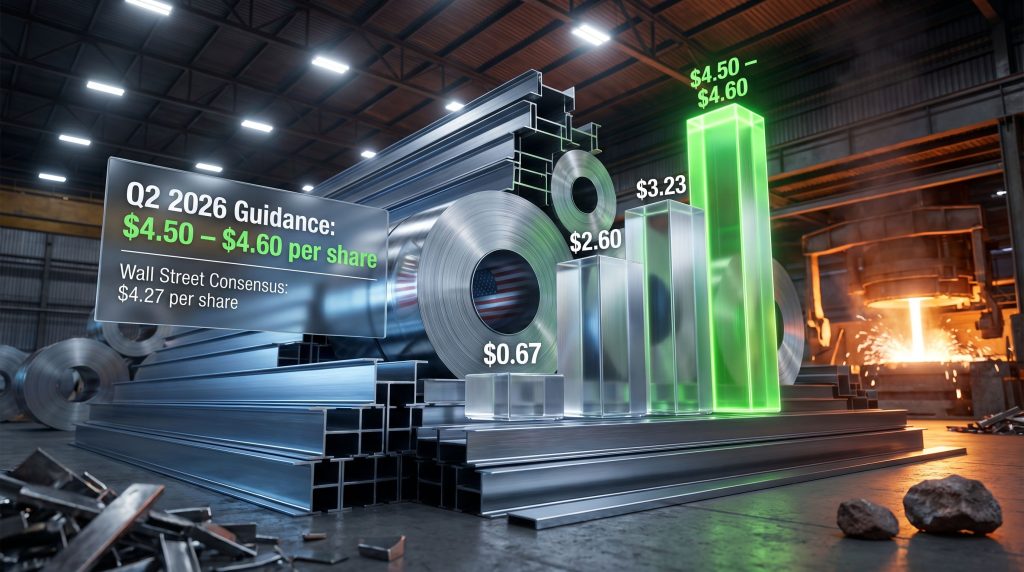
Nucor guided its Q2 2026 adjusted earnings per share to a range of $4.50 to $4.60, comfortably exceeding the Wall Street consensus of $4.27 per share compiled by LSEG. That outperformance margin of roughly 5 to 8% above analyst estimates is meaningful in a sector where earnings beats of even 2 to 3% tend to generate significant share price reactions.
The broader earnings recovery trajectory makes the context even more striking:
| Quarter | Reported / Guided EPS | Primary Driver |
|---|---|---|
| Q1 2025 | $0.67 per share | Margin compression, weak pricing |
| Q2 2025 | $2.60 per diluted share | Partial pricing recovery |
| Q1 2026 | $3.23 per share | Volume growth, improved pricing |
| Q2 2026 (Guidance) | $4.50 – $4.60 per share | Firmer prices, strong mill volumes |
The year-over-year comparison between Q1 2025 and Q1 2026 alone tells a remarkable story. Moving from $0.67 per share to $3.23 per share in a single year represents an improvement of approximately 382%, driven by a combination of pricing normalisation across steel products and meaningful volume recovery within Nucor's steel mills segment. The Q2 2026 guidance range extends that trajectory further, implying that the conditions supporting margin expansion have not yet peaked.
Nucor has confirmed it plans to release its full Q2 2026 results after market close, with investors and analysts expected to focus closely on margin sustainability commentary and any volume guidance provided for the second half of 2026.
Three Structural Forces Tightening Domestic Steel Supply
The earnings beat cannot be fully understood without examining the supply-side dynamics that have concentrated pricing power among domestic producers. Three distinct forces are operating simultaneously.
Trade Policy Frameworks and Import Compression
The persistence of tariff structures on imported steel has fundamentally altered the competitive calculus for foreign producers attempting to access the US market. When landed import costs are elevated by trade measures, domestic producers face less price competition at the margin, allowing them to sustain higher average selling prices across product categories. The US steel and aluminium tariffs have been a consistent tailwind for US-based steelmakers throughout the current cycle, though it is important to note that policy environments can shift, and no tariff framework should be treated as permanent.
Geopolitical Supply Disruptions
Global steel supply chains in 2026 have been affected by ongoing geopolitical tensions that have disrupted production and logistics across multiple regions. The China steel and iron ore market has also contributed to shifting trade flows, and when international supply becomes less predictable, buyers who might otherwise source steel globally tend to prioritise domestic supply chains for reliability. This preference shift increases order volumes at US mills and provides additional support for domestic pricing.
Planned Mill Maintenance as a Supply Tightening Mechanism
A less frequently discussed but genuinely important factor in the current earnings cycle is the role of scheduled maintenance shutdowns. When major US producers temporarily reduce output for planned capital maintenance, the effective supply available to the market contracts even if underlying demand remains constant.
When maintenance schedules at domestic facilities coincide with compressed import availability, the resulting supply tightening can amplify per-unit margins substantially for vertically integrated producers. This dynamic is particularly favourable for operators with diversified mill networks, because the production impact of any single shutdown is limited relative to total capacity.
The combination of these three forces simultaneously operating in the same direction is unusual and helps explain why the Nucor second quarter profit forecast has moved as decisively above consensus as it has.
How Nucor's Business Model Creates Structural Earnings Leverage
Not all steel producers are positioned equally to benefit from the current environment. Nucor's particular competitive advantages amplify the earnings impact of favourable market conditions in ways that blast furnace competitors cannot easily replicate.
The Electric Arc Furnace Cost Advantage
Nucor operates primarily through electric arc furnace technology, which melts recycled scrap metal rather than processing raw iron ore through energy-intensive blast furnace processes. Furthermore, innovations such as hydrogen iron ore reduction are reshaping how the broader industry thinks about input cost structures. This approach offers several critical advantages in volatile markets:
- Output volumes can be adjusted relatively quickly in response to demand changes, reducing the risk of margin erosion during softening cycles
- The primary raw material input is scrap steel, which is domestically sourced and avoids the logistical exposure of iron ore supply chains tied to international shipping
- Energy costs, while significant, are more predictable and manageable than the complex input requirements of integrated blast furnace operations
- Fixed-cost structures are comparatively lower, meaning that incremental revenue improvements flow through to earnings at a higher rate during upcycles
Revenue Diversification Across Downstream Products
Nucor's business is not confined to raw steel production. The company's downstream steel products segment, which manufactures fabricated steel for construction, industrial, and infrastructure applications, provides an additional earnings layer that creates margin buffering when raw steel pricing moves through temporary soft patches. This vertical integration means Nucor captures value at multiple points in the steel supply chain rather than depending entirely on mill-level pricing.
| Competitive Dimension | Nucor Structural Advantage |
|---|---|
| Production Flexibility | EAF model enables rapid output adjustment |
| Geographic Footprint | Diversified US mill network limits regional demand concentration |
| Downstream Integration | Products segment buffers margin during price volatility |
| Capital Efficiency | Lower fixed-cost base versus blast furnace competitors |
| Raw Material Sourcing | Domestic scrap supply reduces international logistics exposure |
Raw Material Dynamics: The Input Cost Story Behind the Earnings Beat
Understanding steel sector earnings requires tracking not just finished product prices but the spread between those prices and the cost of raw material inputs. For electric arc furnace operators like Nucor, scrap metal availability and pricing is the single most important input variable.
Scrap steel pricing in the US is influenced by a complex set of factors including industrial demolition activity, manufacturing sector output rates, and the competitiveness of export markets for American scrap. When domestic scrap prices remain contained while finished steel prices firm up, the margin expansion available to EAF producers can be substantial.
Iron ore prices, while more directly relevant to blast furnace operations, still influence the overall steel market by affecting the cost position of integrated competitors. When iron ore spot markets are elevated, integrated producers face input cost pressure that EAF operators largely avoid, shifting the competitive advantage further toward the scrap-based model.
The spread between hot-rolled coil steel prices and scrap metal input costs is sometimes described as the EAF margin indicator. When this spread widens, as appears to be occurring in Q2 2026, electric arc furnace operators generate earnings that can significantly exceed what integrated producers achieve at the same revenue level.
Energy costs, particularly electricity rates, also factor meaningfully into EAF economics. Regional power pricing variation across Nucor's geographically diversified mill network means the company's aggregate energy exposure is naturally hedged to some degree by operational geography.
Macro Demand Drivers Supporting the Steel Price Recovery
Supply-side compression alone cannot sustain a pricing recovery without corresponding demand. The US steel market in mid-2026 is drawing support from several structural demand anchors that have been building for multiple years.
Infrastructure and Construction Spending
The multi-year rollout of domestic infrastructure investment across roads, bridges, transit systems, and energy infrastructure has created sustained baseline demand for structural steel products. Construction activity, both commercial and residential, remains a primary end market for the types of steel products Nucor manufactures at scale. Unlike demand tied to single discretionary projects, infrastructure-related steel consumption tends to be durable and relatively insensitive to short-term economic fluctuations.
Industrial Reshoring Trends
The broader trend of manufacturing capacity returning to US soil has generated a category of steel demand that was largely absent from the market for the previous two decades. Factories, data centres, semiconductor fabrication facilities, and energy transition infrastructure all require significant quantities of structural and specialty steel. This reshoring-driven demand pool is still in relatively early stages of development, suggesting a medium-term demand runway that extends well beyond current fiscal year dynamics.
Import Substitution Effects
As foreign steel faces cost and logistical headwinds in reaching US buyers, domestic producers effectively gain market share that was previously contested. Consequently, this import substitution effect means that even modest demand growth translates into proportionally larger volume increases for domestic mills. The global crude steel outlook provides additional context for understanding how these domestic dynamics sit within a wider international picture.
The next major ASX story will hit our subscribers first
Key Risks That Could Narrow the Earnings Upside
The current trajectory is favourable, but responsible analysis requires identifying the variables that could compress margins relative to guidance expectations.
While the convergence of trade conditions, supply tightening, and demand resilience has created an unusually favourable operating environment, this combination of factors is unlikely to persist indefinitely. Investors should treat current guidance as reflecting peak conditions for several interacting variables rather than a permanent new baseline.
The primary risk categories include:
- Trade policy shifts that reduce import barriers, reintroducing foreign competition and pressuring domestic price floors
- Construction sector softening triggered by elevated interest rates or credit tightening, which would reduce structural steel demand volumes
- Scrap metal price spikes driven by export demand or constrained collection volumes, compressing EAF margins even when finished steel prices hold
- Energy cost increases affecting electricity-intensive electric arc furnace operations, particularly in regions without long-term power purchase agreements
- Execution risks around maintenance scheduling, where unplanned outages extend beyond planned durations and reduce Q2 volume delivery
- Demand timing mismatches where infrastructure project disbursements are delayed, pushing actual steel offtake into later quarters
However, the longer-term structural case for domestic producers remains compelling, particularly as green steel pricing dynamics begin to influence how buyers and regulators value lower-emissions production methods.
What Institutional Investors Are Monitoring Beyond Headline EPS
For sophisticated investors tracking the Nucor second quarter profit forecast, the actual earnings per share number is only the starting point. The metrics that will determine medium-term positioning decisions include:
- Steel mill segment utilisation rates, which indicate how much pricing power is being sustained relative to capacity deployed
- Average selling price per ton across product categories, to assess whether pricing gains are broad-based or concentrated in a single product line
- Downstream products segment margin trends, which reveal whether value-added processing is contributing proportionally to the earnings improvement
- Management commentary on H2 2026 order books, particularly around infrastructure and industrial end markets
- Capital allocation signals, including share buyback activity and capacity investment decisions, which indicate management's confidence in earnings sustainability
- Scrap metal cost trends disclosed in earnings commentary, providing visibility into input cost trajectory for the remainder of the year
The earnings release scheduled for after market close carries particular significance as a data point not just for Nucor specifically, but as a leading indicator for conditions across the broader US domestic steel sector. When the largest and most operationally efficient domestic producer reports results that exceed consensus by a meaningful margin, it typically signals that the pricing and volume conditions it experienced were broadly shared across the industry rather than uniquely attributable to company-specific factors.
FAQ: Nucor Second Quarter Profit Forecast
What is Nucor's Q2 2026 adjusted EPS guidance?
Nucor has guided Q2 2026 adjusted earnings per share to a range of $4.50 to $4.60, representing a meaningful sequential improvement from the $3.23 per share reported in Q1 2026.
How does this guidance compare to analyst expectations?
The guidance range exceeds the Wall Street consensus of $4.27 per share compiled by LSEG by approximately 5 to 8%, constituting a material positive surprise relative to pre-announcement positioning.
What is driving the improvement versus the prior year?
The primary drivers are higher average selling prices across Nucor's steel mills segment and stronger shipment volumes, both of which reflect the supply tightening and demand conditions described above. The year-over-year comparison against Q1 2025's $0.67 per share also benefits from a particularly weak base period.
When will full Q2 2026 results be released?
Nucor has confirmed results will be released after market close, following the standard pattern for its quarterly earnings disclosures.
What segment is contributing most to the Q2 2026 outperformance?
The steel mills segment, which encompasses Nucor's electric arc furnace production operations, is the primary earnings driver based on the guidance commentary emphasising firmer prices and strong volumes in that division.
How should investors interpret the EPS recovery from Q1 2025 to Q2 2026?
The trajectory from $0.67 per share in Q1 2025 to a guided range of $4.50 to $4.60 in Q2 2026 reflects both cyclical recovery and structural advantages that have concentrated earnings power at domestic producers during a period of constrained import competition. Investors should assess whether the conditions supporting this recovery are durable before extrapolating the trajectory further.
This article is intended for informational purposes only and does not constitute financial or investment advice. Forward-looking guidance, earnings forecasts, and analyst consensus estimates are subject to change and involve inherent uncertainty. Past earnings recovery trajectories are not indicative of future results.
Want to Capitalise on the Next Major ASX Mineral Discovery Before the Market Moves?
Discovery Alert's proprietary Discovery IQ model delivers real-time alerts on significant ASX mineral discoveries, instantly transforming complex mineral data into actionable investment insights for traders and long-term investors alike. Explore why historic discoveries have generated extraordinary returns on Discovery Alert's dedicated discoveries page, and begin your 14-day free trial today to position yourself ahead of the broader market.