June 21, 2026
The Profitability Paradox: Why Some of the Best-Run Silver Miners Trade at the Deepest Discounts
In precious metals markets, operational excellence rarely guarantees a premium valuation. The mining sector has a long history of rewarding narrative over fundamentals, favouring exploration stories and resource announcements over quietly profitable producers grinding out consistent returns. This dynamic creates a specific class of mispricing that value-oriented investors spend considerable energy hunting for: the disciplined, cash-generative producer that the market has failed to reprice despite materially improved economics.
Silvercorp Metals sits squarely in this category. Trading on both the TSX and NYSE American under the ticker SVM, the company operates what is widely considered one of the lowest-cost silver mining operations in the world, yet continues to attract valuation multiples that place it at the bottom of its peer group. Understanding why that gap exists, and more importantly whether it is structural or correctable, is central to the investment thesis. The Silvercorp Metals undervalued stock argument, furthermore, is not built on a single data point but on a convergence of independent frameworks.
When big ASX news breaks, our subscribers know first
Is Silvercorp Metals Actually Undervalued? A Multi-Framework Assessment
Defining the Valuation Gap in Practical Terms
The word "undervalued" is among the most abused terms in equity markets. For it to carry analytical weight, it needs to be grounded in methodology. In Silvercorp's case, multiple independent valuation frameworks are pointing in the same direction, each arriving at a meaningful gap between where the stock trades and where various models suggest it should trade.
| Valuation Source | Implied Upside | Methodology |
|---|---|---|
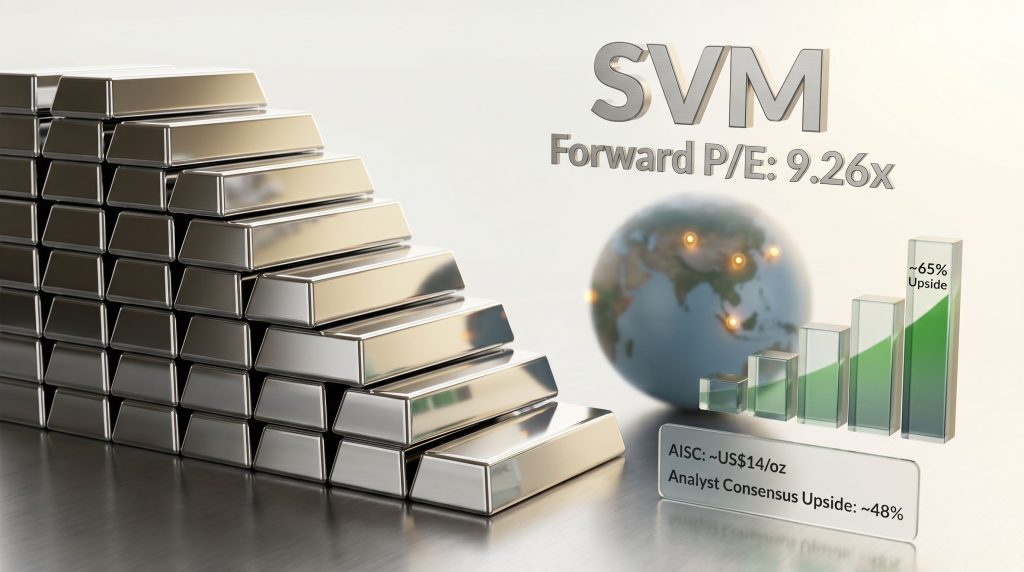
| Simply Wall St (DCF-based) | ~65% | Future cash flow estimate vs. current price |
| Investing.com Consensus | ~48% | 12-month average analyst price target |
| Alpha Spread (CAD) | ~19% | Analyst consensus in Canadian dollar terms |
| Yahoo Finance (2025 Screen) | Significant | Forward P/E of 9.26x vs. sector average |
| Acquirer's Multiple (Historical) | Deep value signal | P/E of 9.8x vs. 5-year average of 22.27x |
Note: These figures reflect different share prices, currencies, and reporting dates and are not directly comparable. They should be treated as directional signals only, not precise price targets.
The core of the Silvercorp undervalued stock thesis is not that one methodology shows a discount. It is that multiple independent methodologies, using different assumptions and data sets, converge on the same conclusion: the stock is trading well below both intrinsic value estimates and peer-relative benchmarks.
A forward price-to-earnings ratio of 9.26x is particularly striking when measured against sector norms, and even more so given that the company's trailing P/E of 9.8x sits dramatically below its own five-year historical average of 22.27x. This internal discount, comparing the company to its own historical trading range rather than peers, is a signal that warrants serious attention. For broader context on how metal prices and mining equities interact, this dynamic is well-documented across the sector.
What Is Driving Silvercorp's Financial Performance Right Now?
The Metal Price Multiplier Effect on Margin
Silver mining economics are inherently leveraged to the underlying metal price. When silver prices rise, a low-cost producer does not simply earn marginally more. It can earn exponentially more, because fixed and semi-fixed cost structures mean that incremental revenue flows almost entirely to the bottom line. This is precisely the dynamic playing out in Silvercorp's recent reporting periods.
The company has delivered consistently positive net income across multiple market cycles, but the most recent quarters ended December and March revealed what higher metals prices actually mean for a producer operating at the cost levels Silvercorp maintains. Quarterly earnings have reached levels that, on an annualised basis, are multiples of what the company would have recorded in full fiscal years during periods of lower silver prices.
Furthermore, understanding silver's dual nature as both a precious and industrial metal helps contextualise why demand-side pressures continue to support elevated price floors even during periods of broader market uncertainty.
The NSR Per Tonne Framework: A More Precise Profitability Lens
Rather than measuring performance purely in ounces produced or total revenue, Silvercorp's management tracks what they call a profit-per-tonne framework using net smelter return (NSR) per tonne of ore mined and milled. This unit economics approach integrates grade delivery, realised metals prices, and cost control into a single operational signal.
- The blue line represents NSR revenue per tonne of ore, driven by the grades being achieved and the prevailing silver price
- The red line represents all-in sustaining cost (AISC) per tonne of ore mined
- The green bars represent the gap between these two lines: operational profit per tonne
This visual framework makes it immediately apparent when margin is expanding or compressing, and in the most recent quarters, that green bar has widened sharply in response to rising silver prices against a broadly contained cost base.
Seasonality and the Chinese New Year Effect
Historically, Silvercorp's fourth fiscal quarter, which encompasses the Chinese New Year period, has been one of its seasonally weaker reporting windows. Mine operations are curtailed during the holiday period, and a number of timing-related payments compress reported results. However, with expanded production capacity now in place at the Ying Mine, this seasonal softness was notably absent in the most recent fourth quarter ended March. That is a meaningful operational development that the market may not yet have fully absorbed.
How Silvercorp Controls Costs While the Broader Mining Industry Faces Inflation
Electric Ore Haulage: Eliminating Diesel Dependency
Mining companies globally have struggled to contain operating costs through an inflationary cycle that has driven up energy, labour, and consumable costs across the board. Silvercorp has actively worked to insulate itself from these pressures through targeted operational changes.
One of the most consequential has been the conversion of all underground ore haulage trucks from diesel to rechargeable electric vehicles. This eliminates diesel as a cost input for the ore transport function entirely, removing both the direct fuel cost and the exposure to diesel price volatility from that element of the production chain.
Off-Peak Electricity Scheduling
For electricity-intensive activities such as crushing and dewatering pumps, Silvercorp has shifted operational scheduling to take advantage of lower tariff rates available during overnight hours. This is a straightforward but genuinely effective mechanism for reducing per-tonne energy costs without sacrificing throughput.
Mechanisation and Automation: Labour Intensity Reduction
The company is actively pursuing greater mechanisation on both the mining and milling sides of operations. The principle is straightforward: by deploying more equipment to move a tonne of rock, the labour input per tonne declines. In underground silver mining, where labour is one of the largest variable cost components, this shift can compound meaningfully over time.
Treatment and Refining Charges: A Market-Driven Tailwind
As a concentrate producer, Silvercorp's realised revenue is affected not only by spot metals prices but by treatment and refining charges (TC/RCs), which are the fees smelters charge to process concentrates. In recent years, strong demand for silver concentrates and notably tightening conditions in the zinc market have caused these charges to move in the company's favour, contributing incrementally to higher net revenue per tonne of ore processed.
Silvercorp's all-in sustaining cost for the 12 months ended March was reported at just over US$14 per ounce of silver, net of byproduct credits from lead, zinc, and a growing gold component. This positions the company among the lowest-cost silver producers in its peer group globally.
What Is the China Discount and How Much Is It Weighing on Valuation?
Single-Asset, Single-Jurisdiction Risk: The Structural Haircut
When fund managers and analysts assess a mining company, jurisdiction concentration is one of the first risk factors they apply to their valuation models. A company whose entire revenue, earnings, and cash flow derive from a single asset in a single country is inherently more vulnerable to a concentrated set of operational, regulatory, and geopolitical risks than a multi-asset producer spread across several regions.
Silvercorp has, until recently, fit that description almost precisely. The Ying Mine in China's Henan province has been the dominant, effectively exclusive source of the company's financial performance. This single-asset status is widely cited as the primary driver of the valuation discount. Silver supply deficits at the macro level have not been sufficient on their own to overcome this jurisdiction-related headwind in terms of market repricing.
The Comparables Problem
Compounding the single-jurisdiction issue is an absence of comparable companies. There are no other TSX or NYSE-listed silver producers operating primarily in China. This means investors and analysts have no direct benchmark against which to assess whether Silvercorp's operational performance, cost structure, or regulatory environment is typical or exceptional. Without a comparable, uncertainty is elevated, and markets tend to price uncertainty conservatively.
| Peer Category | Valuation Position Relative to SVM |
|---|---|
| North American silver producers (median EV/EBITDA) | Trading at a premium to Silvercorp |
| Chinese-listed mining companies | Also trading at a premium to Silvercorp |
| Silvercorp (current) | At the lower end of both peer universes |
The notable point here is that Silvercorp trades at a discount not only to its North American peer group but also to Chinese-listed mining companies when assessed on comparable valuation multiples. The company is effectively being discounted by both the market it operates in and the market it is listed on.
How Silvercorp Is Building a Self-Funded Growth Pipeline Beyond the Ying Mine
El Domo, Ecuador: Copper-Polymetallic Production Target of Mid-2027
In a move that significantly changes the company's asset profile, Silvercorp acquired a company holding the El Domo project in Ecuador several years ago and has since taken that asset into active construction. El Domo is a copper-rich polymetallic deposit with a targeted production commencement of mid-2027. When operational, it will add a geographically separate revenue stream in a different commodity category, beginning the transformation from single-asset to multi-asset producer.
Condor, Ecuador: A Hidden Value Asset in Plain Sight
The same acquisition that brought El Domo also included the Condor project, a gold-focused asset that management describes as having the characteristics of a viable low-cost underground gold operation. Condor was not the primary rationale for the acquisition at the time, but subsequent exploration and development work has demonstrated that it may represent significant standalone value that was not priced into the original transaction, which in retrospect proved to be a cost-effective entry.
Kyrgyzstan: Over 6 Million Ounces of Staged Gold Development Potential
Earlier in 2025, Silvercorp made a significant move into Central Asia with the acquisition of two gold projects in Kyrgyzstan. Combined, these assets provide exposure to and operational control of over 6 million ounces of gold resource that the company intends to develop on a staged basis. The Kyrgyzstan acquisitions were made during a period of elevated gold prices, but with development plans that are described as actionable in the near term rather than speculative long-term targets.
The Revenue Transformation Roadmap
| Project | Location | Commodity Focus | Expected Timeline |
|---|---|---|---|
| Ying Mine (Core) | China | Silver, Lead, Zinc, Gold | Ongoing, capacity being expanded |
| El Domo | Ecuador | Copper-polymetallic | Mid-2027 production target |
| Condor | Ecuador | Gold (underground) | Advanced exploration and development |
| Kyrgyzstan Assets (x2) | Kyrgyzstan | Gold | Staged development, near-term plans |
Taken together, these projects represent a pathway from approximately US$400 million in current annual revenues to a potential US$2 billion revenue base within five to six years. This is not an incremental growth story. It is a structural transformation of the company's earnings capacity.
The next major ASX story will hit our subscribers first
Financing Growth Without Diluting Shareholders
Internal Cash Generation as the Capital Foundation
Perhaps the most underappreciated element of Silvercorp's position is that its growth pipeline is designed to be funded primarily through internally generated cash flow. In a capital markets environment where equity issuance windows are unpredictable and share dilution is a persistent concern for shareholders in junior and mid-tier mining companies, a self-funded growth model is a genuine structural advantage.
The RMB Credit Facility: ~US$220 Million in Undrawn Capacity
Silvercorp has also secured a renminbi-denominated term credit facility with Chinese banking institutions, providing approximately US$220 million in currently undrawn debt capacity at rates described as competitive. This facility provides a meaningful buffer against reliance on equity markets during periods when capital markets may be less receptive, and it allows the company to move opportunistically on growth without being forced to issue shares at inopportune valuations.
Chinese Engineering Capability as a Construction Cost Advantage
One less-discussed but practically significant aspect of Silvercorp's growth execution capability is its access to Chinese engineering, construction, and equipment supply chains. In jurisdictions like Ecuador and Kyrgyzstan, where infrastructure costs can be substantial, the ability to source technical expertise, hard assets, and construction services from a deep and competitive Chinese market may allow Silvercorp to build projects at lower capital costs and maintain tighter schedules than competitors relying solely on local or Western supply chains.
The Hong Kong Stock Exchange Listing: Expanding the Investor Universe
Silvercorp has filed a registration statement to pursue a listing on the Hong Kong Stock Exchange, which would establish it as a company trading across three exchanges spanning North America and Asia.
| Exchange | Status | Primary Investor Base |
|---|---|---|
| TSX (Toronto) | Active | Canadian institutional and retail |
| NYSE American | Active | U.S. institutional and retail |
| Hong Kong Stock Exchange | Registration filed (2025) | Asian institutional, high net worth, and retail |
The strategic rationale is multifaceted. Asian institutional funds and individual investors have shown growing interest in precious metals equities, not just physical metal. As that investment appetite expands from commodity exposure into the companies that produce those commodities profitably, Silvercorp's profile becomes significantly more relevant to that investor base. The listing is intended to add marginal buying power to the stock's trading liquidity and bring the company's story to investors who may never have encountered it through North American channels. The broader precious metals outlook for 2025 suggests sustained institutional appetite for well-managed producers precisely like Silvercorp.
Key Bear Case Arguments and How They Stack Up
Risk vs. Mitigant Analysis
| Risk Factor | Severity | Mitigating Factor |
|---|---|---|
| Single-asset concentration | High (historically) | Diversification pipeline actively underway |
| China jurisdiction risk | Moderate | Long operating track record; domestic RMB credit access |
| Execution in new markets | Moderate | Experienced mine-building team; Chinese supply chain access |
| Silver price reversal | High | Low AISC of ~US$14/oz provides meaningful downside buffer |
| Equity dilution | Low | Self-funded model plus US$220M undrawn credit facility |
The bear case arguments against Silvercorp are real and should not be dismissed. Revenue concentration in a single Chinese asset remains a legitimate concern until the growth pipeline is operational. Execution risk in Ecuador and Kyrgyzstan exists for any company developing projects in emerging market jurisdictions. And silver price sensitivity cuts both ways: the same leverage that has amplified recent earnings could compress them quickly if prices retreat toward multi-year lows.
However, the mitigating factors are also substantive. An AISC of just over US$14 per ounce means the company remains profitable at silver price levels well below current market prices. The undrawn credit facility insulates against equity market dependency. And the growth pipeline is at various stages of concrete development, not speculative exploration. Analyst estimates compiled by Alpha Spread similarly reflect this nuanced picture, with consensus views acknowledging both the discount and the operational quality underpinning it.
Frequently Asked Questions About Silvercorp Metals
What is Silvercorp's all-in sustaining cost per ounce of silver?
For the 12 months ended March 2025, Silvercorp reported an AISC of just over US$14 per ounce of silver, calculated net of byproduct credits from lead, zinc, and gold. This places the company among the lower-cost silver producers globally.
Why does Silvercorp trade at a discount to North American silver mining peers?
The discount reflects a combination of single-asset concentration, single-jurisdiction exposure in China, and the absence of a directly comparable peer group that would allow standard valuation benchmarking.
What commodities does Silvercorp produce beyond silver?
The Ying Mine produces silver as its primary output alongside lead, zinc, and an increasing gold component. The growth pipeline adds copper exposure through El Domo and expands the gold component significantly through Condor and the Kyrgyzstan acquisitions.
Is Silvercorp's growth self-funded?
Primarily, yes. The company's growth pipeline is designed to be financed through operating cash flows supplemented by an approximately US$220 million undrawn RMB-denominated credit facility, with equity issuance treated as an option rather than a necessity.
What is the significance of the Hong Kong listing?
The Hong Kong Stock Exchange registration filing is intended to open Silvercorp's shareholder base to Asian institutional capital and retail investors, expanding trading liquidity and exposing the company's story to a new audience already oriented toward precious metals investment.
The Re-Rating Thesis: What Would Need to Happen
The path toward closing Silvercorp's valuation gap is not dependent on any single catalyst. Rather, it is a convergence of operationally and strategically driven milestones:
- El Domo reaching production in mid-2027, adding a geographically separate, copper-rich revenue stream and formally transitioning Silvercorp from single-asset to multi-asset producer status
- Condor demonstrating viable gold economics and being recognised by the market as a standalone value contributor rather than an acquisition afterthought
- Hong Kong listing attracting new institutional demand from Asian investors not previously exposed to the Silvercorp story
- Sustained or rising silver prices compounding free cash flow generation and widening the profit-per-tonne margin further
- Peer group reclassification as a multi-asset, multi-jurisdiction producer, which typically commands meaningfully higher valuation multiples in the mining equity universe
The undervaluation case for Silvercorp is fundamentally a convergence thesis. No single milestone will close the gap in isolation. But as operational excellence, geographic diversification, new capital market access, and a sustained precious metals environment layer on top of one another, the structural reasons for the current discount progressively diminish.
The company's current position, generating quarterly earnings that rival historical full-year figures, carrying one of the lowest AISCs in its peer group, holding an undrawn US$220 million credit facility, and advancing a concrete growth pipeline toward US$2 billion in potential revenues, represents a fundamentally different business than the one the market has historically assigned a single-digit earnings multiple to. In addition, the gold-silver ratio remains a key reference point for institutional investors assessing relative value between the two metals, and any shift in that ratio could further accelerate re-rating interest in producers like Silvercorp. Whether the market reprices that difference in six months or three years depends on execution, metal prices, and investor attention. But the raw material for a re-rating is increasingly difficult to overlook. Morningstar's coverage of SVM provides an additional independent lens through which to track how mainstream analytical platforms are progressively recognising the Silvercorp Metals undervalued stock argument.
This article is intended for informational and educational purposes only. It does not constitute financial advice or a recommendation to buy or sell any security. All valuations, forecasts, and financial projections referenced herein involve assumptions and inherent uncertainty. Past financial performance is not indicative of future results. Readers should conduct their own independent due diligence and consult a licensed financial adviser before making any investment decisions.
Want to Catch the Next Major Mineral Discovery Before the Broader Market Does?
Discovery Alert's proprietary Discovery IQ model delivers real-time alerts on significant ASX mineral discoveries, turning complex mineral data into actionable insights for both short-term traders and long-term investors — explore historic examples of exceptional discovery returns to understand what early positioning can mean, then begin your 14-day free trial at Discovery Alert to secure your market-leading edge.