June 21, 2026
Africa's Atlantic Margin and the Frontier Premium Reshaping Offshore Investment
Frontier basin exploration has never followed a straight line. Capital flows toward under-explored geology in waves, retreating during commodity downturns and surging back when nearby discoveries recalibrate what operators believe is geologically possible. The Atlantic margin of West and Central Africa is currently experiencing one of those surges, and São Tomé and Príncipe offshore oil contracts are sitting at the centre of renewed investor attention.
The commercial discoveries that have reshaped regional risk perception are well documented. TotalEnergies and Shell's Graff and Venus wells in Namibia's Orange Basin, Eni's Baleine field off Côte d'Ivoire, and continued pre-salt production growth in Angola's deepwater blocks have collectively compressed the perceived risk premium across the entire Atlantic Equatorial Transform Margin. When supermajors demonstrate commercial viability in one part of a geological corridor, the adjacent acreage that once seemed speculative begins attracting serious technical scrutiny.
São Tomé and Príncipe sits squarely within this corridor. The dual-island archipelago nation occupies a geographic position that places it in geological proximity to producing formations in both Gabon and Equatorial Guinea, while sharing structural affinities with Brazil's equatorial margin through the Atlantic conjugate margin relationship. This combination of location and geology is increasingly difficult for international oil companies to overlook, particularly as global exploration licensing trends shift toward frontier Atlantic acreage.
When big ASX news breaks, our subscribers know first
Understanding São Tomé and Príncipe's Dual Offshore Licensing Framework
A fundamental distinction shapes all analysis of São Tomé and Príncipe offshore oil contracts: the country operates two structurally separate licensing jurisdictions, each with different governance arrangements, revenue sharing structures, and levels of current activity.
The EEZ: Where the Action Is
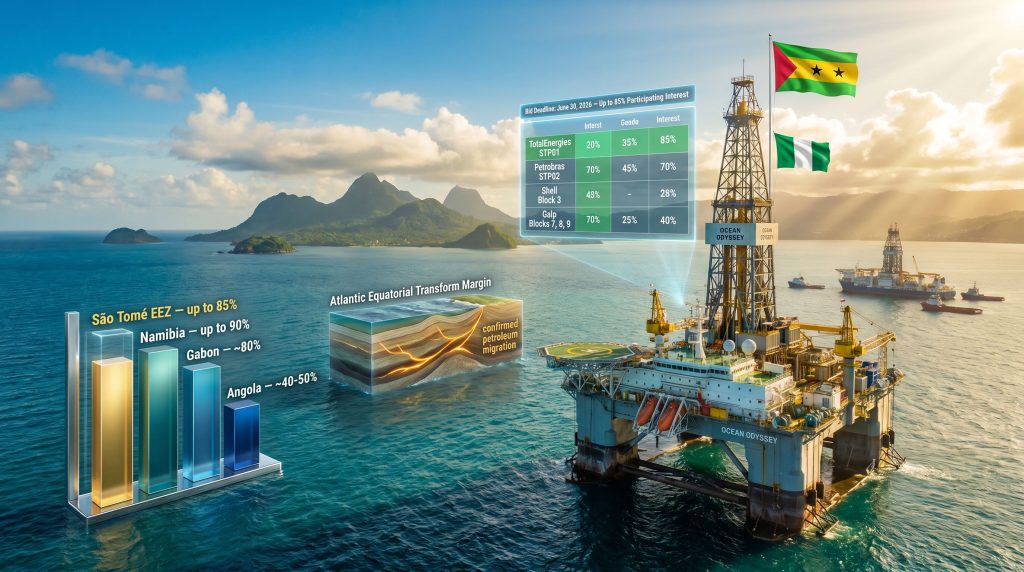
The Exclusive Economic Zone, administered independently by the Agência Nacional do Petróleo de São Tomé e Príncipe (ANP-STP), uses production-sharing contracts as its primary legal instrument. Under the current licensing round, operators can secure participating interests of up to 85% in the available blocks, a figure that ranks among the highest offered in any contemporary African offshore round. This generosity is deliberate: it reflects the government's understanding that early-stage frontier geology must be offset by commercially attractive terms to compete for international capital alongside more de-risked opportunities elsewhere.
The dual-submission bid structure requires applicants to provide both a technical work programme proposal and a separate financial proposal for each targeted block. This format allows ANP-STP to evaluate the quality of planned exploration activity alongside commercial commitment, rather than awarding blocks on financial terms alone.
The JDZ: A Treaty-Based Co-Administration Arrangement
The Joint Development Zone operates under a bilateral treaty between São Tomé and Príncipe and Nigeria, administered by the Joint Development Authority. Revenue from petroleum produced within the JDZ is distributed asymmetrically: Nigeria retains 60% of proceeds while São Tomé and Príncipe receives 40%. This split reflects the relative negotiating positions of the two countries at the time the treaty was established, with Nigeria's larger economy and established petroleum sector giving it substantially greater leverage.
JDZ activity has slowed materially since the zone's initial drilling phase produced disappointing results, redirecting operator attention and government promotional energy toward the EEZ blocks, where contractual flexibility and favourable terms are creating renewed momentum. The US Trade and Development Agency's country guide provides useful context on the regulatory framework underpinning both jurisdictions.
The Regional Competitive Landscape: Where São Tomé Sits
Understanding the relative positioning of São Tomé and Príncipe's offshore opportunity requires a comparative view across the Atlantic margin's active and emerging basins. Furthermore, the geopolitical mining landscape shaping commodity investment decisions in 2025 and 2026 is directly influencing where IOCs choose to allocate frontier exploration budgets.
| Basin / Country | Exploration Stage | Recent Discoveries | Key Operators |
|---|---|---|---|
| Namibia (Orange Basin) | Active appraisal | Graff, Venus | TotalEnergies, Shell |
| Angola (Deepwater) | Production + new exploration | Multiple pre-salt targets | TotalEnergies, BP, Eni |
| Côte d'Ivoire | Appraisal | Baleine field | Eni, Petroci |
| Gabon | Mature + new rounds | Shallow/deep targets | Perenco, TotalEnergies |
| São Tomé and Príncipe (EEZ) | Early-stage frontier | Petroleum system confirmed, no commercial find | TotalEnergies, Petrobras, Shell, Galp |
| São Tomé and Príncipe (JDZ) | Dormant/re-emerging | Disappointing early results | Under review |
The table reveals a clear pattern. São Tomé and Príncipe is positioned as the earliest-stage jurisdiction among the major Atlantic margin plays, meaning it carries the highest per-well exploration risk but also offers the largest potential uplift from a commercial discovery. This risk-return profile is precisely what attracts a specific category of IOC: operators with the technical capability to evaluate frontier geology and the balance sheet to absorb exploration write-offs without material damage to their overall portfolio.
The 2026 Bid Round: Blocks 7, 8, and 9 in Detail
The current São Tomé and Príncipe offshore oil contracts process covers three blocks located in the western portion of the country's EEZ. The round launched in May 2026 and the bid submission deadline is June 30, 2026. ANP-STP executive director Alvaro Silva has confirmed the intention to finalise production-sharing contracts for all three blocks before the end of 2026, which would allow seismic campaigns and early drilling preparations to commence in 2027.
Key commercial and technical parameters for the round include:
- Location: Western EEZ, adjacent to geologically analogous producing formations in Gabon and Equatorial Guinea
- Geological target: Cretaceous-age structural traps within the Atlantic Equatorial Transform Margin corridor
- Bid structure: Dual-submission format requiring both a technical work programme and a separate financial proposal per block
- Operator stake: Up to 85% participating interest, among the highest offered in current African offshore licensing
- Bid deadline: June 30, 2026
- Contract target: Production-sharing agreements finalised before December 31, 2026
- Flexibility: Operators may bid on one, two, or all three blocks
Shell and Galp have been identified as among the companies that have expressed interest in the round, according to reporting by Upstream. Shell's involvement carries particular significance: supermajor-level technical due diligence applied to a frontier basin functions as an independent credibility signal for other potential bidders.
Galp's interest reflects both its established Atlantic margin expertise across deepwater Brazil, Namibia, and Mozambique, and its historical commercial presence in Portuguese-speaking African markets, giving it institutional familiarity that can accelerate the evaluation process. Shell has also been active in drilling offshore São Tomé and Príncipe, further reinforcing the basin's growing credibility among tier-one operators.
Operator Positioning: TotalEnergies and Petrobras Build Scale
TotalEnergies' Northern EEZ Consolidation
TotalEnergies has established a dominant position in the northern EEZ corridor through its operation of Block STP01 and its June 2024 acquisition of a 60% operated interest in Block STP02. The adjacency of these two blocks creates a contiguous exploration footprint that enables shared seismic infrastructure, integrated geological interpretation, and reduced per-well exploration costs through economies of scale.
This dual-block approach mirrors the strategy TotalEnergies has deployed in other frontier basins, including Namibia's Orange Basin, where controlling contiguous acreage allows the operator to build a basin-wide geological model rather than evaluating isolated structures. The pattern suggests a long-term development thesis rather than opportunistic acreage accumulation.
Petrobras' Atlantic Corridor Expansion
Petrobras' acquisition of a 75% stake in Block 3 from Nigeria's Oranto Petroleum represents a structurally significant shift in the operator nationality mix within the EEZ. The transaction remains subject to regulatory approvals, which introduces a material timeline uncertainty that serves as a live test of ANP-STP's institutional processing capacity.
Beyond Block 3, Petrobras has reportedly secured or is pursuing interests in Blocks 4, 10, 11, and 13, suggesting a deliberate portfolio-building strategy consistent with its deepwater expertise in the Brazilian pre-salt. The geological rationale is compelling: São Tomé's offshore geology shares structural analogues with Brazil's Santos and Campos basins through the Atlantic conjugate margin relationship, meaning Petrobras brings directly transferable technical knowledge that other operators would need to develop from scratch.
The following table summarises the current operator landscape across EEZ blocks:
| Block | Primary Operator | Participating Interest | Status (2026) |
|---|---|---|---|
| STP01 | TotalEnergies | Operated | Active exploration |
| STP02 | TotalEnergies | 60% (acquired June 2024) | Recently awarded |
| Block 3 | Petrobras (from Oranto Petroleum) | 75% (pending regulatory approval) | Under regulatory review |
| Blocks 4, 10, 11, 13 | Petrobras (reported) | Various | 2024–2025 expansion |
| Block 6 / Block 11 | Shell, Galp (joint arrangements) | Various | Active |
| Blocks 7, 8, 9 | Open – bid round closes June 30, 2026 | Up to 85% offered | Competitive bidding phase |
The Geology: What the Rocks Actually Say
Cretaceous Corridor Analogues
Blocks 7, 8, and 9 target Cretaceous-age structures within the geological corridor that underpins production in both Gabon and Equatorial Guinea. Key structural similarities with these producing regions include syn-rift and post-rift sedimentary sequences, salt-related trapping mechanisms, and Albian carbonate reservoir potential. Gabon's Anguille and Gamba formations represent the closest producing analogues for reservoir quality assessment in the São Tomé context.
The Jaca-1 and Falcão-1 wells, previously drilled in the archipelago, confirmed active petroleum systems, validating source rock maturity, migration pathways, and partial trap integrity. This is critical information: it means the basin is not in the speculative pre-system category but in the more advanced and more investable "petroleum system confirmed, commerciality unproven" tier.
The Conjugate Margin Thesis
The Atlantic conjugate margin concept deserves particular attention as an analytical framework for evaluating São Tomé's deeper exploration targets. When the African and South American plates separated during the Mesozoic, the rifting process created geologically paired basins on either side of the Atlantic. São Tomé's offshore geology is the eastern conjugate of Brazil's equatorial margin, and the same tectonic forces that generated the Santos Basin's prolific pre-salt reservoirs also shaped the structural framework on São Tomé's side of the ocean.
This analogue has proven commercially reliable elsewhere. The Guyana-Suriname basin, which sits on the western side of the Atlantic conjugate relationship with West Africa's transform margin, has delivered some of the most significant offshore discoveries of the past decade. ExxonMobil's Stabroek block alone hosts recoverable resources exceeding 11 billion barrels of oil equivalent as of recent estimates. The directional inference for São Tomé is clear, even if the basin-specific risk remains substantial.
The next major ASX story will hit our subscribers first
Scenario Modelling: Three Contractual Outcome Pathways for 2026
Any forward-looking analysis of São Tomé and Príncipe offshore oil contracts must account for the range of possible outcomes from the current bid round.
Scenario A: Full Round Completion (Base Case)
All three blocks are awarded before December 31, 2026. Initial seismic campaigns commence in Q1 2027. First exploration wells become possible within 24 to 36 months of contract signing. This outcome is supported by confirmed IOC interest from Shell and Galp, strong regional discovery momentum, and ANP-STP's stated institutional commitment to year-end completion.
Scenario B: Partial Award with Carry-Over (Moderate Case)
One or two blocks are awarded in 2026, with remaining blocks re-tendered in 2027. Possible causes include insufficient competing bids for all three blocks or gaps in technical proposal quality for specific acreage. The consequence is delayed seismic data acquisition and reduced portfolio diversification for the government's near-term revenue planning.
Scenario C: Round Extension or Suspension (Downside Case)
The bid deadline is extended beyond June 30, 2026, or the round is suspended pending broader regulatory review. Potential triggers include delays in the Petrobras-Oranto Block 3 approval creating institutional uncertainty, a deterioration in current crude oil prices, or broader geopolitical factors affecting IOC capital allocation decisions. The impact would be investor confidence erosion and potential re-pricing of the risk premium for subsequent rounds.
Risk Factors That Investors Cannot Ignore
Exploration Risk: The Gap Between Confirmation and Commerciality
The distance between "petroleum system confirmed" and "commercial discovery declared" is where the majority of frontier basins fail to deliver investor returns. São Tomé has drilled multiple wells without a commercial find, a historical track record that must be weighed against the improving regional context. No amount of favourable analogue evidence eliminates well-by-well geological risk, and investors should model exploration outcomes probabilistically rather than assuming discovery.
Regulatory Timeline Risk
The pending approval of Petrobras' Block 3 acquisition from Oranto Petroleum is a live stress test of ANP-STP's administrative capacity. If this transaction faces prolonged delays, it signals institutional bottlenecks that could affect the execution timeline of the 2026 bid round contracts.
Revenue Dependency and Pre-Production Economics
São Tomé and Príncipe has a population of approximately 230,000 and an economy currently structured around tourism, cocoa exports, and development assistance. The country has not yet achieved commercial offshore production, meaning licensing fees, signature bonuses, and work programme commitments from operators represent the totality of near-term petroleum sector revenues.
Transformative fiscal change requires a commercial discovery and a full field development decision, a pathway that typically spans a decade or more from initial exploration contract to meaningful production revenue. Equatorial Guinea's oil economy transformation following its 1990s offshore discoveries illustrates both the scale of the potential upside and the length of the timeline investors must accept.
Energy Transition Capital Allocation Pressures
Major IOCs face increasing ESG-related scrutiny over exploration budgets directed toward frontier basins with long lead times before potential production. Consequently, the energy transition demand narrative is reshaping how operators justify frontier exploration to their shareholders and boards. However, this pressure does not eliminate frontier exploration investment entirely. The operators currently active in São Tomé's EEZ, including TotalEnergies and Petrobras, have both indicated through their portfolio strategies that frontier Atlantic margin exploration remains within their long-dated investment mandate.
Furthermore, the trade war impact on oil markets adds another layer of macro uncertainty that operators must factor into their capital allocation frameworks when evaluating projects with long development horizons.
How São Tomé's Licensing Terms Compare Regionally
| Country | Primary Contract Type | Max Operator Interest | State Participation | Bid Round Status |
|---|---|---|---|---|
| São Tomé and Príncipe (EEZ) | PSC | Up to 85% | ANP-STP carried interest | Active (2026 round) |
| Gabon | PSC + Concession | ~80% typical | Gabon Oil Company back-in | Periodic |
| Equatorial Guinea | PSC | ~80% typical | GEPetrol participation | Periodic |
| Namibia | PSC | ~90% (frontier terms) | NAMCOR participation | Active (multiple rounds) |
| Angola | PSC (deepwater) | ~40–50% typical | Sonangol mandatory participation | Managed by ANPG |
"São Tomé's offer of up to 85% participating interest is structurally competitive with Namibia's frontier terms, which are widely regarded as the most investor-friendly in the current African offshore market. This positioning reflects the government's calculated recognition that geological uncertainty must be compensated by commercial generosity to attract IOC capital away from more de-risked alternatives."
Frequently Asked Questions
Has São Tomé and Príncipe Ever Produced Commercial Oil Offshore?
No. As of mid-2026, São Tomé and Príncipe has not achieved commercial offshore oil production. The petroleum sector remains entirely in the exploration phase, with confirmed active petroleum systems but no commercial discovery declared.
What Is the Difference Between the EEZ and the JDZ?
The EEZ is administered solely by São Tomé and Príncipe through ANP-STP using production-sharing contracts. The JDZ is co-administered with Nigeria under a bilateral treaty, with Nigeria receiving 60% of petroleum revenues and São Tomé and Príncipe receiving 40%.
When Will the 2026 Bid Round Contracts Be Finalised?
The bid submission deadline is June 30, 2026. ANP-STP has indicated its intention to finalise production-sharing contracts for awarded blocks before the end of 2026, enabling seismic campaigns and early drilling preparations in 2027.
What Revenue Does the Government Currently Earn from Its Offshore Sector?
In the absence of commercial production, government revenues are limited to licensing fees, signature bonuses, and operator work programme commitments. Material fiscal transformation depends on a commercial discovery and subsequent field development decision.
This article contains forward-looking statements and scenario analysis based on publicly available information as of June 2026. Exploration outcomes, contract timelines, and commercial results are inherently uncertain. Nothing in this article constitutes financial or investment advice. Readers should conduct independent research and consult qualified advisers before making investment decisions.
Want to Track the Next Major Mineral Discovery the Moment It Hits the ASX?
While São Tomé and Príncipe's frontier offshore potential unfolds over years, significant ASX mineral discoveries can deliver substantial returns within days of announcement — and Discovery Alert's proprietary Discovery IQ model delivers real-time alerts the moment those discoveries are made, turning complex geological data into actionable insights for investors at every experience level. Explore historic discoveries and their remarkable returns to understand what's possible, then begin your 14-day free trial to position yourself ahead of the broader market.