June 18, 2026
When Central Banks Stand Still, Markets Don't
There is a recurring paradox in modern monetary policy: sometimes the most market-moving decision a central bank can make is the decision to do nothing. Rate holds are not neutral events. When they arrive wrapped in hawkish language, they can reprice entire asset classes faster than an actual rate change would. Understanding why requires looking past the headline number and into the mechanics of forward guidance.
This dynamic played out sharply in June 2026 when the US Federal Reserve opted to hold its benchmark rate steady under newly appointed Chairman Kevin Warsh, and the ripple effects were felt thousands of kilometres away on the Australian Securities Exchange. The ASX falls after Fed holds rates story is not simply about one overnight session — it reflects structural linkages between the world's largest economy and one of its most globally exposed equity markets.
When big ASX news breaks, our subscribers know first
The Hawkish Hold: Why Staying Still Sends a Signal
Rate Decisions Are Really Communication Events
In modern central banking, the actual rate decision often matters less than the framing around it. A hold can be interpreted in two very different ways depending on tone and forward guidance.
A dovish hold tells markets that rate cuts are approaching — rates are unchanged for now, but the direction is downward. A hawkish hold does the opposite: it keeps rates steady but signals that further increases remain a live possibility. The latter is arguably more disruptive to equities because it closes off the optionality that investors had already priced in.
When markets expect a rate cut and receive a hold with hawkish commentary instead, the repricing isn't just about current rates — it's about the entire expected rate trajectory being shifted upward. That shift flows immediately into equity valuations, bond yields, and currency markets.
What the Fed Actually Did in June 2026
Warsh, who took over the Fed chairmanship under the Trump administration, held the US cash rate unchanged at the June 2026 meeting. This surprised a market that had broadly anticipated a cut, partly based on political signals suggesting the administration wanted looser monetary conditions. Instead, Warsh's post-meeting commentary emphasised the priority of defeating price instability — language that investors parsed as keeping rate hikes firmly on the table.
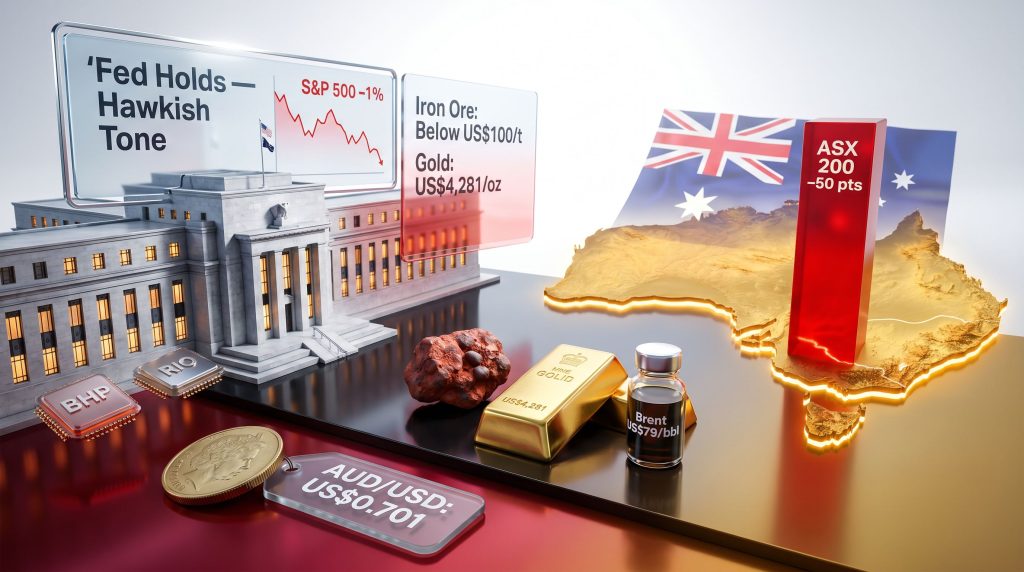
The reaction was immediate and risk-off in nature. The S&P 500 declined approximately 1%, while the Nasdaq and Dow Jones Industrial Average posted even steeper losses — reflecting the particular sensitivity of growth-oriented stocks to discount rate expectations. Furthermore, two-year yield signals in the bond market confirmed that traders were rapidly repricing their expectations for the Fed's future path.
How Wall Street's Reaction Reached the ASX
The Transmission Mechanism in Practice
The ASX does not operate in isolation from US monetary policy. Several interconnected channels carry the impact of a Fed decision into Australian trading sessions:
- Overnight futures pricing — ASX SPI futures reprice in real time as US markets move, setting the tone before the 10am Sydney open
- USD strength dynamics — a hawkish Fed drives the US dollar higher, which puts downward pressure on the Australian dollar and suppresses USD-denominated commodity prices simultaneously
- Risk-off capital flows — global institutional investors reduce exposure to higher-beta, smaller markets like Australia when US monetary uncertainty rises
- Rate differential repricing — when the Fed signals higher-for-longer rates, the spread between US and Australian yields shifts, influencing capital allocation decisions
| Market Event | US Reaction | ASX Follow-Through |
|---|---|---|
| Fed hawkish hold (June 2026) | S&P 500 -1%, Nasdaq/Dow deeper losses | ASX 200 projected ~50-point open decline |
| Historical hawkish Fed surprise | Broad Wall Street selloff | Banks and technology among largest drags |
| Fed rate cut cycle (historical) | Risk-on rally | Resources and financials outperform |
Why Australian Investors Treat the Fed as a Local Event
Australian institutional portfolios carry significant US equity exposure, meaning overnight Wall Street losses translate directly into mark-to-market pressure on fund performance. Beyond portfolio construction, the AUD/USD exchange rate is among the most Fed-sensitive currency pairs in the developed world.
The Australian dollar's high correlation with global risk appetite and its role as a commodity currency make it particularly vulnerable when the Fed tightens its tone. Following the June 2026 decision, the AUD was tracking at approximately US$0.701 (70.1 US cents) at the Australian market open — a level consistent with a market absorbing USD strength and reduced risk appetite simultaneously. In addition, ASX market performance in prior Fed-sensitive periods reinforces how consistently this transmission mechanism plays out.
Two Central Banks Hold in the Same Week
The RBA's Own Pause Creates a Compressed Policy Environment
What made the June 2026 episode particularly significant for Australian investors was that the Reserve Bank of Australia had held its own cash rate steady just days earlier, on Tuesday June 17. Two of the most globally significant central banks for Australian asset prices both standing pat within the same week created what could be described as a compressed policy environment — limited near-term relief for rate-sensitive sectors, with uncertainty dominating the outlook.
Policy Divergence Risk: Three Scenarios for Australian Investors
The interplay between Fed and RBA positioning creates distinct scenarios with very different implications for ASX sector performance:
- Scenario A — Fed hikes while RBA holds: The AUD depreciates materially. Import costs rise, consumer spending contracts, and ASX consumer discretionary and retail stocks face compounding headwinds from both weaker sentiment and input cost pressures.
- Scenario B — Both central banks hold with hawkish tone: Equity markets remain range-bound. Defensive sectors such as utilities and healthcare tend to offer relative outperformance as investors seek yield stability.
- Scenario C — Fed pivots to cuts, RBA follows: Risk-on conditions return. Resources, financials, and growth-oriented stocks historically lead the recovery in this scenario.
The June 2026 environment most closely resembled Scenario B — a dual hold with hawkish undertones — but with the added complexity of a potential Strait of Hormuz reopening providing a partial geopolitical offset for energy and resource stocks.
The ASX 200 at the Open: What the Numbers Showed
Morning Session Mechanics and the 50-Point Projected Decline
Australian futures markets pointed to an approximately 50-point decline in the ASX 200 at the Thursday morning open on June 18, 2026. This projection reflected the direct repricing of risk after Wall Street's negative close and was consistent with the pattern observed in comparable prior episodes.
A historically comparable Fed hawkish hold event produced an ASX 200 decline of 1.7% — illustrating that the June 2026 projected move, while significant, sits within the established range of responses to this type of Fed outcome. However, the commodity price impact on individual ASX names added an additional layer of pressure beyond the index-level move itself.
Sector-Level Impact: Who Bears the Brunt
Not all ASX sectors respond equally to a hawkish Fed signal. The following breakdown reflects both theoretical sensitivities and observed historical patterns:
| Sector | Sensitivity to Hawkish Fed | Likely Direction |
|---|---|---|
| Financials / Banks | High (rate curve, credit conditions) | Negative |
| Technology | High (growth stock discount rate rises) | Negative |
| Resources / Materials | Moderate (USD commodity pricing offset by AUD weakness) | Mixed |
| Healthcare | Low to Moderate (defensive characteristics) | Relatively Resilient |
| Real Estate (REITs) | High (yield-sensitive, capital cost rises) | Negative |
| Energy | Moderate (geopolitical factors can offset) | Mixed |
Commodity Markets: Iron Ore, Gold, and Brent Crude React
Iron Ore Drops Below the US$100 Threshold
Iron ore prices fell below US$100 per tonne in Singapore trading following the Fed's decision. This level carries psychological and practical significance — it is a widely watched threshold for the profitability of Australian iron ore producers, particularly for higher-cost operations. Furthermore, the iron ore price decline below this key level reflects how a stronger USD environment creates a direct headwind for USD-denominated commodity prices.
For BHP (ASX: BHP) and Rio Tinto (ASX: RIO), the world's two largest listed iron ore producers, sustained weakness below US$100/tonne would begin to pressure earnings forecasts and, eventually, dividend projections.
Gold Reverses Despite Safe-Haven Logic
Gold's behaviour following the Fed decision was counterintuitive to many retail investors who view it as an automatic safe-haven play during equity weakness. The precious metal reversed earlier gains to trade at approximately US$4,281 per ounce — a move that reflects a less commonly understood dynamic. Understanding the gold and bond dynamics at play here is essential for investors navigating these conditions.
When the Fed signals higher-for-longer rates, two forces work against gold simultaneously:
- USD strength increases the opportunity cost of holding a non-yielding asset priced in dollars
- Real yield increases make interest-bearing alternatives more attractive relative to gold's zero yield
This explains why hawkish Fed outcomes, even when accompanied by equity market weakness, do not always trigger the gold rally that conventional safe-haven logic might predict.
Oil Finds a Geopolitical Counterweight
Brent Crude held relatively steady near US$79 per barrel despite the broader commodity weakness — a divergence explained by a separate geopolitical development. A preliminary US-Iran agreement related to a potential reopening of the Strait of Hormuz had been circulating in markets, providing an independent bullish signal for energy prices that partially offset the Fed-driven USD headwinds.
This is a useful reminder that commodity markets rarely move on a single driver. The Hormuz factor also explained why both BHP (ASX: BHP) and Macquarie Group (ASX: MQG) had reached new record highs earlier in the week before the Fed decision reintroduced uncertainty.
The next major ASX story will hit our subscribers first
Are ASX Heavyweights Actually Insulated From This Volatility?
The Natural Hedge Within Large-Cap Miners
One of the least understood dynamics in ASX resource investing is the non-linear relationship between Fed policy, the AUD, and miner earnings. Major diversified miners like BHP and Rio Tinto generate revenue predominantly in USD while reporting in Australian dollars. When a hawkish Fed weakens the AUD, their Australian dollar earnings can actually improve — even if USD commodity prices simultaneously fall.
The net effect depends entirely on which force is larger. If the AUD weakens by 3% but iron ore falls 5%, the Australian dollar earnings of an iron ore producer still decline. If the AUD weakens by 5% while iron ore falls only 2%, the earnings translation actually improves.
For ASX resource investors, the question is never simply "did the Fed turn hawkish?" — it is "how much did the AUD move relative to the commodity price change?" These two variables must be assessed together, not in isolation.
Record Highs as a Complicating Factor
The fact that both BHP and Macquarie entered the post-Fed session at or near record highs adds a layer of complexity. Stocks trading at record levels carry elevated valuations that are more susceptible to sentiment shifts. A Fed-driven risk-off move arriving precisely when heavyweights are most richly priced creates asymmetric downside risk compared with a selloff that arrives mid-cycle.
What History Says About Recovery From Fed-Driven ASX Selloffs
ASX falls after Fed holds rates have historically been short-to-medium duration events when Australian domestic economic conditions remain stable. The recovery pattern tends to follow a recognisable sequence:
- Initial sharp selling in rate-sensitive sectors (banks, REITs, technology)
- Commodity price stabilisation as USD strength moderates
- AUD finding a floor as domestic economic data reasserts itself
- Resources and financials leading the bounce as risk appetite returns
Prolonged weakness following hawkish holds has historically only materialised when the Fed's tone was subsequently validated by actual rate hikes — meaning the initial repricing was correct rather than an overreaction.
The June 2026 episode adds a geopolitical dimension that prior episodes lacked. The partial recovery in energy prices and the record highs in major ASX names suggest the market entered this selloff with more underlying strength than many comparable historical episodes — a factor that may support a shorter recovery timeline, all else being equal.
Key Signals for Australian Investors to Monitor Going Forward
Given the multi-factor nature of the current environment, investors should track several concurrent developments rather than fixating on the Fed decision in isolation:
- Fed forward guidance language — the tone of post-meeting communications matters more than the rate decision number itself
- AUD/USD exchange rate — a real-time indicator of how markets are pricing the Fed-RBA policy differential; watch for stabilisation as a potential early signal of ASX recovery
- Iron ore relative to US$100/tonne — sustained weakness below this level would begin to pressure ASX resource sector earnings and dividend assumptions meaningfully
- Gold's real yield response — tracking US real yields (inflation-adjusted bond yields) provides better context for gold price movements than nominal yields alone
- Strait of Hormuz developments — geopolitical news flow around energy supply routes can provide offsetting tailwinds for energy stocks and diversified miners simultaneously
- RBA communication — any shift in the RBA's tone following the Fed's hawkish hold could amplify or dampen the domestic impact on rate-sensitive ASX sectors
Frequently Asked Questions: ASX Falls After Fed Holds Rates
Why Does the ASX Fall When the US Federal Reserve Holds Rates?
The ASX declines when the Fed holds rates in a hawkish manner because markets interpret the decision as reducing the probability of near-term rate cuts. This strengthens the USD, pressures commodity prices, and triggers a global risk-off shift that flows through to Australian equities overnight.
What Is a Hawkish Hold in Monetary Policy?
A hawkish hold occurs when a central bank keeps rates unchanged but signals through its language or projections that further rate increases remain possible. The hold itself is neutral, but the accompanying rhetoric creates a tightening bias in market expectations.
How Much Did the ASX Fall After the Fed's June 2026 Decision?
Australian futures markets pointed to an approximately 50-point decline in the ASX 200 at the Thursday open following the Fed's June 2026 hold decision. A comparable prior episode saw the ASX 200 fall 1.7% under similar Fed-driven conditions.
What Happened to Iron Ore and Gold After the Fed Held Rates?
Iron ore fell below US$100 per tonne in Singapore, while gold reversed to approximately US$4,281 per ounce. Both moves reflected the stronger USD environment that typically follows a hawkish Fed signal.
How Does the Fed's Decision Affect the Australian Dollar?
A hawkish Fed outcome typically strengthens the USD, which places downward pressure on the AUD. Following the June 2026 decision, the AUD/USD was tracking at approximately US$0.701 (70.1 US cents).
Does the RBA Follow the Fed When Setting Australian Interest Rates?
The RBA sets rates independently based on domestic economic conditions. However, Fed policy indirectly influences RBA decisions through its impact on the AUD, inflation via import prices, and global financial conditions. The RBA held its own cash rate steady in the days immediately preceding the Fed's June 2026 decision.
The material in this article is intended for informational purposes only and does not constitute financial or investment advice. Readers should conduct independent research and consult a licensed financial adviser before making any investment decisions. Forecasts, scenario analyses, and historical comparisons referenced in this article are for educational purposes and should not be relied upon as predictors of future market performance.
Want to Stay Ahead of ASX Mineral Discoveries When Markets Shift?
When Fed-driven volatility reshapes the ASX landscape, identifying high-potential mineral discoveries quickly becomes a decisive advantage — Discovery Alert's proprietary Discovery IQ model delivers real-time alerts on significant ASX discoveries, turning complex data across 30-plus commodities into clear, actionable insights. Explore historic examples of exceptional discovery returns and begin your 14-day free trial at Discovery Alert to position yourself ahead of the market.