June 18, 2026
What Six Years of Holding a Mining Giant Reveals About Patient Investing
Long-duration investing in cyclical resource stocks requires a mindset that sits uncomfortably with human psychology. Markets reward conviction unevenly, front-loading volatility and back-loading returns in ways that test even experienced portfolio managers. For investors willing to hold through the turbulence, however, the mathematics of compounding and commodity cycles can produce outcomes that feel disproportionately generous relative to the initial risk taken.
BHP Group Ltd (ASX: BHP) offers one of the most instructive case studies in this regard. Studying BHP shares performance since 2020 reveals a layered story involving pandemic-era uncertainty, a historic commodity boom, a painful Chinese demand correction, and a powerful re-rating that pushed the stock to record territory by mid-2026. Understanding how each of these phases interacted with share price, dividends, and reinvestment mechanics provides a framework that extends well beyond any single stock.
When big ASX news breaks, our subscribers know first
A Six-Year Price Journey: From Uncertainty to Record Highs
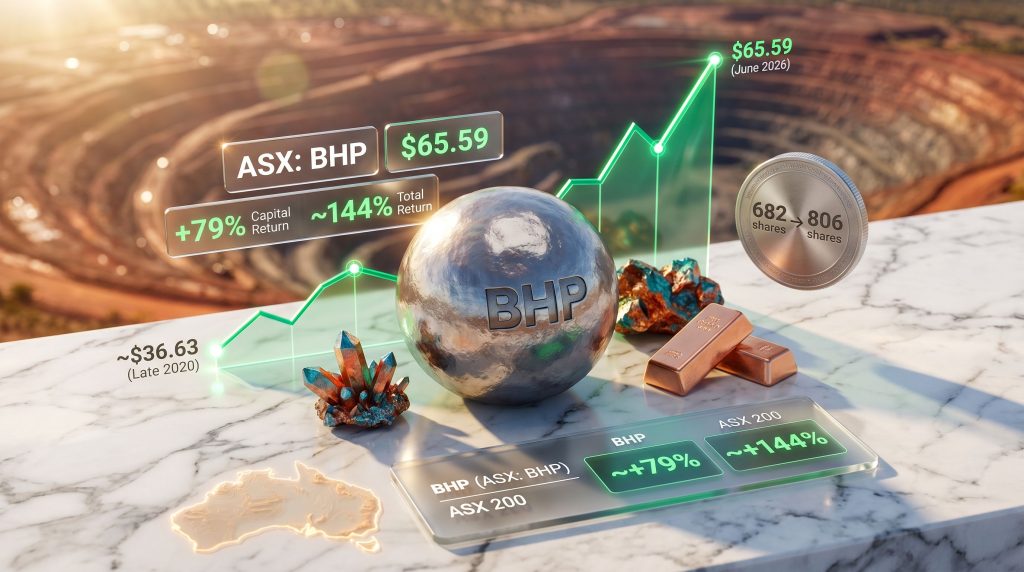
BHP's trajectory since late 2020 has been anything but linear. The stock entered that period at approximately $36.63 per share, against a backdrop of pandemic disruption, commodity market volatility, and significant investor anxiety about global growth trajectories.
By mid-June 2026, BHP reached a 52-week high of $65.59, representing capital appreciation of roughly 79% from the late 2020 entry point. The year-to-date gain in 2026 alone stood at approximately 43.18%, with the trailing 12-month gain reaching an impressive 72% from mid-2025 levels.
The following table maps the key phases of BHP's price evolution across the full period:
| Period | Approximate Starting Price | Approximate Ending Price | Capital Return |
|---|---|---|---|
| Late 2020 (Baseline Entry) | ~$36.63 | — | Baseline |
| 2021 Commodity Rally | ~$36.63 | ~$50+ | ~+37% |
| 2022 Peak and Pullback | ~$50 | ~$45–48 | Moderate decline |
| 2023–2024 China Headwinds | ~$45 | ~$38–42 | Contraction phase |
| FY2026 YTD (to June 2026) | ~$45.53 | $65.59 | +43.18% |
| Full Period (Late 2020 to June 2026) | ~$36.63 | $65.59 | ~+79% |
Note: Prices are approximate and for illustrative purposes only. Past performance is not indicative of future returns.
The Four Phases That Shaped BHP's Performance
Phase 1: Pandemic Uncertainty (2020)
BHP briefly retreated into the low $30s as investors priced in demand destruction risk and supply chain disruption. This phase tested investor resolve early and established the psychological baseline for what followed.
Phase 2: The Commodity Supercycle (2021–2022)
Iron ore prices surged to record levels above US$230 per tonne in mid-2021, driven by Chinese infrastructure stimulus spending, significant supply disruptions from Brazilian operations, and a powerful post-pandemic demand recovery. As one of the world's largest iron ore producers, BHP was a primary beneficiary, with earnings and dividends reaching exceptional levels during this window. Furthermore, the iron ore demand outlook during this period created conditions that were near-impossible to replicate.
Phase 3: China's Property Sector Contraction (2022–2024)
China's real estate market deterioration materially suppressed forward iron ore demand expectations. Steel production growth slowed, and BHP's share price drifted from peak levels back toward the high $30s. This phase highlighted the asymmetric risk profile of commodity-linked equities, where the same macro force that drives outperformance can reverse sharply.
Phase 4: The 2026 Re-Rating and Record Territory
BHP's surge to $65.59 in June 2026 was underpinned by a combination of copper demand re-pricing linked to electrification infrastructure, improved market expectations around Chinese stimulus policy, and a broader re-evaluation of diversified miners with energy transition commodity exposure.
Modelling a Real Investment: What $25,000 Actually Delivered
Applying the 682-share scenario to concrete numbers makes the abstract concept of total return tangible for investors.
An investor who allocated approximately $24,987 to BHP shares in late 2020 at ~$36.63 per share would have acquired 682 shares. By mid-June 2026, with BHP trading at $65.59, that holding would carry a market value of approximately $44,732, representing a capital gain of around $19,745 before tax.
However, capital appreciation tells only part of the story.
The Dividend Layer: Where the Real Wealth Accumulation Occurred
BHP has historically ranked among the ASX's most substantial dividend payers, particularly during peak commodity cycle phases. Over the 2020 to 2026 period, cumulative dividends per share are estimated at approximately $24 per share, reflecting both ordinary and special dividend distributions during the supercycle years.
On a 682-share holding, this translates to roughly $16,368 in gross dividend income across the period.
Dividend income from resource stocks during commodity cycle peaks can dwarf what investors typically model when assessing yield. BHP's per-share distributions during 2021 and 2022 alone represented yields that, on a cost-basis calculation from the 2020 entry price, significantly exceeded headline market yields.
The combined return picture is materially different from capital-only analysis:
| Return Component | Estimated Value |
|---|---|
| Initial Investment (682 shares @ ~$36.63) | ~$24,987 |
| Market Value at $65.59 (682 shares) | ~$44,732 |
| Capital Gain | ~$19,745 |
| Estimated Dividends Received (682 shares × ~$24) | ~$16,368 |
| Total Value Created | ~$36,113 |
| Effective Total Return | ~144% |
General illustration only. Actual returns depend on entry and exit timing, tax treatment, franking credit utilisation, and dividend reinvestment choices.
How BHP's Dividend Reinvestment Plan Amplifies Long-Term Outcomes
The mechanics of BHP's dividend reinvestment plan introduce a compounding dimension that fundamentally alters the wealth-building trajectory for enrolled shareholders. Understanding how this mechanism functions is essential context for long-duration investors.
Step-by-Step: How BHP's DRP Compounds Wealth Over Time
- BHP declares an interim or final dividend for eligible shareholders
- Shareholders enrolled in the DRP elect to receive new shares in lieu of cash distributions
- New shares are issued at a price that typically reflects the prevailing market rate over a defined calculation period
- The expanded shareholding generates proportionally higher entitlements for subsequent dividend payments
- The cycle repeats across each dividend period, steadily accelerating the compounding effect
Modelling DRP participation across the full 2020 to 2026 period produces a materially different endpoint. Assuming an average share price of approximately $51 across the reinvestment window, the 682-share base position could have grown to approximately 806 shares through systematic DRP participation alone.
At $65.59 per share, an 806-share holding would carry a market value of approximately $52,866, representing an additional ~$8,134 in portfolio value compared to the non-DRP scenario. Those additional 124 shares were generated without deploying any fresh capital.
Why Compounding Matters More in Cyclical Stocks Than Many Investors Realise
A counterintuitive insight about cyclical miners is that dividend reinvestment during price troughs, when sentiment is weakest, can acquire shares at relatively low prices that carry significant upside when the commodity cycle turns. Investors who reinvested BHP dividends during the 2023 and early 2024 correction phase would have accumulated shares at prices materially below the eventual 2026 high, amplifying the compounding benefit.
BHP's Commodity Exposure: The Architecture Behind the Returns
Understanding why BHP delivered these returns requires examining its commodity exposure structure, which shapes both the earnings profile and the cyclical risk characteristics of the stock.
Iron Ore: The Dominant Earnings Engine
Iron ore remains BHP's primary earnings driver, with the company's Pilbara operations in Western Australia producing among the world's largest volumes of the commodity. This concentration creates a direct linkage between Chinese steel production activity and BHP's profitability, making the stock effectively a high-quality proxy for Chinese industrial demand cycles.
A detail that many retail investors underappreciate is that iron ore quality and grade specifications significantly affect realised pricing. BHP's Pilbara blend typically achieves pricing premiums over benchmark seaborne cargoes due to consistent grade specifications and low impurity profiles — a factor that matters during periods of Chinese blast furnace operators managing input costs tightly. In addition, the broader commodity price sensitivity across BHP's portfolio means earnings can shift dramatically with relatively modest moves in spot prices.
Copper: The Energy Transition Re-Rating Story
Copper has become an increasingly significant component of BHP's strategic narrative. The company's South American copper operations, including Escondida in Chile (the world's largest copper mine by production volume), position BHP as a major beneficiary of the structural demand growth associated with electric vehicle production, grid infrastructure buildout, and renewable energy generation capacity.
Copper demand from energy transition applications is projected to grow substantially through the 2030s, with some industry analysts estimating that clean energy technologies could represent over 40% of copper demand by the end of the decade, compared to a much smaller share historically.
The copper supply crunch contributed meaningfully to BHP's 2026 price surge, as markets began pricing in tighter supply-demand balances for the metal over a medium-term horizon.
Potash: The Long-Duration Growth Option
The Jansen Potash Project in Saskatchewan, Canada, represents a multi-decade growth investment targeting global food security themes. Potash is a critical agricultural fertiliser input, and BHP's entry into this market provides commodity diversification that partially decouples future earnings from steel cycle dynamics. This is a lesser-known dimension of BHP's long-term positioning that receives limited attention relative to iron ore and copper in mainstream investment commentary.
BHP vs. ASX 200: Benchmarking the Outperformance
Contextualising BHP's returns against the broader market is essential for assessing whether the outperformance compensated investors appropriately for the additional cyclical risk assumed. The ASX 200 benchmark provides a useful reference point for evaluating how BHP's total return stacks up against the broader market over the same period.
| Metric | BHP (ASX: BHP) | ASX 200 (Approximate) |
|---|---|---|
| Capital Return Since Late 2020 | ~+79% | ~+30–40% (est.) |
| Dividend Yield (Historical Average) | ~5–8% p.a. | ~4% p.a. |
| Total Return (Estimated) | ~+144% | ~+55–65% (est.) |
| Cyclicality | High | Moderate |
| Commodity Price Sensitivity | Very High | Low–Moderate |
Comparative figures are approximate and for educational illustration purposes only.
BHP's estimated total return of approximately 144% over the period significantly exceeded the broader ASX 200's estimated total return of 55–65%, though this differential came with substantially higher volatility and commodity price risk throughout the holding period.
The next major ASX story will hit our subscribers first
Valuation Frameworks for Assessing BHP at Current Levels
With BHP trading at $65.59, investors face a different risk-reward calculation than those who entered in late 2020. Several valuation frameworks are relevant for resource sector assessment:
- Price-to-Earnings (P/E): Must be interpreted relative to commodity cycle positioning, as earnings are highly variable year-to-year
- EV/EBITDA: Provides a more stable comparison metric for capital-intensive miners, normalising for different capital structure approaches
- Dividend Yield on Current Price: At higher prices, the yield compresses relative to cost-basis yield, altering the income-return proposition
- Net Asset Value (NAV) per Share: Reflects the underlying value of mineral resources and reserves, providing a longer-term intrinsic value anchor independent of short-term commodity prices
Scenario Analysis: Bull, Base, and Bear Cases Beyond 2026
| Scenario | Key Assumptions | Potential Implication |
|---|---|---|
| Bull Case | Iron ore holds above US$100/t; copper demand accelerates; Chinese stimulus materialises | Share price sustains above $60; strong dividend continuation |
| Base Case | Commodity prices moderate; steady Chinese demand; copper growth offsets iron ore softness | Share price consolidates in $50–$65 range; moderate dividends |
| Bear Case | Iron ore falls below US$80/t; Chinese demand disappoints; global recession risk increases | Share price retreats toward $38–$45; dividend reductions likely |
Investor Caution: BHP's strong multi-year performance since 2020 does not imply similar returns ahead. Commodity cycles are inherently difficult to predict, and investors entering at materially higher prices face a different entry-point risk profile than those who accumulated during the 2020 uncertainty period. This content is general in nature and does not constitute personal financial advice.
Frequently Asked Questions: BHP Shares Performance Since 2020
How much has BHP's share price increased since 2020?
From a late 2020 entry price of approximately $36.63, BHP reached $65.59 by mid-June 2026, representing capital appreciation of approximately 79% on price alone. You can review BHP's historical share price data to examine the full trajectory across this period.
What dividends has BHP paid since 2020?
Cumulative dividends per share over the 2020 to 2026 period are estimated at approximately $24 per share, reflecting substantial distributions during the 2021 and 2022 commodity boom years.
What is BHP's total return including dividends since 2020?
On a 682-share holding established in late 2020, the estimated total return combining capital gains and dividend income is approximately 144%, or roughly $36,000 in value created on a ~$25,000 initial outlay.
How does BHP's dividend reinvestment plan work?
The DRP allows enrolled shareholders to receive new BHP shares instead of cash dividends, issued at a price reflecting the prevailing market rate. Participation allows the shareholding base to grow organically without additional capital deployment, amplifying future dividend entitlements.
What commodity prices most influence BHP's share price?
Iron ore pricing is the dominant short-term driver given its centrality to BHP's earnings. Copper price movements are increasingly influential as energy transition demand themes are incorporated into market valuations. Broader economic indicators affecting Chinese industrial activity serve as leading indicators for both commodities.
The Three Pillars of BHP's Wealth-Building Mechanism
BHP shares performance since 2020 demonstrates a repeatable, if cyclically volatile, wealth-building architecture built on three interconnected components:
- Capital appreciation driven by commodity cycle upswings and strategic portfolio repositioning toward future-facing minerals
- Dividend income that can represent a substantial or even dominant share of total return, particularly when yield is measured on original cost rather than current price
- Compounding through reinvestment, which allows the share count to expand organically, creating a self-reinforcing mechanism that magnifies returns in subsequent up-cycles
The patience premium embedded in this framework is significant. Investors who maintained their position through the pandemic uncertainty, the commodity boom, the Chinese demand correction, and the 2026 re-rating captured the full value of each phase. Those who exited during the 2022 to 2024 contraction avoided short-term drawdown but sacrificed the largest single-year gain in the entire period.
Consequently, BHP's experience reinforces a core principle of long-duration resource investing: high-quality, globally diversified mining assets with multi-commodity exposure tend to reward conviction across full market cycles in ways that shorter holding periods systematically undervalue.
This article contains general financial information only and does not constitute personal financial advice. Investors should consider their own circumstances, risk tolerance, and investment objectives, and consult a licensed financial adviser before making any investment decisions. Past performance is not indicative of future returns. All figures are approximate and illustrative only.
Want to Identify the Next Major Mineral Discovery Before the Broader Market Does?
While BHP represents the patient, long-duration approach to resource investing, Discovery Alert's proprietary Discovery IQ model scans ASX announcements in real time, instantly alerting subscribers to significant new mineral discoveries — the kind of early-stage opportunities that can generate substantial returns well before a stock matures into a large-cap holding. Explore historic discovery returns on Discovery Alert's dedicated discoveries page and begin your 14-day free trial to position yourself at the forefront of the next major ASX mineral discovery.