June 21, 2026
Chasing Yield in a Commodity World: What Fortescue's Dividend Really Tells You
Income investing looks deceptively simple on the surface. Find a stock with a high yield, collect the dividends, repeat. But the most dangerous trap in yield-focused investing is confusing a high headline number with a reliable income stream. Commodity-linked dividend payers operate by an entirely different set of rules compared to banks, utilities, or consumer staples companies, and Fortescue Ltd (ASX: FMG) is one of the clearest examples of this distinction playing out in real time.
Before asking whether the Fortescue share price is a buy for its 8% dividend yield, investors need to understand what that yield figure actually represents, where it comes from, and how quickly it can disappear when the underlying commodity cycle turns.
When big ASX news breaks, our subscribers know first
Breaking Down the Yield: What the 8% Figure Actually Means
The ~8% yield figure attached to Fortescue shares is not the cash dividend yield. It is the grossed-up yield, which incorporates the value of franking credits attached to the dividend payment. This is a critical distinction that is frequently misunderstood, particularly by newer income investors comparing Fortescue to other asset classes.
Here is how the numbers break down:
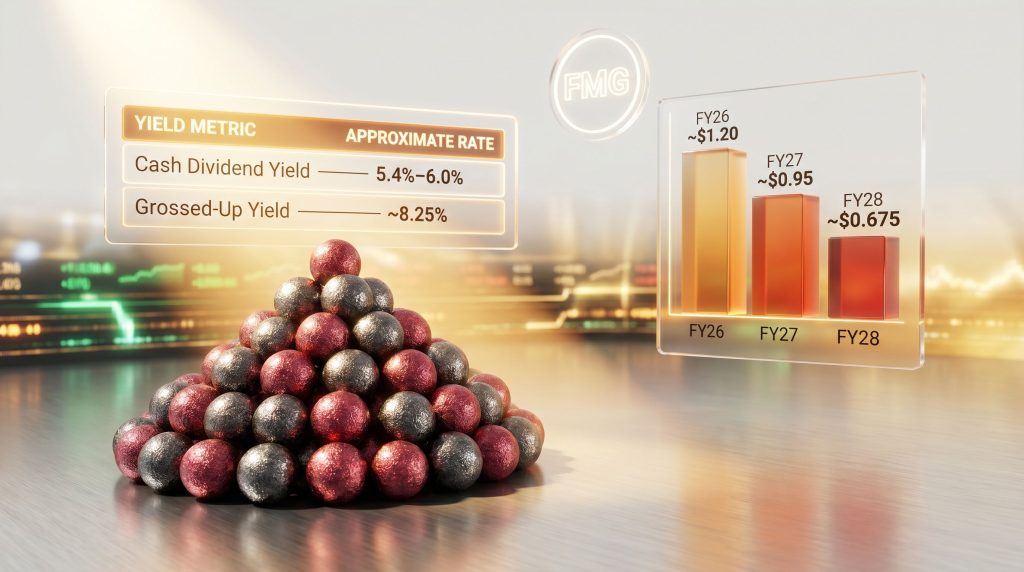
| Yield Metric | Approximate Rate | Includes Franking Credits? |
|---|---|---|
| Cash Dividend Yield | 5.4%–6.0% | No |
| Grossed-Up Yield | ~8.25% | Yes |
| Total Shareholder Yield | Varies | Partially |
How Franking Credits Work and Why They Matter
Australia's dividend imputation system allows companies to attach franking credits to dividends, representing corporate tax already paid on those earnings. When an Australian tax resident receives a franked dividend, they receive a credit for this prepaid tax, which offsets their personal tax liability.
For self-managed superannuation fund (SMSF) investors in pension phase, the benefit is even more pronounced. These investors pay zero tax on earnings, meaning franking credits can generate a direct cash refund from the Australian Taxation Office. This makes the grossed-up yield a genuinely meaningful figure for this cohort, not simply an accounting construct.
However, the franking benefit is exclusively available to Australian tax residents. International investors holding Fortescue shares receive the cash dividend only, making the effective yield comparison considerably less compelling when benchmarked against global income alternatives.
The grossed-up yield of ~8.25% is real for certain Australian investors, particularly SMSF pension phase members, but it represents a tax system benefit rather than additional cash flow from the business itself.
How Iron Ore Prices Drive Every Dividend Decision
Fortescue's dividend policy is directly linked to net profit, which is in turn highly sensitive to iron ore price trends. This makes Fortescue's income stream fundamentally different from a bank or utility dividend, which tends to be more stable and predictable across economic cycles.
The Commodity-Dividend Feedback Loop
The company operates a percentage-of-profit payout model, which means when iron ore prices are elevated, dividends are large, and when prices compress, dividends follow proportionally downward. There is no fixed dividend floor or minimum payout commitment that insulates shareholders from commodity price volatility.
Key price dynamics to understand:
- Iron ore prices held above US$100 per tonne through most of FY26, providing a strong earnings foundation
- Prices briefly peaked above US$110 per tonne in mid-May 2026 before retreating
- The US$100 per tonne level functions as an approximate threshold for robust earnings generation at Fortescue's cost structure
- Fortescue's all-in costs, including shipping and royalties, mean profit margins compress materially as prices approach the US$80–$90 per tonne range
Scenario Modelling: Three Iron Ore Price Pathways
Rather than treating the current price environment as permanent, income investors should stress-test their return expectations across multiple scenarios. Furthermore, understanding the iron ore downside risks is essential before committing capital to any dividend thesis built on commodity earnings.
Scenario A: Iron Ore Holds Above US$100/tonne
- FY26 dividend likely sustained at approximately $1.20 per share
- Grossed-up yield remains attractive on current entry prices
- This scenario requires continued resilience in Chinese steel demand and no major supply disruptions
Scenario B: Iron Ore Retreats to US$80–$100/tonne
- Dividend compression becomes probable; FY27 consensus estimates of approximately $0.95 per share become the relevant benchmark
- Cash yield on today's entry price shrinks to roughly 4.5%–5.0% before franking
- Margin pressure increases; capital loss risk rises alongside income reduction
Scenario C: Iron Ore Falls Below US$80/tonne
- Significant dividend reduction becomes near-certain
- The income thesis collapses entirely; the stock's investment case shifts from yield to commodity recovery speculation
- This scenario has historical precedent during periods of Chinese property sector stress
What Analyst Consensus Is Forecasting for FY27 and FY28
The critical issue confronting income investors in Fortescue is not the FY26 dividend, which looks well supported at current iron ore prices. The problem is the trajectory beyond this financial year. In addition, the China steel demand outlook remains subdued, adding further uncertainty to any forward earnings projections.
Projected Dividend per Share: A Multi-Year Decline
| Financial Year | Forecast DPS | Year-on-Year Change |
|---|---|---|
| FY26 | ~$1.20 | Base year |
| FY27 | ~$0.95 | ↓ approximately 21% |
| FY28 | ~$0.675 | ↓ approximately 29% further |
These projections carry important implications for anyone buying Fortescue shares today primarily for income. An investor entering at current prices to capture the FY26 yield is effectively purchasing a dividend stream that consensus expects to decline by roughly 44% in total over the following two financial years.
By FY28, the cash dividend yield on today's entry price would fall to approximately 3%–4%, which is no longer exceptional relative to the broader ASX market or term deposit rates. The apparent 8% yield is therefore better understood as a short-duration income event rather than a sustainable passive income foundation.
The African Iron Ore Supply Structural Risk
One of the less-discussed but increasingly consequential factors in iron ore pricing is the expected expansion of production capacity from African iron ore operations. Several large-scale West African projects, including those in Guinea, have been in various stages of development for years and represent a meaningful addition to global seaborne supply when they eventually reach commercial production.
Greater seaborne supply, particularly from lower-cost or higher-grade sources, creates a structural headwind for iron ore prices over the medium term. Higher-grade African ores also compete differently in Chinese steel mills, where environmental and efficiency pressures incentivise the use of premium iron ore products. Consequently, this dynamic could gradually erode pricing power for lower-grade Pilbara producers, compressing margins beyond what simple volume projections suggest.
Investors often focus on demand-side risks like Chinese property sector weakness, but supply-side expansion from emerging African producers represents an equally significant, if slower-moving, structural challenge for Fortescue's long-term earnings outlook.
Benchmarking Fortescue Against ASX Income Alternatives
Context matters enormously when evaluating yield. Fortescue's grossed-up yield of approximately 8.25% appears exceptional in isolation, but the relevant comparison is not simply whether the number is large. It is whether the income quality justifies the risk premium embedded in that yield.
Risk-Adjusted Yield Comparison
| Asset Category | Typical Grossed-Up Yield | Dividend Stability |
|---|---|---|
| Fortescue (FMG) | ~8.25% (FY26 est.) | Low: commodity-linked |
| ASX 200 Average | ~5%–6% | Moderate |
| Major ASX Banks | ~7%–9% | Moderate to High |
| Infrastructure and Utilities | ~5%–7% | High |
What this comparison reveals is that the yield premium Fortescue offers over, say, ASX infrastructure or utility stocks is not free. It directly reflects the commodity price risk, earnings volatility, and dividend unpredictability that are structural features of the iron ore mining business. Major ASX banks offer comparable grossed-up yields with significantly more stable earnings bases and regulatory frameworks that constrain but also stabilise payout behaviour. For context, Australia's iron ore dominance does provide some competitive insulation, however it does not eliminate the fundamental earnings volatility that drives dividend unpredictability.
A Five-Step Decision Framework for Income Investors
For yield-focused investors genuinely considering Fortescue as an income holding, the following structured approach can help clarify whether the investment makes sense for a specific portfolio context:
-
Define your income time horizon. If reliable income over three to five years is the objective, the declining dividend trajectory is a material problem. If a one to two year income window is acceptable with reduced income thereafter, the FY26 yield may still hold merit.
-
Establish your commodity price conviction. Buying Fortescue for income without a view on iron ore prices means accepting unquantified commodity risk. Investors should be explicit about whether they believe prices can sustain above US$100 per tonne and on what basis.
-
Calculate the effective forward yield. Using FY27 consensus DPS of approximately $0.95 and FY28 consensus of approximately $0.675 against today's entry price provides a far more realistic picture of multi-year income returns than the FY26 headline figure.
-
Assess opportunity cost rigorously. Are there ASX income alternatives offering comparable or superior risk-adjusted yields with greater dividend consistency? For many income investors, the answer is yes.
-
Size appropriately within a portfolio. Commodity miners are satellite income holdings, not core income anchors. Even investors bullish on the near-term iron ore outlook should limit Fortescue's weight in any income-focused portfolio to reflect its inherent dividend variability.
The next major ASX story will hit our subscribers first
What Analyst Sentiment Signals About Current Valuation
Professional analyst opinion on Fortescue is notably cautious. The current distribution of analyst ratings sits at eight sell recommendations, eight hold recommendations, and just one buy recommendation. This near-unanimous absence of buy ratings from sell-side analysts is a data point that retail income investors should weigh carefully rather than dismiss.
Analyst caution is typically driven by a forward-looking assessment of earnings and valuation, not simply a reaction to near-term conditions. The concentration of sell ratings suggests that at the current Fortescue share price, the market is pricing in optimistic assumptions that analysts believe are unlikely to be fully realised given the commodity price trajectory and supply dynamics outlined above. Furthermore, the global iron ore market impacts stemming from trade policy shifts add another layer of earnings uncertainty that professional forecasters are increasingly factoring into their models.
Conditions That Could Shift the Analyst Outlook
- A sustained recovery in iron ore prices to the US$110–$120 per tonne range and above
- Materially stronger Chinese steel production driven by infrastructure or construction demand recovery
- Meaningful progress in Fortescue's diversification strategy that reduces dependence on iron ore earnings
- Structural cost reductions that improve profit margins at lower price points
None of these catalysts are impossible, but none can be assumed based on current market conditions.
Frequently Asked Questions: Fortescue Dividend and Share Price
Is Fortescue's 8% dividend yield sustainable?
The ~8.25% grossed-up yield projected for FY26 reflects a strong iron ore pricing environment and a high single-year payout. Analyst consensus forecasts point to meaningful dividend reductions in FY27 and FY28, suggesting this yield level is unlikely to persist at the same rate over the medium term.
What is the difference between Fortescue's cash yield and grossed-up yield?
The cash dividend yield of approximately 5.4%–6.0% represents the actual dividend payment relative to the current share price. The grossed-up yield of approximately 8.25% adds the tax value of attached franking credits, which are only directly accessible to Australian tax residents. SMSF investors in pension phase can receive the most complete benefit from this structure. Investors seeking a detailed breakdown of Fortescue's dividend history can review payout data to better understand how distributions have fluctuated across commodity cycles.
Why are analysts cautious on Fortescue despite the high yield?
Professional analysts are weighing the attractive near-term yield against the probability of earnings and dividend compression in FY27 and FY28, reflecting potential iron ore price softness and the longer-term structural pressure from African supply growth. With eight sell ratings and eight hold ratings against only one buy rating, the prevailing professional view is that current share prices do not offer an adequate margin of safety.
How does iron ore price affect Fortescue's dividend?
Fortescue's dividend is directly linked to net profit, which is highly sensitive to iron ore spot prices. Prices above US$100 per tonne support strong free cash flow and large dividend payments. If prices fall materially below this level, earnings compress and dividends are reduced accordingly under the company's profit-linked payout model.
Is Fortescue a suitable stock for SMSF income investors?
For SMSF investors in pension phase who can fully utilise franking credits, the grossed-up yield is genuinely attractive on a short-term basis. However, the variable nature of the dividend tied to commodity prices means Fortescue is better positioned as a supplementary income holding rather than a primary income anchor within a retirement portfolio. Investors can review Fortescue's investor relations page directly for the latest guidance on capital management and payout policy.
The Bottom Line: Does the Yield Justify the Risk?
Evaluating whether the Fortescue share price is a buy for its 8% dividend yield requires moving beyond the headline figure and engaging with the mechanics behind it. The FY26 grossed-up yield is genuinely high and meaningfully attractive for certain Australian investors, particularly those with full access to franking credit benefits. On that narrow measure, the income case has real substance.
However, the investment thesis weakens considerably when stress-tested across time. Consensus analyst forecasts imply a sustained multi-year reduction in dividends, structural iron ore supply growth from African producers creates a meaningful medium-term headwind, and professional analyst sentiment is overwhelmingly cautious. The eight sell ratings and eight hold ratings versus a single buy recommendation represent a clear signal that the current share price is not universally seen as an attractive entry point even at this yield level.
For income investors considering Fortescue, the most honest framing is this: the stock may offer an attractive short-duration income event in FY26, but it does not currently present the profile of a durable, multi-year passive income holding without a strong, explicit view on iron ore price sustainability.
Summary Framework for Income Investors:
- High FY26 grossed-up yield? Yes, approximately 8.25%
- Forward yield sustainability? Questionable, declining consensus into FY27 and FY28
- Analyst backing? Predominantly sell and hold rated
- Portfolio fit? Satellite position only, requiring commodity price conviction
This article contains general information only and does not constitute personal financial advice. Past dividend payments are not indicative of future payments. Investors should consider seeking independent financial advice before making investment decisions. Dividend forecasts referenced are based on analyst consensus estimates and are subject to change.
Want to Catch the Next Major ASX Mineral Discovery Before the Market Does?
While Fortescue illustrates how quickly commodity-driven income can shift, Discovery Alert's proprietary Discovery IQ model delivers real-time alerts the moment significant mineral discoveries are announced on the ASX — transforming complex data across 30+ commodities into clear, actionable opportunities for both traders and long-term investors. Explore historic discoveries and their returns to see what's possible, then begin your 14-day free trial and position yourself ahead of the broader market.