July 20, 2026
When Oil Routes Become Fault Lines: Reading the ASX Market Open Through a Geopolitical Lens
Every few years, a single weekend reshapes the investment calculus for millions of Australian traders before they have taken their first sip of coffee on a Monday morning. The geography of global energy infrastructure rarely enters everyday market conversation, yet it underpins the pricing of almost every asset class in ways that only become visible during moments of acute geopolitical stress. The events that unfolded over the weekend of 20 July 2026 represent exactly that kind of moment, and the ASX market open US-Iran escalation is set to reflect it with uncomfortable clarity.
When big ASX news breaks, our subscribers know first
The Escalation Architecture: Why This Weekend Was Different
Markets had spent several weeks pricing in a measured diplomatic resolution to US-Iran tensions. That optimism was not irrational; back-channel negotiations and the absence of direct military engagement had provided a plausible off-ramp. That off-ramp has now closed.
US President Donald Trump authorised additional military strikes against Iranian military infrastructure early Sunday morning in Australian time. The trigger was a prior Iranian-linked attack on Jordan that resulted in two US military fatalities and one soldier listed as missing. Peace negotiations were formally suspended in the wake of the authorisation, eliminating the scenario markets had been quietly embedding in valuations for weeks.
What makes this escalation structurally different from a typical geopolitical flare-up is the combination of variables converging simultaneously. Furthermore, the market volatility impact of these converging pressures extends well beyond simple index movements:
- The diplomatic pathway has been formally closed, not merely paused
- US Gulf allies are reportedly repositioning in ways that suggest a broader coalition may form
- Markets had recently rallied on settlement expectations, meaning the unwind is sharper than if tensions had been consistently elevated
- A concurrent retreat in US semiconductor stocks adds a second, non-geopolitical source of downside pressure
This dual-shock structure, geopolitical risk layered on top of sector-specific technology weakness, is what separates this week's setup from more contained historical precedents.
ASX Market Open Signals: What the Futures Are Telling Investors
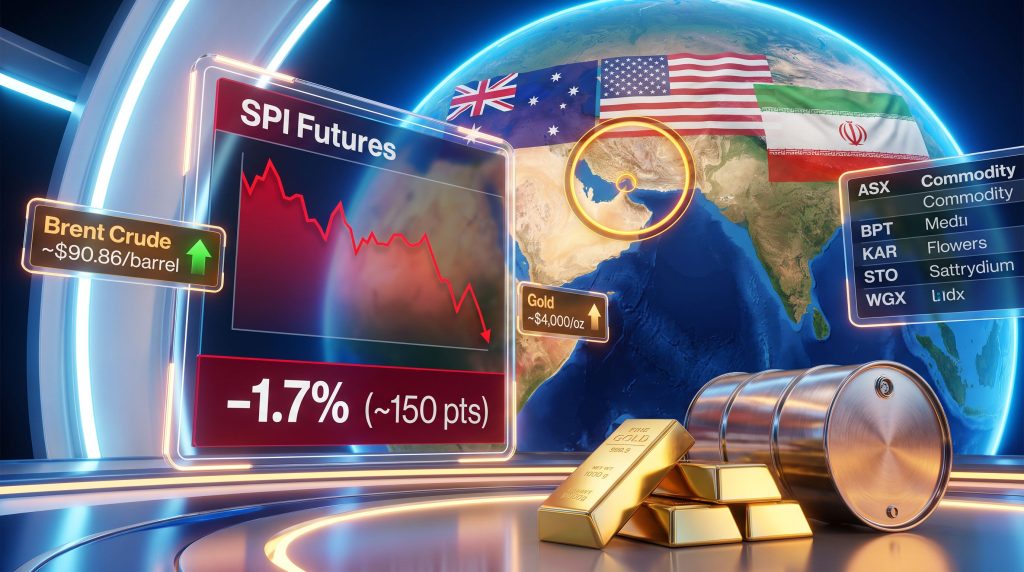
The SPI futures market, which Australian traders use to gauge likely index direction before the open, shifted dramatically between Friday's close and Sunday night. The contrast in positioning is stark:
| Indicator | Pre-Escalation Signal | Post-Escalation Signal |
|---|---|---|
| SPI Futures | +0.6% (bullish open) | -1.7% (~150 pts decline) |
| Brent Crude | ~$90.86/barrel | Rising on supply risk |
| Gold | ~$4,000/oz | Safe-haven demand building |
| Iron Ore | ~$100/tonne (Singapore) | Demand-side uncertainty |
| AUD/USD | ~US 69.7 cents | Pressure from risk-off flows |
| US Nat Gas Futures | ~$2.89/GJ | Flat, monitoring Hormuz risk |
A 1.7% decline translates to roughly 150 index points, effectively erasing the gains accumulated across the prior trading week in a single opening session. The Dow Jones Industrial Average had already closed the prior week down 0.8%, with the S&P 500 off a full percentage point, so the ASX market open US-Iran escalation is not arriving from a position of strength.
The critical distinction between a short-duration volatility event and a sustained macro regime shift comes down to a single variable: whether the Strait of Hormuz remains operationally open. Approximately 20% of global oil supply transits this chokepoint. Its status this week is the most consequential market variable Australian investors face.
According to reporting from The Australian, US-Iran attacks have delivered a significant reality check on market optimism that had been building throughout June and early July.
Sector-by-Sector Breakdown: Winners, Losers, and the Nuanced Middle Ground
Energy: The Direct Beneficiary Class
Brent Crude was already sitting at $90.86 per barrel before the weekend's developments and is moving higher on supply risk. For ASX-listed oil and gas producers, this creates a direct revenue uplift mechanism. The more important dynamic, however, is the Hormuz premium, which is a structural price floor that forms when credible threats to the strait's navigability exist.
The timing of scheduled quarterly production reports makes this week particularly significant for energy investors. In addition, an oil price shock of this magnitude typically compresses the window in which producers can lock in favourable hedging conditions:
- Beach Energy (ASX: BPT): Quarterly update due this week; oil price tailwind could prompt upside guidance revision
- Karoon Energy (ASX: KAR): Oil producer directly exposed to crude price movements; Hormuz risk premium adds to valuation support
- Santos (ASX: STO): Thursday operational update represents the highest-profile energy event of the week; LNG market implications will be scrutinised alongside crude pricing dynamics
Gold and Critical Minerals: The Safe-Haven Rotation Play
Gold retraced back toward the $4,000 per ounce level following last week's modest dip. Escalation events of this magnitude historically accelerate the rotation into safe-haven assets, and gold's proximity to a psychologically significant round number creates additional momentum potential. Consequently, gold safe-haven demand is already building ahead of Monday's open.
Westgold Resources (ASX: WGX) releases its quarterly update this week, providing a real-time operational read on one of Australia's mid-tier gold producers at precisely the moment when gold's macro backdrop is strengthening.
Lynas Rare Earths (ASX: LYC) also reports this week. While rare earths are not a direct safe-haven play in the traditional sense, supply chain anxiety generated by Middle East instability tends to amplify investor interest in critical minerals that sit outside conventional commodity categories.
Technology and Semiconductors: A Dual Headwind Environment
The ASX technology sector faces a particularly uncomfortable setup this week. US semiconductor stocks retreated during the prior week, and with US earnings season in full swing, chip company results during Week 30 will either stabilise or deepen that trend.
The geopolitical risk-off environment adds a second layer of pressure that is entirely separate from fundamental earnings dynamics. Australian technology holdings with indirect exposure to global semiconductor supply chains will absorb the combined impact of both forces during Monday's session and potentially beyond.
Materials and Broad Cyclicals: The Uncertainty Discount
Iron ore is sitting at $100 per tonne in Singapore, a level that reflects current Chinese demand conditions. However, iron ore demand prospects remain sensitive to any sustained global growth slowdown triggered by prolonged Middle East disruption. For now, the level holds, but the uncertainty discount being applied to broad cyclical names will widen if escalation continues.
The Corporate Calendar: This Week's Fundamental Anchors
In weeks where macro uncertainty dominates sentiment, company-level operational data takes on added importance. Quarterly production reports provide investors with fundamental anchors when index-level direction is driven by forces beyond any single company's control.
| Company | ASX Code | Reporting Window | Key Relevance |
|---|---|---|---|
| South32 | S32 | Monday | Diversified miner; bellwether for materials sector |
| Yancoal | YAL | Monday | Coal exposure; energy price tailwind |
| Beach Energy | BPT | This week | Oil/gas producer; crude price uplift |
| Lynas Rare Earths | LYC | This week | Critical minerals; supply chain focus |
| Westgold | WGX | This week | Gold producer; safe-haven commodity |
| Karoon Energy | KAR | This week | Oil producer; Hormuz risk premium |
| Santos | STO | Thursday | Major LNG; most-watched energy update |
| Regis Resources | REG | Friday | Gold producer; end-of-week read |
Thursday also brings Australian labour force data at lunchtime, which functions as a critical domestic counterweight to the geopolitical narrative. Strong employment figures would provide partial insulation against the risk-off sentiment drag, while weak data would compound the negative macro backdrop and complicate the Reserve Bank of Australia's rate trajectory simultaneously.
How Geopolitical Shocks Cycle Through Australian Equities
Understanding the typical progression of Middle East escalation events through the ASX requires distinguishing between three distinct market phases. As reported by the ABC's markets live blog, the pattern of risk repricing following US-Iran developments has been rapid and broad-based.
Phase 1: Immediate Shock (Days 1–3)
The initial session is characterised by an uncertainty premium being applied broadly. Energy and gold stocks typically decouple from the index, moving higher while broad names sell off. The Australian dollar weakens on risk-off flows, which provides a partial offset for export-oriented resource companies translating foreign currency revenues back into AUD.
Phase 2: Reassessment (Days 4–10)
Markets begin pricing the conflict's likely duration and geographic scope. If oil supply routes remain demonstrably intact, the initial shock partially reverses as traders recalibrate the risk premium. Critically, this phase is where the Hormuz variable becomes decisive: sustained navigability concerns prevent the reversal from completing.
Phase 3: Structural Repricing (Weeks 2–6)
Persistent elevated oil prices begin flowing through to broader inflation expectations. Central bank policy outlooks get recalibrated, as higher energy costs complicate rate-cut timelines globally. For the RBA specifically, an oil-driven inflation resurgence at a moment when rate relief was being anticipated by mortgage holders would create a particularly difficult policy environment.
The next major ASX story will hit our subscribers first
The AUD Crosscurrent: Two Forces Pulling in Opposite Directions
The Australian dollar at US 69.7 cents sits at an interesting inflection point this week. Two opposing forces will compete for dominance:
- Downward pressure: Risk-off global sentiment typically triggers capital flows away from commodity-linked currencies like the AUD toward traditional safe havens including the USD and JPY
- Upward support: A surge in oil and gold prices provides commodity-linked support for a currency whose underlying economy is heavily exposed to resource exports
The net direction of the AUD will depend on which force dominates, and that outcome will itself be determined by whether the Hormuz chokepoint remains open. A contained escalation favours the commodity support mechanism; however, a genuine supply disruption scenario accelerates the safe-haven flight out of risk-correlated currencies.
Three Variables That Will Define Week 30
Australian investors navigating this week's complexity can organise their monitoring around three decisive variables:
- Hormuz Status: The operational state of the strait is the single most consequential input for oil prices, energy stock valuations, inflation expectations, and central bank policy outlooks. It determines whether the ASX market open US-Iran escalation represents a volatility spike or a genuine regime shift.
- US Semiconductor Earnings: Week 30 chip company results will either confirm or arrest the prior week's technology sector retreat, with direct implications for ASX technology holdings in Tuesday's session.
- Australian Labour Force Data: Thursday's employment figures will interact with the geopolitical backdrop to shape near-term RBA expectations, adding a domestic policy dimension to an already complex external environment.
The combination of an ASX market open US-Iran escalation environment, a concentrated corporate reporting calendar, and a pivotal domestic data release makes Week 30 one of the more analytically demanding weeks Australian investors have faced in recent months. The energy sector's positioning relative to the broader index will likely be the defining trade of the week, irrespective of how the other variables resolve.
This article is intended for informational and educational purposes only and does not constitute financial advice. All figures and market data referenced reflect conditions as reported on 20 July 2026. Readers should conduct their own independent research and consult a licensed financial adviser before making any investment decisions. Forward-looking statements and scenario projections involve inherent uncertainty and should not be interpreted as predictions of future outcomes.
Want to Identify ASX Mineral Discoveries Before the Market Moves?
When geopolitical shocks like US-Iran escalation trigger rapid sector rotations into energy and gold, timing is everything — Discovery Alert's proprietary Discovery IQ model delivers real-time alerts on significant ASX mineral discoveries, instantly translating complex data into actionable insights for both short-term traders and long-term investors. Explore historic examples of major mineral discoveries and their market returns on Discovery Alert's dedicated discoveries page, and begin your 14-day free trial today to position yourself ahead of the next market-moving announcement.