
August 7, 2026
Reading the Room Before the Bell: How Global Markets Set the ASX's Daily Tone
Every trading day on the Australian Securities Exchange begins not in Sydney, but thousands of kilometres away in New York. By the time Australian investors wake up and pour their morning coffee, Wall Street has already rendered its verdict on the current state of global risk appetite. The ASX market open Wall Street impact is shaped by a constellation of overnight signals, and understanding how to decode them is one of the more underappreciated skills in retail and institutional investing alike.
The relationship between the ASX market open and Wall Street's impact is not simply a case of mirroring American index movements. It is a far more layered transmission process involving commodity pricing, currency dynamics, geopolitical developments, and domestic policy shifts that can either amplify or neutralise what happened on the other side of the Pacific.
When big ASX news breaks, our subscribers know first
The Cross-Pacific Transmission Mechanism Explained
Why U.S. Equity Markets Function as a Global Sentiment Barometer
American equity markets collectively represent roughly 60% of global market capitalisation. When institutional money managers in New York adjust their risk positioning, the reverberations travel across every time zone. The S&P 500, in particular, serves as a real-time proxy for global growth expectations, credit conditions, and earnings momentum.
For Australian traders, the overnight U.S. session effectively becomes a pre-market intelligence briefing. Because Australian Eastern Standard Time sits approximately 14 to 16 hours ahead of New York, the ASX opens its doors each morning with the luxury of knowing exactly how Wall Street closed. This time-zone architecture gives local participants a meaningful informational advantage over markets that trade simultaneously with New York.
Structural Linkages Between the S&P 500 and the S&P/ASX 200
The correlation between the S&P 500 and the ASX 200 is positive but imperfect. Over rolling 12-month windows, the two indices have historically shown a correlation coefficient ranging between 0.6 and 0.8, meaning they tend to move in the same direction but the magnitude of moves diverges significantly depending on local conditions. The ASX's heavy weighting toward materials and financials creates natural points of divergence from an American index dominated by technology and consumer discretionary stocks. For further context on how these dynamics play out in practice, ASX trading insights can help investors better understand the structural forces at play.
What the Three U.S. Benchmarks Signal for the ASX Open
Not all Wall Street indices carry equal weight for Australian investors. Each benchmark tells a different part of the global risk story.
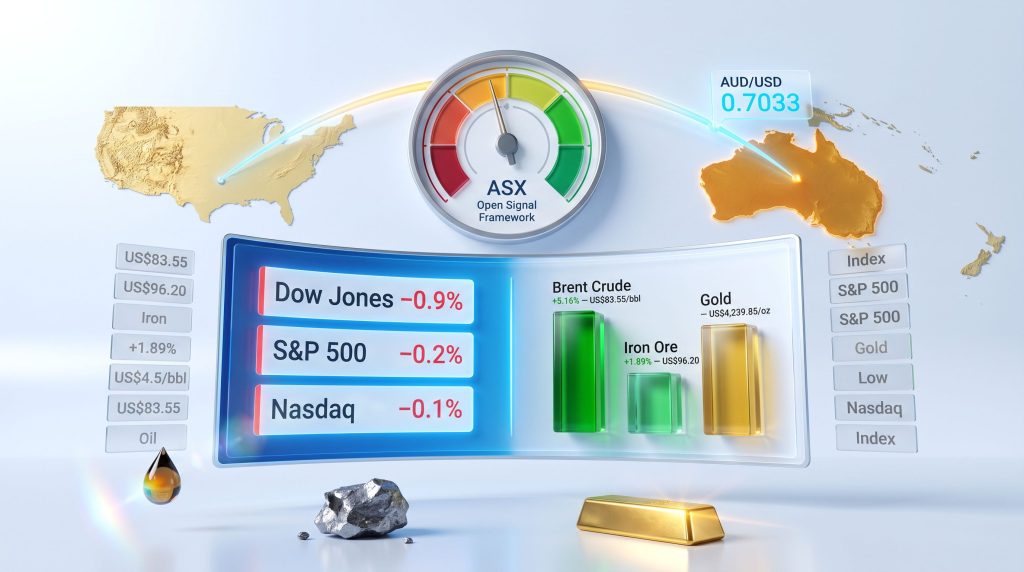
| U.S. Index | Recent Session Move | Implied ASX Sentiment |
|---|---|---|
| Dow Jones Industrial Average | -0.9% | Moderately Bearish |
| S&P 500 | -0.2% | Mildly Cautious |
| Nasdaq Composite | -0.1% | Broadly Neutral |
Why the Three Indices Tell Different Stories
The Dow Jones Industrial Average is a price-weighted index of 30 large-cap industrials and financials. Its decline of 0.9% carries more psychological weight than statistical weight, given the index's narrow composition. A Dow selloff driven by industrials or financial heavyweights tends to resonate with the ASX's own financial sector weighting.
The S&P 500's modest 0.2% slip is arguably the most meaningful single data point for ASX watchers. It reflects broad institutional sentiment across 500 companies and is the benchmark most closely tracked by global fund managers adjusting their risk books overnight.
The Nasdaq's 0.1% decline matters most for ASX technology and growth-oriented stocks, which represent a smaller but increasingly significant slice of the Australian index. On this particular session, weakness in AI-linked hardware names including Western Digital and its spin-off Sandisk added a cautionary note to the technology sector after Sandisk's forward guidance fell marginally short of analyst consensus expectations.
Quick Reference: ASX Open Signal Framework
A Dow decline of under 1% combined with a mild S&P 500 dip typically produces a flat-to-slightly-lower ASX open rather than a sharp directional selloff. The cause of a U.S. move carries as much interpretive weight as its magnitude.
When Index Divergence Matters More Than the Headline Number
When the Dow falls sharply but the Nasdaq holds firm, the signal is often sector-specific rather than systemic. Conversely, when all three major indices decline in unison, even mildly, the probability of a coordinated ASX pullback rises substantially. The session described here, with modest and relatively uniform softness across benchmarks, typically produces a contained and often recoverable opening dip on the ASX rather than a trend-setting decline.
Furthermore, the ASX reaction to US tariffs has demonstrated that policy-driven moves can occasionally overwhelm the standard index correlation framework entirely, adding another layer of complexity to pre-open analysis.
The Commodity Channel: Where the ASX Diverges Most Sharply from Wall Street
How Energy and Metals Prices Compound or Counteract Overnight U.S. Signals
Australia's equity market carries a commodity signature that has no parallel in the United States. The combined weighting of materials and energy stocks within the ASX 200 means that iron ore prices, crude oil movements, and gold valuations often exert more influence on a given morning's open than anything that happened on the S&P 500 the night before.
The current commodity landscape presents a striking counterpoint to Wall Street's cautious tone:
- Brent Crude surged 5.16% to US$83.55 per barrel, a move driven primarily by geopolitical tension surrounding the Strait of Hormuz. This scale of intraday crude movement is the kind that immediately reprices ASX-listed energy producers at the open.
- Monitoring iron ore price trends is essential at present, as iron ore climbed 1.89% to US$96.20 per tonne, a positive signal for major ASX materials stocks given that iron ore royalties and export volumes sit at the core of Australian national revenue streams.
- Gold reached US$4,239.85 per ounce, sustaining elevated levels that continue to benefit ASX-listed gold miners. Gold as a safe haven remains an active trade rather than a passive store of value at these price levels.
- US natural gas futures fell 2.05% to US$2.63 per MMBtu, a modest softening that carries limited immediate consequence for the ASX given Australia's LNG export pricing mechanisms, which are typically linked to oil indices rather than the Henry Hub benchmark.
Key Insight: When commodity prices move counter to Wall Street equity direction, the ASX frequently decouples from U.S. index performance in meaningful ways. Mining-heavy sessions where iron ore and gold dominate index weighting are the clearest examples of this structural independence.
The AUD/USD Rate as a Secondary Transmission Variable
Currency Transmission and Its Effect on Sector-Level Pricing
The Australian dollar's standing at US$0.7033 provides another interpretive layer for pre-market analysis. The AUD is widely understood in currency markets as a commodity-linked, risk-sensitive currency. Its performance overnight functions as a condensed signal of how global investors view the intersection of Chinese demand expectations, commodity pricing, and broader risk appetite.
The mechanics of AUD influence on ASX sectors work in opposing directions depending on the business model:
- A weaker AUD benefits resource exporters by increasing the Australian dollar value of their USD-denominated commodity revenues without requiring any change in production volumes or commodity prices.
- A stronger AUD benefits importers and domestically focused businesses by reducing input costs on overseas purchases but compresses the translated earnings of companies with significant offshore revenue.
- The carry trade dimension means that a declining AUD can sometimes signal deteriorating global risk appetite, amplifying any negative Wall Street signal rather than offsetting it.
At US$0.7033, the Australian dollar is sitting at a level that provides modest support for resource exporters without signalling acute currency stress.
Geopolitical Risk: The Strait of Hormuz Factor
How Regional Tensions Ripple Into ASX Pricing at the Open
The 5.16% surge in Brent crude is not attributable to supply fundamentals alone. Reports have emerged suggesting a potential diplomatic framework involving Iran and Oman that could give Tehran effective oversight over shipping transiting the Strait of Hormuz. This critical chokepoint carries roughly 20% of global seaborne oil traffic, making any credible threat to its freedom of navigation an immediately market-moving event for energy commodities worldwide.
In addition, the broader consequences of trade wars and supply chains remain a persistent undercurrent that amplifies the sensitivity of commodity markets to geopolitical flashpoints such as this one.
The scenario matrix for how this situation resolves carries materially different implications for ASX sector performance:
| Scenario | Oil Price Direction | ASX Energy Sector | ASX Materials Sector | Broader ASX Tone |
|---|---|---|---|---|
| Diplomatic resolution reached | Declining | Moderate pullback | Neutral to positive | Risk-on recovery |
| Tensions escalate further | Rising sharply | Strong outperformance | Mixed | Defensive rotation |
| Status quo maintained | Sideways | Stable | Stable | Follows Wall Street lead |
For ASX investors, the practical implication is a heightened sensitivity at the open for energy-exposed names, combined with potential defensive positioning in gold equities if the geopolitical uncertainty deepens rather than resolves.
The next major ASX story will hit our subscribers first
Domestic Policy Signals That Can Override Offshore Cues
The RBA Cash Rate Decision: A High-Conviction Local Catalyst
On days surrounding Reserve Bank of Australia meetings, domestic monetary policy can completely overwhelm any signal arriving from Wall Street. Leading economists have forecast that the RBA will hold its cash rate steady at its upcoming Tuesday meeting. An unchanged rate outcome would be broadly consistent with current market pricing and is unlikely to generate significant volatility on its own. However, the RBA's accompanying statement and forward guidance language carries the real informational content.
The sectors most sensitive to RBA policy signals include:
- Major bank stocks, which reprice relative to net interest margin expectations whenever cash rate trajectories shift.
- Real estate investment trusts (REITs), which carry elevated sensitivity to discount rate assumptions embedded in property valuations.
- Consumer discretionary stocks, which reflect household spending capacity as a function of mortgage servicing costs.
The interplay between RBA independence and Federal Reserve policy expectations also deserves attention. Even when the RBA holds rates, a divergence between the Fed's forward path and the RBA's creates AUD volatility that feeds back into sector pricing at the ASX market open Wall Street impact equation.
The Minerals Workforce: A Structural Risk Building Below the Surface
Skilled Migration Policy and Its Long-Term Implications for ASX Mining
Beyond the daily market signals, a structural issue is gathering momentum that deserves attention from investors with exposure to ASX-listed miners. The Minerals Council of Australia has raised concerns that federal government moves to deprioritise offshore skilled migration visa applicants will create meaningful friction in an industry already managing complex workforce requirements.
The workforce numbers provide important context:
| Metric | Data Point |
|---|---|
| Direct mining industry jobs | 290,000+ |
| Total direct and indirect jobs | ~1.25 million |
| Projected new jobs by 2028 | Up to 35,400 |
| Skilled migrant share of minerals workforce | 1.24% |
The counterintuitive insight here is that a cohort representing just 1.24% of the total minerals workforce carries disproportionate strategic weight. Skilled migrants filling specialised roles in geotechnical engineering, metallurgical processing, and advanced drilling operations are not interchangeable with locally available labour at short notice. When these roles remain vacant, project commissioning timelines extend, capital costs escalate, and export earnings are deferred.
Policy Watch: The Minerals Council of Australia has indicated that restricting access to specialised offshore talent, even at a proportionally small workforce share, risks creating bottlenecks in critical and hard-to-fill roles. The downstream consequences extend beyond mining into construction, clean energy, defence, advanced manufacturing, AI infrastructure, and cybersecurity.
The historical precedent is instructive. Australia's minerals industry was partly built on successive waves of skilled migration during the gold rushes of the 19th century, and later during the iron ore and LNG construction booms of the 2000s and 2010s. Workforce accessibility has always been a non-trivial variable in project execution risk for mining equities.
A Pre-Open ASX Checklist: Reading the Morning Market Setup
Step-by-Step: How to Interpret Overnight Signals Before the Bell
Building a structured pre-open routine removes emotion from the process and replaces it with a repeatable analytical framework. Here is a practical sequence:
- Check U.S. index performance and note both the direction and magnitude of the Dow, S&P 500, and Nasdaq. A mild and uniform dip carries different implications than a sharp divergence between indices.
- Review ASX 200 futures pricing to determine whether the overnight Wall Street move has already been absorbed. If futures have moved significantly, the open gap may be smaller than the raw U.S. numbers suggest.
- Scan iron ore, gold, and crude oil prices as the three commodity data points most directly relevant to ASX index composition and sector weighting.
- Check the AUD/USD rate for signals about overnight risk appetite and potential translation effects on resource exporter earnings.
- Identify domestic catalysts including RBA decisions, major earnings releases, or policy announcements that could generate local price discovery independent of offshore signals.
- Assess active geopolitical risk with particular attention to oil supply disruption scenarios, trade policy developments, or diplomatic events with direct commodity exposure.
For investors seeking a reliable source of daily pre-open intelligence, Morningstar's ASX market reports provide consistent coverage of overnight developments and their likely implications for Australian equities.
Frequently Asked Questions: ASX Market Open and Wall Street Influence
Does Wall Street Always Predict the ASX Open Direction?
No. While there is a statistically meaningful correlation, the ASX regularly diverges from Wall Street when commodity prices move sharply in the opposite direction to U.S. equities, when major domestic catalysts are present, or when the AUD moves sufficiently to reprice exporter earnings.
What Time Does the ASX Open and When Are Futures Available?
The ASX opens for equity trading at 10:00 AM AEST. ASX SPI 200 futures begin trading on the ASX 24 platform from 5:10 PM AEST the previous day, giving traders overnight price discovery before the equity market opens.
Which Wall Street Index Is Most Relevant to the ASX 200?
The S&P 500 is generally the most useful single benchmark for ASX sentiment modelling because of its broad composition and its role as the primary reference for global institutional fund allocation decisions.
How Much Does Iron Ore Price Movement Affect the ASX Open?
Iron ore is one of Australia's largest export earners and directly underpins the revenue models of the ASX's largest materials companies. A 1–2% swing in iron ore pricing can meaningfully shift opening sentiment in the materials sector, which carries significant index weight within the ASX 200.
Can the ASX Rise Even When Wall Street Falls?
Yes, and it happens with reasonable regularity. A sharp rise in commodity prices, a dovish RBA statement, or a positive earnings surprise from a heavyweight ASX constituent can all generate enough local buying pressure to overcome a mildly negative offshore lead.
Key Takeaways: The ASX Open as a Multi-Variable Equation
The ASX market open Wall Street impact is best understood not as a simple reflection of U.S. indices but as a synthesis of competing global and domestic signals. The following hierarchy provides a useful reference for weighting those signals:
| Signal Type | Relevance to ASX Open | Primary Sectors Affected |
|---|---|---|
| S&P 500 direction | High | Broad market sentiment |
| Dow Jones move | Moderate to High | Industrials, financials |
| Nasdaq performance | Moderate | Technology, growth stocks |
| Iron ore price | High | Materials, BHP, RIO |
| Brent crude price | High | Energy sector |
| Gold price | Moderate to High | Gold miners, defensives |
| AUD/USD rate | Moderate | Exporters, importers |
| RBA policy signal | High (on decision days) | Banks, REITs, consumer |
| Geopolitical risk | Situational | Energy, defensives |
When Wall Street and commodities align directionally, the morning open signal is at its clearest and most actionable. However, when they diverge, the more useful analytical lens shifts from index-level sentiment to sector rotation, with commodity-linked names and defensives likely to move in different directions than the broader benchmark.
The session described here is a textbook example of that divergence: mild U.S. equity softness points to a flat-to-lower ASX open, while a surging crude oil price, firm iron ore, and elevated gold create a meaningful upside counterweight concentrated in energy and materials. For investors who track only the headline Wall Street numbers, these are precisely the sessions where disciplined pre-market analysis creates a genuine informational edge. Those seeking an additional layer of market commentary and analysis may find value in the daily briefings published by AFR Markets, which covers both domestic and international developments influencing Australian equities.
The material in this article is provided for informational purposes only and does not constitute financial or investment advice. All market data, forecasts, and scenario analyses reflect conditions at the time of writing and are subject to change. Readers are encouraged to conduct independent research and consult a licensed financial adviser before making any investment decisions.
Want to Stay Ahead of the Next Major ASX Mineral Discovery?
While tracking overnight Wall Street signals and commodity price movements provides a critical edge at the open, Discovery Alert's proprietary Discovery IQ model delivers real-time alerts the moment significant mineral discoveries are announced on the ASX — turning complex data across 30+ commodities into a single, actionable gold-equivalent metric. Explore historic discoveries and the exceptional returns they generated, then begin your 14-day free trial at Discovery Alert to ensure you're positioned ahead of the market when the next major find is announced.