June 10, 2026
The Multi-Commodity Architecture Powering ASX Mining in 2025–2026
Commodity cycles rarely arrive with equal strength across multiple metals simultaneously. Historically, a single dominant force, whether a Chinese infrastructure boom or a post-war reconstruction surge, would lift one or two commodities while others languished. What is unfolding across the ASX resources sector in 2025–2026 is structurally different: gold, copper, and iron ore are all holding elevated price positions at the same time, each supported by a distinct and largely independent demand architecture. For investors navigating the ASX mining stocks to watch, understanding why this divergence matters is more valuable than simply knowing which stocks are moving.
This is not a uniform bull market. It is three separate commodity theses running in parallel, and the portfolio implications of that distinction are significant.
When big ASX news breaks, our subscribers know first
What Makes This Commodity Cycle Structurally Unusual
The 2010 to 2012 commodity supercycle was almost entirely a China story. Infrastructure-led growth pulled iron ore and coking coal into decade-high prices, and most ASX miners benefited by proximity to that single demand source. When China's fixed-asset investment growth eventually moderated, the cycle turned, and it turned hard.
The current environment looks materially different across almost every structural dimension:
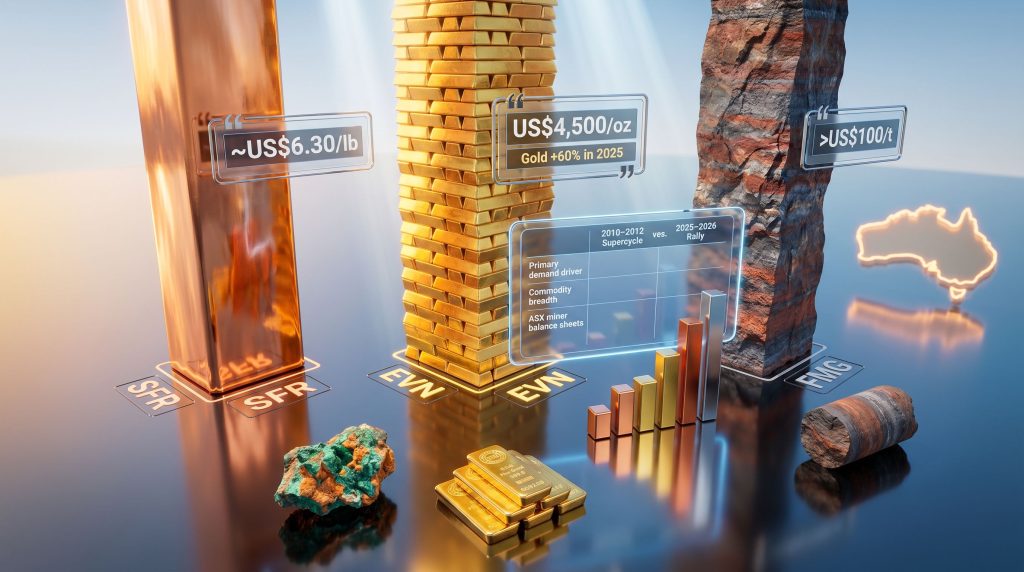
| Factor | 2010–2012 Supercycle | 2025–2026 Multi-Commodity Rally |
|---|---|---|
| Primary demand driver | Chinese infrastructure buildout | Energy transition + AI + central bank buying |
| Commodity breadth | Iron ore and coal dominant | Gold, copper, iron ore, lithium, rare earths |
| Supply constraint type | Logistics bottlenecks | Mine grade decline + pipeline gaps |
| ASX miner balance sheets | Heavily leveraged | Net cash positions emerging |
| Geopolitical overlay | Low | High (supply chain nationalism) |
The current cycle's broadened demand base reduces, but does not eliminate, single-point-of-failure risk. Central bank gold accumulation, electrification infrastructure investment, and AI data centre buildout are all driving demand for different metals from different buyers, across different geographies. That diversification is a meaningful structural shift for investors assessing risk-adjusted exposure across the ASX resources sector.
Critical Framework Point: The danger in the current environment is that investors conflate multi-commodity strength with low risk. Each commodity still carries its own distinct downside scenario. The breadth of the rally reduces correlation risk, but does not eliminate commodity-specific vulnerabilities.
A Framework for Evaluating ASX Mining Stocks to Watch
Before drilling into individual commodity themes and stock profiles, investors benefit from applying a consistent evaluation lens across all candidates. Our comprehensive ASX mining stocks guide outlines the key principles, and the following four-factor model provides a disciplined starting point:
-
Commodity Thesis Durability – Is the price strength rooted in multi-year structural demand, or is it a short-cycle headline trade that has already run its course?
-
Balance Sheet Resilience – Net cash versus net debt is the most revealing balance sheet signal. Companies that have converted from leveraged acquirers to net cash holders have eliminated a significant constraint on capital returns.
-
Operational Leverage – The relationship between commodity price movements and earnings is non-linear for miners. A producer operating at low all-in sustaining costs (AISC) with a wide margin per unit has dramatically more earnings sensitivity to price than a high-cost operator running thin margins.
-
Concentration Risk – Single-commodity, single-jurisdiction producers offer maximum upside leverage but also maximum downside exposure. Diversified operators smooth volatility but dilute returns in bull markets.
Investor Warning: Stocks that have already undergone a significant re-rating in response to commodity price moves may offer a reduced margin of safety at current entry levels. Late-cycle entry into a commodities rally requires distinguishing between stocks still offering genuine value and those where the bull case is already fully priced into the share price.
Copper: The Highest-Conviction Structural Theme on the ASX
Why Copper's Supply-Demand Imbalance Is Uniquely Durable
Copper is trading near US$6.30 per pound, approaching historical record territory, and the forces sustaining that price are rooted in physical supply-demand dynamics rather than speculative positioning. The copper supply crunch is being driven by three converging demand sources that are simultaneously increasing copper consumption:
-
Electric vehicles: A single battery electric vehicle requires approximately 3 to 4 times more copper than an equivalent internal combustion vehicle. As EV penetration scales globally, the incremental copper demand generated is structurally permanent.
-
Power grid infrastructure: The transition to renewable energy generation requires extensive transmission and distribution upgrades. Wind turbines, solar farms, and the grid connections linking them consume copper at every stage.
-
AI data centres: High-density computing facilities require significant copper in power delivery and cooling infrastructure. As hyperscaler investment in AI compute capacity accelerates, copper demand from this sector is growing faster than most analysts anticipated.
On the supply side, the structural deficit is equally compelling. Ore grades at operating copper mines have been declining for decades, as the highest-grade orebodies are depleted first and miners progressively process lower-grade material. New copper discoveries are rarer and typically located in more challenging jurisdictions. Critically, new copper mines require 10 to 15 years from discovery through feasibility, permitting, construction, and ramp-up before reaching nameplate production capacity. This means no supply response to current prices can arrive quickly enough to close the near-term deficit.
Sandfire Resources (ASX: SFR): Pure-Play Copper Leverage
Among ASX-listed copper-focused companies, Sandfire Resources stands out as one of the sector's few genuine pure-play copper producers. The company operates two producing assets: the MATSA copper-zinc complex in Spain and the Motheo copper mine in Botswana. This dual-asset, multi-jurisdiction structure provides some geographic diversification while maintaining the concentrated commodity exposure that copper bulls are seeking.
A particularly significant balance sheet milestone was achieved as of the March 2026 quarter: Sandfire reported a net cash position of US$76 million, representing the completion of an aggressive debt reduction programme following the substantial capital deployed to acquire MATSA. Moving from leveraged acquirer to net cash holder is a classic re-rating catalyst in the mining sector, as it removes the earnings drag from interest expenses and creates optionality for shareholder returns or further growth.
The principal risk for investors considering Sandfire at current levels is that the share price has already moved considerably in response to copper's strength. Investors evaluating entry now are not acquiring the same risk-reward profile that was available 12 to 18 months ago. That does not negate the structural copper thesis, but it does require a more careful assessment of valuation relative to the commodity price scenarios being priced in.
Gold: Structural Support Beyond the Headline Narratives
Why Gold at US$4,500/oz Persists Even as Risk Narratives Shift
Gold's sustained elevation above US$4,500 per ounce has remained intact through periods of shifting geopolitical sentiment, including episodes where diplomatic progress on various international tensions briefly reduced safe-haven demand. That resilience is analytically important. It demonstrates that the current gold price is not primarily a fear trade that would collapse on positive geopolitical news.
The more durable support mechanism is central bank accumulation. Furthermore, central bank gold demand from multiple sovereign wealth funds and emerging market institutions has been systematically increasing gold reserves as part of a broader diversification away from USD-denominated assets. This structural buying provides a price floor that is largely insulated from short-term sentiment movements. Gold has risen more than 60% across 2025, and that magnitude of appreciation reflects institutional demand at a scale that retail sentiment alone cannot explain.
Key Monitoring Metric: Monthly central bank gold purchase data, published periodically by the World Gold Council, is the most important leading indicator for assessing whether gold's structural demand floor remains intact.
Evolution Mining (ASX: EVN): The Balance Sheet Transformation Story
Evolution Mining illustrates the operational leverage thesis for gold producers with particular clarity. As one of Australia's larger low-cost gold producers, the company also generates meaningful copper by-product revenue, which provides an additional cash flow buffer in the current environment where both metals are elevated.
The financially significant milestone from the March 2026 quarter was Evolution's achievement of a net cash position of A$42 million, clearing its net debt position ahead of its own internal financial year-end target. This balance sheet transformation carries multiple implications for investors:
- Debt elimination removes the interest expense drag on earnings, amplifying free cash flow at any given gold price
- Net cash position provides flexibility for accelerated dividend distributions or capital returns
- The company's credibility with the market improves when self-imposed financial targets are met or exceeded ahead of schedule
The risk side of the gold producer thesis is equally important to understand. Gold at US$4,500/oz generates exceptional margins for low-cost producers. However, a 10% contraction in the gold price, to approximately US$4,050/oz, has a disproportionately larger negative impact on earnings than a 10% contraction in production volume, because the cost base does not move proportionally with revenue.
Iron Ore: Resilient But Carrying the Highest Concentration Risk
Understanding Why Iron Ore Has Defied Bearish Consensus
Iron ore's persistence above US$100 per tonne has surprised a significant portion of the analyst community that anticipated a sharper correction driven by China's well-documented property sector difficulties. The key factor sustaining prices has been Chinese steel production holding up better than the property sector headlines implied, supported by infrastructure investment and manufacturing export activity that requires domestic steel supply.
However, iron ore's demand architecture is fundamentally different from copper and gold. In particular, China iron ore demand shows that where copper benefits from diversified global demand drivers, iron ore's trajectory is almost entirely determined by a single buyer: Chinese steel mills. This concentration creates an asymmetric risk profile: benign China scenarios support the price floor, but any meaningful deterioration in Chinese steel demand would transmit directly and rapidly to iron ore prices.
Fortescue (ASX: FMG): High Leverage, High Reward, High Risk
Fortescue operates large-scale, low-cost iron ore production from the Pilbara region of Western Australia. Its cost structure is competitive by global standards, meaning the company generates meaningful free cash flow at current price levels, which supports its well-known dividend capacity. For income-oriented investors, Fortescue's dividend yield remains a key attraction.
The medium-term structural risk is the Simandou iron ore project in Guinea, one of the largest undeveloped iron ore deposits in the world. Simandou's progression toward production will introduce significant volumes of new, competitively priced seaborne iron ore supply, potentially creating persistent downward pressure on prices over a multi-year horizon. The timing and scale of Simandou's production ramp are the critical variables to track.
| Commodity | Price Level | Primary Demand Driver | China Dependency | Structural Duration |
|---|---|---|---|---|
| Copper | ~US$6.30/lb | Energy transition + AI | Moderate | Multi-decade |
| Gold | ~US$4,500/oz | Central bank buying + geopolitical hedge | Low-moderate | Structural + cyclical |
| Iron Ore | >US$100/t | Chinese steel demand | Very high | Near-term fragile |
The next major ASX story will hit our subscribers first
Broader ASX Mining Themes Worth Monitoring
Lithium: Recovery Thesis Taking Shape
After a severe price contraction through 2023 and 2024, lithium is showing early signs of stabilisation. The lithium market downturn has nonetheless left Pilbara Minerals (ASX: PLS) and Liontown Resources (ASX: LTR) as the most closely tracked names, with price recovery trajectories tied to the pace of battery demand growth and the behaviour of Chinese lithium chemical pricing. Lithium represents a higher-volatility, longer-duration recovery thesis compared to gold or copper, and investors should size positions accordingly.
Rare Earths: Supply Chain Nationalism as a Durable Tailwind
Lynas Rare Earths (ASX: LYC) holds a strategically distinctive position as the world's largest rare earths producer operating outside of China. Growing Western interest in securing non-Chinese supply of critical minerals used in permanent magnets, defence applications, and electric motors creates a durable demand backdrop for Lynas that extends beyond commodity pricing cycles. The China-US technology and trade competition has made supply chain origin a geopolitical consideration that is unlikely to diminish over the medium term.
Gold Sector Breadth Beyond the Major Producers
| Company | ASX Code | Key Characteristic |
|---|---|---|
| Northern Star Resources | NST | Major producer, Tier-1 assets |
| Evolution Mining | EVN | Low-cost producer, copper by-product |
| Genesis Minerals | GMD | Growing production profile |
| Gold Road Resources | GOR | Joint venture gold exposure |
| Ramelius Resources | RMS | Active M&A strategy |
For a broader view of the materials sector, resources such as ASX listed materials companies offer useful screening data for investors building a watchlist. In addition, independent research platforms like Stockhead's resources coverage provide ongoing news and analysis across the ASX mining stocks to watch.
How to Build a Balanced ASX Mining Portfolio Across Risk Profiles
Portfolio construction in the mining sector requires matching commodity exposure to risk tolerance, time horizon, and the investor's capacity to absorb drawdowns during commodity price corrections.
| Risk Profile | Suggested Commodity Weighting | Representative Exposure Type |
|---|---|---|
| Conservative | Gold 60%, Iron Ore 30%, Copper 10% | Large-cap producers with net cash |
| Balanced | Copper 40%, Gold 35%, Iron Ore 25% | Mix of mid-cap and large-cap producers |
| Growth-Oriented | Copper 40%, Gold 20%, Lithium 25%, Rare Earths 15% | Mid-cap producers + selective developers |
| Speculative | Lithium 40%, Rare Earths 30%, Gold Exploration 30% | Small-cap developers and explorers |
Step-by-Step: Researching an ASX Mining Stock Before Investing
-
Identify the commodity thesis – Determine whether the underlying commodity is supported by structural multi-year demand or a shorter-cycle price movement.
-
Assess the balance sheet – Net cash versus net debt is the most critical single metric. Track the direction of travel, not just the snapshot position.
-
Calculate operational leverage – Compare AISC to current commodity price. The wider the margin per unit, the greater the earnings sensitivity to price movements in either direction.
-
Map concentration risk – Single-commodity and single-jurisdiction exposure amplifies both upside and downside. Understand what you are buying.
-
Evaluate the valuation entry point – Has the stock already re-rated to fully reflect the commodity bull case? A strong commodity thesis in a fully priced stock offers limited margin of safety.
-
Stress-test the downside scenario – Model the base case, bull case, and bear case for the commodity over a 12 to 24 month horizon. Ensure the bear case is survivable for the company given its balance sheet.
Disclaimer: This article provides general informational and educational content only and does not constitute financial advice. Commodity prices, share prices, and company financial positions are subject to change. Past performance is not indicative of future results. Investors should conduct their own independent research and consider seeking advice from a licensed financial adviser before making investment decisions. All figures and data referenced are based on information available at the time of writing and may not reflect current market conditions.
Want to Spot the Next Major ASX Mineral Discovery Before the Market Does?
Discovery Alert's proprietary Discovery IQ model delivers real-time alerts on significant ASX mineral discoveries across gold, copper, and beyond — instantly translating complex mineral data into actionable investment insights for traders and long-term investors alike. Explore Discovery Alert's dedicated discoveries page to understand how historic mineral discoveries have generated substantial returns, and begin your 14-day free trial to position yourself ahead of the broader market.