
August 20, 2026
When Overnight Crude Moves the Market Before a Single Trade Is Placed
Few forces in global finance travel as quietly or as destructively across time zones as an overnight surge in crude oil. While most Australian investors wake to headlines about Wall Street direction, the more consequential number is often the one sitting in the Brent crude column. Oil's relationship with equity markets is rarely linear, and that complexity becomes especially pronounced at the ASX market open oil prices impact, where energy price signals collide with domestic inflation expectations, Reserve Bank psychology, and the trading positioning established hours earlier on the other side of the world.
Understanding how rising oil prices impact the ASX open is not just a technical exercise. It is a framework for reading the real economy through the lens of commodity markets, and for anticipating the cross-sector ripple effects that can define an entire trading session before 10:00 AM AEST arrives.
When big ASX news breaks, our subscribers know first
Why the ASX Is Unusually Sensitive to Crude Price Movements
Australia occupies a peculiar position in global markets. It is simultaneously a major commodity exporter, a significant energy importer, and an economy whose central bank operates with one of the most inflation-sensitive mandates among developed-market peers. This combination means that crude oil price trends affect the ASX through multiple transmission channels at once, rather than through the single-vector impact seen in many other markets.
The first channel is direct sector exposure. Energy stocks listed on the ASX respond almost immediately to overnight crude moves, with producers benefiting from higher realised prices per barrel. The second channel is inflationary pass-through, where higher oil feeds into transport, logistics, and manufacturing costs, raising the prospect of sustained consumer price inflation. The third, and often most underappreciated, channel is rate expectation repricing, where the market rapidly adjusts its probability distribution for future Reserve Bank of Australia (RBA) decisions based on what crude is doing.
This third mechanism is particularly relevant in the current environment, where the RBA has signalled data-dependency and household budgets remain stretched by prior rate cycles. A meaningful jump in Brent crude does not just raise petrol prices; it shifts the entire forward rate curve in ways that compress valuations across rate-sensitive sectors simultaneously.
The Pre-Open Signal: How ASX SPI Futures Absorb Overnight Oil Moves
Before the ASX opens for regular trading, the ASX SPI (Share Price Index) futures market provides a real-time window into how overnight developments, including commodity price shifts, are being priced by professional participants. A significant rise in Brent crude during the US session will typically be reflected in a softer ASX futures print before 10:00 AM AEST, even when Wall Street itself closed higher.
This divergence between US equity gains and ASX futures positioning is one of the most misunderstood dynamics in Australian market analysis. Retail investors who see a positive S&P 500 session often assume a positive local open. In reality, when crude is simultaneously climbing, the inflationary implications can override the equity optimism entirely, as this detailed breakdown of ASX market dynamics illustrates clearly.
When oil prices are rising sharply, a positive Wall Street session provides far weaker support for the ASX open than most investors assume. The cost-push inflation signal embedded in higher crude often carries more weight for the Australian market than direction from New York equities.
The Macro Context: US Debt, Treasury Yields, and Commodity Price Amplification
The current macro environment gives oil price moves an amplified transmission mechanism that did not exist to the same degree a decade ago. US government debt has now surpassed US$40 trillion, more than doubling over the past ten years. Concerns around US debt and inflation give the relationship between commodity prices and sovereign bond yields heightened significance at this scale.
When oil rises, inflation expectations increase. When inflation expectations increase, US Treasury yields typically move higher in response. Higher Treasury yields make risk assets less attractive globally, as the discount rate applied to future earnings rises. For the ASX, which carries significant weighting in rate-sensitive sectors including real estate investment trusts (REITs) and financials, this yield sensitivity translates directly into valuation pressure at the open.
The interaction between a US$40 trillion debt load and an oil-driven inflation impulse creates a particularly challenging environment for equities. Fiscal stimulus at the scale implied by that debt level is inherently inflationary over the medium term, meaning that crude price surges do not occur against a neutral monetary backdrop but against one already tilted toward concern about price stability.
Where Brent Crude Sits Right Now and What History Says
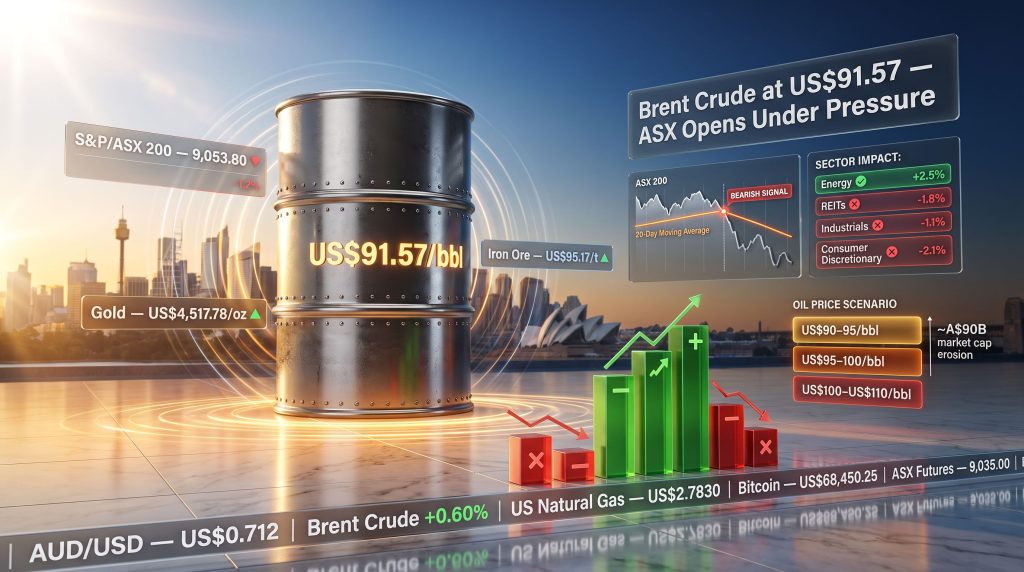
Brent crude has recently gained 0.60% to US$91.57 per barrel, a level that sits within a historically meaningful range for ASX sensitivity. The table below illustrates how the ASX 200 index has typically responded at different Brent crude price levels, based on observed historical patterns:
| Brent Crude Level | Observed ASX 200 Response | Key Driver |
|---|---|---|
| US$90 to US$95/bbl | Muted to modest decline (~0.2% to 0.5%) | Inflation concern, rate anxiety |
| US$95 to US$100/bbl | Moderate decline (~0.5% to 1.2%) | Broad sector selling, energy outperforms |
| US$100 to US$110/bbl | Sharp decline (~1.7% to 2.85%) | ~A$90B market cap erosion recorded |
| Above US$110/bbl | Severe correction risk | Supply shock pricing, RBA rate speculation |
The March 2026 episode provides a concrete reference point. When Brent crude approached US$110 per barrel, the ASX 200 experienced a sharp correction with approximately A$90 billion in market capitalisation erased across the session. That episode illustrated with clarity that oil is not a secondary variable for Australian equities; under the right macro conditions, it can be the primary driver of a single session's direction.
At US$91.57, the market sits close to the lower boundary of the range where historical ASX pressure has been observed. Furthermore, a continuation of the current crude rally toward the US$95 level would likely intensify both the technical and fundamental headwinds facing the index.
How Oil Feeds Into Australian Inflation and RBA Decision-Making
The pathway from crude to consumer inflation in Australia is more direct than in many comparable economies. Transport costs, which are heavily energy-dependent, underpin pricing across almost every goods category. When Brent rises, logistics and distribution costs increase almost immediately, with those cost pressures typically flowing through to consumer prices within two to three months.
The RBA treats commodity price movements, particularly oil, as a leading indicator of near-term inflationary pressure. In a policy environment where the central bank is already monitoring whether prior rate increases have sufficiently anchored inflation expectations, a sustained crude rally introduces the possibility of a higher-for-longer rate path that markets may not have fully priced.
For equity investors, the mechanism here is valuation compression through rising discount rates. When the expected path for the cash rate shifts higher, the present value of future earnings declines across the board. Sectors with long-duration earnings, including REITs, infrastructure, and growth-oriented technology stocks, are disproportionately affected because their valuations are most sensitive to changes in the discount rate applied to cashflows many years in the future.
Rising oil does not just raise petrol prices. It has the potential to shift the entire interest rate expectations curve in a way that simultaneously devalues every long-duration asset class on the ASX within a single trading session.
Which ASX Sectors Benefit and Which Face the Greatest Pressure
The sector-level impact of rising crude is not uniform, and understanding the differentiation is central to navigating oil-sensitive sessions. The following framework maps likely impacts across major ASX sectors:
| ASX Sector | Oil Price Direction | Typical Impact | Reason |
|---|---|---|---|
| Energy (Oil and Gas) | Rising | Positive | Higher revenue per barrel, improved margins |
| Consumer Discretionary | Rising | Negative | Fuel costs reduce household spending capacity |
| Industrials | Rising | Negative | Transport and logistics cost increases |
| Real Estate (REITs) | Rising | Negative | Rate sensitivity amplified by inflation risk |
| Materials (ex-energy) | Rising | Mixed | Input cost pressure versus commodity demand |
| Utilities | Rising | Mixed | Energy input costs rise, some pass-through possible |
| Financials | Rising | Mixed | Rate uplift can benefit margins, but credit risk rises |
| Healthcare | Rising | Defensive | Relatively insulated from energy cost exposure |
Energy stocks are the clearest beneficiary during a crude rally. ASX-listed oil and gas producers see revenue uplift with each dollar added to the Brent price, and in sessions where the broader index is falling on inflation concerns, energy stocks frequently act as the primary offset.
Consumer discretionary stocks face dual pressure. Rising petrol prices directly reduce the disposable income available to households for non-essential spending, while the rate-sensitivity risk from oil-driven inflation simultaneously weighs on the sector's valuation multiples.
REITs arguably carry the most concentrated risk during crude spikes. Their sensitivity to interest rates makes them particularly exposed to any shift in RBA expectations, and their yield-like structure means they compete directly with bonds for investor capital as yields move higher.
The next major ASX story will hit our subscribers first
The Five-Factor Pre-Open Checklist for Oil-Sensitive Sessions
Experienced ASX participants typically monitor a specific set of variables before the open on sessions where crude is moving meaningfully. These factors collectively determine whether the oil price signal is likely to dominate the session or be offset by other developments:
- Brent crude overnight percentage change – direction and magnitude of the move, particularly whether it exceeds 1% in either direction
- ASX SPI futures – pre-open positioning relative to the prior close, providing the most direct read on how overnight moves are being priced locally
- US Treasury 10-year yield – inflation expectations embedded in bond markets, with rising yields compounding the equity headwind from higher crude
- Middle East or OPEC supply headlines – geopolitical risk premium assessment, as OPEC's market influence carries different valuation implications than demand-driven crude moves
- AUD/USD exchange rate – the Australian dollar's response to crude moves, since a stronger AUD can partially offset the inflationary impact of higher oil for import costs
The Australian dollar's relationship with crude oil is nuanced. Australia's commodity exporter status means the AUD often strengthens when broad commodity prices rise. However, if oil-driven US inflation causes the US Federal Reserve to maintain or lift rates while the RBA diverges, the resulting USD strength can pressure the AUD downward even as crude climbs.
Current Market Conditions: The ASX 200 Below Its 20-Day Moving Average
The S&P/ASX 200 recently fell 16.20 points, or 0.18%, to 9,053.80, crossing below its 20-day moving average in the process. This technical development carries significance beyond the headline number. For technically-oriented participants, a breach below the 20-day moving average during a period of rising commodity prices can function as a bearish confirmation signal, reinforcing the case for near-term caution.
When the ASX 200 crosses below its 20-day moving average at the same time as macro headwinds such as elevated oil prices are building, technical traders often treat this combination as a momentum shift rather than a temporary pullback.
Offshore, the major US indices closed higher. The S&P 500 gained 0.32% to 7,716.51, the Nasdaq added 0.21% to 26,345.60, and the Dow Jones advanced 0.18% to 53,440.95, supported by easing US Treasury bond yield pressure. However, the simultaneous rally in crude means that the positive signal from Wall Street faces a meaningful offset in the local open, consistent with the dynamic described earlier where the ASX market open oil prices impact can cancel out equity optimism from overnight sessions.
Reporting Season Results Providing Underlying Fundamental Context
While macro forces dominate the pre-open narrative, several corporate results from the current reporting season are adding layers of fundamental context to the session.
Super Retail Group (ASX: SUL) reported sales growth of 3.2% to $4.2 billion for FY26, describing the result as solid against a backdrop of meaningful headwinds including geopolitical instability, adverse weather conditions, and mounting interest rate pressure on household budgets. The fact that a major consumer discretionary name is explicitly flagging interest rate pressure as a headwind underscores the real-world relevance of the oil-inflation-rate chain being discussed.
Cleanaway Waste Management (ASX: CWY) delivered gross revenue growth of 13.5% to $4,371.3 million, with net revenue climbing 13.1% to $3,736.7 million. Growth was supported by strategic acquisitions including Contract Resources for $319.8 million and Citywide Waste for $103.3 million, demonstrating that acquisition-driven industrial growth strategies can deliver meaningful scale even in challenging macro conditions.
Heartland Group Holdings (ASX: HGH) posted NPAT of $93.2 million for FY26, more than doubling from $38.8 million in FY25, driven by margin expansion and improved asset quality. This turnaround story provides an example of how company-specific fundamentals can deliver significant performance independent of macro headwinds.
Westgold Resources (ASX: WGX) delivered a standout update from the mining sector, reporting a 41% increase in ore reserves to 4.1 million ounces at a reserve addition cost of just $27 per ounce, alongside 8% growth in mineral resources to 14.4 million ounces after adjusting for non-core divestments of 3 million ounces. Reserve growth achieved at that cost-per-ounce figure represents highly capital-efficient resource expansion, particularly in an environment where gold safe-haven demand is driving prices to US$4,517.78 per ounce.
Regulatory Developments Adding to Energy Sector Complexity
On the regulatory front, the Australian Energy Regulator (AER) is set to repay $25 million in penalties to AGL Energy following a Full Federal Court ruling that upheld AGL's appeal against findings related to Centrepay overcharging obligations. The original penalties were imposed in December 2024 after proceedings initiated by the AER in December 2022.
Separately, the AER has confirmed it is reviewing the implications of this judgment in the context of ongoing proceedings against four Origin Energy subsidiaries, which face related allegations of Centrepay overcharging rule breaches arising from proceedings initiated in December 2025. These regulatory developments add a layer of uncertainty to the domestic energy sector that operates independently of the crude price dynamics being discussed but contributes to the overall complexity of the session's risk landscape.
Cross-Asset Commodity Snapshot: Reading the Full Picture
Crude does not operate in isolation. The full commodity picture provides a more complete view of where cross-market risk sits heading into the open:
| Commodity | Price | Movement | ASX Implication |
|---|---|---|---|
| Brent Crude | US$91.57/bbl | +0.60% | Energy sector tailwind; broader inflation risk |
| Iron Ore (Singapore) | US$95.17/t | -0.12% | Mild headwind for major miners |
| Gold | US$4,517.78/oz | Elevated | Safe-haven demand reflects macro uncertainty |
| US Natural Gas | US$2.7830/GJ | +0.25% | Modest energy complex support |
| AUD/USD | US$0.712 | Steady | Commodity currency holding |
Gold at US$4,517.78 is perhaps the most telling cross-asset signal in this table. Sustained elevated gold prices historically reflect genuine uncertainty about both inflation trajectories and financial system stability. In the current context, gold's strength is consistent with the narrative that commodity markets are pricing in a more persistent inflationary environment than what official forward guidance might suggest.
Iron ore's mild softness at US$95.17 per tonne creates a modest additional headwind for the materials sector, particularly for major ASX-listed miners with significant iron ore exposure. However, the magnitude of this move is unlikely to dominate session direction given the larger forces at play. You can track live Brent crude pricing to monitor how these movements develop in real time.
Scenario Analysis: What Happens to the ASX If Crude Continues Higher From Here
Mapping the range of possible outcomes from the current crude trajectory helps investors think probabilistically rather than reactively.
Scenario A: Gradual grind higher (US$91 to US$95 over two weeks)
- Modest ASX headwind with energy stocks outperforming and consumer discretionary underperforming
- RBA commentary likely becomes more cautious on rate cuts; bond yields edge higher
- AUD/USD may strengthen modestly on commodity currency dynamics
- No acute market dislocation; sector rotation becomes the primary investment response
Scenario B: Rapid supply-shock spike (US$91 to US$100+ within days)
- ASX opens sharply lower, with estimated declines of 1% to 2% based on historical precedent
- Approximately A$50 billion to A$90 billion in market capitalisation at risk based on prior episodes
- Energy sector provides partial offset to broader losses; REITs and discretionary stocks absorb the heaviest selling
- RBA rate cut expectations pushed materially further out on the calendar
Scenario C: Oil retreats below US$85 on demand destruction or OPEC supply increase
- Broad ASX relief rally likely; consumer and industrial sectors recover
- Rate cut probability increases, supporting growth stock re-rating
- Energy sector gives back recent gains; broader index recovers lost ground
Frequently Asked Questions: Oil Prices and the ASX Market Open
Does a Rising Wall Street Always Mean a Positive ASX Open?
Not necessarily. When oil prices are climbing simultaneously, inflationary concerns can outweigh the positive signal from US equity gains, resulting in a flat or negative ASX open despite overnight Wall Street strength. The ASX market open oil prices impact is frequently the more dominant variable during periods of acute commodity market movement.
How Quickly Do Oil Price Moves Feed Into ASX Sector Performance?
The impact is typically felt from the opening bell. Energy stocks respond almost immediately to overnight crude moves, while broader sector effects in consumer discretionary and real estate may develop through the session as market participants reassess rate implications.
Which ASX Sectors Are Most Defensive When Oil Prices Spike?
Healthcare and, to a lesser extent, utilities tend to exhibit more resilience during oil price spikes, as their revenue streams are less directly tied to discretionary consumer spending or energy input cost fluctuations.
What Is the Relationship Between Oil Prices and the Australian Dollar?
Australia's commodity exporter status means the AUD often moves in correlation with commodity prices broadly. However, oil-driven inflation can complicate this relationship if it sustains elevated US interest rates, strengthening the USD and potentially pressuring the AUD downward even as crude climbs.
Key Takeaways for Navigating Today's ASX Open
- Brent crude at US$91.57/bbl sits in a historically meaningful range for ASX sensitivity, with each dollar gained from here adding to the inflationary signal
- The ASX 200 at 9,053.80 has crossed below its 20-day moving average, adding technical vulnerability to existing macro headwinds
- Wall Street's positive session (+0.32% S&P 500, +0.21% Nasdaq, +0.18% Dow) provides a partial offset but is unlikely to fully counteract the ASX market open oil prices impact for the local session
- Energy stocks remain the primary sector beneficiary of rising crude, while REITs, consumer discretionary, and industrials carry the most concentrated downside risk
- Gold at US$4,517.78 signals persistent macro uncertainty that extends beyond a single session's oil move
- Reporting season results from SUL, CWY, HGH, and WGX provide company-specific context that may create selective buying opportunities independent of the macro-driven index direction
- The five pre-open watchpoints (Brent crude change, ASX SPI futures, US 10-year Treasury yield, supply headlines, and AUD/USD) remain the most reliable composite indicator of session direction when energy prices are the dominant variable
This article is intended for informational purposes only and does not constitute financial advice. Investors should conduct their own research and consult a licensed financial adviser before making investment decisions. Past market behaviour during similar crude price environments does not guarantee future outcomes.
Want to Catch the Next Major ASX Mineral Discovery Before the Market Does?
Whilst macro forces like rising crude oil reshape sector valuations overnight, significant mineral discoveries announced on the ASX can deliver transformative returns entirely independent of broader market direction — and Discovery Alert's proprietary Discovery IQ model ensures subscribers receive real-time alerts the moment those discoveries are announced, turning complex data across 30+ commodities into clear, actionable opportunities. Explore historic discovery returns on Discovery Alert's dedicated discoveries page and begin a 14-day free trial to position ahead of the market.