August 20, 2026
When the Fed Changes Its Own Rhythm, Markets Listen Differently
Central banks have long understood that how they communicate is often as consequential as what they decide. The architecture of monetary policy, including the frequency of meetings, the cadence of published projections, and the regularity of press conferences, functions as a policy instrument in its own right. When that architecture shifts, markets do not simply adjust their rate expectations. They recalibrate the entire framework through which they interpret uncertainty.
That recalibration is precisely what unfolded on August 19, 2026, when the Federal Reserve published its minutes from the July 28-29 Federal Open Market Committee meeting. Buried past the vote tallies and rate deliberations was something the official record had never contained before: a sitting Fed Chair formally proposing to shrink the institution's annual meeting schedule, with implications that extend well beyond any single rate decision.
When big ASX news breaks, our subscribers know first
The Kevin Warsh Six FOMC Meetings Proposal: What the Minutes Actually Revealed
The July 2026 FOMC minutes, released at 2:00 p.m. ET on August 19, confirmed that the committee voted 9-to-3 to hold the federal funds rate at its existing target range of 3.50% to 3.75%. Nine members, including Chair Kevin Warsh alongside Williams, Barr, Bowman, Cook, Jefferson, Paulson, Powell, and Waller, voted to maintain the current stance.
Three regional Federal Reserve presidents cast dissenting votes in favour of a quarter-point rate increase: Beth Hammack of the Cleveland Fed, Neel Kashkari of the Minneapolis Fed, and Lorie Logan of the Dallas Fed. According to Reuters, this level of internal opposition represents the most significant dissent any incoming Fed chair has encountered since the 1970s, and it is the first simultaneous three-member dissent in favour of a hike since September 2016.
But the vote count, while historically notable, was not the detail that moved markets.
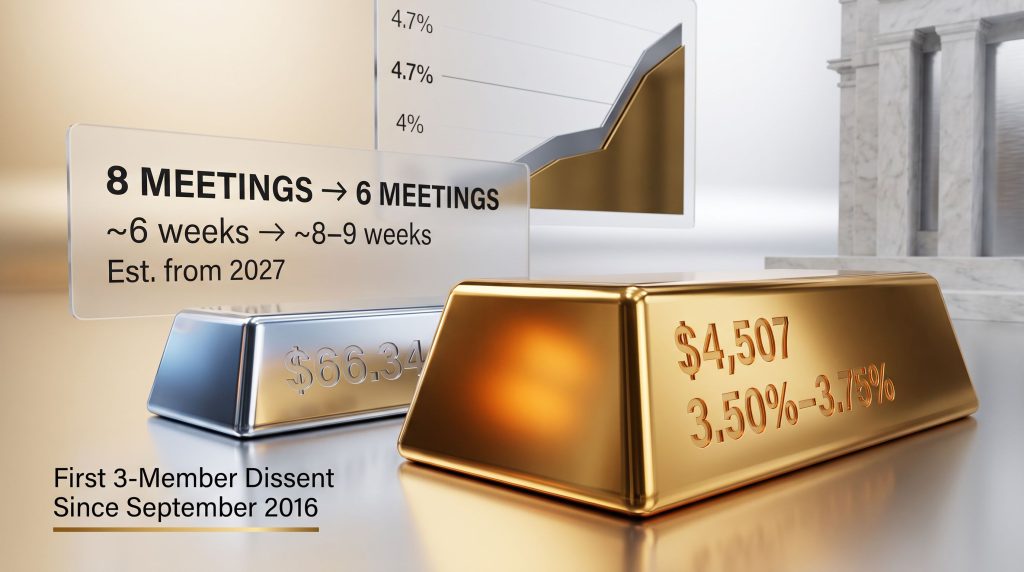
Further into the minutes, Chair Warsh formally raised the Kevin Warsh six FOMC meetings proposal: a structural change that would reduce the committee's annual meeting schedule from eight sessions to six, beginning in 2027. His stated rationale, as described in the minutes, was that a longer interval between formal sessions would allow additional economic data to accumulate before each decision and provide both policymakers and staff with more time to evaluate broader strategic monetary policy questions. The committee discussed the concept but reached no formal conclusion. The existing eight-meeting calendar was confirmed as unchanged for the remainder of 2026.
Four Decades of Eight Meetings: Why This Proposal Is Historically Significant
The Federal Reserve has operated on an eight-meeting annual schedule since the early 1980s, making the current structure one of the most enduring features of the institution's modern governance. The Federal Reserve Act itself sets only a minimum threshold of four meetings per year, leaving the FOMC significant discretion over its actual cadence. A move to six sessions would therefore be legally straightforward, but institutionally it would represent the most substantial scheduling change in over a generation.
It is worth noting that the Fed's current frequency is comparatively high relative to other major central banks:
- The European Central Bank restructured its meeting calendar in 2024, separating rate-setting decisions from broader economic assessment forums and reducing the frequency of formal rate votes
- The Bank of England and Bank of Canada both operate on schedules with fewer than eight formal rate decisions per year
- The Bank of Japan holds eight meetings annually but with considerably longer gaps between substantive guidance updates
In this context, a reduction to six meetings would bring the Fed more closely in line with global peers rather than positioning it as an outlier. The meaningful difference is that the Fed's eight-meeting structure has been the foundation of how markets, analysts, and the financial press consume monetary policy information for decades. The institutional habits built around that rhythm are difficult to overstate.
Understanding the Governance Architecture Behind the Proposal
Separating Rate-Setting from Strategic Deliberation
One reported element of the six-meeting framework involves pairing six formal rate-setting sessions with two additional forums dedicated to broader economic and institutional policy thinking. This bifurcation, separating tactical decisions from longer-range strategic review, mirrors structures already used at several peer central banks and reflects a coherent philosophy about how monetary policy committees should allocate their deliberative bandwidth.
The argument is straightforward: when a committee meets every six weeks with a rate decision required at each session, the gravitational pull of short-term data dominates discussion. Extending the inter-meeting gap creates space for analysis that is structurally crowded out by the frequency of required decisions.
The Dot Plot Dimension
Alongside the meeting-frequency question, reporting indicates the proposal may involve reducing how often the Fed publishes its Summary of Economic Projections (SEP), the document containing the widely tracked interest rate forecast grid known as the "dot plot." Currently released four times per year on a roughly quarterly basis, fewer SEP publications would reduce the regularity with which markets can extract forward-looking rate path information directly from policymakers' own projections.
This is significant because the dot plot has functioned, in practice, as a form of soft forward guidance even during periods when the Fed has formally stepped back from explicit guidance language. Reducing its frequency would close one of the remaining windows through which market participants calibrate their rate expectations against the committee's internal thinking.
Compounding an Already Guidance-Light Environment
The Kevin Warsh six FOMC meetings proposal does not exist in isolation. Under Warsh's leadership, the Fed has already moved away from the explicit forward guidance framework that defined post-2008 monetary policy. That shift, combined with a reduction in meeting frequency and potentially fewer SEP releases, produces a compounding reduction in the market's scheduled access to policy signals rather than a simple linear one. Furthermore, central banks influencing gold prices is a well-documented dynamic, and structural Fed changes of this nature add another layer to that relationship.
Consider the two variables independently:
- Variable A: Reduced forward guidance frequency limits the market's ability to anticipate future rate paths between meetings
- Variable B: Reduced meeting frequency extends the duration of each inter-meeting uncertainty window
Together, these variables do not merely add. They multiply. Each additional week of inter-meeting silence carries more positional consequence when it is no longer counterbalanced by a regular stream of guidance signals.
A Structural Comparison: What Changes Under a Six-Meeting Calendar
| Metric | Current Structure (8 Meetings) | Proposed Structure (6 Meetings) |
|---|---|---|
| Annual meetings | 8 | 6 |
| Average inter-meeting gap | ~6 weeks | ~8-9 weeks |
| SEP / dot plot releases | 4 per year | Likely reduced |
| Rate-setting opportunities | 8 | 6 |
| Legal minimum (Federal Reserve Act) | 4 | 4 (compliant) |
| Structure in place since | Early 1980s | Proposed from 2027 |
What Fewer Fed Meetings Mean for Gold and Silver
The Uncertainty Window Mechanism
Gold and silver do not require rate cuts to perform well. What they require, historically, is an environment in which the direction and pace of monetary policy is genuinely uncertain. That uncertainty functions as a structural condition rather than a short-term catalyst, and it tends to accumulate positioning in precious metals over time. Gold safe-haven demand is particularly sensitive to precisely this kind of extended uncertainty, as market participants seek assets with returns not correlated to scheduled Fed communication events.
A six-meeting schedule permanently widens the uncertainty window between formal policy signals. Every two-to-three additional weeks of inter-meeting silence represents more time during which gold and silver positioning can build without a calendar-anchored event to force resolution in either direction.
August 19, 2026: The Market's Immediate Response
Both metals had already begun rising before the 2:00 p.m. ET minutes release, driven by a softening U.S. dollar and retreating Treasury yields through the morning session. The 10-year Treasury yield eased toward 4.70%, pulling back from a 20-month high near 4.75% recorded the previous session. Consequently, gold and bond dynamics were clearly at play, with the yield retreat providing a meaningful macro tailwind for precious metals.
Following the minutes release:
- Gold traded near $4,507 as of 3:45 p.m. ET, representing approximately a 4% gain against its opening price of $4,334
- Silver reached approximately $66.34, a gain of roughly 4.7% from its $63.35 open
- Silver's percentage outperformance of gold was consistent with genuine demand breadth rather than a simple safe-haven flight
The distinction between what drove those moves matters considerably:
| Market Catalyst | Nature | Pre-Priced Prior to Minutes? |
|---|---|---|
| 9-3 vote to hold rates | Tactical / rate-specific | Largely yes, after July 29 statement |
| Three hawkish dissents | Sentiment / internal division | Partially |
| Six-meeting proposal | Structural / governance reform | No |
| Dollar softening / yield retreat | Macro trend | Partially |
The vote outcome was anticipated. The meeting-frequency proposal was not. That distinction explains why the metals reaction extended well beyond what a simple rate-hold vote would typically produce.
Reading the Gold-Silver Ratio as a Diagnostic
The gold-silver ratio analysis, which measures how many ounces of silver are required to purchase one ounce of gold, serves as an internal health indicator for precious metals market momentum. When silver outperforms gold on a percentage basis, the ratio compresses, signalling that demand is broadening beyond safe-haven allocation into industrial and speculative participation as well.
On August 19, 2026, silver's 4.7% gain outpaced gold's 4% advance, suggesting the ratio was compressing from its recent high-60s range. Historically, sustained compression of the gold-silver ratio from elevated levels has preceded multi-week precious metals rallies rather than isolated single-session spikes. This pattern is worth monitoring closely as the September FOMC meeting approaches.
The next major ASX story will hit our subscribers first
Governance Implications: Accountability, Transparency, and Volatility Risk
The Accountability Question
Reducing the number of FOMC meetings also reduces the number of formal accountability moments: the post-meeting statements, press conferences, and minutes releases that provide Congress, markets, and the public with structured insight into the Fed's current thinking. Critics of the proposal argue this reduction narrows the regularity of democratic oversight over the institution responsible for U.S. monetary policy.
Proponents counter that the quality and depth of deliberation matters more than its frequency, and that the existing eight-meeting structure can encourage short-horizon decision-making that undermines long-term price stability objectives.
The Inter-Meeting Volatility Dynamic
A less commonly discussed risk of the six-meeting structure is the potential for amplified volatility around scheduled meeting dates. Gold in market volatility environments has historically demonstrated its value, however the dynamics shift when fewer calendar anchors structure market positioning. With speculative capital potentially accumulating larger directional bets between meetings, sharper price movements when the Fed does convene become more likely. This dynamic is particularly relevant for:
- Long-duration Treasury bonds, where rate sensitivity is highest
- Growth equities with valuations anchored to discount rate assumptions
- Currency markets, where Fed divergence from other central banks drives positioning
- Commodity markets, particularly precious metals, where monetary policy uncertainty drives allocation
What Investors Should Monitor in the Weeks Ahead
Near-Term Catalysts
-
Jackson Hole Economic Symposium (late August 2026): Chair Warsh is scheduled to speak at the symposium, which represents the most likely near-term venue for elaboration on the six-meeting proposal's timeline and rationale. Markets will scrutinise his remarks closely for any indication of how the calendar change might be formalised.
-
September 2026 FOMC Meeting: With three sitting dissents already on record favouring a rate increase, the probability of another fractured vote is elevated. A fourth dissent, or a closer margin, would signal that hawkish pressure inside the committee is intensifying rather than dissipating.
-
Gold-Silver Ratio Trajectory: Continued compression from the high-60s range would confirm that silver is leading the current precious metals advance on genuine demand breadth. A reversal back toward the 70+ range would suggest the August move was primarily a gold-specific reaction rather than a broader metals repricing.
-
10-Year Treasury Yield: The yield's retreat from its 20-month high near 4.75% provided a macro tailwind for metals on August 19. A reversal back toward that level would represent a meaningful headwind for both gold and silver.
-
Congressional and Academic Response: Any formal proposal to restructure the FOMC's annual calendar may attract scrutiny from Congressional oversight committees given the transparency and accountability implications of reduced meeting frequency. The Federal Reserve's official monetary policy framework outlines the legislative boundaries within which such changes would need to operate.
Key Indicators at a Glance
| Indicator | Reading (Aug 19, 2026) | Significance |
|---|---|---|
| Gold spot price | ~$4,507 | Near all-time high range |
| Silver spot price | ~$66.34 | Outperforming gold on percentage basis |
| 10-year Treasury yield | ~4.70% | Retreating from 20-month high ~4.75% |
| Federal funds rate | 3.50%-3.75% | Held; three dissents favour a hike |
| FOMC dissent count | 3 (hawkish) | Highest since September 2016 |
| Gold-silver ratio | High-60s range | Compressing; watch for sustained move lower |
Frequently Asked Questions: Kevin Warsh Six FOMC Meetings Proposal
What is the Kevin Warsh six FOMC meetings proposal?
Chair Kevin Warsh formally raised the idea of reducing the FOMC's annual meeting schedule from eight sessions to six during the July 28-29, 2026 meeting, with the change proposed to take effect from 2027. The proposal was disclosed in the meeting minutes released August 19, 2026. No formal decision has been made, and the 2026 calendar remains unchanged at eight meetings.
Is reducing FOMC meetings legally permitted?
Yes. The Federal Reserve Act requires a minimum of four FOMC meetings per year. A reduction to six sessions satisfies this requirement comfortably and would represent a discretionary scheduling decision rather than a legislative change. Furthermore, the FOMC's historical meeting records illustrate how the committee's scheduling has evolved over several decades.
Why does the meeting-frequency proposal affect gold prices?
Gold historically performs well during extended periods of monetary policy uncertainty. Fewer scheduled meetings lengthen the windows between formal Fed communication events, structurally expanding the space in which uncertainty-driven gold positioning builds without a calendar-fixed catalyst to resolve it. This is a structural mechanism, not a near-term rate prediction.
Who dissented at the July 2026 FOMC meeting?
Beth Hammack (Cleveland Fed), Neel Kashkari (Minneapolis Fed), and Lorie Logan (Dallas Fed) all dissented in favour of a quarter-point rate increase. This marked the first simultaneous three-member hawkish dissent since September 2016.
When will the six-meeting proposal be decided?
No timeline has been confirmed. The Jackson Hole Economic Symposium in late August 2026, where Warsh is scheduled to address central banking governance, is the most anticipated near-term opportunity for further detail.
Disclaimer: This article is for informational and educational purposes only and does not constitute investment, financial, or purchasing advice of any kind. Precious metals investing involves risk, including the potential loss of principal. Past performance is not indicative of future results. All price figures referenced reflect conditions as of August 19, 2026. Always consult a qualified financial adviser before making investment decisions. Forecasts and scenario projections contained herein are speculative in nature and should not be relied upon as predictions of future market outcomes.
Want to Know Which ASX Mineral Discoveries Could Benefit From Extended Monetary Uncertainty?
Discovery Alert's proprietary Discovery IQ model delivers real-time alerts on significant ASX mineral discoveries, instantly identifying actionable opportunities during precisely the kind of prolonged inter-meeting uncertainty windows that structural Fed changes like the Warsh six-meeting proposal are designed to create — explore historic examples of major discovery returns to understand the potential at stake, then begin your 14-day free trial to position yourself ahead of the broader market.