
August 20, 2026
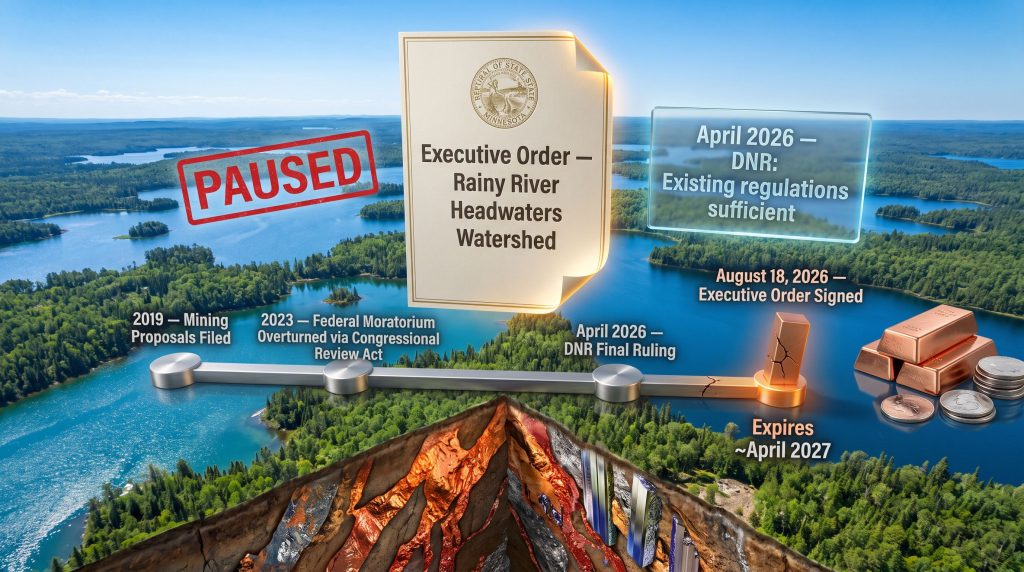
When State Regulators and Governors Collide: The Mechanics Behind Minnesota's Mining Standoff
Across the United States, the governance of subsurface mineral rights has long existed in a state of productive tension between federal authority, state regulatory discretion, and the economic aspirations of local communities. Rarely does that tension crystallise into a single executive action as consequential and legally contested as the one signed by Minnesota Governor Tim Walz on August 18, 2026. Understanding what that action actually does, what it does not do, and why those distinctions matter enormously for investors, mining companies, and policy analysts requires moving well beyond the headline shorthand of a "mining ban."
The phrase "Walz reinstates Minnesota mining ban" has circulated widely, but it contains an embedded assumption that deserves immediate scrutiny. No ban has been reinstated in any legally precise sense. What has occurred is a state-level executive intervention into permitting and leasing processes, one with a defined legal lifespan and a contested statutory foundation.
When big ASX news breaks, our subscribers know first
Decoding the Executive Order: What Was Actually Signed
Governor Walz's August 18 executive order targets a specific geographic and hydrological zone: the Rainy River Headwaters Watershed (RRHW), a drainage basin that sits upstream of the Boundary Waters Canoe Area Wilderness. The order's operational directives are precise and worth enumerating:
- The Minnesota Department of Natural Resources (DNR) and the Minnesota Pollution Control Agency (MPCA) are directed to cease all new environmental review and permitting work on nonferrous mineral mining proposals within the RRHW.
- State agencies are prohibited from issuing new mineral leases or surface leases in the affected watershed.
- Minnesota agencies are instructed not to participate as cooperating partners in any federal environmental review processes tied to affected projects.
- The DNR must immediately audit all existing nonferrous mineral leases within the RRHW for compliance.
- The DNR is directed to draft permanent legislative language that could eventually codify the order's restrictions into statute.
What the order does not accomplish is equally important. It does not restore the federal 20-year mining moratorium that Congress overturned in 2023 via the Congressional Review Act. That reversal was executed through a constitutional legislative mechanism, and no governor, state or federal, holds the authority to undo it through executive action alone. The federal pathway, while now open, remains subject to its own separate review processes.
The practical distinction matters: the executive order creates a state-level regulatory pause, not a permanent prohibition. Its legal shelf life is approximately 90 days beyond Walz's departure from office, placing its outer boundary near April 2027 under current timelines.
The Boundary Waters: Geography, Geology, and the Stakes Beneath the Surface
Why the RRHW Is Hydrologically Decisive
The Boundary Waters Canoe Area Wilderness (BWCAW) encompasses more than one million acres in northeastern Minnesota and consistently ranks among the most visited wilderness areas in the entire United States. Its ecological value is inseparable from the quality of water flowing into it. Because the RRHW lies upstream, any contamination originating from mining activity within the watershed would migrate downstream into the BWCAW's interconnected lake and river system.
This upstream-downstream dynamic is central to the environmental argument against mining in the region. Sulfide ore bodies, which host the copper and nickel deposits targeted by mining proposals, generate acid mine drainage when sulfide minerals are exposed to air and water during extraction. Unlike iron ore mining, which has a long history in Minnesota's Iron Range, copper-nickel sulfide mining carries a categorically different environmental risk profile. There is no operating sulfide mine in the United States that has avoided water quality impacts, a fact cited repeatedly by environmental advocates, though contested by industry proponents who point to advances in modern tailings management.
The Mineral Endowment: Nonferrous Metals and Their Strategic Significance
The deposits targeted within the RRHW are classified as nonferrous, meaning they contain metals other than iron. Furthermore, these resources are of considerable national importance, as the primary targets include:
| Metal | Primary Application | U.S. Strategic Classification |
|---|---|---|
| Copper | EV wiring, power grids, electronics | Critical mineral |
| Nickel | EV battery cathodes, stainless steel | Critical mineral |
| Cobalt | Battery chemistry, aerospace alloys | Critical mineral |
| Platinum-group elements | Catalytic converters, hydrogen fuel cells | Critical mineral |
The Twin Metals Minnesota project, which has been pursuing approvals to mine copper, nickel, and associated precious metals in the Superior National Forest since 2019, sits at the centre of this dispute. The project's mineral endowment is substantial by North American standards, and its development would represent one of the most significant new base metal mining operations in the United States in decades. In addition, the copper investment trends surrounding similar projects globally underscore just how strategically valuable these deposits have become.
A Timeline of Regulatory and Legislative Escalation
The current standoff did not emerge overnight. Consequently, it reflects nearly a decade of overlapping federal, state, and judicial processes:
| Year | Development | Significance |
|---|---|---|
| 2019 | Twin Metals formally pursues mining approvals in the Superior National Forest | Triggers multi-agency review cycle |
| 2023 | U.S. Congress overturns 20-year federal BWCAW mining moratorium via Congressional Review Act | Reopens federal permitting pathway |
| April 2026 | Minnesota DNR issues final ruling in six-year administrative lawsuit | Finds existing state regulations sufficient to protect the BWCAW |
| August 18, 2026 | Governor Walz signs executive order halting state permitting and leasing in the RRHW | Creates state-level regulatory dead zone for new project advancement |
The April 2026 DNR ruling deserves particular attention because it forms the crux of the legal tension now surrounding Walz reinstates Minnesota mining ban coverage. That ruling concluded a six-year administrative proceeding initiated by an anti-mining advocacy group that challenged the adequacy of Minnesota's nonferrous mining regulations. The process involved expert testimony from both sides, review by an administrative law judge, and consideration of more than 4,000 public comments. The DNR's conclusion was unambiguous: existing state rules are sufficient to prevent pollution, impairment, or destruction of the Boundary Waters and its watershed.
The August executive order effectively constitutes a gubernatorial override of his own administration's independent regulatory conclusions, a legal inconsistency that forms the primary basis for industry legal challenges.
Legal Vulnerabilities and the Question of Statutory Authority
Industry's Core Legal Objection
MiningMinnesota Executive Director Julie Lucas stated publicly that the order lacks legal standing and precedent, and characterised it as a response to political pressure rather than the findings of the state's own regulatory apparatus. That criticism points to a genuine constitutional question: can a governor's executive order override the final administrative determination of an independent state agency that followed due process?
The legal questions now circulating within industry and legal circles include:
- Whether the executive order has statutory authority to countermand a final DNR administrative ruling.
- Whether affected permit applicants or leaseholders have grounds for legal challenge based on due process or regulatory takings arguments.
- What financial liability the state of Minnesota may face if existing leases are effectively suspended without legislative authorisation.
- Whether the order's directive to state agencies not to participate in federal review processes creates additional exposure under cooperative federalism frameworks.
The Built-In Sunset: A Temporary Instrument
Under Minnesota state law, an executive order issued by an outgoing governor expires 90 days after that governor leaves office. With Walz scheduled to depart in early 2027, the order's theoretical maximum lifespan extends to approximately April 2027, absent either legislative codification or adoption by a successor governor. The order itself acknowledges this limitation by directing the DNR to develop permanent legislative language, effectively conceding that the executive mechanism alone is insufficient to create durable policy.
This sunset provision is critically important for investment analysis. It means the regulatory pause is, by legal design, a temporary instrument whose continuation depends on political variables rather than independent regulatory merit. However, a definitive feasibility study for any project in the region remains effectively unachievable while this blockade is in place.
Project-Level Impact: What the Pause Means Operationally
State Permits as a Practical Gating Mechanism
A nuance frequently lost in public coverage is that state environmental approvals are non-negotiable prerequisites even for projects situated on federal land. The Superior National Forest is federally administered, but mining activity requires concurrent state permits for water appropriation, air quality, tailings management, and environmental review. Without those state approvals, no project can advance regardless of its federal permitting status.
The executive order therefore creates a practical blockade at the state level that operates independently of whatever federal processes may be available. Twin Metals Minnesota's development timeline, already extended by years of regulatory and legal proceedings, faces further indefinite delay.
The Iron Range Dimension: Community Economics and Political Geography
Northeastern Minnesota's economy has been shaped by resource extraction for over a century. The Iron Range communities that have historically depended on mining employment view copper-nickel development as a generational economic opportunity. Industry stakeholders have argued consistently that Minnesota's regulatory framework, validated by the April 2026 DNR ruling, already demands that proposed projects demonstrate compliance with some of the most rigorous environmental and labour standards applied anywhere in the world.
Twin Metals Minnesota described the executive order as directly contradicting independent regulatory findings and as harmful to communities in northeastern Minnesota that want proposed projects evaluated through a neutral, science-driven process. From a community economics perspective, the order defers job creation and capital investment in a region where alternative economic drivers remain limited. Save the Boundary Waters and similar advocacy groups, however, continue to argue that the ecological stakes justify precisely this kind of intervention.
The next major ASX story will hit our subscribers first
Three Scenarios for Resolution
Pathway Analysis: How This Ends
Scenario 1: Legislative Codification
The DNR drafts statutory language as directed, and a future Minnesota legislature passes a permanent mining prohibition in the RRHW. This would create durable policy but faces substantial political resistance in a legislature that has historically reflected the divided interests of urban environmental constituencies and rural mining communities.
Scenario 2: Executive Order Reversal
A successor governor, particularly one more aligned with resource development interests following the 2026 election cycle, declines to adopt the Walz order. State permitting and review processes resume, though accumulated delays would extend project timelines significantly regardless.
Scenario 3: Judicial Intervention
Affected companies or leaseholders pursue legal action challenging the order's authority to override a final administrative determination. Courts assess whether gubernatorial executive power extends to countermanding independent agency rulings made through due process. This pathway is the most uncertain in terms of timeline and outcome.
The National Policy Contradiction at the Heart of the Dispute
Federalism, Critical Minerals, and the Limits of State Authority
The Boundary Waters dispute exposes a structural contradiction in U.S. resource governance. At the federal level, copper and nickel have been formally designated as critical minerals central to electric vehicle supply chains, defence industrial capacity, and clean energy infrastructure. The broader critical minerals and energy security debate at the federal level has expressed consistent interest in reducing import dependence for these materials, particularly given that the United States currently relies heavily on foreign sources for both refined copper and battery-grade nickel.
Yet even where federal permitting pathways are open, state regulatory authority can function as an effective veto. The Minnesota situation demonstrates that state-level governance can override federally articulated resource priorities without formal conflict preemption, creating a governance gap that no national critical minerals strategy has yet resolved.
This dynamic is not unique to Minnesota. Similar tensions between state environmental authority and federal mineral development priorities are playing out in Nevada, Alaska, and Arizona, suggesting a systemic challenge rather than an isolated local dispute. Furthermore, the evolving mining claims framework in other jurisdictions illustrates just how complex these multi-layered governance conflicts have become globally. For investors and project developers, the Minnesota case offers a cautionary study in the risks of regulatory fragmentation across jurisdictional layers.
The deeper policy question is not whether the Boundary Waters should be protected, a proposition with broad bipartisan support, but whether executive action that contradicts independent scientific and legal findings represents a durable or defensible mechanism for achieving that protection.
Frequently Asked Questions
Does the Walz executive order permanently ban mining near the Boundary Waters?
No. It is a temporary regulatory pause that expires approximately 90 days after Walz leaves office. Without legislative codification or adoption by a successor governor, it has no permanent legal effect.
Does this order restore the federal mining moratorium overturned by Congress in 2023?
No. The Congressional Review Act reversal of the federal moratorium cannot be undone through state or federal executive action. The federal pathway remains open under its own separate regulatory processes.
Why do state permits matter for projects on federal land?
Minnesota's environmental review and leasing approvals are legally required prerequisites for mining activity even within federally administered forests. Without state permits, no project can proceed regardless of federal status.
What minerals does the order affect?
The order covers nonferrous mineral mining within the RRHW, encompassing copper, nickel, cobalt, and platinum-group elements, all classified as critical minerals under U.S. federal policy.
What did the April 2026 DNR ruling find?
After six years of administrative proceedings, expert testimony from both sides, an administrative law judge review, and more than 4,000 public comments, the Minnesota DNR concluded that existing state regulations are adequate to protect the Boundary Waters from mining-related harm.
Can the order be challenged legally?
Industry stakeholders have raised substantive questions about the order's statutory authority, particularly given that it appears to override a final administrative determination made through due process. Legal challenges are a realistic prospect.
Key Takeaways for Investors, Policy Analysts, and Industry Observers
- The Walz reinstates Minnesota mining ban narrative, whilst politically potent, overstates the order's legal permanence. It is a politically significant but legally temporary instrument whose durability depends entirely on legislative action or gubernatorial continuity after April 2027.
- It creates an immediate state-level regulatory blockade for nonferrous mining proposals in the RRHW without resolving the underlying policy debate or permanently closing any development pathway.
- The order's most significant legal vulnerability is its apparent contradiction of the DNR's own April 2026 independent administrative finding, a tension that is likely to drive litigation.
- The dispute highlights a growing structural conflict between U.S. critical minerals policy at the federal level and state-level environmental governance, a conflict that no current legislative framework has definitively resolved.
- For project developers and investors, the Minnesota case illustrates that regulatory risk in resource development increasingly originates at the state level, even when federal pathways are formally open.
- The 2026 gubernatorial election cycle in Minnesota is now a material variable for any investment thesis tied to RRHW copper-nickel development timelines.
This article is analytical and informational in nature. Nothing contained herein constitutes investment advice. Regulatory and legal outcomes described involve forecasts and scenarios subject to significant uncertainty. Readers should conduct independent due diligence before making any investment or business decisions related to the matters discussed.
Want to Stay Ahead of Critical Mineral Discovery Opportunities on the ASX?
While regulatory battles over copper, nickel, and cobalt deposits play out across jurisdictions like Minnesota, Discovery Alert's proprietary Discovery IQ model scans ASX announcements in real time, instantly alerting subscribers to significant mineral discoveries across these same critical commodities — turning complex data into actionable opportunities. Explore why major mineral discoveries can deliver extraordinary returns and begin your 14-day free trial at Discovery Alert to position yourself ahead of the broader market.