August 19, 2026
The Structural Case for Hard Assets in a World of Soft Money
Every major commodity bull market in modern history has been preceded by the same conditions: prolonged underinvestment in physical supply, monetary conditions that erode purchasing power, and a generation of investors who have forgotten why tangible assets exist in a portfolio. Those conditions are not emerging today; they are already entrenched. Understanding why Rob McEwen bullish on gold and copper mining stocks requires stepping back from short-term price charts and examining the deeper architecture of the current cycle.
When big ASX news breaks, our subscribers know first
The Macro Case: Structural Forces Driving the Precious Metals Bull Market
Monetary Debasement as a Generational Catalyst
The forces driving gold higher in 2025 are not the product of a single policy error or geopolitical shock. They reflect a multi-decade accumulation of fiscal decisions that have progressively eroded the purchasing power of sovereign currencies across the developed world. Governments in the United States, Europe, Canada, and beyond continue to expand monetary supply at rates that structurally outpace productive economic growth.
Debt levels at every level of government remain at historically elevated positions, and defence spending associated with ongoing geopolitical conflicts is accelerating expenditure further. Gold production, by contrast, expands at approximately 1% per year. When monetary expansion runs at multiples of that figure, the supply-demand dynamic for gold becomes asymmetric in a way that is difficult to reverse through policy alone. This is not a cyclical imbalance; it is a structural one.
Why Central Banks Are Swapping Treasuries for Gold
One of the most telling signals in the current environment is the sustained pace at which central bank gold demand has grown globally, with institutions simultaneously reducing holdings of U.S. Treasury securities. This trend carries significant informational content. Central banks are not momentum traders; they operate on multi-decade mandates and carry enormous reputational costs for strategic errors.
Their continued preference for gold over sovereign debt instruments reflects a growing institutional concern about the long-term reliability of paper-based reserve assets. The question worth asking is not whether central banks are buying gold, but why they feel compelled to do so in such volume and with such consistency. The answer points directly to the same structural forces driving individual investors toward hard assets.
The Most Overlooked Statistic in Financial Markets
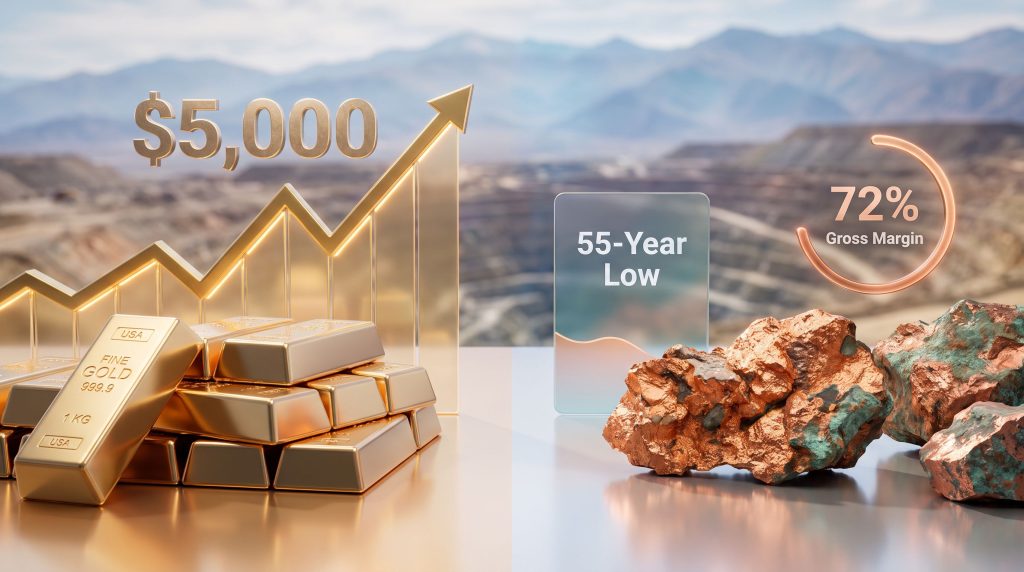
Perhaps the single most important data point that mainstream financial commentary continues to underweight is the relative valuation of commodities versus financial assets. Commodities as an asset class are currently priced at their lowest level relative to equities and financial instruments in 55 years. This is not a marginal imbalance; it represents a multi-generational dislocation between the physical inputs required to sustain economic activity and the paper claims built on top of that activity.
"Commodity valuations relative to financial assets sit at a 55-year low. For investors willing to think across cycles rather than quarters, this represents one of the most asymmetric positioning opportunities in modern market history."
This statistic has been largely ignored by institutional allocators who have spent two decades optimising for technology and financial sector exposure. That inattention, paradoxically, is precisely what makes the opportunity significant.
Where Is the Gold Price Headed? Analysing the Path to $5,000 Per Ounce
Gold Above $4,400: Foundation or Peak?
The gold price forecast points to further upside, even as gold has already climbed above $4,400 per ounce — a level that would have seemed improbable to most mainstream forecasters just three years ago. The natural investor instinct at this price point is to ask whether the move is exhausted. McEwen's framework offers a different lens: rather than asking whether gold is expensive relative to its recent history, investors should ask whether anything in the world has genuinely become cheaper over the same period.
Inflation remains persistent. Debt loads continue expanding. The answer to that question consistently points in the same direction. Long-term commodity investors are not focused on whether gold corrects 8% from current levels. They are focused on the structural trajectory over a multi-year horizon, and that trajectory remains supported by the same forces that have driven the metal from under $2,000 to where it trades today.
The Tether Effect: Crypto Capital Migrating to Physical Gold
One of the more unusual demand signals emerging in the current cycle involves the migration of capital from the digital asset ecosystem into physical gold. The cryptocurrency platform Tether has been reported to be purchasing approximately two tonnes of gold per month, a volume that is significant not just in quantity but in what it represents conceptually. A company whose entire business model is built around digital currency is actively accumulating physical metal at scale.
"The movement of crypto-native institutions into physical gold purchasing represents a demand dynamic that did not exist in any previous commodity cycle. It signals that even within the digital economy, there is growing recognition that hard assets carry value that synthetic instruments cannot replicate."
This convergence between digital finance and physical commodity ownership is a novel feature of the current cycle and one that deserves more analytical attention than it has received.
Gold Bullion vs. Gold Equities: Where the Value Gap Sits
One of the more actionable observations in the current market is that gold equities have meaningfully underperformed the gold price itself. This creates a valuation gap that institutional and sophisticated investors are beginning to recognise.
| Metric | Physical Gold (Bullion) | Gold Mining Equities |
|---|---|---|
| Current Price Exposure | Direct | Leveraged |
| Global Equity Portfolio Allocation | N/A | ~1.5-2% (historical norm: 9-11%) |
| Upside Potential | Moderate | High, if re-rating occurs |
| Risk Profile | Lower | Higher |
| Dividend and Cash Flow Potential | None | Growing at current metal prices |
The implication is that buying gold exposure through producing companies rather than bullion may offer superior value at current price levels, provided the operational fundamentals are intact.
Why Copper May Be the Most Strategically Important Metal of the Next Decade
Chilean Production in Structural Decline
Chile remains the world's largest copper-producing nation, but its production trajectory is increasingly problematic. Output from Chilean operations has been declining, and the structural challenges facing its major mines — including ore grade deterioration, water scarcity, and rising energy costs — suggest this is not a temporary dip. The copper supply crunch is therefore becoming a critical concern for a world simultaneously accelerating electrification, expanding AI infrastructure, and continuing to urbanise at scale.
New copper mines take between 10 and 20 years from discovery to production. Furthermore, the pipeline of shovel-ready large-scale projects is exceptionally thin. This combination of demand acceleration and supply inertia is precisely the setup that drives extended commodity price cycles.
Three Demand Vectors Converging Simultaneously
Copper sits at the intersection of three structural demand forces that are not cyclical:
- Electrification: The transition to electric vehicles, renewable energy infrastructure, and upgraded power grids requires copper at volumes that dwarf historical consumption patterns.
- AI Infrastructure: Large-scale data centre construction, which is accelerating rapidly across the United States, Asia, and Europe, requires substantial copper for power delivery and cooling systems.
- Global Urbanisation: Continued urban development across emerging economies, particularly in Southeast Asia and Africa, sustains baseline copper demand that exists independently of the energy transition narrative.
Argentina's Emergence as a Copper Jurisdiction
The Argentina copper potential is considerable, with the country holding a substantial concentration of large, undeveloped deposits that have remained largely untapped. U.S. State Department engagement with Argentina around mineral sovereignty signals Western nations' recognition that securing copper supply chains outside the traditional Chile-Peru corridor is a strategic priority. This geopolitical dimension adds a layer of complexity to copper's investment thesis that goes beyond simple supply-demand economics.
"Argentina's mineral endowment positions it as a potential significant copper producer over the coming decade. The geopolitical dimension of Western nations actively engaging with Argentina over resource sovereignty reflects how central copper has become to national industrial strategy."
Why Copper Has Not Yet Had Its Price Spike
Analysts who track commodity cycles closely note that copper, despite reaching record prices, has not experienced the kind of sharp vertical price movement that gold underwent during its most recent acceleration phase. The prevailing view among commodity strategists is that copper's defining price spike is still ahead, driven by the lag between demand acceleration and the market's full recognition of the supply constraint. When that recognition crystallises, the price response could be rapid and significant.
Los Azules: The Copper Project Attracting Major Mining Capital
Project Fundamentals at Today's Copper Prices
McEwen Copper's Los Azules project in Argentina represents one of the few large-scale copper development assets in the world that has reached an advanced stage of pre-construction readiness. At current copper prices, the economics are compelling by any measure.
| Project Metric | Los Azules (McEwen Copper) |
|---|---|
| Gross Margin (Feasibility Study) | 72% |
| Initial Mine Life | 21 years |
| Extended Life (Alternative Recovery Process) | Additional 33 years |
| Water Usage vs. Conventional Mine | Less than 25% |
| Carbon Emissions vs. Conventional Mine | One-tenth |
| Energy Target | 100% renewable |
| Development Stage | Pre-construction financing phase |
The New Social Licence Model
What distinguishes Los Azules beyond its geological scale is its environmental and social design philosophy. The project is being developed with a model that would consume less than a quarter of the water used by a conventional copper mine of comparable size, emit one-tenth of the carbon, and target 100% renewable energy sourcing. Plans include on-site food production and, notably, the construction of a hotel at the mine site to provide public transparency into operations.
This approach represents a deliberate strategy to reframe the relationship between large-scale mining and host communities. In an era where social licence to operate has become as critical as regulatory approval, this model is being watched closely by the broader industry as a potential template for future large-scale developments.
Why Major Miners Are Competing for Copper Development Assets
The shortage of large, development-ready copper projects globally has major producers actively competing for assets. Anglo American's attempt to acquire additional copper exposure earlier in 2025 illustrates the intensity of this competition. For senior producers who have historically divested exploration and development assets during low-price environments, the current landscape presents a difficult problem: the assets they sold cheaply are now extraordinarily valuable, and the replacement pipeline is thin.
Mining Equities Re-Rating: Why Stocks Are Still Lagging Metal Prices
What the Market Is Waiting to See
Despite record or near-record gold and copper prices, many mining equities have not experienced the re-rating that investors anticipated. The reason is relatively straightforward: the market is waiting for confirmation that elevated metal prices are translating into sustained free cash flow, and ultimately into dividends or capital returns. Until producers demonstrate that they can consistently convert high commodity prices into shareholder returns, many institutional investors will remain on the sidelines.
The historical parallel most often cited by veteran mining investors is Homestake Mining during the 1930s gold bull market, which became one of the highest-rated equities on U.S. exchanges and paid dividends that rivalled its own late-1920s trading price. The argument is that today's senior producers are approaching a comparable inflection point.
The Capital Allocation Question: Dividends or Reinvestment?
Senior producers have been following a familiar playbook: divesting high-cost operations, reducing debt, and rebuilding balance sheets. The next question is what they do with the cash. Two competing imperatives exist:
- Return capital to shareholders through dividends and buybacks to attract institutional investors who have avoided the sector.
- Reinvest aggressively in the next generation of projects to address the development pipeline shortage before the peak of the cycle.
The tension between these two priorities is likely to define corporate strategy for senior producers over the next two to three years.
Only 2% of Global Equity Capital Is in Metals
Perhaps the most striking structural observation about the current cycle is the allocation gap. Approximately 2% of global equity capital is currently invested in metals-related equities. In the early 1950s, that figure was around 10-11%, and similar levels prevailed at the turn of the twentieth century. The potential demand shock from even a partial normalisation of that allocation would be transformative for mining equity valuations.
"If global capital allocation to metals equities moves even halfway back toward historical norms, the inflow into the sector would be extraordinary relative to current market capitalisations. The re-rating, when it comes, could be both rapid and substantial."
The next major ASX story will hit our subscribers first
M&A Acceleration: Why Majors Are Selling and Who Is Buying
The Divestment Playbook and Its Unintended Consequences
A recurring pattern in the current cycle is that major producers have been selling assets at prices that, in retrospect, have proven deeply undervalued. The Newmont divestiture of Timmins-area properties is a particularly instructive case. The transaction was reportedly negotiated when gold was trading around $2,200 per ounce. By the time the deal closed, gold had crossed $4,000 per ounce, and the acquiring company's market capitalisation moved from the hundreds of millions to multiple billions.
A comparable Barrick divestiture of the Hemlo asset at $1 billion was followed by a significant re-rating in the acquirer's valuation. The pattern is consistent: major producers systematically underestimate the durability of gold price appreciation, creating acquisition opportunities for well-capitalised mid-tier and junior companies willing to take a longer view.
Old Mining Districts Revisited
Beyond major asset sales, a second wave of M&A activity involves companies revisiting established mining districts where historical operations were uneconomic at lower prices. Modern processing technologies, improved geological modelling, and elevated metal prices are collectively unlocking resources that were previously stranded. This is occurring across multiple jurisdictions, including notable examples in Finland and established North American gold belts.
September-October as a Seasonal Inflection Point
Historically, the September-October period has represented a seasonal strengthening window for mining equities and M&A activity. While this pattern is not guaranteed and a broader equity market selloff would affect mining stocks alongside other asset classes, the combination of seasonal tailwinds and elevated commodity prices makes the autumn period worth watching for deal announcements and equity re-rating catalysts.
The Labour Crisis: The Bottleneck That Could Constrain the Entire Cycle
Two Decades of Declining Enrolment
The most operationally acute challenge facing the mining industry in 2025 is not capital, permitting, or technology. It is people. Enrolment in mining engineering and geology programmes fell sharply over the preceding two decades, driven partly by the perception that mining was an environmentally destructive industry to be avoided rather than reformed. The consequence is a workforce pipeline that is simultaneously losing experienced practitioners to retirement and failing to replace them with sufficient numbers of trained entrants.
This demographic crunch is arriving precisely when metal prices are rising and the demand for new mine development is accelerating. The result is intense competition for skilled labour across every operational function, from underground mining to geological interpretation to processing plant management.
Policy Response and Its Limitations
The U.S. federal government has announced a $180 million grant directed at mining schools to rebuild educational capacity in mineral resource disciplines. While this represents meaningful institutional recognition of the problem, the timeline for impact is inherently long. Industry analysts broadly estimate that even with immediate and sustained policy intervention, it will take approximately a decade before new workforce entrants materially relieve current labour shortages.
"Funding mining education today is the right policy response, but the lag between enrolment and experienced workforce contribution means the industry will be operating in a labour-constrained environment for at least another decade regardless of current interventions."
Automation and AI as the Medium-Term Solution
The structural response to the labour deficit is likely to come through technology rather than workforce expansion alone. AI in mineral exploration, alongside robotics and automation, is emerging as a critical tool for maintaining and improving productivity in the absence of adequate human capital. The involvement of high-profile technology investors in mining-focused automation and exploration companies signals that this convergence between mining and technology is gaining momentum beyond theoretical discussion.
Travis Kalanick, co-founder of Uber, has invested in a mining robotics and automation company, reflecting the growing recognition among technology investors that the physical infrastructure underlying the digital economy requires material-intensive solutions that the mining industry must deliver.
How to Position Across the Mining Capital Stack in 2025
Risk-Adjusted Framework for Mining Investment
Rob McEwen's investment philosophy is explicitly risk-tier based. His view is that the appropriate entry point within the mining capital stack depends entirely on an investor's risk tolerance, time horizon, and capacity to absorb volatility.
| Investor Profile | Recommended Exposure | Rationale |
|---|---|---|
| Conservative | Royalty and Streaming Companies | Lower operational risk, diversified revenue streams |
| Balanced | Senior Gold Producers | Cash flow generation, growing dividend potential |
| Growth-Oriented | Mid-Tier Developers | Leverage to metal prices, re-rating opportunity |
| High-Risk / High-Reward | Junior Explorers | Explosive upside potential, high failure rate |
| Thematic / Long-Term | Copper Developers | Decade-long demand tailwinds, supply scarcity premium |
The Hidden Cost of Royalty and Streaming Deals
McEwen holds a characteristically direct view on royalty and streaming arrangements: while they offer investors a lower-risk entry to commodity exposure, they represent a structurally poor deal for the mining operators who enter into them. Companies that sell royalties or streams are effectively trading their profit margin and long-term resilience for short-term capital without the dilution optics of an equity raise. The beneficiaries of these arrangements are primarily the royalty companies and their shareholders, not the producers who created the underlying asset value.
What a $290 Million Personal Stake Signals
McEwen's combined personal investment across McEwen Mining and McEwen Copper exceeds $290 million. In the context of capital allocation signalling, this level of personal commitment by a founder-operator represents one of the strongest possible forms of conviction expression. It aligns his financial interests directly with those of public shareholders in a way that is relatively rare among senior mining executives. Investors seeking further context on his broader outlook can follow his market commentary directly.
Frequently Asked Questions: Rob McEwen on Gold and Copper
Why is Rob McEwen bullish on gold and copper mining stocks right now?
McEwen's position is grounded in structural macro analysis rather than short-term price momentum. Persistent monetary expansion, sovereign debt accumulation, currency debasement, and the historically low allocation of global equity capital to metals collectively support a multi-year bull case for both gold and copper. He views current gold equity valuations as materially underpricing the cash flow embedded at today's metal prices.
What is McEwen's gold price target?
McEwen has publicly articulated a view that gold could reach $5,000 per ounce, with the same structural drivers — central bank accumulation, inflation persistence, and commodity undervaluation relative to financial assets — forming the analytical foundation for that outlook.
Why is copper a priority alongside gold?
Copper sits at the convergence of electrification, AI infrastructure build-out, and global urbanisation. Combined with declining output from the world's dominant producing nation and a very limited pipeline of development-ready large-scale projects, copper's supply-demand dynamics are becoming structurally more favourable over a multi-year horizon.
What milestones should investors watch over the next 12 to 18 months?
- Mine development progress at Canadian operations in the Timmins district and Manitoba
- Exploration results from Nevada properties
- Restart timeline for Mexican operations
- Completion of project financing for the Los Azules copper development
- Free cash flow generation and dividend announcements from senior producers across the sector
How does the labour shortage affect the investment thesis?
The labour shortage creates a dual constraint: it limits the speed at which new supply can come online, which is supportive of prices, while simultaneously increasing operating costs and execution risk for producers. Automation and AI-assisted exploration are the medium-term mitigants, but meaningful workforce normalisation is likely a decade away.
Final Framework: Three Questions Every Mining Investor Should Ask
Regardless of where an investor positions within the mining capital stack, three foundational questions should anchor every capital deployment decision in the current environment:
- Is the asset in a proven district with established geological credibility? Historical production data and geological continuity significantly reduce exploration risk and support resource estimation reliability.
- Is the operator deploying technology effectively to offset labour constraints and improve margins? Companies that are integrating AI, automation, and robotics into operations are structurally better positioned to navigate the decade-long labour shortage ahead.
- Is the current share price reflecting today's metal prices, or does a meaningful valuation gap remain? The largest returns in commodity cycles typically accrue to investors who identify and hold positions through the re-rating phase, not those who enter after it has already occurred.
The convergence of macro monetary forces, a 55-year commodity valuation low, accelerating copper demand, and a deeply under-allocated global equity base creates a backdrop that experienced commodity investors describe as generational. Whether the re-rating unfolds over two years or five, the structural argument for Rob McEwen bullish on gold and copper mining stocks — and for hard assets in a world of persistently soft money — remains intact.
This article is for informational purposes only and does not constitute financial advice. All forecasts, price targets, and projections discussed reflect the views of the individuals cited and involve inherent uncertainty. Past commodity cycles are not necessarily indicative of future outcomes. Readers should conduct their own due diligence before making any investment decisions.
Want to Know When the Next Major ASX Mineral Discovery Hits the Market?
Discovery Alert's proprietary Discovery IQ model delivers real-time alerts the moment significant mineral discoveries are announced on the ASX, transforming complex geological data into clear, actionable opportunities across gold, copper, and more than 30 other commodities — exactly the kind of early intelligence that matters most in a structural bull market. Explore why historic mineral discoveries have generated extraordinary returns and begin your 14-day free trial today to position yourself ahead of the broader market.