August 14, 2026
The Regulatory Bottleneck That Separates PGM Projects From PGM Mines
In the global mining industry, no jurisdiction tests developer patience quite like South Africa. The country sits atop the world's most extraordinary concentration of platinum group metals, yet converting that geological endowment into producing mines has never been a straightforward exercise. Regulatory timelines stretching across years, community consultations requiring genuine structural equity participation, and a licensing bureaucracy under sustained resource pressure have collectively created one of the most demanding pre-production environments anywhere in the resources sector.
Understanding this context is essential before examining what Southern Palladium awarded mining right for Bengwenyama in August 2026 actually represents. This is not merely a procedural formality ticked off a checklist. Within South Africa's mining framework, the grant of a formal mining right is the foundational legal event upon which all subsequent project execution activity depends. It is the single document that transforms an exploration and development asset into a construction-ready opportunity.
When big ASX news breaks, our subscribers know first
Why South Africa's Mining Right Process Carries Such Disproportionate Weight
The Department of Mineral and Petroleum Resources has long been characterised as chronically under-resourced relative to the volume of applications it must assess. Industry participants operating across multiple South African projects routinely factor in multi-year licensing horizons as a standard assumption in project financial models.
Southern Palladium submitted its Bengwenyama mining right application in 2023, with formal approval confirmed in August 2026. That timeline, while not unusual by South African standards, underscores a critical investor insight: the regulatory risk premium embedded in South African PGM development projects is real, measurable, and often underappreciated by investors accustomed to faster-moving jurisdictions.
The 30-year tenure granted under this mining right is particularly significant for project bankability. Lenders and project finance institutions require legal certainty over operational lifespans before committing capital. A three-decade right provides that certainty with considerable margin, covering the envisaged mine life with substantial buffer, and underpinning the financing discussions that will now formally accelerate.
Without a granted mining right, no major contractor can be legally mobilised, no definitive feasibility study can be formally finalised for finance purposes, and no construction activity can commence. The document is not symbolic. It is operational.
Bengwenyama Project Overview: Location, Scale, and Commodity Scope
Where Geology and Scale Intersect
The Bengwenyama project occupies 5,280 hectares on the Eastern Limb of South Africa's Bushveld Complex in Limpopo Province, positioned directly adjacent to the Valterra/African Rainbow Minerals Modikwa Mine. The Bushveld Complex is the most mineralogically significant layered intrusion geology on the planet, hosting the vast majority of the world's known PGM reserves and a substantial portion of its chrome resources.
The Eastern Limb is a geologically distinct zone within the Bushveld. While it has historically attracted less capital than the more extensively developed Western and Northern Limbs, it is increasingly recognised as hosting reef packages of comparable, and in some cases superior, grade consistency. The proximity to Modikwa is analytically instructive: it validates the geological interpretation at Bengwenyama and provides a reference point for processing infrastructure and operational benchmarking.
Commodity Coverage: Broader Than a Standard PGM Play
The granted mining right covers an unusually comprehensive suite of recoverable minerals, positioning Bengwenyama as a multi-commodity asset rather than a pure PGM development:
| Commodity | Market Relevance |
|---|---|
| Platinum Group Metals (PGMs) | Primary revenue driver; autocatalyst, jewellery, and hydrogen economy demand |
| Chrome | High-value by-product; ferrochrome and stainless steel input markets |
| Gold | Supplementary precious metal by-product |
| Copper | Industrial demand and energy transition applications |
| Cobalt | Battery supply chain positioning |
| Nickel | EV batteries and stainless steel feedstock |
| Silver | Precious metal by-product recovery |
This multi-mineral scope is not merely academic. Furthermore, as the chrome recovery analysis below demonstrates, by-product revenue diversification can meaningfully alter the economics of a PGM project at the cost-per-ounce level. The growing critical minerals demand from the energy transition adds further long-term relevance to these by-product streams.
Ownership Architecture: The B-BBEE Community Partnership
South Africa's Mineral and Petroleum Resources Development Act requires meaningful black economic empowerment participation in mining ventures. At Bengwenyama, this requirement has been structured through a genuine equity partnership rather than a nominal compliance arrangement.
Southern Palladium holds a 70% interest in the project through its subsidiary Miracle Upon Miracle Investments. The remaining 30% equity stake is retained by the Bengwenyama community, creating direct financial alignment between local stakeholders and project outcomes.
Community equity structures at meaningful ownership levels are increasingly interpreted by institutional ESG-focused investors as a positive governance signal. Projects where community interests are genuinely tied to commercial outcomes have historically demonstrated more durable social licences to operate than those relying on benefit-sharing arrangements alone.
This structural approach matters operationally. Community opposition to mining in South Africa has derailed or significantly delayed projects in the past. A 30% equity participation creates economic incentive for the community to actively support project advancement rather than simply tolerate it.
Capital Strategy: The Shift to a Two-Phase Development Model
Why the Revised Plan Changes the Financing Equation
One of the most consequential decisions in Bengwenyama's development history predates the mining right award itself. In July 2025, Southern Palladium restructured its capital deployment model from a single-stage construction programme to a phased rollout, with material implications for financing risk.
| Metric | Original Single-Stage Plan | Revised Two-Phase Plan |
|---|---|---|
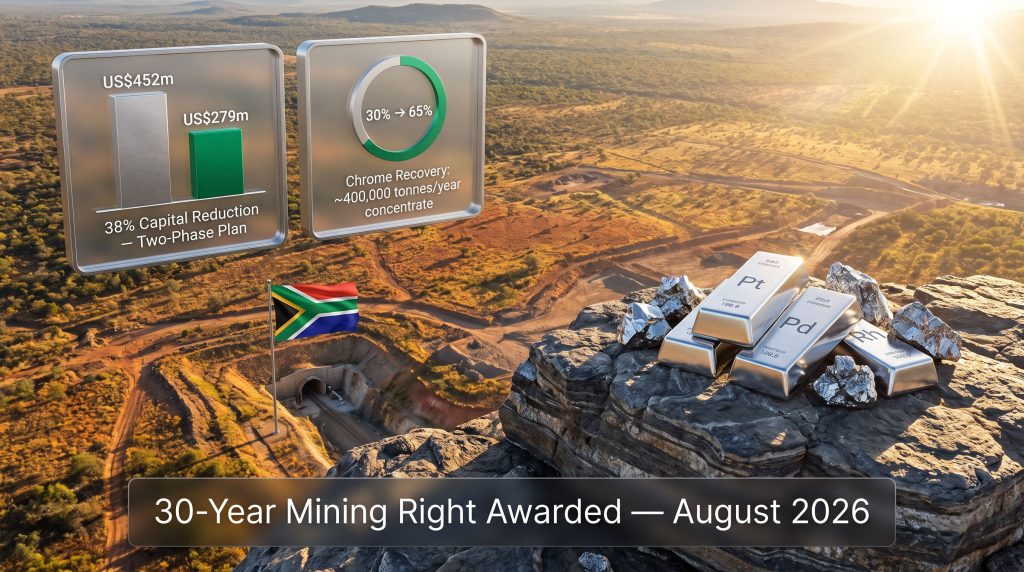
| Peak Funding Requirement | US$452 million | US$279 million |
| Annual PGM Output (Phase 1) | 400,000 oz | 200,000 oz |
| Project Mine Life (original) | ~20 years | Extended under Phase 2 |
| Capital Risk Profile | Elevated | Materially reduced |
| Funding Reduction | – | ~US$173 million (approx. 38%) |
The logic behind phased development is well-established in resource project finance. By targeting a smaller, more capital-efficient first phase, Southern Palladium reduces the quantum of external financing required to reach production. Once Phase 1 generates cash flow, a portion of that revenue can be directed toward funding Phase 2 construction, reducing dependence on equity markets or debt facilities at potentially unfavourable terms.
This is a particularly astute strategy in the current PGM financing environment. Investor appetite for junior mining capital raises has been uneven, and the ability to demonstrate production from Phase 1 before committing to the full build substantially de-risks the overall project from a capital markets perspective.
Chrome Recovery: The Economics-Shifting By-Product Revision
From 30% to 65%: Why Doubling Recovery Changes the Entire Cost Profile
In April 2026, Southern Palladium revised its chrome recovery assumptions upward in a manner that significantly improves Bengwenyama's financial profile. Previous metallurgical assumptions modelled chrome recovery at approximately 30%. Updated test work produced a revised recovery estimate of 65%, translating to approximately 400,000 tonnes per year of chrome concentrate from a planned ore feed of 100,000 tonnes per month.
To understand why this revision is analytically significant, it helps to examine the mechanics of PGM mine economics:
- The primary revenue driver is the PGM basket price, which is inherently volatile and beyond management control.
- By-product revenues function as a natural offset to unit operating costs, effectively reducing the cost per PGM ounce produced.
- Higher by-product recovery rates improve project margins without requiring additional capital expenditure or throughput increases.
- Greater chrome revenue diversifies the revenue stream, providing partial insulation against PGM price weakness.
Current market dynamics add further context here. Chrome ore has been demonstrably more profitable than ferrochrome processing in recent market cycles, a dynamic evidenced by comparable operations in the Eastern Limb and noted by industry observers tracking Merafe Resources and similar chrome-producing entities. Selling chrome concentrate rather than processing it through a smelter avoids the substantial capital and energy costs of ferrochrome production while capturing competitive spot pricing.
For a development-stage PGM project, doubling chrome recovery rates represents a free economic option. No additional resource delineation is required, no new infrastructure is needed, and the benefit flows directly to project-level returns from first production.
The next major ASX story will hit our subscribers first
The Path From Mining Right to Operating Mine: What Remains
Critical Outstanding Milestones
The mining right award is an enabling milestone, not a production trigger. Several critical steps remain before physical mining operations can commence at Bengwenyama:
Regulatory approvals still outstanding:
- Water-use licence under South Africa's National Water Act (a separate and often protracted approval process)
- Waste management approvals required for environmental compliance
Development activities now unlocked by the mining right:
- Completion of the Definitive Feasibility Study, targeted for Q4 2026
- Finalisation of the project execution plan
- Contractor mobilisation for decline and box-cut works
- Commencement of early works at the project site
Commercial and financing activities:
- Formal project financing discussions with lenders and strategic partners, typically triggered by DFS completion
- Offtake agreement negotiations for PGM concentrate and chrome concentrate
The water-use licence deserves particular attention. South Africa's water licensing framework operates independently of the DMPR and is administered under different regulatory architecture. Water approvals have historically created separate, sometimes lengthy, delays for mining projects even after mining rights have been secured. Consequently, this remains a critical path item that investors and project analysts should monitor closely.
Bengwenyama Development Timeline
| Milestone | Status | Target Timing |
|---|---|---|
| Mining Right Application Submitted | Complete | 2023 |
| Mining Right Granted (30-year tenure) | Complete | August 2026 |
| Environmental Guarantee Lodged with DMPR | Complete | August 2026 |
| Definitive Feasibility Study (DFS) | In Progress | Q4 2026 |
| Water-Use Licence | Pending | TBC |
| Waste Management Approvals | Pending | TBC |
| Contractor Mobilisation (Decline/Box-Cut) | Pending | Post-DFS |
| Phase 1 Production Commencement | Pending | TBC |
Bengwenyama Within South Africa's Broader PGM Supply Landscape
Eastern Limb Development and the Structural Case for New PGM Capacity
South Africa accounts for approximately 70-75% of global platinum production, a concentration that creates both strategic opportunity and systemic supply chain vulnerability. The Eastern Limb of the Bushveld Complex, historically less developed than the Western Limb infrastructure corridor anchored by operations around Rustenburg and Marikana, is increasingly the focus of new project development activity.
The structural rationale is compelling. Several major Western Limb operations are encountering the economic consequences of mining progressively deeper, higher-cost ore bodies. As shaft depths increase, so do unit extraction costs, ventilation requirements, and logistical complexity. Against this backdrop, the development of shallower, higher-grade Eastern Limb deposits carries outsized significance for the medium-term supply outlook.
Platinum's emerging role as a catalyst in hydrogen fuel cell technology adds a demand-side dimension to this analysis. The platinum and palladium market faces short-term pressure from electric vehicle adoption reducing catalytic converter demand, however the hydrogen economy represents a structural long-term demand pathway that many market participants have not yet fully priced into project valuations.
Eastern Limb Comparative Context
| Operation | Operator | Annual PGM Output | Stage |
|---|---|---|---|
| Bengwenyama (Phase 1 Target) | Southern Palladium | 200,000 oz | Pre-construction |
| Modikwa Mine | Valterra/ARM | ~200,000-250,000 oz (est.) | Operating |
| Bokoni Platinum | ARM | Restart phase | Reboot |
Bengwenyama's Phase 1 output target of 200,000 oz/year would, upon reaching production, represent a meaningful addition to Eastern Limb supply at a scale comparable to established neighbouring operations. For context, African Rainbow Minerals platinum operations in the same corridor provide a useful operational benchmark for what mature production looks like in this geological setting.
Frequently Asked Questions: Bengwenyama Mining Right
What is the Bengwenyama project?
Bengwenyama is a platinum group metals development project covering 5,280 hectares on the Eastern Limb of South Africa's Bushveld Complex in Limpopo Province. Primary target commodities are PGMs, with chrome, gold, copper, cobalt, nickel, and silver as additional recoverable minerals. Further detail on the project's operational scope is available via Southern Palladium's operations page.
Who awarded the Bengwenyama mining right?
The South African Department of Mineral and Petroleum Resources formally granted the Southern Palladium awarded mining right for Bengwenyama in August 2026, covering a 30-year tenure period.
What is Southern Palladium's ownership stake?
Southern Palladium holds a 70% interest through its subsidiary Miracle Upon Miracle Investments. The Bengwenyama community holds the remaining 30% equity stake.
How much will Phase 1 cost to develop?
Under the revised two-phase development model, peak funding for Phase 1 is estimated at US$279 million, reduced from US$452 million under the original single-stage concept.
Is Bengwenyama ready to begin mining immediately?
Not yet. The mining right unlocks the legal authority to advance construction activities, but the project still requires completion of its DFS, a water-use licence, waste management permits, contractor mobilisation, and project financing commitments before production can commence.
What is the chrome recovery revision, and why does it matter?
Updated metallurgical work completed in April 2026 revised chrome recovery from 30% to 65%, implying approximately 400,000 tonnes per year of chrome concentrate from planned ore throughput. This improvement enhances project economics through higher by-product revenues without requiring additional capital expenditure. The full announcement regarding the Southern Palladium awarded mining right for Bengwenyama and associated project details was made available through the ASX announcement lodged in August 2026.
Disclaimer: This article is intended for informational purposes only and does not constitute financial advice. Forecasts, project timelines, capital estimates, and production targets referenced in this article are subject to material change based on technical, regulatory, market, and financing conditions. Investors should conduct their own due diligence and consult qualified financial advisers before making investment decisions. Past performance of comparable projects is not indicative of future outcomes.
Want to Be First When the Next Major PGM Discovery Hits the ASX?
Discovery Alert's proprietary Discovery IQ model scans ASX announcements in real time, instantly identifying significant mineral discoveries across platinum group metals and beyond — turning complex data into actionable investment insights before the broader market reacts. Explore how historic discoveries have generated substantial returns on Discovery Alert's dedicated discoveries page, and begin your 14-day free trial today to position yourself ahead of the next major find.