August 14, 2026
When a Single Buyer Controls Half a Market, Every Deal Becomes a Precedent
The iron ore trade has historically been governed by bilateral relationships between miners and steelmakers, with pricing benchmarked against Singapore Exchange futures and settled in US dollars. That architecture, refined over decades, is now under pressure from a structural force that did not exist five years ago: a single, state-coordinated procurement body representing more than half of China's entire steelmaking capacity.
Understanding the mechanics of this shift matters not just for mining executives, but for anyone with exposure to iron ore equities, commodity derivatives, or the broader materials sector. The Anglo American iron ore deal with China state buyer China Mineral Resources Group (CMRG) offers a window into how this new procurement reality is reshaping the commercial terms, negotiating dynamics, and strategic positioning of the world's largest seaborne iron ore market.
When big ASX news breaks, our subscribers know first
What CMRG Actually Is and Why Its Scale Changes Everything
China Mineral Resources Group was established in 2022 as a state-owned enterprise with a specific mandate: consolidate China's iron ore purchasing power to counter what Beijing viewed as an imbalance in pricing negotiations with the world's three dominant miners. Before CMRG, individual Chinese steelmakers negotiated separately with suppliers, a fragmented approach that left producers like BHP, Rio Tinto, and Vale with significant pricing leverage.
CMRG fundamentally inverted that dynamic by aggregating demand across its member mills, which now represent more than 50% of China's domestic steelmaking capacity. This is not merely a large buyer. It is a monopsonistic bloc with the structural ability to shift pricing baselines across the entire seaborne iron ore market. Furthermore, understanding the broader China steel and iron ore market context is essential for appreciating how CMRG's emergence fits within longer-term structural trends.
Key characteristics of CMRG's procurement model include:
- Centralised negotiation on behalf of member mills, replacing individual bilateral contracts
- Annual deal cycles that reset leverage positions each year
- The ability to use staggered negotiations across different miners to extract sequential concessions
- Growing membership that continues to expand its demand representation
Kumba Iron Ore's Position Within Anglo American's Dual-Geography Strategy
Anglo American operates two geographically and commercially distinct iron ore businesses. Kumba Iron Ore, headquartered in South Africa and centred on its flagship Sishen and Kolomela mines, produces a premium-grade product characterised by higher iron content relative to the 62% Fe benchmark that dominates market pricing. Minas-Rio, located in Brazil's Minas Gerais state, produces a different product type and operates under a fundamentally different commercial model.
The distinction matters enormously in the context of the CMRG deal:
| Asset | Location | Product Type | China Long-Term Contracts | CMRG Coverage |
|---|---|---|---|---|
| Kumba Iron Ore | South Africa | Premium high-Fe lump and fines | Yes | Included |
| Minas-Rio | Brazil | Iron ore slurry / pellet feed | No | Excluded |
Kumba sold approximately 37 million tons of iron ore in 2025, positioning it as a mid-tier supplier by global volume but a premium-tier supplier by product quality. The premium nature of Kumba's ore is a double-edged commercial reality: it commands a price premium over benchmark grades in open markets, but it also complicates standardised contract pricing with a procurement body that prefers uniform terms across its member mills.
The Core Terms of the Anglo American and CMRG Supply Agreement
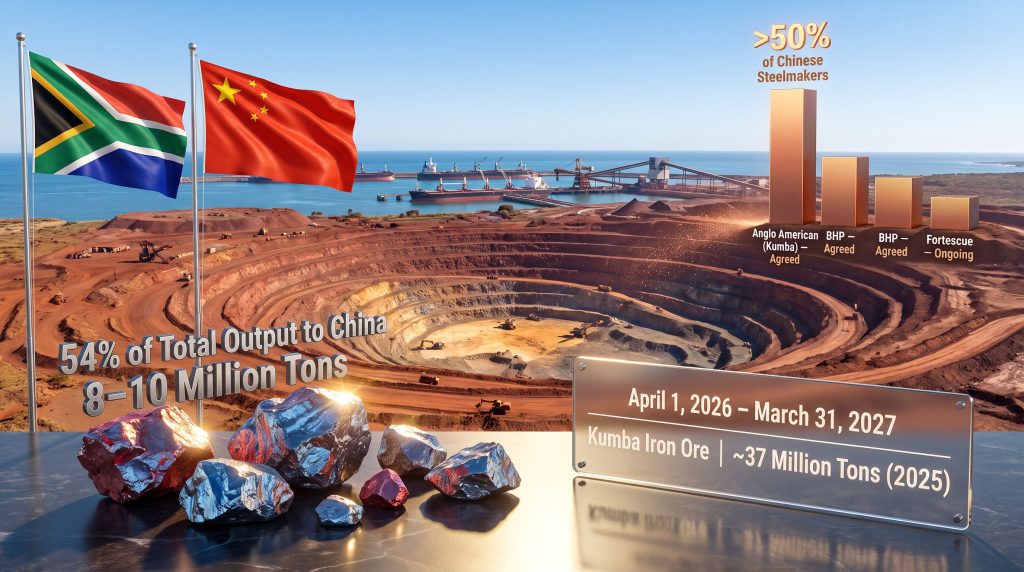
The supply agreement between Kumba Iron Ore and CMRG covers the period from April 1, 2026 through March 31, 2027, structured as a one-year arrangement consistent with the annual deal cycle CMRG has pursued across its negotiations with major miners.
Estimated contracted volumes fall in the range of 8 to 10 million tons, derived from Kumba's confirmed sales data, estimated spot volumes, and the number of CMRG member mills participating in the arrangement. Pricing terms were not publicly disclosed, as confirmed in Anglo American's official press release.
Anglo's global head of sales and trading confirmed on the company's July 2026 earnings call that a CMRG agreement was in place as of April 1, noting that despite approximately 54% of Anglo's total iron ore output flowing into China, the CMRG-specific contracted volumes represent a relatively contained portion of that total China exposure. The remainder flows through spot sales and non-CMRG long-term contracts with Chinese mills outside the CMRG framework.
This sales channel diversification is a deliberate commercial hedge. By maintaining parallel routes to Chinese buyers, Anglo preserves pricing optionality and reduces the leverage any single procurement structure can exert over its total revenue base.
How Anglo's Deal Compares to BHP and Fortescue's Negotiations
The contrast between Anglo's relatively smooth CMRG agreement and the experiences of larger, more diversified miners reveals a structural pattern in how CMRG exercises its leverage.
| Miner | CMRG Deal Status | Key Challenges | Notable Concession |
|---|---|---|---|
| Anglo American (Kumba) | Agreed, April 2026 to March 2027 | Premium ore pricing complexity | Not disclosed |
| BHP | Agreed, after extended negotiations | Large, multi-grade portfolio | Yuan-denominated pricing accepted |
| Fortescue (FMG) | Ongoing, tense negotiations | Large volume, grade mix issues | Under negotiation |
BHP's negotiation stretched over months and ultimately required the company to accept yuan-denominated pricing for a portion of its contracted volumes. This is a concession with implications that extend well beyond any individual deal. Pricing iron ore in yuan rather than US dollars introduces currency risk management complexity for miners, reduces transparency against Singapore futures benchmarks, and creates a parallel pricing system that could gradually erode the dollar's role as the reference currency for seaborne iron ore trade.
Fortescue's ongoing difficulty is particularly instructive. As the world's fourth-largest iron ore exporter with a portfolio weighted toward lower-grade products, Fortescue faces a negotiating environment where CMRG can credibly argue that grade discounts should be built into contract structures. Indeed, China's state iron ore buyer has extended restrictions on Fortescue, underscoring the tense nature of those negotiations as of mid-2026.
Why Portfolio Complexity Creates Structural Disadvantage
One of the less-discussed dynamics in CMRG negotiations is the relationship between portfolio complexity and negotiating friction. Anglo's relatively straightforward agreement compared to BHP's months-long ordeal can be partly explained by the single-origin, single-product nature of the Kumba offering.
When a miner brings multiple ore grades from multiple geographic origins to a centralised procurement table, standardising contract terms across all those products creates genuine complexity. CMRG must reach consensus among its member mills about acceptable grade-adjusted pricing, delivery terms, and volume allocation. The more heterogeneous the product offering, the longer that internal consensus process takes.
This structural reality creates several notable dynamics:
- Smaller, single-asset iron ore producers may reach CMRG agreements faster than diversified majors, giving them potential commercial advantages in securing early-deal pricing.
- CMRG can exploit extended negotiations to extract incremental concessions, using time pressure against miners who need volume certainty for operational planning.
- Premium ore suppliers face a specific tension between defending price premiums and meeting CMRG's preference for standardised, benchmarkable contract terms.
- The renewal cycle in early 2027 will test whether initial agreements set lasting precedents or whether miners can renegotiate on improved terms.
The next major ASX story will hit our subscribers first
The Yuan Pricing Question and Its Long-Term Market Implications
BHP's acceptance of yuan-denominated pricing, even for a portion of its CMRG volumes, deserves deeper analysis than it typically receives in mainstream commodity coverage. Iron ore has been priced in US dollars since the seaborne market developed in the 1960s and 1970s. The Singapore Exchange's iron ore futures contracts, which serve as the primary hedging instrument for both miners and steel mills, are denominated in dollars.
Introducing yuan pricing into long-term contracts creates a bifurcated reference framework. Miners would need to manage currency exposure between yuan receivables and dollar-denominated cost structures. Chinese mills would benefit from reduced foreign exchange risk, but the global benchmark function of dollar-priced futures would be diluted over time if yuan contracts became widespread. The global iron ore market impact of these pricing shifts is further compounded by ongoing US tariff pressures reshaping trade flows.
If CMRG successfully pushes yuan pricing across the 2027 renewal cycle for multiple major miners simultaneously, the effective benchmark for seaborne iron ore pricing could shift materially, compressing margins for higher-cost producers and accelerating consolidation pressure across the sector.
This scenario remains speculative, but the precedent BHP has already set makes it a live possibility rather than a theoretical risk. Moreover, the iron ore surplus in China adds further downward pricing pressure, reinforcing CMRG's leverage at every renewal negotiation.
India as a Structural Counterweight to CMRG's Growing Leverage
Analysts tracking iron ore demand trajectories have increasingly flagged India as a potential counterbalance to China's procurement dominance. India's steel sector has ambitious expansion targets, with government plans targeting domestic steel capacity well above current levels by 2030. If Indian steelmakers absorb a growing share of seaborne iron ore volumes, miners would have a credible alternative customer base to reference in CMRG negotiations.
The India dynamic is still nascent. Indian steelmakers largely use domestic iron ore and have not yet emerged as large-scale seaborne importers at the scale needed to materially shift negotiating leverage away from CMRG. However, the directional trajectory matters for long-term contract strategy, particularly when viewed alongside the China iron ore outlook for the coming years.
For premium ore producers like Kumba specifically, India's growing appetite for high-quality iron ore inputs for direct reduced iron (DRI) steelmaking pathways could create a commercially attractive alternative market that reduces China dependency over time. Consequently, the evolution of China demand prospects will remain a central variable for Anglo American's revenue planning.
Investor Considerations Within Anglo's Broader Restructuring Context
Anglo American has been executing a significant portfolio rationalisation over recent years, divesting non-core assets and sharpening its focus on higher-quality, differentiated commodity positions. Iron ore sits within its retained asset base, and Kumba's premium product positioning aligns with the company's broader strategic preference for assets that can command quality premiums rather than competing on volume alone.
For investors assessing Anglo's iron ore exposure, several factors warrant attention:
- Revenue visibility: The CMRG agreement, even for a relatively small contracted volume, provides a degree of certainty over a defined 12-month period.
- Pricing opacity: The non-disclosure of contract pricing terms limits the market's ability to assess margin implications of the CMRG deal relative to spot and non-CMRG contract pricing.
- Renewal risk: The 2027 renewal cycle is the next meaningful test of whether CMRG extracts additional concessions, including potential yuan pricing demands directed at Kumba.
- Channel diversification value: Anglo's maintenance of spot sales and non-CMRG long-term contracts in China is a genuine risk management asset, not a secondary channel.
- Chinese steel demand trajectory: Structural factors including China's property sector slowdown and the government's push toward electric arc furnace steelmaking (which uses less iron ore) could affect the volume ceiling for CMRG-contracted purchases over time.
This article does not constitute financial advice. Investors should conduct independent research and consult qualified advisers before making investment decisions based on commodity market developments.
Key Data Reference: Anglo American and the CMRG Iron Ore Framework
| Metric | Detail |
|---|---|
| Contract start date | April 1, 2026 |
| Contract end date | March 31, 2027 |
| Covered entity | Kumba Iron Ore (South Africa) |
| Excluded entity | Minas-Rio (Brazil) |
| Estimated contracted volume | 8 to 10 million tons |
| Kumba annual sales (2025) | Approximately 37 million tons |
| Anglo China sales share | Approximately 54% of total output |
| CMRG mill representation | More than 50% of Chinese steelmakers |
FAQ: Anglo American Iron Ore Deal with China's State Buyer
What is the Anglo American iron ore deal with China's state buyer?
Kumba Iron Ore, Anglo American's South African subsidiary, secured a one-year supply agreement with CMRG covering the period from April 1, 2026 to March 31, 2027. The deal was confirmed during Anglo's July 2026 earnings call without public disclosure of pricing terms.
How much iron ore is covered under the CMRG contract?
Estimated contracted volumes fall in the range of 8 to 10 million tons, based on Kumba's confirmed sales figures, estimated spot volumes, and the number of participating CMRG member mills.
Does the deal include Anglo's Brazilian iron ore operations?
No. Minas-Rio is not sold into China on a long-term contract basis and is explicitly outside the scope of the CMRG arrangement.
Why did BHP and Fortescue face more difficulty than Anglo?
Portfolio complexity is a primary factor. Miners with multiple ore grades from multiple geographic origins face greater friction in standardising contract terms across CMRG's member mills. Anglo's Kumba offering, as a single-origin premium product, simplified the negotiation structure considerably.
What percentage of Anglo's iron ore goes to China?
Approximately 54% of Anglo's total iron ore output is directed to Chinese customers, though the CMRG-specific contracted volumes represent only a contained portion of that total.
What happens when the deal expires in March 2027?
The 2027 renewal round will be the next significant test of CMRG's leverage. Yuan pricing demands, volume commitments, and grade-specific discount structures are all plausible pressure points that CMRG may seek to introduce as its membership and negotiating position continue to strengthen.
Want to Stay Ahead of the Next Major Mineral Discovery on the ASX?
While China's procurement dynamics reshape iron ore pricing structures, Discovery Alert's proprietary Discovery IQ model cuts through the complexity — scanning daily ASX announcements in real time to deliver instant, actionable alerts on significant mineral discoveries across more than 30 commodities. Start your 14-day free trial today and explore historic discovery returns on Discovery Alert's dedicated discoveries page to understand what early positioning in a major find can mean for your portfolio.