
August 14, 2026
The Hidden Economics of Keeping Aluminium Alive in Australia
Energy-intensive industries face a structural reckoning across developed economies. As wholesale electricity prices climb and legacy power contracts reach their expiry dates, governments are being forced into an uncomfortable question: which industries are worth saving, and at what cost to the public purse? The answer, increasingly, involves numbers large enough to reshape fiscal priorities for a decade.
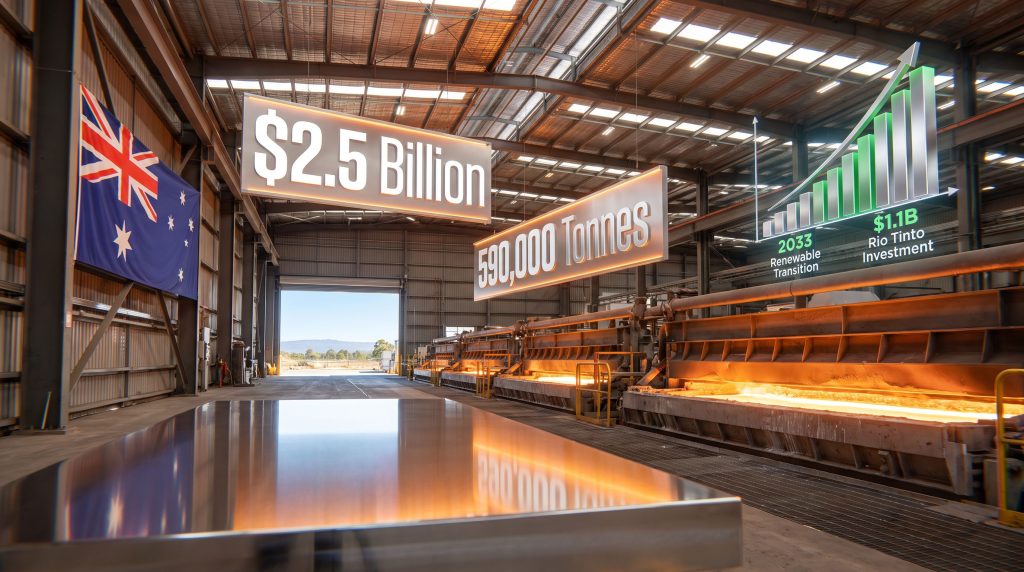
Australia's response to this question has crystallised around a single facility in the Hunter Valley. The Tomago Aluminium government bailout, valued at $2.5 billion over ten years, is the country's most consequential industrial intervention in years. Understanding why it happened, how it is structured, and what it means for taxpayers and regional economies requires moving well beyond the headline figures.
When big ASX news breaks, our subscribers know first
A Facility at the Centre of Australian Aluminium Production
Tomago Aluminium has operated continuously since 1983, making it one of Australia's longest-running primary metal processing facilities. Its production capacity of up to 590,000 tonnes per annum represents approximately 40% of Australia's entire aluminium output, a concentration of industrial capability that has no easy substitute within the domestic economy.
Rio Tinto holds a principal ownership stake in the facility. The smelter directly employs around 1,000 workers, with a significantly larger number of jobs in the surrounding Hunter Valley region tied to the supply chains, logistics networks, and service industries that depend on the smelter's continued operation. Industrial economists typically apply a multiplier of 2x to 4x direct employment when estimating total regional exposure, which implies several thousand livelihoods are indirectly connected to Tomago's operational status.
Why Aluminium Smelting Is So Exposed to Energy Markets
Aluminium production is among the most electricity-intensive industrial processes in existence. The electrolytic reduction of aluminium oxide into primary aluminium metal, a process known as the Hall-Heroult process, consumes approximately 14 to 16 megawatt-hours per tonne of aluminium produced. At Tomago's scale, this translates into an enormous and unrelenting electricity demand that makes the facility acutely sensitive to movements in wholesale power prices.
This energy dependency is not incidental. It is the defining commercial variable for any aluminium smelter, and it explains why smelters are often built adjacent to low-cost generation assets such as hydroelectric stations or coal-fired power plants. As Australia's National Electricity Market (NEM) has experienced prolonged price elevation driven by the accelerating retirement of coal generation capacity, the economics of smelting have deteriorated materially. Furthermore, the Australia green metals push has added additional complexity to the sector's long-term planning horizons.
The fundamental challenge is structural rather than cyclical. Rising NEM prices reflect a transition still in progress, where dispatchable coal capacity is exiting the grid faster than firm renewable and storage capacity can replace it. For large industrial consumers locked into long-term operations, this creates a gap that commercial electricity contracts cannot bridge at affordable prices.
Breaking Down the $2.5 Billion Bailout Package
The Tomago Aluminium government bailout is a joint commitment between the Federal Government and the NSW Government, structured around a 10-year power purchase agreement (PPA) designed to provide stable, subsidised electricity costs from 2029, when the smelter's existing energy contract expires in 2028. According to reporting by the ABC, this intervention represents one of the largest single industrial support packages in Australian history.
| Funding Component | Amount | Timeframe |
|---|---|---|
| Total Government Commitment | $2.5 billion | ~10 years |
| NSW Government Contribution (capped) | $1.225 billion | 10 years from 2029 |
| Federal Government Contribution | Uncapped (reported) | To be confirmed |
| Rio Tinto Capital Investment | At least $1.1 billion | Concurrent |
| Rio Tinto Decarbonisation Allocation | $100 million | Within investment period |
The NSW contribution carries a defined ceiling of $1.225 billion, providing a degree of fiscal certainty for that jurisdiction. The federal component, however, has been reported as potentially uncapped, a structural feature that introduces meaningful uncertainty into the total public cost of this intervention.
Rio Tinto's co-investment commitment of at least $1.1 billion covers operational upgrades and facility improvements, with a dedicated $100 million allocation for decarbonisation infrastructure. This private capital contribution is central to the government's framing of the arrangement as a partnership rather than a straightforward subsidy.
The Uncapped Federal Exposure: Why It Matters
The asymmetry between the NSW Government's capped contribution and the federal government's open-ended liability is the most fiscally significant feature of this deal. If NEM electricity prices remain structurally elevated, or if global aluminium prices deteriorate significantly, the cost to federal taxpayers could escalate well beyond the headline $2.5 billion figure.
Fiscal caution is warranted here. The $2.5 billion figure represents the current projected baseline. Adverse movements in energy markets or commodity prices could materially increase the total public cost. Investors and policy analysts tracking Australia's fiscal position should treat the actual liability as a range with an uncertain upper bound.
This is not hypothetical risk management. The history of government-backed industrial interventions demonstrates that initial cost estimates frequently understate final expenditure, particularly when the underlying commercial variable — in this case wholesale electricity pricing — is itself subject to structural forces that governments cannot control. The broader decarbonisation economics at play across Australian industry further complicate long-term cost projections.
The Policy Debate: Industrial Strategy or Market Distortion?
The Tomago Aluminium government bailout has crystallised a long-standing tension in Australian industrial policy: when is state intervention in a commercially stressed private industry justified, and where does legitimate strategic support end and market distortion begin?
Arguments Supporting the Intervention
-
Regional employment concentration: The Hunter Valley has limited alternative employers of comparable scale, and the region is already navigating the structural decline of its coal industry. Tomago's closure would compound economic stress in communities with few immediate alternatives.
-
National production significance: Losing 40% of domestic aluminium output would create supply chain vulnerabilities across construction, transport, and manufacturing sectors that depend on domestically produced primary aluminium.
-
Decarbonisation pathway attached: The PPA structure requires a transition to renewable electricity supply from 2033, framing the public investment as a contribution to industrial transformation rather than pure cost subsidisation.
-
Green aluminium premium potential: Aluminium produced using renewable energy is increasingly attracting a market premium in European and North American markets where carbon border adjustment mechanisms are being introduced. A successfully decarbonised Tomago could access this premium, potentially improving long-term commercial viability.
Arguments Against the Intervention
-
Private ownership dynamic: Rio Tinto, a globally profitable mining and metals major, retains full commercial ownership of the facility while governments absorb the energy cost risk through the PPA structure. Critics describe this as socialising downside risk while leaving upside returns with a private multinational.
-
Market distortion precedent: Providing a bespoke energy subsidy to one smelter raises questions about competitive neutrality. Other energy-intensive industries facing similar NEM price pressures could reasonably argue for equivalent treatment.
-
Opportunity cost: $2.5 billion in public capital committed to a single smelter represents funding unavailable for broader industrial transition programs, renewable energy infrastructure, or other economic priorities.
-
Indefinite subsidy risk: The 10-year horizon addresses the immediate contract expiry cliff, but does not resolve the underlying question of whether Tomago can eventually operate commercially without ongoing public support.
Australia's History of Aluminium Smelter Interventions
The Tomago bailout does not occur in isolation. Australia has a documented history of government intervention to preserve aluminium smelting capacity, and comparing these episodes provides useful context for assessing the current arrangement. For instance, Rio Tinto aluminium repowering efforts at Gladstone demonstrate a parallel strategic push to modernise and sustain domestic smelting capacity.
| Intervention | Industry | Government Support | Outcome |
|---|---|---|---|
| Tomago Aluminium (2026) | Aluminium smelting | $2.5B (Federal + NSW) | Ongoing |
| Portland Aluminium (2016-2021) | Aluminium smelting | ~$300M+ (Federal + Vic) | Operational |
| Whyalla Steelworks (2024) | Steel manufacturing | Federal administration | Restructuring |
| Automotive Industry (pre-2017) | Vehicle manufacturing | Multi-billion over decades | Closure (2017) |
The Portland Aluminium precedent in Victoria is particularly instructive. Government intervention in 2016, following a grid disruption that shut down the smelter temporarily, preserved that facility through a similar energy cost crisis. Portland remains operational today, suggesting that targeted energy support can sustain aluminium smelting operations through difficult market periods.
The Australian automotive industry provides the cautionary counterpoint. Decades of sustained public investment in vehicle manufacturing ultimately could not prevent closure in 2017 when structural economics became irreversible. The distinction that policymakers draw is that aluminium smelting, unlike vehicle assembly, involves a process where Australia holds genuine long-term competitive advantages through proximity to bauxite resources and, increasingly, renewable energy potential.
The Green Aluminium Opportunity: A Speculative but Significant Upside
One dimension of the Tomago story that receives insufficient attention is the emerging commercial case for low-carbon primary aluminium. The European Union's Carbon Border Adjustment Mechanism (CBAM), which applies carbon pricing to imported goods including aluminium, creates a direct financial incentive for exporters to decarbonise their production processes. Consequently, green metals pricing dynamics are becoming an increasingly important variable in determining the long-term viability of facilities like Tomago.
If Tomago successfully transitions to renewable electricity by 2033 as structured under the PPA, the facility could position Australian aluminium as a premium low-carbon product in precisely the markets where that premium is most valuable. Similarly, the Alcoa energy partnership model illustrates how structured energy arrangements can underpin viable long-term smelting operations.
This is speculative territory, and the timeline depends on both the successful delivery of renewable energy supply into the NEM and Rio Tinto's decarbonisation investment executing as planned. However, it represents the most commercially coherent long-term rationale for the government's investment, and it is the scenario where public support functions as a bridge to commercial sustainability rather than an indefinite subsidy.
The 2028 Energy Contract Cliff: Why the Deadline Was Unavoidable
A detail that contextualises the urgency of the Tomago Aluminium government bailout is that the 2028 energy contract expiry was not a sudden crisis. It had been a known structural pressure point for years, with industry participants and government observers fully aware that commercial renewal at NEM prices would be economically unviable without intervention.
The fact that formal announcement of a resolution came in 2026, just two years before the expiry, reflects the complexity of negotiating a co-investment arrangement involving federal government, state government, and a major multinational mining company, each with different financial incentives and risk tolerances. As the AFR noted, national interest considerations ultimately proved paramount in bringing all parties to agreement.
Key milestones investors and policy observers should track through this period include:
- 2028: Existing electricity supply agreement expires. The PPA must be fully operational to prevent a supply interruption.
- 2029: NSW Government funding commitment formally activates under the agreed structure.
- 2033: Renewable electricity supply transition commences under the PPA terms.
- Ongoing: Federal funding exposure remains subject to NEM price conditions and global aluminium market dynamics.
The next major ASX story will hit our subscribers first
What This Means for the Hunter Valley Economy
The Hunter Valley sits at an unusual intersection of industrial history and economic transition. The region built its prosperity on coal mining, an industry now in structural decline as domestic and international demand erodes. Tomago Aluminium represents one of the region's largest remaining heavy industrial employers and a significant contributor to local government revenues, infrastructure utilisation, and community services.
The economic multiplier effects of large industrial facilities are well documented in regional economics literature. For facilities of Tomago's scale, the ratio of indirect to direct employment typically ranges from two to four times, meaning the 1,000 direct jobs at the smelter likely represent a total regional employment dependency in the thousands when contractor roles, logistics providers, maintenance services, and downstream supply chain positions are included.
For a regional economy already absorbing the employment contraction from coal mine closures and reduced coal royalty revenues, the loss of Tomago would have represented a compounding economic shock with limited short-term offset. This regional dimension, rather than pure national production logic, likely explains the NSW Government's willingness to commit $1.225 billion to the arrangement despite the fiscal pressure involved.
Frequently Asked Questions: Tomago Aluminium Government Bailout
What is the Tomago Aluminium bailout?
The $2.5 billion package is a joint commitment from the Federal and NSW Governments to keep Australia's largest aluminium smelter operational beyond 2028 through a subsidised 10-year power purchase agreement, accompanied by at least $1.1 billion in private investment from Rio Tinto.
Why was intervention necessary?
Commercial electricity prices in the NEM had risen to levels that made profitable smelter operation unviable without subsidised energy costs. The 2028 expiry of the existing power contract created a hard deadline for resolution.
What is each government contributing?
The NSW Government's contribution is capped at $1.225 billion over 10 years from 2029. The Federal Government's contribution has been reported as potentially uncapped, creating fiscal uncertainty over the total public cost.
When does renewable energy transition begin?
Under the PPA structure, the transition to renewable electricity supply is scheduled to commence from 2033.
Who owns Tomago Aluminium?
Rio Tinto holds a principal ownership stake in the facility.
What are the main risks to this arrangement?
Prolonged weakness in aluminium prices, delays in renewable energy infrastructure delivery, political changes affecting commitment levels, and escalation of the uncapped federal liability under adverse NEM conditions are the primary risk factors.
Readers seeking further context on the Tomago Aluminium government bailout and Australia's broader aluminium industry can explore related reporting via the Australian Mining Review at australianminingreview.com.au.
This article contains forward-looking analysis and scenario projections. Actual outcomes will depend on energy market conditions, commodity pricing, government policy continuity, and private investment delivery. Nothing in this article constitutes financial advice.
Want to Track the Next Major Resource Discovery Before the Market Moves?
Discovery Alert's proprietary Discovery IQ model delivers real-time alerts on significant ASX mineral discoveries, cutting through the complexity of over 30 commodities to surface actionable investment opportunities — the kind that have historically generated substantial returns, as documented on Discovery Alert's dedicated discoveries page. Begin your 14-day free trial at Discovery Alert and position yourself ahead of the broader market.