August 14, 2026
India's Mining Tax System Was Never Designed to Last
For decades, the fiscal architecture governing India's mining sector functioned less like a coherent national framework and more like an improvised settlement between competing constitutional interpretations. States extracted what they could, courts periodically rewrote the rules, and mining companies absorbed the uncertainty into their project economics as best they could. The result was a compliance environment where retrospective tax liabilities spanning 10 to 15 years were not anomalies but industry norms.
The MMDR Amendment Bill mineral rights and state levies framework, introduced in the Lok Sabha by Union Coal and Mines Minister G. Kishan Reddy and subsequently passed by both Houses of Parliament, represents Parliament's attempt to end this era of structured ambiguity. The Bill introduces a statutory prohibition on states imposing taxes, cesses, or levies on mineral rights and mineral-bearing lands outside conditions prescribed by the Central Government. It is, in essence, a legislative redrawing of the boundary between central authority and state fiscal autonomy in the resources sector.
When big ASX news breaks, our subscribers know first
The Constitutional Fault Line That Created the Problem
Seventy Years of Deliberate Ambiguity
The Mines and Minerals (Development and Regulation) Act, 1957, which serves as the primary legislative instrument for the sector, was never precise about where state taxation authority ended and central regulatory power began. Entry 50 of the State List of the Seventh Schedule grants states the authority to tax mineral rights, but only subject to any limitations imposed by Parliament. The operative word is subject to, and Parliament spent the better part of seven decades not defining what those limitations actually were.
States filled that silence pragmatically. Since the Constitution grants states control over land, many governments interpreted this to extend naturally to land containing mineral resources, using the logic of territorial sovereignty to justify the imposition of independent levies and cesses on top of centrally determined royalties.
How Judicial Reversals Made Things Worse
The resulting legal landscape was destabilised by shifting judicial positions at the highest level:
- 1990s: Courts ruled against states' capacity to impose royalties independently of central legislation.
- 2004: The judicial position reversed, prompting multiple state governments to enact their own mineral taxation laws.
- 2024: A nine-judge Supreme Court Constitution Bench ruled that royalty collected under Section 9 of the MMDR Act is not a tax, thereby affirming state authority to levy royalties on minerals.
- 2026: Parliament passed the MMDR Amendment Bill, introducing Section 9D to statutorily override the 2024 judicial position.
The 2024 nine-judge bench ruling represented the most constitutionally authoritative endorsement of state mineral taxation power in India's legal history. The 2026 Bill's passage through Parliament constitutes a direct legislative counter-move, creating a collision between judicial precedent and parliamentary intent that may ultimately require the Supreme Court to adjudicate its own prior position.
This cycle of judicial reversal and legislative response is not incidental. It reflects a deeper structural tension that the MMDR Amendment Bill attempts to resolve through statutory force rather than constitutional negotiation. Furthermore, the implications extend well beyond domestic legal debate, touching directly on India's positioning within global critical minerals trade arrangements.
What the New Legislation Actually Does
Key Provisions of Section 9D at a Glance
| Provision | Description |
|---|---|
| Section 9D (New) | Bars state-level levies on mineral rights and mineral-bearing lands without Central Government approval |
| Levy Basis Restriction | Prohibits charges based on mineral quantity, mineral value, royalty, or any other basis |
| Retrospective Invalidation | State levies imposed but not yet deposited or recovered before commencement are rendered invalid |
| Non-Refund Clause | Previously deposited or recovered state levies are not subject to refund |
| Mineral-Bearing Land Definition | Defined by mineral content parameters set by the Central Government under prescribed rules |
The architecture of the Bill is deliberately asymmetric. States lose the ability to impose future levies but retain every rupee already collected. This prospective-only structure is designed to withstand constitutional challenge by avoiding retroactive financial penalties, and it directly addresses the retrospective liability problem that has historically made Indian mining projects difficult to finance.
Monalisa Nanda, Team Manager at the NFPRC Foundation, has noted that while states may face future revenue constraints, the prospective nature of the law ensures they retain past collections, and that uniform taxation is likely to improve investor confidence in ways that could offset revenue shortfalls through increased long-term investment. (ET EnergyWorld, August 2026)
The Revenue Numbers That Explain Why States Are Worried
Royalty Accruals: A Trajectory That Changes Everything
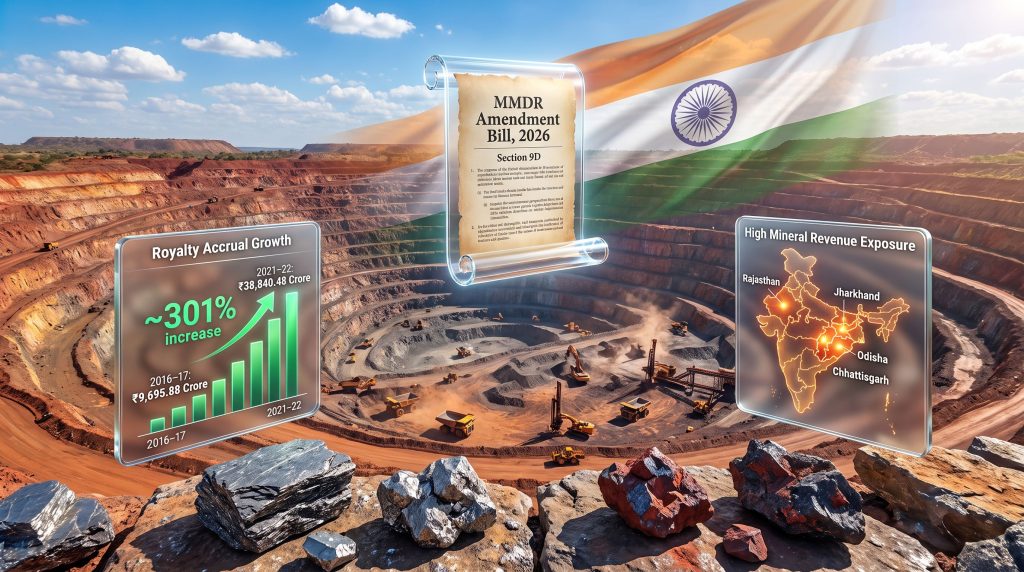
The fiscal stakes are not abstract. According to data provided by the Coal and Mines Ministry in 2023, royalty accruals to states from minerals increased from ₹9,695.88 crore in 2016-17 to ₹38,840.48 crore in 2021-22 (provisional), representing a growth of approximately 301 percent over five years.
| Financial Year | Royalty Accrual to States (₹ Crore) |
|---|---|
| 2016-17 | ₹9,695.88 crore |
| 2021-22 (Provisional) | ₹38,840.48 crore |
| Growth Rate | ~301% increase over five years |
This trajectory matters for a specific reason: it tells us that mineral-rich states have not merely tolerated royalty income as a secondary revenue stream. Over the five-year period captured by this data, mining revenues became a structurally significant component of their fiscal base. States such as Jharkhand, Odisha, Chhattisgarh, Rajasthan, and Andhra Pradesh, which host the majority of India's commercially productive mineral deposits, face the sharpest exposure to revenue compression under the new framework.
Critical Fiscal Risk: A state deriving even 5 to 10 percent of its own-tax revenue from mineral-related levies faces a structurally significant gap in the absence of any formal compensation mechanism from the Centre. The current Bill contains no such mechanism.
The Welfare Levy Problem Nobody Is Discussing
One underappreciated dimension of the Bill's fiscal impact involves state-level mining welfare funds and community compensation cesses. Several mineral-rich states have historically used the levy framework not just as a revenue instrument but as a redistributive mechanism, channelling funds toward communities affected by mining operations. Whether such welfare-linked levies fall within the scope of Section 9D's prohibition remains a live legal question, and the Bill provides no explicit carve-out. This ambiguity represents a potential flashpoint that is distinct from the broader royalty debate.
Critical Minerals and the Sovereignty Argument
Why the Centre Frames This as a National Security Question
The Central Government has positioned the MMDR Amendment Bill mineral rights and state levies legislation partially as a sovereign interest measure. The Ministry of Coal and Mines has argued publicly that excessive cumulative levy burdens can render mining operations commercially unviable, reduce private capital deployment, and in more extreme cases, contribute to mine closures. The investment-liberalisation rationale connects directly to India's critical minerals demand ambitions at a moment when domestic supply of battery-relevant materials remains heavily dependent on imports.
Pranati Chestha Kohli, Public Affairs Head at Lohum, has observed that the Bill represents a constructive step toward liberalising the mining sector and enabling greater private participation at lower costs, noting particular potential benefit for critical minerals such as graphite and nickel where domestic opportunities exist. However, for minerals like lithium and cobalt, India will continue to require international sourcing alongside recycled material streams. (ET EnergyWorld, August 2026)
Where the Investment Dividend Is Most Realistic
| Mineral | Domestic Opportunity | Current Supply Position |
|---|---|---|
| Graphite | Moderate domestic reserves | Significant import dependence |
| Nickel | Emerging exploration activity | High import reliance |
| Lithium | Limited domestic reserves | Near-total import dependence |
| Cobalt | Minimal domestic production | Requires international sourcing |
This distinction matters for investors. Levy rationalisation can meaningfully shift the economics of graphite and nickel extraction where the resource base exists. For lithium and cobalt, however, even an optimally designed fiscal regime cannot compensate for geological scarcity. India's lithium strategy, for instance, will need both the fiscal reforms embedded in this Bill and continued international procurement partnerships — India's lithium strategy highlights precisely this dual requirement for bilateral sourcing agreements and investment in battery recycling infrastructure.
China's entrenched dominance across the global critical mineral supply chain, from extraction through refining to battery-grade processing, adds urgency to India's domestic development agenda. Consequently, it also highlights the limits of treating levy rationalisation as a standalone supply security solution.
Fiscal Federalism Under Pressure
Three Paths States Could Take
The Bill's passage does not guarantee smooth implementation. States with significant mineral revenue exposure have multiple available responses:
- Judicial Challenge: States may approach the Supreme Court to contest the constitutional validity of Section 9D, particularly its interaction with Entry 50 of the State List and the 2024 nine-judge bench ruling. This is the most legally consequential pathway.
- Fiscal Compensation Demands: Mineral-rich states may use the Finance Commission framework and intergovernmental forums to seek structured revenue compensation from the Centre, drawing on the precedent set by the GST transition arrangement.
- Compliance with Strategic Delay: States may formally implement the Bill while pursuing parallel legal and political strategies, creating a period of uncertainty that could itself act as an investment deterrent.
India's GST transition demonstrated that Centre-state fiscal rebalancing can succeed, but only when accompanied by multi-year compensation mechanisms and clearly defined transition arrangements. The MMDR Amendment Bill currently lacks an equivalent structure, which creates the conditions for sustained intergovernmental friction rather than cooperative implementation.
The next major ASX story will hit our subscribers first
The Investment Case: Stronger, But Not Sufficient
What the Bill Actually Fixes for Mining Investors
For private sector mining operators and project financiers, the structural improvements introduced by the Bill are genuine:
- Elimination of state-level levy unpredictability removes a significant variable-cost risk from long-term project financial models.
- Centralised definition of mineral-bearing land, based on parameters set by the Central Government, provides greater legal certainty over land classification and associated regulatory obligations.
- The non-refund clause ensures companies do not face clawback demands on previously settled levy obligations, cleaning up balance sheets that have historically carried contingent liability provisions.
- Outstanding but unrecovered state levies are invalidated at commencement, providing a clean break for projects carrying legacy liability exposure from the period of contested state-level taxation.
What the Bill Does Not Fix
Critics of the investment-catalyst thesis make a valid structural point: fiscal uncertainty was never the only barrier to mining investment in India. Land acquisition complexity, environmental clearance timelines, infrastructure deficits in mineral-rich regions, and limited geological survey coverage all remain significant constraints that Section 9D cannot address.
The investment dividend from uniform central taxation is therefore likely to be real but partial. Projects that were genuinely deterred by levy unpredictability will benefit. Projects stalled by land access or infrastructure gaps will not. Policymakers who treat the MMDR Amendment Bill mineral rights and state levies reform as a comprehensive solution risk underestimating the structural work that still lies ahead.
What Comes Next for India's Mineral Governance
Three Scenarios for the Path Forward
Scenario 1: Smooth Implementation with Investment Uplift
States comply without legal challenge. The Centre establishes workable conditions under Section 9D. Private sector investment in critical mineral exploration accelerates over a five to seven year horizon, and India meaningfully reduces import dependence in at least some mineral categories.
Scenario 2: Prolonged Judicial Contestation
One or more mineral-rich states mount a Supreme Court challenge. Implementation is stayed pending adjudication. Investor uncertainty persists during the legal process, deferring the investment dividend that the Bill was designed to deliver.
Scenario 3: Negotiated Federalism Adjustment
States use Finance Commission and intergovernmental forums to secure compensatory fiscal transfers. The Centre introduces a structured transition arrangement. A modified implementation framework emerges that partially restores state fiscal flexibility within a centrally defined boundary.
Policy Gaps That Still Need Resolution
- No state compensation mechanism: Unlike the GST transition model, the MMDR Amendment Bill contains no formal revenue compensation structure for states that lose levy income.
- Welfare levy ambiguity: The treatment of mining-linked community welfare funds and compensation cesses under Section 9D remains unclear and requires legislative or regulatory clarification.
- Geological survey underinvestment: Fiscal reform cannot substitute for expanded geological survey activity and infrastructure development in mineral-bearing regions.
- Critical mineral strategy alignment: The Bill's investment-liberalisation rationale needs explicit integration with critical minerals policy frameworks to ensure coherence across government departments. Indeed, the MMDRA Bill 2026 has already drawn considerable commentary on precisely this gap.
Frequently Asked Questions: MMDR Amendment Bill, Mineral Rights, and State Levies
What does the MMDR Amendment Bill, 2026 prohibit states from doing?
The Bill bars state governments from imposing any tax, cess, or levy on mineral rights or mineral-bearing lands outside conditions prescribed by the Central Government. This prohibition applies regardless of whether the charge is calculated on mineral quantity, value, royalty, or any other basis.
Are previously collected state mineral levies subject to refund?
No. The Bill's invalidation provision applies only to levies imposed but not yet deposited or recovered before commencement. Amounts already collected by states are explicitly protected from any refund obligation.
How does the 2026 Bill interact with the 2024 Supreme Court ruling?
The 2024 nine-judge Constitution Bench held that royalty under Section 9 of the MMDR Act is not a tax, affirming state authority to levy royalties. The 2026 Bill seeks to legislatively override this position through new statutory restrictions, creating a direct tension between judicial precedent and parliamentary intent. Furthermore, the mining sector's response to this legislative development has been broadly positive, though analysts caution that judicial resolution remains an open question.
Which states face the greatest fiscal impact?
States with the highest concentration of commercially active mineral deposits, including Jharkhand, Odisha, Chhattisgarh, Rajasthan, and Andhra Pradesh, face the most significant revenue exposure given their historical reliance on royalties and state-level mineral cesses. However, the precise revenue impact will ultimately depend on how the Central Government defines the conditions permissible under Section 9D.
This article contains forward-looking analysis and scenario projections based on publicly available legislative information. It does not constitute legal or financial advice. Readers should conduct independent analysis before drawing investment or policy conclusions.
Want to Track the Next Major Mineral Discovery Before the Market Does?
Discovery Alert's proprietary Discovery IQ model delivers real-time alerts on significant ASX mineral discoveries, cutting through complex geological and commodity data to surface actionable investment opportunities the moment they are announced — explore the historic returns major discoveries have generated and begin your 14-day free trial to position yourself ahead of the broader market.