August 14, 2026
When Commodity Concentration Becomes a Sovereign Liability
Across economic history, few structural vulnerabilities have proven as persistent as the single-commodity trap. Nations that discover extraordinary natural resource wealth frequently build fiscal architectures so dependent on that one revenue stream that any disruption to it sends shockwaves through the entire sovereign balance sheet. The pattern is well-documented: initial prosperity, rising public expenditure commitments, infrastructure investment funded by commodity rents, then the slow erosion of institutional capacity to generate revenue from anything else. When the commodity falters, the state falters with it.
This dynamic has played out across oil-exporting nations, copper-dependent economies, and cocoa-reliant states throughout sub-Saharan Africa. What makes Botswana's current position particularly instructive is not merely that it faces fiscal pressure, but that it does so from a position of historical strength. For decades, Botswana was held up as the exemplary counter-narrative to the resource curse, a landlocked African nation that converted diamond wealth into genuine human development gains. The question now is whether Botswana economic diversification from diamonds can leverage that same institutional maturity to power the structural transformation the country urgently needs.
When big ASX news breaks, our subscribers know first
The Diamond Dependency Threshold and What It Signals to Capital Markets
Understanding Commodity Concentration Risk
Sovereign credit analysts and development economists have long used a threshold of roughly 70% export revenue concentration to flag elevated vulnerability. When a single commodity crosses that line, it fundamentally changes the nature of fiscal risk, converting what might otherwise be a manageable cyclical downturn into a potential structural crisis.
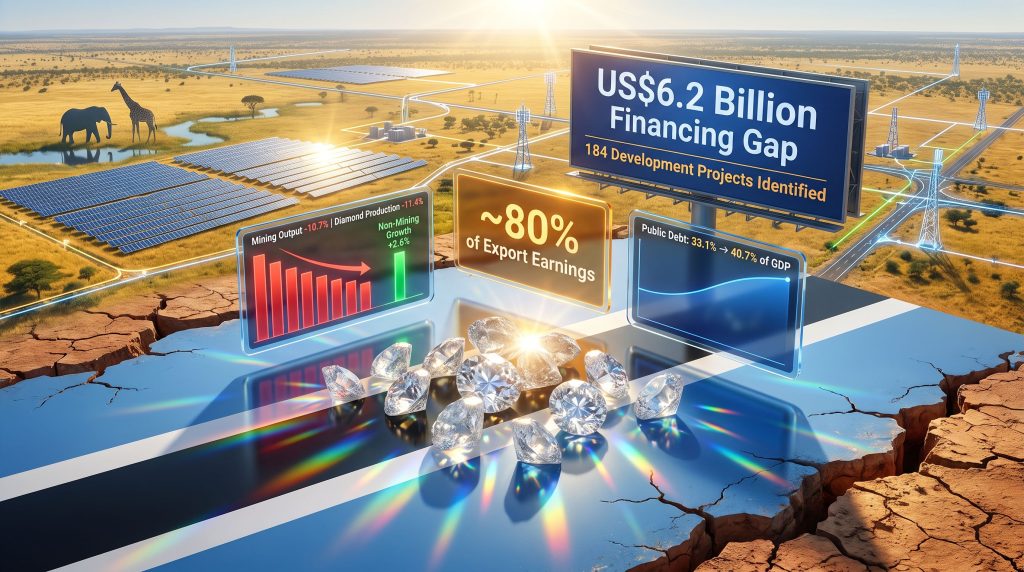
Botswana has exceeded that threshold for decades. Diamonds currently account for approximately 80% of the country's total export earnings and contribute around 30% of GDP, figures that position the economy as one of the most commodity-concentrated in sub-Saharan Africa. Furthermore, this concentration differs from oil dependency in one important respect: oil markets are driven primarily by global energy demand, which carries its own cyclical patterns.
Diamond markets, however, are shaped by discretionary consumer sentiment, luxury goods competition, and increasingly, by the competitive disruption of synthetic alternatives, making demand forecasting fundamentally less predictable. These commodity price pressures are explored in depth through analysis of commodity price pressures across mining-dependent economies.
The Lab-Grown Diamond Disruption: A Structural Break, Not a Cycle
The rise of lab-grown diamonds warrants particular analytical attention because it represents something qualitatively different from the commodity price cycles Botswana has navigated before. Synthetic diamond production has advanced from a novelty to a commercially dominant force in the jewellery segment at an accelerating pace. Laboratory-created stones are now chemically and physically identical to mined diamonds, and they are being sold at price points that compress the pricing power of natural stone producers.
Unlike cyclical demand weakness, which reverses when economic conditions improve, the market share captured by lab-grown diamonds does not revert. The structural change in consumer preference and price expectation represents a permanent reconfiguration of the natural diamond market's addressable opportunity.
This distinction matters enormously for fiscal planning. A government banking on a diamond market rebound as its primary fiscal recovery strategy is, in effect, waiting for a market structure to reverse itself, something that available evidence suggests will not happen. The rational policy response is to treat the current revenue compression as the new baseline and plan accordingly.
Mapping Botswana's Economic Deterioration in 2025
Key Indicators of Structural Stress
The 2025 macroeconomic data tells a sobering story. Botswana's GDP contracted by 0.7%, while mining output fell by 10.7% and diamond production specifically declined by 11.4%. These are not marginal fluctuations but significant downward shifts that compressed the government's revenue base at precisely the moment fiscal commitments remained elevated.
| Economic Indicator | Value |
|---|---|
| GDP growth (2025) | -0.7% (contraction) |
| Mining output decline (2025) | -10.7% |
| Diamond production decline (2025) | -11.4% |
| Non-mining sector growth (2025) | +2.6% |
| Diamond share of export earnings | ~80% |
| Diamond contribution to GDP | ~30% |
The most strategically significant number in that table may be the one that looks the smallest: non-mining sector growth of 2.6%. In isolation it appears modest. In context, it represents the first measurable evidence that economic activity beyond diamonds is capable of generating positive momentum independently of the commodity cycle. That capacity, nascent as it is, forms the foundation upon which diversification strategy must be built.
The Fiscal Deterioration in Detail
The revenue compression has translated directly into balance sheet deterioration across every major fiscal metric.
| Fiscal Metric | 2024 | 2025 | Change |
|---|---|---|---|
| Mineral revenue change | Baseline | -23.4% | Significant decline |
| Fiscal deficit (% of GDP) | Lower baseline | 9.5% | Widening |
| Public debt (% of GDP) | 33.1% | 40.7% | +7.6 percentage points |
| International reserves | US$3.5bn | US$3.1bn | -US$400 million |
The compression of international reserves from US$3.5 billion to US$3.1 billion within a single fiscal year is particularly concerning for a landlocked economy with limited export diversification. Reserve buffers serve as the primary shock absorber against external pressures, and a US$400 million drawdown in twelve months narrows the margin for managing any additional economic disruption, whether from global commodity markets, regional trade disruption, or domestic fiscal shocks.
A public debt ratio rising from 33.1% to 40.7% of GDP in one year also compresses future borrowing flexibility. Each additional percentage point of debt-to-GDP reduces the government's capacity to deploy counter-cyclical fiscal policy, a capacity Botswana will need if diversification investments require upfront public expenditure before private capital flows materialise.
The US$6.2 Billion Financing Gap: Why the Numbers Demand New Capital Architecture
Defining the Shortfall
The African Development Bank's 2026 Country Focus Report on Botswana identifies a development financing requirement of approximately US$6.4 billion against average annual financing flows of only US$217 million over the preceding five years. The resulting structural gap of roughly US$6.2 billion is not a rounding error; it is an order-of-magnitude mismatch that fundamentally cannot be resolved through conventional sovereign borrowing.
| Financing Metric | Value |
|---|---|
| Estimated total development financing need | US$6.4 billion |
| Average annual financing flows (past 5 years) | ~US$217 million |
| Resulting structural financing gap | ~US$6.2 billion |
Closing a gap of this magnitude requires a fundamentally different capital mobilisation architecture, one that moves well beyond government budget allocations and into the architecture of blended finance, institutional investment, and domestic capital market development. As resource governance analysis from the Natural Resource Governance Institute outlines, the structural frameworks underpinning diversification are as critical as the financing mechanisms themselves.
The Four Capital Pillars That Must Replace Diamond Revenue
-
Public-Private Partnerships: Botswana has already identified 184 projects under its Economic Transformation Programme and drafted a PPP legislative framework in 2025, creating a structural pipeline for private capital deployment.
-
Development finance institution engagement: Multilateral lenders including the African Development Bank offer concessional financing instruments that can bridge the gap between commercial viability and public investment needs.
-
Domestic capital market deepening: Expanding the bond market to accommodate infrastructure instruments and local currency debt would reduce reliance on offshore financing and improve risk alignment.
-
Diaspora and remittance mobilisation: Remittances reached US$128.3 million in 2024, providing a meaningful foundation for diaspora bond structures that channel offshore Botswana savings into domestic productive investment.
The Pension Fund Paradox: Capital Sitting Idle While Infrastructure Goes Unfunded
A Domestic Capital Pool of Extraordinary Scale
One of the less widely appreciated dimensions of Botswana's economic position is the sheer scale of its pension savings relative to the size of its economy. Pension assets equivalent to 68.6% of GDP in 2025 represent one of the largest domestic institutional capital pools relative to economic size anywhere in sub-Saharan Africa.
The structural paradox is stark: a country facing a multi-billion dollar infrastructure financing gap simultaneously holds pension assets worth nearly 70% of its entire economy, with the majority of those assets allocated offshore or to conservative instruments that do not fund domestic development.
Redirecting even a modest portion of these assets into purpose-built domestic investment vehicles could fundamentally change the financing calculus for Botswana's diversification agenda. Relevant structures include:
- Infrastructure bonds linked to transport corridors, energy grid expansion, and digital connectivity
- Green bonds tied to Botswana's renewable energy transition, particularly its substantial solar resource potential
- Blended finance instruments combining pension capital with development finance institution guarantees to manage downside risk
The regulatory and governance reforms required to unlock this capital are significant but achievable. They require modernising the investment mandate framework for pension funds, developing domestic bond market infrastructure, and establishing credit enhancement mechanisms that make domestic infrastructure investments competitive with offshore alternatives on a risk-adjusted basis.
Sector Diversification: What Botswana's Post-Diamond Economy Could Look Like
Priority Growth Sectors
| Sector | Strategic Rationale | Key Constraint |
|---|---|---|
| Renewable energy | Exceptional solar irradiance; domestic energy cost reduction | Grid infrastructure gaps |
| Tourism | World-class conservation assets; US$116bn natural capital base | Air connectivity limitations |
| Agro-processing | Food security; regional export potential | Water scarcity; small domestic market |
| Manufacturing | Employment generation; value-added production | High input costs; weak private sector depth |
| Digital infrastructure | Youth employment; services export potential | Skills gap; connectivity costs |
| Non-diamond mining | Copper, nickel, gold, coal, sodium carbonate | Capital intensity; exploration investment lag |
Mining Diversification as a Near-Term Bridge Strategy
Within the mining sector itself, diversification beyond diamonds offers a credible near-term revenue bridge. Botswana holds deposits of copper and nickel-copper, both of which carry growing strategic relevance as critical minerals and energy transition technologies accelerate globally. Battery systems, electric motors, and grid infrastructure all require copper and nickel at scale, creating a demand profile that is structurally different from the consumer discretionary dynamics that govern diamond pricing.
Indeed, the broader picture of critical minerals demand suggests that Botswana's non-diamond mineral endowments are entering a particularly favourable structural environment. Gold, silver, coal, and sodium carbonate represent additional lower-capital entry points that could generate fiscal revenue while longer-horizon diversification into renewable energy and digital infrastructure matures. The sequencing matters: near-term mining diversification buys fiscal space, while structural transformation of the broader economy proceeds in parallel.
Natural Capital: Botswana's US$116 Billion Asset That Rarely Appears on the Balance Sheet
Botswana's natural capital, valued at approximately US$116 billion as of 2020, represents an asset class that conventional fiscal analysis consistently undervalues. Integrating natural capital in mining and conservation planning offers a framework for unlocking this value more systematically. The Okavango Delta ecosystem, protected conservation areas covering a substantial proportion of the country's landmass, and biodiversity assets of global significance create a platform for:
- Carbon credit generation through conservation finance mechanisms
- Biodiversity offset structures linked to international corporate sustainability commitments
- Blue and green economy frameworks that monetise ecosystem services without depleting the underlying asset base
The next major ASX story will hit our subscribers first
Private Investment and the Credit Access Bottleneck
FDI Decline as a Warning Signal
Foreign direct investment into Botswana fell from 3.8% of GDP in 2023 to 2.4% of GDP in 2024, a trajectory that signals deteriorating investor confidence at precisely the moment when private capital is most critical. This decline needs to be addressed through structural improvements in the investment environment rather than promotional activity alone.
The domestic private sector faces its own constraints. Private-sector credit stands at approximately 30% of GDP, a comparatively low ratio for an economy at Botswana's development stage. High collateral requirements systematically disadvantage small and medium enterprises, while underdeveloped credit information infrastructure limits the ability of lenders to accurately price risk. In addition, copper investment trends across comparable resource-dependent economies suggest that copper investment trends in more diversified mining jurisdictions offer instructive lessons for Botswana's capital attraction strategy.
Three structural fixes could meaningfully improve private sector access to capital:
- Credit registry modernisation to include movable assets and intellectual property as acceptable collateral
- Partial credit guarantee programmes to de-risk SME lending for commercial banks without requiring full government balance sheet exposure
- Digital financial infrastructure investment to reduce transaction costs and extend formal financial services to informal sector businesses
Growth Projections and the Employment Imperative
The Recovery Timeline and Its Limitations
The African Development Bank projects GDP growth recovering to 0.8% in 2026 and 3.5% in 2027, alongside inflation rising to 6.7% in 2026 before easing in subsequent years. While directionally positive, the pace of projected recovery carries significant limitations.
Growth of 0.8% in 2026 is insufficient to make meaningful progress against an unemployment rate of 21% and youth unemployment of 28.9% as of 2024. At that pace of economic expansion, the labour market absorbs negligible net new employment, while the youth cohort entering the workforce continues to grow. Consequently, the urgency of labour-intensive sector development cannot be overstated.
Botswana's diversification challenge is not only macroeconomic. With nearly three in ten young Batswana unable to find work, the social dimensions of the transition are as urgent as the fiscal ones. Sectors capable of absorbing large volumes of workers at varying skill levels must be prioritised alongside higher-value industries.
Agribusiness, tourism services, light manufacturing, and construction linked to infrastructure investment all offer employment intensity that digital and financial services sectors cannot match in the near term. A credible Botswana economic diversification from diamonds strategy must therefore balance the long-term productivity gains of knowledge economy development with the immediate labour market realities facing the country's working-age population. Furthermore, as World Bank research on resource-dependent economies consistently demonstrates, the human capital dimension of diversification is as consequential as the fiscal one.
Tax Architecture Reform and Public Investment Efficiency
Broadening the Revenue Base
Four tax reform levers offer Botswana meaningful fiscal resilience improvement without requiring economic growth to first materialise:
- Digital revenue administration: Technology-enabled tax collection can significantly reduce leakage and improve compliance rates across the existing tax base
- Tax expenditure rationalisation: Reviewing exemptions and concessions that disproportionately benefit capital-intensive sectors would broaden the effective tax base
- Property taxation enhancement: Substantially underutilised across most sub-Saharan African economies, property taxes represent significant untapped revenue potential in Botswana's urban centres
- Extractive sector fiscal optimisation: Ensuring non-diamond mining royalties and levies are structured to capture appropriate resource rents as production scales
The public investment efficiency rating of 76.3% deserves particular scrutiny. This figure implies that approximately 24 cents of every infrastructure dollar spent is lost to planning failures, procurement inefficiencies, or execution gaps. Closing even half of that efficiency deficit through improved project preparation and procurement governance would materially increase infrastructure output without requiring additional sovereign borrowing.
Frequently Asked Questions: Botswana Economic Diversification from Diamonds
What percentage of Botswana's economy depends on diamonds?
Diamonds contribute approximately 30% of GDP and account for close to 80% of Botswana's total export earnings, making the economy among the most commodity-concentrated in sub-Saharan Africa.
Why is Botswana's diamond revenue declining?
Three converging forces are driving the decline: weakening global demand for natural diamonds, the rapid market penetration of lab-grown synthetic diamonds at significantly lower price points, and the natural geological depletion of Botswana's maturing kimberlite pipe deposits.
What sectors is Botswana targeting for economic diversification?
Priority sectors include renewable energy, tourism, agro-processing, manufacturing, digital infrastructure, and the broader development of non-diamond minerals including copper, nickel, gold, and coal.
How large is Botswana's development financing gap?
The African Development Bank estimates a total development financing need of approximately US$6.4 billion, against average annual capital flows of only US$217 million over the past five years, creating a structural gap of approximately US$6.2 billion.
How could Botswana's pension funds support economic diversification?
With pension assets equivalent to 68.6% of GDP, redirecting a portion from offshore and conservative allocations into domestic infrastructure bonds, green bonds, and productive sector investments represents one of the most significant near-term capital mobilisation opportunities available to Botswana.
What is Botswana's current unemployment rate?
As of 2024, Botswana's overall unemployment rate stands at 21%, with youth unemployment at 28.9%, underscoring the urgency of labour-intensive sector development within any credible diversification strategy.
From Constraint to Catalyst: The Architecture of Transformation
The central insight from Botswana's current fiscal position is that the country does not suffer from a shortage of assets. It possesses substantial pension capital equivalent to nearly 70% of GDP, natural resource endowments valued at approximately US$116 billion, a growing diaspora remittance base of US$128.3 million annually, and a pipeline of 184 identified development projects ready for structured financing. What is missing is not the raw material for transformation but the institutional architecture to mobilise it productively.
The sequencing of that mobilisation matters as much as the individual components. Near-term fiscal stabilisation through tax reform and public investment efficiency improvements creates the breathing room for medium-term diversification investments in tourism, agribusiness, and renewable energy to mature. Longer-term structural transformation toward a knowledge and services economy then becomes achievable precisely because the fiscal foundation has been rebuilt on a broader base.
Botswana economic diversification from diamonds, painful as its near-term consequences are, may ultimately prove to be the catalyst that forces the structural reforms the economy has long needed but never faced sufficient pressure to implement. The analytical framework for that transformation is increasingly well-understood. The challenge now is one of execution, governance, and the political will to move at the speed the fiscal mathematics demand.
Disclaimer: This article is intended for informational purposes only and does not constitute financial, investment, or sovereign credit advice. Projections and forecasts referenced herein reflect third-party institutional analysis and are subject to material uncertainty. Readers should conduct independent research and consult qualified advisers before making investment or policy decisions.
Want to Track the Next Major Mineral Discovery Before the Market Does?
As Botswana's diversification push highlights the growing strategic value of copper, nickel, and other critical minerals, Discovery Alert's proprietary Discovery IQ model delivers real-time ASX alerts the moment significant mineral discoveries are announced — explore historic discoveries and their returns to see why early positioning matters, then begin your 14-day free trial to ensure you never miss a market-moving find.