August 14, 2026
Africa's Largest Hydrocarbon Frontier: The Structural Case for Libya Oil and Gas Investment
The global energy capital cycle is shifting. After years of underweighting frontier hydrocarbon markets in favour of politically stable but reserve-depleted jurisdictions, major international oil companies are re-examining high-reserve, complex-risk environments with fresh analytical frameworks. The logic is straightforward: as conventional reserves in mature basins continue to decline, the reserve-rich but politically complex jurisdictions that were once considered uninvestable are now being repriced. Libya sits at the intersection of these forces, offering a reserve profile that is genuinely exceptional by any global standard, combined with a 2026 institutional reset that has drawn the broadest cohort of international energy capital in nearly two decades.
Understanding why Libya oil and gas investment is attracting renewed attention requires more than reading headlines. It demands a systematic examination of the reserve fundamentals, the evolving deal landscape, the structural risks that must be honestly priced, and the forward scenarios that will determine whether 2026 represents a durable inflection or a temporary window.
When big ASX news breaks, our subscribers know first
The Reserve Fundamentals That Define Libya's Investment Case
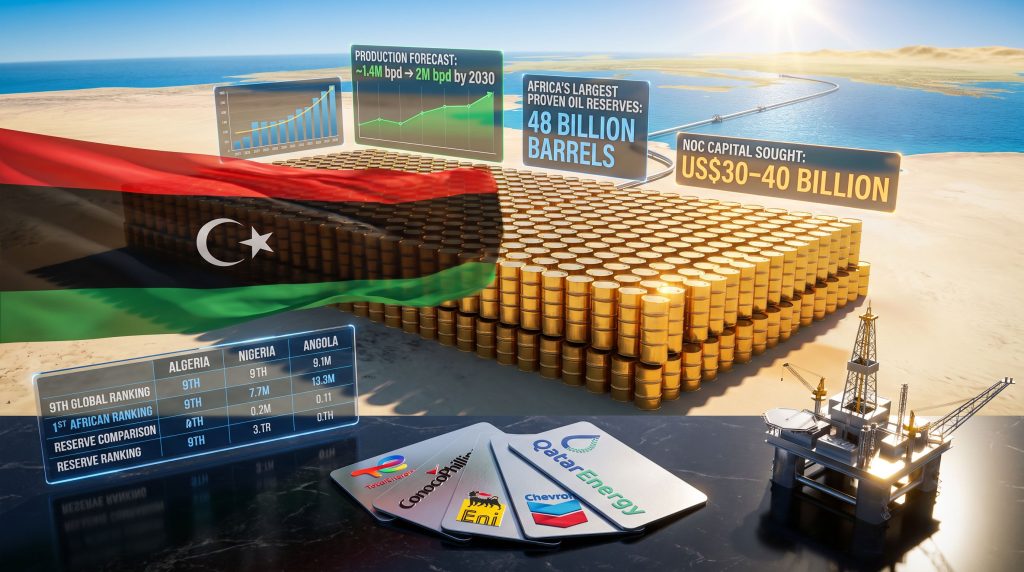
Libya's starting position in any investment analysis is its hydrocarbon endowment. With approximately 48 billion barrels of proven oil reserves, the country holds the largest reserve base on the African continent by a significant margin and ranks ninth globally among sovereign reserve holders. This is not a marginal advantage. It is a foundational differentiator that separates Libya from most emerging market energy destinations.
The comparative picture against peer African producers makes the scale of this advantage clear:
| Metric | Libya | Algeria | Nigeria | Angola |
|---|---|---|---|---|
| Proven Oil Reserves (bn bbls) | ~48 | ~12 | ~37 | ~8 |
| Global Reserve Rank | 9th | ~17th | 11th | ~20th |
| Pipeline Access to Europe | Yes (Greenstream) | Yes (multiple) | No | No |
| Current Production (approx. bpd) | ~1.4M | ~1.0M | ~1.5M | ~1.1M |
Beyond the reserve quantum, Libya's geographic position creates a structural export advantage that few African producers can replicate. The country's proximity to Southern European coastlines means that transportation costs for crude exports are materially lower than for West African or East African producers. More critically, the Greenstream pipeline connecting Libyan gas infrastructure near Tripoli to the Sicilian coast provides a direct physical conduit into the European gas grid, a piece of infrastructure whose strategic value has increased considerably as Europe has worked to diversify away from Russian pipeline dependency.
The Secretary General of the Gas Exporting Countries Forum, Dr. Philip Mshelbila, articulated this geographic advantage precisely at the Libyan Energy and Economic Summit earlier in 2026, noting that Libya's location adjacent to one of the world's largest and most affluent consumer markets creates an export opportunity that extends well beyond crude oil. With gas output expected to reach approximately 750 million standard cubic feet per day, Libya has the capacity to simultaneously support domestic power generation, industrial demand, and European export flows through existing infrastructure. Furthermore, the broader LNG market implications of expanding Libyan gas exports are significant for regional energy pricing dynamics.
The 2026 Inflection: What the Licensing Round Signals to Capital Markets
The single most significant institutional signal of 2026 is the revival of Libya's oil and gas licensing round, the first such exercise the country has conducted since 2007. A gap of nearly two decades between licensing rounds is not merely an administrative delay. It represents a complete freeze on structured foreign investment participation. The resumption of that process, and the competitive response it generated from international majors, signals something more fundamental than commercial opportunity — it signals a sovereign policy recalibration toward rules-based investor engagement.
The companies that participated in or signed agreements through this process represent the upper tier of global energy capital. The resurgence of Libya's sector is turning heads across the investment community:
| Company | Deal Type | Estimated Value | Focus Area |
|---|---|---|---|
| TotalEnergies + ConocoPhillips | 25-Year Development Agreement | US$20bn+ | Upstream development |
| Eni | Offshore Gas Development | ~US$8bn | Offshore gas |
| Chevron | Exploration Agreement | Undisclosed | Offshore exploration |
| QatarEnergy | Licensing Round Participation | Undisclosed | Exploration blocks |
| Repsol | Licensing Round Participation | Undisclosed | Exploration blocks |
The 25-year duration of the TotalEnergies and ConocoPhillips development agreement deserves particular analytical attention. Long-cycle upstream investments are rarely structured beyond 20 years in politically complex jurisdictions. A 25-year commitment, associated with an investment program valued at over US$20 billion, reflects a conviction by two of the world's most sophisticated energy capital allocators that Libya's political trajectory is compatible with ultra-long-cycle exposure. That conviction, expressed through capital rather than commentary, is among the strongest possible signals available to the broader investment community.
Eni's commitment of approximately US$8 billion toward offshore gas development reinforces this signal from a different angle. Eni's existing operational presence in Libya, including its management of Greenstream pipeline infrastructure, gives it a cost and execution advantage over new entrants. The scale of its new commitment suggests the company views its existing footprint as a foundation for significantly expanded activity rather than a position to be managed cautiously.
Quantifying the Capital Requirement: The NOC's Investment Gap
The National Oil Corporation has been explicit about the scale of capital required to activate Libya's underdeveloped hydrocarbon portfolio. The figure identified by NOC Chair Masoud Suleman ranges between US$30 billion and US$40 billion, with more than 60 discovered but commercially undeveloped oil and gas fields representing the investment target set. These are not exploration prospects requiring geological validation. They are fields whose resource base is already established, representing a pre-derisked opportunity set that is unusual in the context of frontier market energy investment.
Near-term capital requirements to generate meaningful production uplift are estimated at approximately US$3 to US$4 billion, establishing an accessible entry threshold for phased investment strategies that do not require full commitment to the total capital envelope upfront.
The NOC's production growth ambition translates into a specific numerical challenge:
- Current production (2025 average): approximately 1.4 million barrels per day, the highest sustained output level in 12 years
- Target production (2030): 2 million barrels per day
- Required uplift: approximately 43% within a five-year window
- Equivalent additional output to be brought online: roughly 600,000 barrels per day
Closing a 600,000 bpd production gap within five years would require Libya to sustain one of the fastest upstream ramp-up rates of any OPEC member in the current decade. Historical benchmarks, including Iraq's post-2010 production expansion and the UAE's recent capacity programs, suggest this is operationally achievable, but only when front-loaded capital deployment coincides with parallel improvements in institutional capacity and security conditions. Libya currently satisfies only some of these prerequisites, making the 2030 target ambitious in the genuine sense of the word. Consequently, understanding OPEC market influence on pricing and quota dynamics remains essential context for evaluating Libya's ramp-up trajectory.
The Structural Risks That Investors Must Honestly Price
No credible analysis of Libya oil and gas investment can omit a systematic treatment of the risk factors that have historically constrained capital deployment in this market.
Governance Fragmentation and Regulatory Ambiguity
Libya remains politically divided between competing administrative factions, with armed militia groups exercising territorial control across significant portions of the country, particularly in the west. This fragmentation creates a specific investment risk that goes beyond general political instability: agreements negotiated with one governing authority may face legitimacy challenges from competing power structures, introducing regulatory ambiguity into deal architecture that is difficult to resolve through standard contractual mechanisms.
The NOC has historically operated as a relatively neutral institutional actor across this political divide, which provides a degree of transactional stability. Investment structures routed through the NOC rather than government-to-government agreements may therefore carry lower regulatory ambiguity risk, though this assessment should be independently verified by investors against their own legal and political risk frameworks. In addition, the broader geopolitical risk landscape across resource-producing regions underscores why governance fragmentation deserves careful due diligence.
Infrastructure Vulnerability: Localised vs. Systemic Risk
The drone strikes on the Zawiya oil refinery in western Libya in mid-2026, which ignited fuel storage infrastructure and damaged adjacent power facilities, illustrate the category of physical risk that investors must account for. Masoud Suleman described these incidents as geographically contained and attributable to isolated actors rather than a manifestation of systemic conflict, a characterisation that frames the risk as manageable rather than existential for the investment thesis.
Investors must distinguish between two fundamentally different risk categories: systemic conflict risk, which would threaten the entire investment thesis, and localised infrastructure risk, which is manageable through asset geographic positioning, JV structures, and insurance mechanisms. Libya's current profile appears closer to the latter, though this assessment is dynamic and requires ongoing monitoring.
Primary investment opportunities identified by the NOC are concentrated in areas geographically removed from active conflict zones. Offshore assets carry materially lower security risk than onshore infrastructure in contested western territories, making the offshore exploration agreements signed by Chevron and Eni particularly well-positioned from a physical security perspective.
The NOC's Fiscal Architecture: Three Interconnected Constraints
The NOC faces a fiscal structure that simultaneously limits its capacity for self-funded capital investment across three interconnected dimensions:
-
Budget dependency: Libya's national budget allocates approximately US$2 billion per year to NOC operating costs, a figure the corporation's leadership considers structurally insufficient for the scale of ambition required. The NOC has identified a target of retaining US$6 to US$7 per barrel produced to cover its own operational expenses, a gap that needs to be closed through reformed revenue retention arrangements.
-
Subsidy drain: The NOC imports approximately 80% of Libya's domestic fuel supply at international market prices and distributes it domestically at heavily subsidised rates, effectively redirecting revenue that could fund upstream development into consumer price support. This subsidy structure is politically entrenched and difficult to reform without social consequences.
-
Smuggling-related revenue leakage: An organised smuggling trade, operating under the protection of armed factions with political connections across both sides of Libya's governance divide, represents a material and ongoing drain on the national energy economy. NOC leadership has characterised this smuggling activity as posing a risk of broader economic destabilisation, elevating it from an operational challenge to a systemic governance concern that investors must factor into revenue flow assumptions.
Libya's European Energy Security Value Proposition
The commercial investment case for Libya is reinforced by a geopolitical dimension that creates alignment between investor return objectives and broader European energy policy priorities. As European governments and energy utilities continue to seek supply diversification away from Russian pipeline gas, Libya's geographic proximity and existing pipeline infrastructure position it as a structurally advantaged supplier.
The Greenstream pipeline's capacity to move Libyan gas directly into the Italian and broader European grid is a tangible competitive advantage. Unlike West African LNG exporters, which compete on price and shipping logistics, Libya can deliver gas to European markets at pipeline economics. As European demand for pipeline-accessible non-Russian gas supply grows, this infrastructure advantage may appreciate in strategic value independent of commodity price movements. This dynamic also reflects a wider energy transition supply shift reshaping how Europe sources its energy inputs.
At the Libyan Energy and Economic Summit in early 2026, NJ Ayuk, Executive Chairman of the African Energy Chamber, framed Libya's trajectory as evidence that African nations can execute energy projects at meaningful scale when political will, investor-friendly frameworks, and operational stability converge. This framing positions Libya not merely as a single investment destination but as a potential proof-of-concept for reassessing African energy investment risk premiums more broadly. However, the global trade war impacts on commodity demand and capital flows remain a meaningful external variable that could influence the pace of that reassessment.
The next major ASX story will hit our subscribers first
Regional Comparison: How Libya Stacks Up Against Peer Producers
| Factor | Libya | Iraq | Algeria | Nigeria |
|---|---|---|---|---|
| Reserve Quality | Very High | Very High | High | High |
| Political Stability | Low-Moderate | Low-Moderate | Moderate | Low-Moderate |
| IOC Contract Frameworks | Improving (2026 reset) | Established | Restrictive | Established |
| Infrastructure Maturity | Moderate | Moderate-High | High | Moderate |
| European Export Access | Direct (pipeline) | Indirect | Direct (pipeline) | Indirect |
| Licensing Activity | Resumed (2026) | Active | Limited | Active |
| Security Risk Level | Moderate-High | Moderate | Low | High |
The comparison table reveals that Libya's risk-adjusted position is more competitive than a surface reading of its political complexity might suggest. Its reserve quality matches Iraq, its European pipeline access matches Algeria, and its 2026 licensing reset has created a first-mover window that established markets like Nigeria cannot replicate.
A Phased Investment Framework for Different Risk Appetites
Phase 1: Near-Term Entry (0 to 2 Years)
- Offshore exploration block participation through the 2026 licensing round minimises physical security exposure
- Joint venture structures with established operators reduce first-mover execution risk
- Target capital range: US$3 to US$4 billion for near-term production uplift contributions
Phase 2: Development Capital Deployment (2 to 5 Years)
- Systematic activation of the 60+ identified undeveloped fields through structured development financing
- Revenue retention structures targeting US$6 to US$7 per barrel embedded in deal architecture from the outset
- Contribution toward the 2 million bpd production objective by 2030
Phase 3: Infrastructure and Export Expansion (5 Years and Beyond)
- Greenstream capacity optimisation and potential expansion to accommodate growing gas export volumes
- Possible LNG infrastructure development to diversify export routes beyond pipeline dependency
- Total capital envelope across all phases: up to US$40 billion
Key Data Reference: Libya's Energy Investment Metrics
| Metric | Figure |
|---|---|
| Global oil reserve ranking | 9th |
| African oil reserve ranking | 1st |
| Proven reserves | ~48 billion barrels |
| Current production (2025 average) | ~1.4 million bpd |
| Production target (2030) | 2 million bpd |
| Required production uplift | ~43% |
| Total capital sought by NOC | US$30 to US$40 billion |
| Near-term capital requirement | US$3 to US$4 billion |
| NOC target retained revenue | US$6 to US$7 per barrel |
| National budget NOC allocation | ~US$2 billion annually |
| Undeveloped discovered fields | 60+ |
| Gas export capacity (current) | ~750 MMscf per day |
| Last licensing round before 2026 | 2007 |
| TotalEnergies and ConocoPhillips deal duration | 25 years |
| TotalEnergies and ConocoPhillips deal value | US$20bn+ |
| Eni offshore gas investment | ~US$8 billion |
Forward Scenarios: Three Pathways for Libya's Energy Trajectory
-
Bull Case: Political stabilisation, front-loaded IOC capital deployment, and meaningful subsidy reform combine to unlock sustained production growth toward 2 million bpd by 2030, positioning Libya as a top-tier African energy economy and a significant European gas supplier.
-
Base Case: Phased investment proceeds in geographically secure zones, production reaches 1.7 to 1.8 million bpd by 2030, gas exports to Europe expand materially through Greenstream optimisation, and Libya establishes a durable track record as an investable market despite residual political complexity.
-
Bear Case: Renewed conflict disruption, accelerating smuggling activity, or governance breakdown triggers IOC capital withdrawal or suspension, production reverts toward pre-2025 levels, and the 2026 licensing round investment cycle is interrupted.
Frequently Asked Questions: Libya Oil and Gas Investment
How large are Libya's proven oil reserves?
Libya holds approximately 48 billion barrels of proven oil reserves, the largest reserve base on the African continent and the ninth largest globally. This reserve endowment underpins the long-term structural investment case regardless of near-term political complexity.
What is Libya's current production level and growth target?
Libya's oil output averaged approximately 1.4 million barrels per day through 2025, its highest sustained level in 12 years. The National Oil Corporation is targeting an increase to 2 million barrels per day by 2030, representing a 43% uplift from current production.
Which international energy companies have committed capital to Libya in 2026?
TotalEnergies, ConocoPhillips, Eni, Chevron, QatarEnergy, and Repsol have all signed agreements or participated in Libya's 2026 licensing round, representing the broadest cohort of major IOC engagement in the country in nearly two decades.
What total investment is Libya's NOC seeking?
The NOC has publicly identified a capital requirement of between US$30 billion and US$40 billion to develop its undeveloped field inventory and achieve its production growth objectives.
What is the Greenstream pipeline and why does it matter?
The Greenstream pipeline is a subsea natural gas pipeline connecting Libyan production infrastructure near Tripoli to the Italian island of Sicily, providing direct physical access to European gas markets at pipeline economics. It is a critical competitive advantage for Libya's gas export strategy and its role in European energy supply diversification.
How should investors think about Libya's security risk?
Libya's security environment involves real operational risks, including militia activity and localised infrastructure attacks. However, the primary investment opportunities identified by the NOC are concentrated in areas geographically separated from active conflict zones, and offshore assets carry materially lower physical security risk. Major IOCs have demonstrated through their 2026 commitments that they consider the risk-return profile acceptable within structured JV and geographic risk management frameworks.
Disclaimer: This article contains forward-looking statements, scenario projections, and investment analysis that are inherently speculative and subject to material uncertainty. Production targets, capital requirement figures, and investment valuations are based on publicly available statements and independent research. Readers should conduct their own due diligence and seek independent financial and legal advice before making any investment decisions related to Libya's energy sector.
Want to Identify the Next Major Resource Discovery Before the Market Does?
Discovery Alert's proprietary Discovery IQ model scans ASX announcements in real time, delivering instant alerts on significant mineral discoveries across more than 30 commodities — giving subscribers an actionable market edge the moment opportunities emerge. Explore historic discoveries and their exceptional returns, then begin your 14-day free trial to position yourself ahead of the broader market.