August 20, 2026
Scandium's Supply Chain Reckoning: Why the Pentagon Is Looking to Central New South Wales
For most of modern industrial history, scandium has occupied an awkward position in the periodic table of commercial relevance. Abundant enough in the Earth's crust to theoretically support large-scale extraction, yet almost never concentrated enough in any single deposit to justify dedicated mining, it has long been treated as a byproduct curiosity rather than a primary target. That structural reality is now colliding with a set of demand forces that have elevated scandium from metallurgical footnote to national security priority, and the consequences of that collision are playing out most visibly at a single project in rural New South Wales.
The Syerston scandium project U.S. Department of Defense loan represents more than a financing milestone for one Australian mining company. It signals a fundamental reorientation in how Western governments are thinking about supply chain architecture for materials that sit at the intersection of defence capability, energy infrastructure, and next-generation wireless technology. Furthermore, the critical minerals demand surge currently reshaping global markets has only intensified the urgency behind this commitment.
When big ASX news breaks, our subscribers know first
What Makes Syerston Geologically Significant?
Most scandium produced globally arrives as a trace byproduct of titanium dioxide, uranium, or aluminium refining operations. This creates an inherent structural problem: supply is tethered to the economics of entirely different commodities, making scandium output unpredictable, low-volume, and strategically unreliable. Primary scandium deposits, where the mineral is concentrated enough to justify extraction on its own merits, are extraordinarily rare.
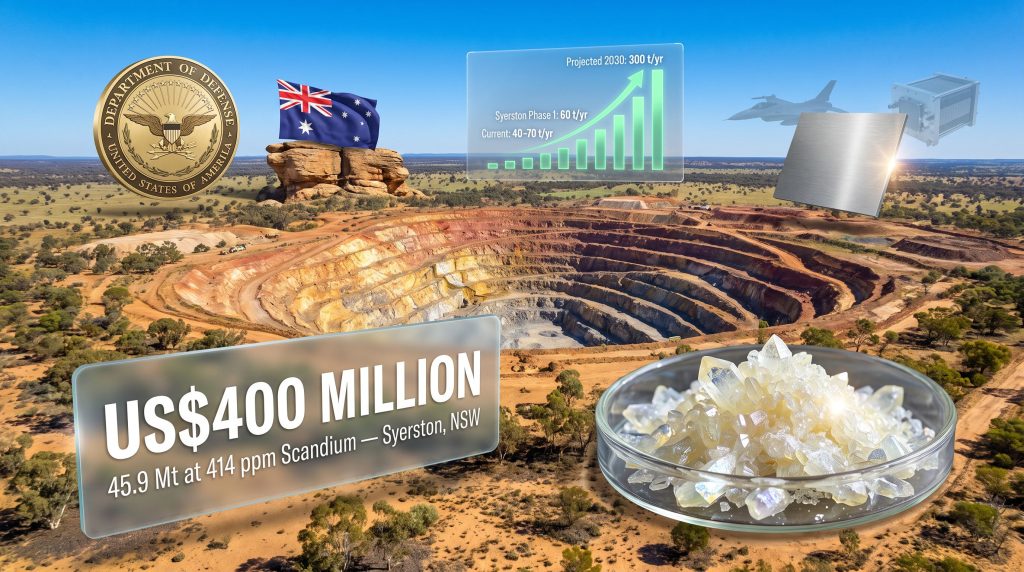
Syerston is one of the very few deposits on Earth that clears this threshold. Located in central New South Wales, the project hosts a measured and indicated resource of 45.9 million tonnes grading 414 parts per million (ppm) scandium, containing approximately 19,007 tonnes of contained scandium. A further inferred resource of 5.7 million tonnes at 364 ppm adds another estimated 2,082 tonnes to the total endowment. The scandium deposit geology at Syerston is considered world-class by any measure.
To contextualise those numbers: the entire current global scandium market, as estimated by the U.S. Geological Survey, sits at just 40 to 70 tonnes of consumption per year. Syerston's planned initial output of 60 tonnes annually would, on its own, approximate the entirety of current worldwide demand sourced from a single Western-jurisdiction mine.
Geological context: Unlike rare earth deposits, where mineralisation is often dispersed across large tonnages at sub-economic grades, Syerston's 414 ppm grade is considered high for primary scandium mineralisation. The deposit's scale and grade combination is what makes commercial standalone extraction economically viable where most other scandium occurrences are not.
The project is operated by Sunrise Energy Metals (ASX: SRL), with Robert Friedland, founder of Ivanhoe Mines, serving as non-executive chairman. Friedland's association with the project spans more than two decades and has included pivots through multiple commodity cycles.
From Nickel Disappointment to Scandium Opportunity: A Two-Decade Pivot
Syerston's journey to its current position as a would-be primary scandium producer is itself a lesson in how commodity market disruptions reshape development trajectories. The deposit was originally advanced as a nickel-cobalt project, brought to shovel-ready status on the back of projections for sustained nickel demand. That thesis collapsed when a surge of Indonesian laterite nickel supply flooded global markets, compressing price outlooks and destroying the economic rationale for Australian nickel laterite development across the board.
What could have been a permanent abandonment instead became a strategic reassessment. The site's scandium endowment, long identified but commercially underweighted, took on new significance as demand signals for the element began shifting in ways that had no precedent in the metal's commercial history.
The transformation in scandium's application profile has been the critical enabling factor. As Sunrise CEO Sam Riggall explained to The Northern Miner, a decade ago scandium's commercial utility was largely confined to solid oxide fuel cells as a niche clean energy application. That has changed materially. Scandium has since found its way into critical minerals for semiconductors, 3D-printed defence components, high-strength aluminium alloys for aerospace applications, and critically, the infrastructure underpinning both 5G and emerging 6G wireless networks. Riggall has stated publicly that there is effectively no functional 5G or 6G wireless technology without scandium, and that no substitute currently exists at scale for these applications. (The Northern Miner, August 2026)
Fuel cells themselves have also undergone a commercial repositioning. What was once framed primarily as a green energy technology is now being deployed as a practical solution to near-term power constraints facing U.S. data centres and artificial intelligence infrastructure. When gas generation capacity is constrained, solid oxide fuel cells offer a rapid-deployment bridging solution, and their operation depends on scandium-stabilised zirconia electrolytes that cannot currently be sourced outside Chinese-controlled supply chains.
Breaking Down the US$400 Million DoD Conditional Commitment
The financing structure announced in August 2026 represents one of the largest individual allocations within a broader U.S. government initiative that has committed approximately US$2 billion across critical mineral projects globally.
| Financing Element | Detail |
|---|---|
| Commitment type | Conditional loan (non-binding pending due diligence and definitive documentation) |
| Committed amount | US$400 million (approximately C$556 million) |
| Issuing authority | U.S. Department of Defense, Office of Strategic Capital |
| Supplementary interest | U.S. Export-Import Bank previously indicated up to US$67 million in separate financing |
| Strategic provision | U.S. government retains a right of first offer on project output |
| Anchor offtake | Lockheed Martin holds an option to purchase up to 15 tonnes of scandium oxide per year for the first five years, representing approximately 25% of planned initial output |
The right of first offer provision is a structurally significant element that distinguishes this arrangement from a conventional mining project loan. It effectively grants American defence contractors and industrial users priority access to Syerston's production before any volume reaches the open market. This transforms what is technically a commercial loan into a mechanism that functions similarly to a strategic reserve replenishment agreement.
It is critical to note that this remains a conditional commitment. Execution depends on completion of regulatory approvals, comprehensive due diligence, and the signing of definitive financing agreements. A final investment decision from Sunrise Energy Metals is targeted for the end of 2026.
The Capital Expansion: Understanding a Fourfold Cost Revision
One of the more striking disclosures accompanying the DoD commitment was the revision to project capital expenditure estimates. The contrast between the original feasibility study figure and the updated scope is significant.
| Cost Estimate | Scope | Amount |
|---|---|---|
| Original feasibility study (March, prior year) | Australian mine and refinery only | US$120 million |
| Revised estimate (August 2026) | Mine + Australian refinery + U.S. processing plant + expanded infrastructure | A$450-475 million (approximately US$315-333 million) |
The approximately fourfold increase from the original feasibility figure reflects a deliberate expansion of the project's strategic scope rather than cost overruns in the conventional sense. Three primary drivers explain the revision:
- Addition of a U.S.-based scandium metal refining facility, aligned with Washington's preference for domestic processing capacity within its critical mineral supply chain.
- Infrastructure investment in power and water systems required to support expanded throughput at the Australian mine and refinery site.
- Output capacity tripling, from the originally planned 60 tonnes per year to a potential 180 tonnes annually under the expanded development scenario.
Riggall has placed the project's scale in comparative context, noting that he and Friedland have worked together on some of the world's largest copper developments, including the Oyu Tolgoi project in Mongolia, and that Syerston is, by comparison, a relatively modest undertaking. The implication is that execution complexity, while real, is manageable within the team's experience base. (The Northern Miner, August 2026)
China's Monopoly and the Semiconductor Dimension
The strategic urgency behind the Syerston scandium project U.S. Department of Defense loan commitment cannot be fully appreciated without understanding the depth of China's dominance over scandium metal production. This is not a situation of market concentration analogous to rare earths, where China holds a large but not absolute share. According to Riggall's statements to The Northern Miner, China currently produces 100% of the world's scandium metal, with no other source of primary metal production existing anywhere on the planet.
This supply reality has created acute tightness in markets where scandium demand has been growing. Riggall described engagement with the semiconductor industry as revealing supplies that are extremely difficult to access and subject to persistent tightness, a dynamic that has sharpened Washington's awareness of the vulnerability. (The Northern Miner, August 2026)
The semiconductor application for scandium is less widely understood than the fuel cell or aerospace alloy uses, but may ultimately prove equally strategic. Scandium is used in aluminium nitride (AlN) substrates and is being incorporated into chip fabrication processes, particularly as next-generation semiconductor architectures require materials with specific thermal and electrical properties. The fact that every tonne of scandium feeding into semiconductor supply chains currently passes through Chinese-controlled processing adds a dimension of strategic risk that extends well beyond the defence procurement community.
How Does This Affect Australia's Critical Minerals Sector?
Australia's critical minerals sector is increasingly central to allied supply chain strategies, and Syerston represents perhaps the most prominent example of this dynamic in action. In addition, the broader defence critical materials strategy being pursued between Washington and Canberra positions Australian deposits as frontline assets in Western supply chain resilience efforts.
The next major ASX story will hit our subscribers first
Supply Routing Concerns and Chain of Custody Risks
The opacity of existing scandium supply chains received public attention in July 2026 when activist investor Hunterbrook Capital released a report alleging that Chinese-origin scandium oxide was reaching U.S. fuel cell manufacturers through indirect routing via Thailand, Japan, and South Korea. The targeted company, Bloom Energy, rejected the report's financial conclusions and described certain claims as false and misleading.
Industry insight: The episode illustrated a supply chain dynamic well understood within the critical minerals sector but rarely discussed publicly. Third-country routing of Chinese-origin materials can obscure ultimate provenance in ways that complicate compliance with domestic procurement requirements. For sectors subject to defence-related supply chain law, this opacity creates genuine legal and strategic exposure, not just reputational risk.
Regardless of the specific allegations' resolution, the broader point about systemic vulnerability in Western scandium sourcing was reinforced. Riggall acknowledged that while urgency is now visible within government circles, industry adoption of alternative supply sources will likely lag, creating a window of continued exposure even as projects like Syerston move through development. (The Northern Miner, August 2026)
Modelling the Supply Gap: Current Demand Against Projected Growth
The mismatch between current scandium supply, projected demand growth, and even optimised Syerston output is one of the most underappreciated aspects of the strategic picture.
| Scenario | Annual Scandium Demand | Syerston Phase 1 (60t/yr) | Syerston Phase 2 (180t/yr) |
|---|---|---|---|
| Current market (USGS estimate) | 40-70 tonnes/year | Covers ~86-150% of current demand | Exceeds current demand by ~3x |
| Projected demand by 2030 | ~300 tonnes/year | Covers ~20% of projected demand | Covers ~60% of projected demand |
Even at full Phase 2 capacity, Syerston alone would supply only around 60% of projected 2030 demand. Lockheed Martin's option to purchase up to 15 tonnes per year for the first five years absorbs roughly a quarter of Phase 1 output, leaving approximately 45 tonnes annually for other U.S. and allied industrial users in the initial production phase.
The fuel cell sector is identified as the primary volume driver through 2030, but the alloy and semiconductor segments are growing in strategic importance. The combination of these demand vectors against a supply base that currently consists entirely of Chinese production creates one of the more acute commodity supply gaps in the critical minerals universe.
Corporate Repositioning: The U.S. Listing and Redomiciliation Question
Sunrise Energy Metals announced alongside the DoD commitment that it is exploring a listing on a U.S. securities exchange. Friedland's public commentary following the announcement went further, suggesting the company may ultimately redomicile to the United States entirely, reflecting Washington's preference for domestically incorporated entities within its critical mineral financing programmes.
This pattern is not unique to Sunrise. The U.S. government's financing structures for critical minerals have created a structural incentive for allied-nation mining companies to restructure their corporate presence toward American domicile. For ASX-listed developers watching Syerston's trajectory, the question of whether U.S. capital market repositioning is a prerequisite rather than an optional enhancement for accessing Pentagon-adjacent financing is likely to become increasingly relevant.
Key Milestones and Decision Points Through 2028
- End of 2026: Final investment decision targeted by Sunrise Energy Metals, contingent on definitive DoD financing documentation.
- Ongoing (2026): Early works and pre-construction activities already under way at the Syerston site in central New South Wales.
- Pending: Completion of due diligence and execution of definitive agreements for the conditional US$400 million loan commitment.
- Pending: Potential U.S. securities exchange listing and assessment of corporate redomiciliation options.
- Approximately 2028: Targeted commencement of first scandium production at 60 tonnes per year initial capacity.
- Post-2028: Potential expansion to 180 tonnes per year, contingent on construction of the U.S.-based scandium metal refining facility.
Investor note: The conditional nature of the DoD loan means that execution risk remains the dominant variable in assessing project probability. Multiple interdependent milestones, including the final investment decision, definitive financing agreements, and regulatory approvals, must resolve concurrently. Investors should treat the conditional commitment as a meaningful de-risking signal rather than confirmed project financing. This article does not constitute financial advice.
A Template Transaction for the Broader Critical Minerals Sector
The structural parallels between scandium's current predicament and the rare earth supply concentration crisis of the early 2010s are instructive, but with an important distinction. The rare earth episode eventually generated a pipeline of Western-jurisdiction development projects, several of which have now reached production or near-production status. Scandium, by contrast, has no operating primary Western-jurisdiction mine.
As reported by the SMH, Syerston's development would not merely add supply capacity to an existing Western producer base; it would create that base from scratch. The Syerston scandium project U.S. Department of Defense loan commitment, consequently, carries a significance that extends well beyond the project's own commercial merits.
The DoD's use of a conditional loan structure, rather than a grant or purchase agreement, also carries broader implications for how the U.S. government engages with allied-nation mining projects. If the Syerston model is replicated across lithium, cobalt, graphite, and manganese, the Office of Strategic Capital's approach could become a reference architecture for the next wave of critical mineral project financing. For Australian developers in particular, Syerston may represent the most detailed publicly available template for structuring a U.S. government financing engagement, complete with the corporate repositioning expectations that appear to accompany it.
What Syerston ultimately demonstrates is that the calculus around critical mineral development has shifted from purely commercial to explicitly geopolitical, and that this shift creates both material risks and material opportunities for the projects positioned at the intersection of both.
For ongoing reporting on the Syerston scandium project and the broader critical minerals financing landscape, the Canadian Mining Journal at canadianminingjournal.com continues to track developments across the sector.
Want to Catch the Next Major Critical Minerals Discovery Before the Market Does?
Discovery Alert's proprietary Discovery IQ model delivers real-time alerts on significant ASX mineral discoveries — including the critical minerals reshaping global supply chains — turning complex geological data into actionable investment insights for both short-term traders and long-term investors. Explore historic discoveries and their extraordinary returns, then begin your 14-day free trial at Discovery Alert to position yourself ahead of the broader market.