
August 24, 2026
Uranium's Supply Gap and the Strategic Value of Frontier Assets
The global uranium market is navigating a structural tension that has been building for more than a decade. On one side sits an accelerating wave of nuclear energy demand, driven by decarbonisation commitments and the recognition that baseload low-carbon power requires more than wind and solar alone. On the other side sits a chronically underdeveloped supply pipeline, shaped by years of low prices, permitting complexity, and the exit of major producers from marginal projects. The uranium supply deficit is projected to widen substantially through the 2030s as new reactor builds accelerate across Asia, Europe, and North America.
Within this context, large undeveloped uranium deposits in established mining corridors carry a strategic premium that extends well beyond their headline resource numbers. The question for investors evaluating frontier uranium assets is never simply how many pounds are in the ground, but rather what combination of grade, geometry, jurisdiction, and technical maturity determines whether a deposit can actually fill that supply gap. It is precisely this multi-variable lens that makes the Atomic Eagle Madaouela uranium project in Niger worthy of close examination.
When big ASX news breaks, our subscribers know first
What Madaouela Actually Is and Why Its Scale Matters
Madaouela sits in north-central Niger near the town of Arlit, a region with a uranium production history stretching back to the 1970s. Arlit is not an emerging frontier in the conventional exploration sense. It is an established uranium production corridor where French operator Orano (formerly Areva) has operated the Somair and Cominak mines for decades, building out regional infrastructure including roads, processing facilities, and a specialised workforce. This existing infrastructure context is a material factor in evaluating any new development proposal in the district.
The deposit covers approximately 122.9 square kilometres and hosts sandstone-hosted uranium mineralisation extending across multiple deposits over a strike length of roughly 17 kilometres. The mineralisation style is shallow and laterally extensive, which has historically been associated with conventional open-pit or shallow underground mining approaches rather than the high-pressure in-situ recovery methods more common in Kazakhstan or the deep high-grade vein systems of Canada's Athabasca Basin.
Resource Metrics: What the Numbers Show
The current mineral resource estimate for Madaouela, prepared under Canada's NI 43-101 framework, stands as follows:
| Resource Category | Contained U₃O₈ (Mlbs) | Tonnage (Mt) | Grade (ppm) |
|---|---|---|---|
| Measured | 30.1 | — | 1,282 |
| Indicated | 66.8 | — | 1,282 |
| Inferred | 19.6 | — | 1,282 |
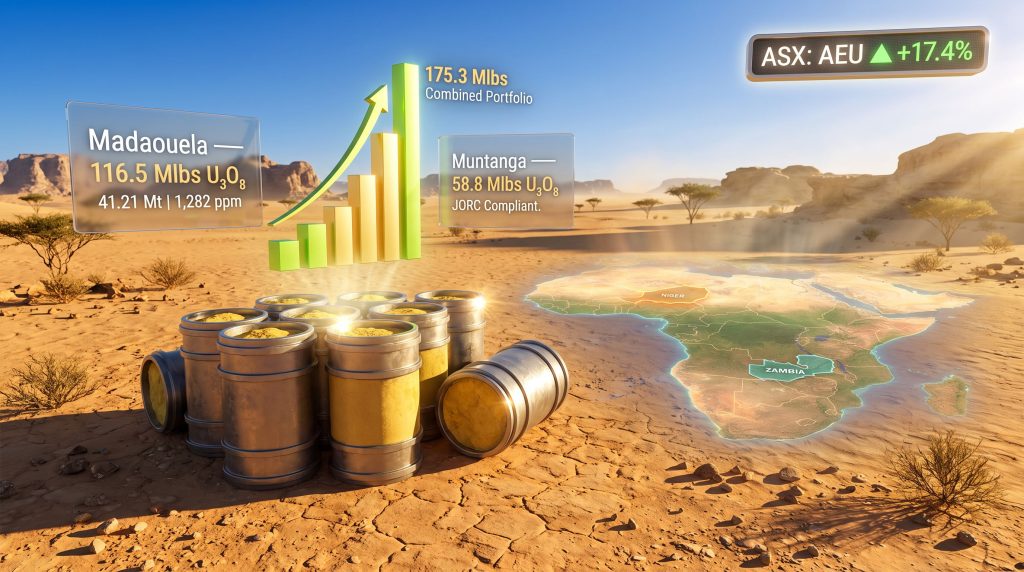
| Total | 116.5 | 41.21 | 1,282 |
Important note for investors: This resource estimate is not currently compliant with the JORC Code, which governs mineral resource reporting standards on the ASX. Atomic Eagle has confirmed that insufficient work has been completed to date to classify the estimate under JORC requirements. A JORC-compliant resource estimate is targeted for Q4 2026, following database verification and QA/QC review.
Grade Context: Where 1,282 ppm Sits Globally
Understanding what 1,282 parts per million U₃O₈ means in a global context requires some benchmarking. Athabasca Basin deposits in Saskatchewan, Canada, which represent the world's highest-grade uranium deposits, commonly exceed 10,000 ppm and can reach well above 100,000 ppm in extreme cases. Namibian operations such as Rossing and Husab, by contrast, typically operate at grades between 200 and 500 ppm, relying on very large tonnage to achieve economic viability.
At 1,282 ppm, Madaouela occupies a mid-grade position that is significantly richer than large-tonnage, low-grade African peers but far below the ultra-high-grade Canadian basement deposits. This grade range, combined with shallow mineralisation amenable to conventional mining, is generally considered economically viable at uranium prices well below the spot price levels observed in recent years. Critically, the deposit is underpinned by approximately 600,000 metres of historical drilling, one of the most extensive exploration databases for any undeveloped African uranium project, reducing the geological uncertainty that typically burdens earlier-stage assets.
How Atomic Eagle Came to Hold a 60% Interest in Madaouela
The path from disputed asset to signed Mining Convention involved multiple corporate and geopolitical turning points spanning roughly two years. Furthermore, understanding the uranium market dynamics at play during this period helps contextualise why Niger's return to commercial engagement was strategically rational for both parties.
The timeline of events:
-
July 2024: Niger's government withdrew the Madaouela mining permit from GoviEx Uranium, the project's previous holder, as part of a broader reassertion of resource sovereignty that accompanied the country's post-coup governance transition.
-
Following the withdrawal: GoviEx initiated international arbitration proceedings under the ICSID (International Centre for Settlement of Investment Disputes) framework, the standard mechanism for foreign investor-state disputes in the mining sector.
-
February 2025: The ICSID arbitration was formally suspended as commercial negotiations between the parties resumed, signalling a diplomatic off-ramp from the legal dispute.
-
November 2025: GoviEx Uranium merged with Tombador Iron to create Atomic Eagle Ltd, listed on the ASX under the ticker AEU and on the Frankfurt Stock Exchange under 6QZ0. The merger created a new corporate entity with a clean commercial mandate and no legacy litigation posture toward Niger.
-
June 2026: Atomic Eagle's technical and legal teams engaged directly with Niger's Ministry of Mines, representing a pivotal moment in rebuilding the bilateral commercial relationship.
-
August 2026: A new Mining Convention was executed, granting Atomic Eagle a 60% interest and full operational control of Madaouela through its newly incorporated Nigerien subsidiary, Madaouela Mining Company SA (MAMICO).
The commercial resolution also included a commitment that all ICSID arbitration proceedings would be formally withdrawn within 7 days of the Mining Convention being signed, drawing a definitive legal line under the dispute period.
Ownership Architecture: Understanding the 40/60 Split
Niger's 40% stake in the project is not a monolithic holding. It is structured in two distinct components that carry meaningfully different financial implications:
-
15% free-carried interest: Niger participates in project economics without contributing to capital expenditure. The operating partner effectively funds this share of development costs and recovers them through priority distributions before profit sharing begins.
-
25% contributing interest: Niger is expected to contribute its proportionate share of capital expenditure. This is a more commercially balanced arrangement than a pure free-carry model because it reduces the effective capital burden on Atomic Eagle over the full mine development cycle, while giving the state skin in the game economically.
This structural distinction matters significantly for project-level financial modelling. A 25% contributing interest from a state partner means that roughly a quarter of construction and operating capital comes from outside Atomic Eagle's balance sheet, provided Niger fulfils its funding obligations.
Payment Obligations and Legal Protections in the Mining Convention
Atomic Eagle's financial commitments under the new agreement are staged to align with project milestones rather than requiring immediate large capital outflows:
-
US$5 million is payable within 30 days of the exploitation permit being formally issued.
-
A further US$5 million becomes payable upon commencement of construction activities.
The total US$10 million payment structure is relatively modest by the standards of African uranium project re-entry transactions, particularly given the scale of the resource being secured. Comparable transactions across West Africa involving assets of this size have often involved upfront payments or work commitments of comparable or greater magnitude.
The exploitation permit carries an initial 10-year term, with successive 5-year renewal rights over the project's operational life. Given that historical technical studies point to a projected mine life of approximately 19 years, the renewal framework will be exercised at least twice, introducing a renewal risk dimension that investors should factor into their long-term modelling.
The Mining Convention also incorporates:
-
Legal, fiscal, and regulatory stabilisation clauses, intended to insulate the project from future changes to Niger's tax regime or mining laws for the duration of the permit.
-
ICSID arbitration access, preserving Atomic Eagle's ability to pursue international legal remedies should future disputes arise.
-
Uranium offtake provisions, which are yet to be negotiated in detail but create a framework within which future sales agreements or offtake-backed financing could be structured.
Risk callout for investors: While stabilisation clauses represent a standard and valuable investor protection in frontier mining jurisdictions, their practical enforceability in Niger's evolving governance environment is not guaranteed. The 2024 expropriation itself occurred despite existing permit protections, which highlights that legal frameworks alone are not sufficient substitutes for ongoing sovereign relationship management.
The Dual-Asset Portfolio: Madaouela and Muntanga Compared
The addition of Madaouela transforms Atomic Eagle from a single-jurisdiction uranium developer into a two-asset African uranium platform. Understanding how the two projects compare is essential for evaluating the company's risk-adjusted development optionality. In addition, the Muntanga uranium project in Zambia provides a JORC-compliant counterbalance to Madaouela's higher-risk, higher-scale profile.
| Attribute | Madaouela (Niger) | Muntanga (Zambia) |
|---|---|---|
| Ownership | 60% (operational control) | 100% |
| Resource (Mlbs U₃O₈) | 116.5 (NI 43-101 foreign estimate) | 58.8 (JORC compliant) |
| Resource Standard | Not yet JORC compliant | JORC Code compliant |
| Development Stage | Resource verification phase | Active drilling, feasibility from 2027 |
| Geographic Setting | Arlit district, north-central Niger | Southern Zambia |
| Project Area | ~122.9 km² | — |
The combined portfolio resource base reaches approximately 175.3 million pounds U₃O₈ across two African jurisdictions, though investors should note that the Madaouela figure remains subject to potential reclassification upon JORC conversion.
Three Development Scenarios for Atomic Eagle
Several plausible strategic pathways exist for how the company progresses both assets concurrently:
-
Sequential development: Muntanga advances toward production first, using cash flows or capital raised against a JORC-compliant asset to fund the longer-dated Madaouela development cycle after JORC conversion and feasibility updating are complete.
-
Parallel capital raise with strategic partnership: A joint venture partner or strategic investor is brought into Madaouela specifically, allowing both projects to advance simultaneously without requiring Atomic Eagle to carry the full financing burden of a dual-development program.
-
Offtake-led financing at Madaouela: Given that the Mining Convention contemplates future offtake arrangements, a committed uranium offtake agreement with a utility buyer could be used as the anchor for a project finance debt facility at Madaouela, a pathway that has been successfully used at comparable African uranium developments.
The JORC Conversion Process: What It Involves and Why It Matters
For ASX-listed companies, the JORC Code is the foundational standard for reporting mineral resources. Institutional investors, many of which are restricted by mandate from attributing value to non-compliant estimates, will typically apply a significant discount or zero weighting to NI 43-101 resources until JORC equivalency is established. This creates a clear value catalyst dynamic: a successful JORC conversion can unlock a materially larger investor audience for Madaouela.
The verification program Atomic Eagle has initiated involves several sequential technical workstreams. For investors accustomed to interpreting drill results, the depth of this validation process underscores how rigorous the path to JORC compliance genuinely is.
-
Validation and reconciliation of the 600,000-metre historical drilling database against original field records.
-
Verification of assay and radiometric data quality, including checks on sample handling, storage, and analytical precision.
-
Review of the geological model, including deposit geometry assumptions, continuity interpretations, and the classification boundaries between Measured, Indicated, and Inferred categories.
-
Assessment of QA/QC procedures applied during historical drilling campaigns to determine whether they meet modern JORC competent person expectations.
-
A fresh resource estimation using validated inputs, with the outcome targeted for Q4 2026.
It is worth noting that JORC conversions of historical NI 43-101 resources do not always preserve the original resource size or classification. Reclassification of material from higher to lower confidence categories, or even removal of tonnes that fail QA/QC validation, is a historically observed outcome. Investors should treat the 116.5 million pound figure as a working estimate rather than a confirmed JORC resource until the conversion process is complete.
The next major ASX story will hit our subscribers first
Market Reaction and What the Share Price Move Signals
On 24 August 2026, AEU shares surged to an intraday high of A$0.54, up from the prior close of A$0.46, representing a 17.4% intraday gain. The scale of the market reaction reflects several overlapping investor responses rather than a single simple narrative.
Markets were pricing a combination of the following:
-
Resource scale optionality: The addition of 116.5 million pounds of contained uranium to a portfolio that previously held 58.8 million pounds represents a near doubling of the company's gross resource base, even on a risk-adjusted basis.
-
Dispute resolution premium: The market had presumably been attributing little or no probability to Madaouela being recovered, meaning the announcement represented an informational surprise rather than a confirming data point in an already-anticipated outcome.
-
Commercial structure signal: The US$10 million total payment structure and Niger's 25% contributing interest were interpreted as commercially reasonable, suggesting the settlement did not come at an excessive cost to future project economics.
However, experienced investors will recognise the distinction between pricing in resource discovery and pricing in development optionality. A 60% interest in a non-JORC resource in a post-coup West African jurisdiction carries risk discounts that the initial share price surge may not fully reflect. The prudent analytical approach is to assess the market capitalisation implied by the post-announcement price against a probability-weighted NPV that incorporates JORC conversion risk, sovereign risk, development timeline uncertainty, and uranium price assumptions.
Key Risk Factors Investors Should Evaluate
Disclaimer: The following analysis is intended as an educational framework for evaluating investment risk and does not constitute financial advice. Investors should conduct independent due diligence and consult qualified financial advisers before making investment decisions.
Sovereign and geopolitical risk remains the most structurally significant concern. Niger's 2024 expropriation of the Madaouela permit demonstrates that resource nationalism is not merely a theoretical risk in this jurisdiction. The new Mining Convention's stabilisation provisions and ICSID access are meaningful protections, but the enforceability of these mechanisms in a rapidly evolving political environment is an ongoing consideration rather than a resolved question. Regional security dynamics in north-central Niger near the Arlit corridor add an additional layer of operational risk.
Technical and resource risk centres on the JORC conversion outcome. The historical NI 43-101 resource was compiled from an extensive database, but its JORC equivalency has not yet been tested. Resource reclassification is a material possibility.
Financial and capital structure risk includes the near-term US$5 million payment obligation triggered by permit issuance, the need to finance parallel development programs at both Muntanga and Madaouela, and the modelling uncertainty introduced by Niger's 25% contributing interest.
Permitting and regulatory risk arises from the 10-year exploitation permit term relative to the projected 19-year mine life, and from the offtake provisions in the Mining Convention that remain subject to future negotiation.
Niger's Uranium Legacy and Its Relevance to Madaouela's Long-Term Potential
Niger has historically ranked among the world's top five uranium-producing nations by output volume. During peak production years in the 1970s and 1980s, the country supplied a significant portion of European uranium requirements, primarily sourced from the Arlit district. This production history translates into tangible infrastructure advantages for any developer re-entering the region, including existing road networks, power infrastructure, and a local workforce with relevant technical experience.
The broader demand context also supports a constructive long-term view on large, conventional-mining-amenable uranium assets. Consequently, current uranium investment trends increasingly favour deposits that can be mined at scale using established open-pit or conventional underground methods, rather than requiring proprietary in-situ recovery infrastructure, for their financing tractability and construction timeline predictability.
Within the African uranium development pipeline, the Atomic Eagle Madaouela uranium project in Niger's combination of resource scale, established drill density, and proximity to Arlit's existing infrastructure positions it as one of the more technically de-risked large undeveloped assets on the continent. This assessment, however, remains conditional on a successful JORC conversion and an updated definitive feasibility study that reflects current cost and price assumptions.
Frequently Asked Questions
What is the Madaouela Uranium Project in Niger?
Madaouela is a large-scale uranium development asset located near Arlit in north-central Niger, covering approximately 122.9 square kilometres. It hosts a foreign mineral resource estimate of 116.5 million pounds U₃O₈ across 41.21 million tonnes at an average grade of 1,282 ppm, making it one of the more significant undeveloped uranium deposits in West Africa.
Who Owns the Madaouela Uranium Project?
Following execution of a new Mining Convention in August 2026, Atomic Eagle Ltd (ASX: AEU) holds a 60% interest and retains operational control through its Nigerien subsidiary MAMICO. The Republic of Niger holds the remaining 40%, comprising a 15% free-carried interest and a 25% contributing interest.
What Happened to Madaouela Before Atomic Eagle Secured It?
The project was previously held by GoviEx Uranium, which had its mining permit withdrawn by Niger's government in July 2024. GoviEx initiated ICSID arbitration proceedings, which were subsequently suspended in February 2025 as commercial negotiations resumed. GoviEx then merged with Tombador Iron in November 2025 to form Atomic Eagle, which concluded the commercial resolution with Niger in August 2026.
Is the Madaouela Resource JORC-Compliant?
No. The current 116.5 million pound U₃O₈ estimate is prepared under Canada's NI 43-101 framework and is not yet compliant with the JORC Code. Atomic Eagle has initiated a resource verification and technical optimisation program with a JORC-compliant estimate targeted for Q4 2026.
What Payments Does Atomic Eagle Owe for Madaouela?
Atomic Eagle has agreed to pay US$5 million within 30 days of the exploitation permit being formally issued, followed by a further US$5 million upon commencement of construction activities, for a total staged commitment of US$10 million.
How Does Madaouela Compare to Atomic Eagle's Muntanga Project in Zambia?
Muntanga hosts a JORC-compliant mineral resource of 58.8 million pounds U₃O₈ and is 100% owned by Atomic Eagle. It is the company's primary near-term development focus, with updated feasibility work targeted from 2027. Madaouela is significantly larger by resource size but carries higher near-term uncertainty due to its non-JORC status and Niger's elevated sovereign risk profile relative to Zambia.
Want to Position Yourself Ahead of the Next Major Uranium Discovery?
Discovery Alert's proprietary Discovery IQ model delivers real-time alerts the moment significant mineral discoveries hit the ASX, transforming complex resource data into actionable investment insights for both short-term traders and long-term investors — explore historic discoveries and the returns they generated to understand why being early matters, then begin your 14-day free trial today.