August 23, 2026
The Structural Gap That Made DISA Uranium Inevitable
For decades, the United States has operated one of the world's largest civilian nuclear fleets while simultaneously failing to produce enough domestic uranium to fuel it. At peak dependency, American utilities sourced well over 90% of their uranium requirements from foreign suppliers, including Kazakhstan, Russia, and Uzbekistan. That structural imbalance, largely ignored during periods of low uranium prices, has become an increasingly uncomfortable reality as energy security concerns reshape capital allocation across the nuclear fuel chain.
The IsoEnergy DISA Uranium Corporation transaction, which closed on August 19, 2026, is best understood not as a routine corporate restructuring but as a direct response to this decades-long supply deficit. It represents one of the most architecturally sophisticated formations in the recent history of U.S. uranium development, combining conventional mine assets with proprietary waste-recovery technology and a genuinely diverse institutional capital base.
When big ASX news breaks, our subscribers know first
Why the U.S. Uranium Supply Deficit Creates Structural Opportunity
The domestic uranium production gap is not a new problem. U.S. mine output collapsed through the 1980s and 1990s as utilities shifted to cheaper imports following the end of Cold War-era procurement programmes. By the early 2020s, domestic production covered only a fraction of annual reactor requirements, which themselves were growing as utilities extended reactor lifetimes and new nuclear capacity entered planning stages.
Furthermore, what changed more recently is the political and capital market response. Energy security policy increasingly treats nuclear fuel supply as a strategic vulnerability, and that shift in framing has pulled institutional capital back toward domestic uranium development. The uranium supply deficit has consequently triggered a wave of corporate activity focused on restarting permitted but idle U.S. mine capacity, a category in which the IsoEnergy DISA Uranium Corporation transaction sits squarely.
In addition, the US ban on Russian uranium has accelerated this strategic repositioning, forcing utilities and developers alike to rethink long-established sourcing arrangements and look closer to home for reliable fuel supply.
The distinction between permitted, past-producing assets and greenfield exploration projects is critical in this environment. Permitted mines carry years of regulatory work already embedded in their value, making them far more actionable for near-term production restarts than projects requiring fresh permitting cycles that can take a decade or longer.
Breaking Down the Utah Portfolio: Five Assets, One Strategic Platform
The asset contribution at the heart of the IsoEnergy DISA Uranium Corporation transaction is a portfolio of five Utah-based properties, each with distinct characteristics but unified by their permitted status and historical production credentials.
| Asset | Type | Status |
|---|---|---|
| Tony M Mine | Conventional uranium/vanadium | Past-producing; near-term restart priority |
| Daneros Mine | Conventional uranium/vanadium | Past-producing; permitted |
| Rim Mine | Conventional uranium/vanadium | Past-producing; permitted |
| Sage Plain Project | Development-stage | Permitted |
| Flatiron Project | Development-stage | Permitted |
The Tony M Mine has been identified as the highest near-term production priority within the portfolio. Its combination of existing infrastructure, permitted status, and historical production data makes it significantly more capital-efficient to restart than a comparable greenfield asset would be to develop from scratch.
Critically, all five assets sit within reach of an existing toll-milling arrangement with Energy Fuels Inc., one of the leading conventional uranium producers in the United States. This processing pathway removes one of the most capital-intensive requirements for early-stage production: the need to build or acquire dedicated milling infrastructure. Toll-milling agreements allow producers to deliver ore to an existing licensed mill, pay a processing fee, and receive uranium concentrate (yellowcake) in return, a structure that materially reduces the upfront capital threshold for a production restart.
IsoEnergy's Retained Economics: Equity Stake and Capital Deployment
Rather than selling its Utah assets outright, IsoEnergy structured the contribution in a way that preserves long-term upside while transferring the ongoing carrying costs to the new entity. In exchange for the Utah Portfolio, IsoEnergy received 1,677,350 shares of DISA Uranium Common Stock.
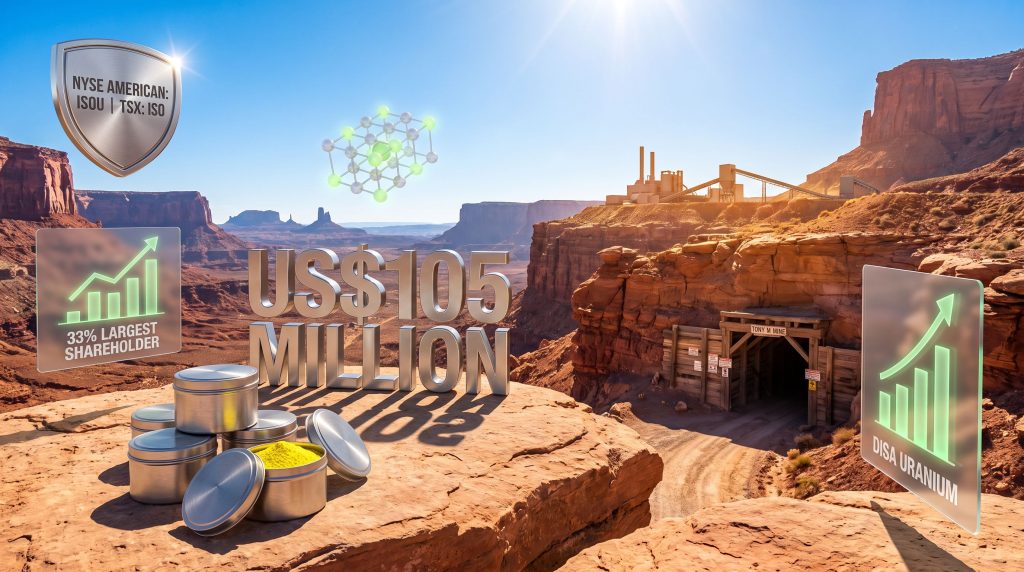
Simultaneously, IsoEnergy deployed US$33 million into the concurrent private placement financing round, which totalled US$105 million across the full investor consortium. Following closing, IsoEnergy holds approximately 33% of DISA Uranium Corporation on a fully diluted basis, a position that makes it the company's single largest shareholder.
The financial logic here is instructive for investors evaluating the transaction:
- The Utah Portfolio had been generating ongoing holding and standby costs without producing revenue
- Transferring these assets into a well-capitalised, operationally focused vehicle eliminates those carrying costs from IsoEnergy's balance sheet
- The 33% equity stake preserves meaningful exposure to any upside in U.S. uranium production economics
- The US$33 million placement investment is structured to generate returns proportional to DISA Uranium's operational success, not merely asset appreciation
This structure reflects a portfolio management approach increasingly common among mid-tier mining companies: concentrating flagship asset focus whilst monetising secondary assets through equity-retaining spin-outs rather than outright divestiture.
The US$105 Million Private Placement: Who Backed DISA Uranium and Why It Matters
The composition of the investor consortium behind DISA Uranium's formation-stage financing round is arguably as significant as the dollar amount itself. A US$105 million raise at the formation stage of a private uranium company is unusual by any measure, but the identity of the backers adds a further layer of strategic signal.
| Investor | Strategic Relevance |
|---|---|
| Tembo Capital | Specialist natural resources fund with deep mining sector expertise |
| BHP Ventures | Venture arm of one of the world's largest diversified miners |
| Galvanize Climate Solutions | Climate-focused capital aligning uranium with clean energy transition |
| Valor Equity Partners | Growth-oriented private equity with operational improvement focus |
| Evok Innovations | Clean technology venture capital |
| Halliburton Labs | Energy technology incubator signalling industrial process credibility |
| Veriten | Energy research and advisory-linked capital |
BHP Ventures' participation deserves particular attention. BHP is one of the world's largest mining companies and its venture arm does not deploy capital casually into early-stage resource companies. Its involvement functions as a form of strategic validation that is difficult to replicate through financial engineering alone.
Equally notable is the presence of climate-focused investors such as Galvanize Climate Solutions and Evok Innovations alongside traditional mining and energy capital. This cross-sector participation reflects a broader repositioning of uranium within ESG-aware investment frameworks. Nuclear energy's carbon-free generation profile has increasingly made it difficult for climate-focused capital allocators to categorically exclude uranium investments, particularly as electricity demand from data centres, electric vehicles, and industrial electrification accelerates globally. Understanding uranium market dynamics is, consequently, becoming essential for a far wider pool of institutional investors than was historically the case.
The breadth of this consortium, spanning a major miner's venture arm, climate capital, energy technology incubators, and specialist natural resources funds, suggests that DISA Uranium is being underwritten as a technology business operating in the uranium sector, not merely a conventional mining company.
What Is HPSA Technology and Why It Creates a Genuine Competitive Moat
The most technically distinctive element of the IsoEnergy DISA Uranium Corporation transaction is the integration of DISA Technologies' proprietary High-Pressure Slurry Ablation (HPSA) technology into the new entity's business model. Understanding this technology requires some context about the legacy uranium mining landscape in the American West.
Decades of uranium mining across states including Utah, Colorado, Wyoming, and New Mexico left behind hundreds of abandoned uranium mine sites containing waste rock and tailings material that could not be economically processed using conventional methods available at the time. These sites represent what the industry calls abandoned uranium mine (AUM) waste, and they constitute a substantial latent uranium resource that has historically been treated primarily as an environmental liability rather than a recoverable asset.
HPSA technology changes that calculus. The process uses high-pressure mechanical energy delivered through a slurry medium to physically liberate uranium from waste material that conventional crushing and leaching methods cannot economically treat. By mechanically disaggregating uranium-bearing mineral matrices at the particle level, HPSA can achieve uranium recoveries from material that traditional processing would classify as sub-economic or non-recoverable. This approach to innovative uranium extraction is representative of a broader shift in how the industry approaches previously uneconomic feedstocks.
What makes this particularly significant from a regulatory standpoint is that DISA Uranium holds the only U.S. Nuclear Regulatory Commission licence authorising the treatment and recovery of uranium from AUM waste across multiple sites. This is not a minor administrative distinction.
Why the NRC Multi-Site AUM Licence Is Irreplaceable
Obtaining NRC authorisation for radioactive material handling is a multi-year process involving extensive environmental review, technical demonstration, safety analysis, and stakeholder engagement. A multi-site licence for AUM waste treatment compounds that complexity considerably, as each site requires its own characterisation data and risk assessment within the broader licensing framework.
For any potential competitor attempting to replicate DISA Uranium's regulatory position, the timeline to obtain equivalent multi-site NRC authorisation would likely span years under the most optimistic assumptions. This creates a durable first-mover advantage that capital alone cannot quickly overcome.
The Dual-Revenue Architecture That Reduces Commodity Risk
HPSA technology applied to AUM waste creates a business model with two distinct revenue streams:
- Uranium recovery and sale from processed AUM waste material, generating direct commodity revenue linked to uranium prices
- Environmental remediation contracts tied to the cleanup and stabilisation of legacy mine sites, a category with potential access to federal funding mechanisms associated with long-standing environmental obligations at abandoned mine locations
This dual-revenue structure materially differentiates DISA Uranium from conventional uranium producers whose economics are almost entirely dependent on spot or term uranium prices. The remediation component provides a degree of revenue stability that is largely decoupled from uranium market cycles.
| Dimension | Conventional Producers | DISA Uranium (HPSA Model) |
|---|---|---|
| Primary feedstock | In-situ or mined ore | AUM waste + conventional mine ore |
| Regulatory complexity | Standard mining permits | NRC multi-site AUM licence (unique) |
| Revenue diversification | Uranium sales only | Uranium sales + remediation revenue |
| Environmental positioning | Neutral to negative perception | Active remediation narrative |
| Capital intensity (per lb U₃O₈) | High | Potentially lower via waste feedstock |
The next major ASX story will hit our subscribers first
Governance Architecture: The Strategic Significance of a Former NRC Commissioner
DISA Uranium's seven-member board reflects a deliberate effort to embed strategic capability across multiple dimensions simultaneously.
- Richard Patricio (Chairman, IsoEnergy Board) provides continuity and alignment between the largest shareholder and board governance
- Philip Williams (IsoEnergy CEO and Director) ensures direct board-level representation for the 33% shareholder
- George Pyper (Tembo Capital Partner) represents the institutional investor base within the governance structure
- Greyson Buckingham (DISA Uranium CEO) drives operational execution across both the conventional production and HPSA technology workstreams
- Scott Saxberg contributes operational leadership experience from the broader energy sector
- Marty Reed brings clean energy and climate technology investment perspective
- Jeffrey Merrifield (former U.S. Nuclear Regulatory Commission Commissioner) provides direct regulatory intelligence at the senior governance level
Merrifield's appointment warrants particular analytical attention. The NRC governs every material aspect of DISA Uranium's business model, from AUM waste handling authorisations to processing facility licences and site decommissioning obligations. Having a former Commissioner at the board level provides insight into regulatory pathway navigation, licensing timeline management, and compliance strategy that cannot be purchased through external consulting arrangements alone.
This appointment signals that DISA Uranium's leadership treats regulatory strategy as a first-order competitive function, not a compliance overhead.
IsoEnergy's Transformed Risk Profile and Dual-Geography Strategy
The IsoEnergy DISA Uranium Corporation transaction materially reshapes IsoEnergy's risk profile in ways that favour its primary development focus.
| Factor | Pre-Transaction | Post-Transaction |
|---|---|---|
| Utah Portfolio carrying cost | Ongoing holding and standby costs | Transferred to DISA Uranium |
| U.S. uranium production exposure | Direct (Utah assets on standby) | Indirect (33% equity in DISA Uranium) |
| Balance sheet flexibility | Constrained by multi-asset portfolio | Improved; capital redeployed into placement |
| Flagship asset focus | Diluted across multiple geographies | Concentrated on Athabasca Basin |
IsoEnergy's primary development focus now sits squarely on the Larocque East Project in Canada's Athabasca Basin, home to the Hurricane deposit, which the company describes as containing the world's highest-grade Indicated uranium Mineral Resource. The Athabasca Basin is globally significant in uranium geology terms, hosting some of the highest-grade uranium deposits ever discovered, with grades that can exceed 20% U₃O₈ in the highest-quality zones, compared to world averages typically below 1%.
However, the broader context of US uranium production rebound is providing a favourable macro tailwind for the Utah assets now held within DISA Uranium, as domestic mine restarts gain momentum across multiple operators simultaneously.
The company maintains dual-market listings on the NYSE American (ISOU) and TSX (ISO), providing access to both U.S. and Canadian institutional capital pools.
Three Strategic Pillars Driving DISA Uranium's Development Roadmap
DISA Uranium has articulated a multi-pronged strategy built around three reinforcing development pillars:
Pillar 1: Conventional Production Restart
The Tony M Mine represents the most immediately actionable conventional production opportunity within the Utah Portfolio. Its existing permitted status, historical infrastructure, and proximity to Energy Fuels' toll-milling capacity create a near-term pathway to uranium production without requiring construction of new milling facilities. Specific production timelines and volume targets are expected to be defined as part of post-closing operational planning.
Pillar 2: HPSA Technology Commercialisation
Deploying HPSA technology across multiple licensed AUM sites represents DISA Uranium's highest-differentiation growth pathway. The scale-up progression from single-site technology demonstration to multi-site commercial operation follows a logical technical and regulatory sequence, with the NRC multi-site licence providing the regulatory framework for that expansion.
Pillar 3: Domestic Processing Capacity Development
Building or acquiring downstream uranium processing infrastructure addresses a systemic vulnerability in the U.S. nuclear fuel chain. Currently, even domestically mined uranium concentrate must typically travel offshore for conversion and enrichment services before returning as reactor fuel. According to the U.S. Energy Information Administration, developing domestic conversion and enrichment capacity would allow producers to operate across a more complete segment of the nuclear fuel cycle, reducing strategic exposure to foreign processing bottlenecks.
Key Takeaways for Investors Evaluating the DISA Uranium Formation
The IsoEnergy DISA Uranium Corporation transaction merits evaluation across several analytical dimensions simultaneously. As noted by the World Nuclear Association, the structural shift toward energy security and domestic fuel sourcing is reshaping how institutional investors assess uranium development companies globally. In that context, DISA Uranium's formation stands out for several reasons:
- The US$105 million formation-stage private placement, backed by a consortium spanning mining majors, climate capital, and energy technology, is exceptional by junior uranium company standards and signals cross-sector institutional conviction
- The exclusive NRC multi-site AUM licence represents a regulatory moat that is genuinely difficult for new entrants to replicate within any commercially relevant timeframe
- The dual-revenue model combining uranium sales with environmental remediation contracts reduces the pure commodity price dependency that characterises most conventional uranium producers
- IsoEnergy's 33% retained stake as the largest single shareholder creates a structured alignment of interests between the contributing entity and the new operating vehicle
- The appointment of a former NRC Commissioner to the board positions regulatory strategy as a core operational competency rather than a peripheral compliance function
- The toll-milling arrangement with Energy Fuels Inc. provides a capital-efficient processing pathway for near-term conventional production without requiring mill construction investment
This article is intended for informational purposes only and does not constitute financial or investment advice. Forecasts, scenario analyses, and projections discussed herein involve inherent uncertainty and should not be relied upon as predictions of future outcomes. Investors should conduct their own due diligence and consult a qualified financial adviser before making investment decisions. All financial figures referenced are sourced from publicly available company announcements.
Want to Catch the Next Major Uranium Discovery Before the Broader Market Does?
Discovery Alert's proprietary Discovery IQ model delivers real-time alerts on significant ASX mineral discoveries — instantly translating complex resource data into actionable investment insights for both short-term traders and long-term investors. Explore why historic mineral discoveries have generated extraordinary returns, and begin your 14-day free trial today to position yourself ahead of the market.