August 22, 2026

Why the Uranium Fuel Cycle Is Heading Toward a Historic Supply Crunch
Commodity markets rarely move in straight lines, and uranium is no exception. What makes the current setup unusual is not the size of the supply gap visible today, but the structural rigidity that prevents the market from self-correcting before the crunch arrives. Mine development timelines measured in years, utility procurement cycles measured in decades, and reactor construction schedules already locked in for the early 2030s are all converging toward the same conclusion: the uranium supply deficit in the early 2030s is not a forecast to debate but a near-certainty to prepare for.
Understanding why requires stepping back from daily spot price movements and examining the architecture of the nuclear fuel cycle itself. Furthermore, the uranium supply-demand volatility currently shaping this market makes it especially critical to understand the long-term structural forces at play.
When big ASX news breaks, our subscribers know first
The Scale of the Current Uranium Deficit and What It Signals
A 20-Million-Pound Gap That Is Already Widening
As of 2025, global uranium production from primary mining sources falls roughly 20 million pounds short of annual consumption requirements when measured against total demand. Primary supply currently covers somewhere between 74% and 90% of demand, depending on assumptions around secondary sources including inventory drawdowns, underfeeding from enrichers, and recycled material.
That shortfall is being bridged, for now, by commercial inventories accumulated during prior periods of oversupply. The critical distinction, however, is that these buffer stocks are finite, and the rate at which they are being consumed is accelerating as reactor capacity expands.
| Time Period | Market Condition | Estimated Primary Supply Coverage |
|---|---|---|
| 2025 | Active deficit (~20M lbs short) | ~80–85% of demand |
| Late 2020s | Persistent tightness | ~85–90% of demand |
| Early 2030s | Fragile balance, high execution risk | ~90–95% scenario-dependent |
| Mid-2030s | Structural deficit risk | Potentially sub-90% without new mines |
The World Nuclear Association's reference case, which represents neither a bullish nor bearish scenario but rather the most probable outcome based on current build pipelines and policy trajectories, projects annual uranium demand reaching approximately 197 million pounds by 2040, more than double current consumption levels. Kazatomprom, the world's largest uranium producer, has itself acknowledged that a structural global deficit is likely to emerge around 2035 if new mine development does not accelerate materially.
Why the Early 2030s Represent the Critical Window
The counterintuitive insight that shapes the entire investment thesis here is that the market is not pricing the 2025 deficit. It is pricing the 2030 to 2035 delivery window right now, through long-term contracts being signed between utilities and producers today.
Long-term uranium prices have climbed from approximately $80 per pound a year ago to $95.50 per pound currently, a move that reflects utility procurement activity targeting late 2020s through mid-2030s delivery. Understanding the broader uranium market dynamics helps contextualise why utilities are scrambling to secure supply for the period where the supply picture becomes genuinely alarming.
The reason this matters is structural. Many of the mining projects theoretically capable of supplying uranium between 2030 and 2035 have not yet broken ground. Given that uranium mines typically require seven to twelve years from discovery to first production, projects that have not commenced construction today cannot mathematically contribute to supply during the critical early 2030s window.
The Demand Engine: 80 Reactors Under Construction and Growing
China's Dominant Role in Near-Term Capacity Addition
Approximately 80 reactors are currently under construction globally, representing a capacity addition pipeline that is historically large by post-Fukushima standards. The single most significant contributor to that total is China, which has 39 reactors under construction, all expected to connect to the national grid within five years.
| Region | Reactors Under Construction | Expected Grid Connection |
|---|---|---|
| China | ~39 | Within 5 years |
| Rest of World | ~41 | 5–7 years |
| United States | 1 (TerraPower Natrium) | 3–4 years |
China's domestic uranium resources are limited relative to the scale of its ambitions, which is why the country has pursued an aggressive strategy of securing long-term offtake agreements and equity stakes in uranium projects across Kazakhstan, Africa, and Canada. This structural demand from China alone, independent of the rest of the world's build programme, creates a persistent floor under uranium demand that grows larger each year another reactor connects to the grid.
Utility Contracting Behaviour as a Leading Indicator
Nuclear utilities operate on procurement cycles that extend well beyond what most commodity market participants consider standard. Fuel procurement for a reactor that will connect to the grid in 2029 or 2030 typically begins five to seven years in advance, meaning utilities are actively negotiating uranium supply contracts for the early 2030s right now.
The term market volume being recorded in 2025 reflects this behaviour. Utilities are not buying for immediate delivery. They are attempting to secure supply for a period where they have calculated, or are beginning to calculate, that supply will be insufficient. The divergence between spot and term prices is the market's real-time reflection of that forward scarcity.
What makes the setup particularly acute is that incumbent producers currently able to offer pounds for delivery in 2032 to 2035, including Cameco, Orano, Uranium One, Kazatomprom, and BHP, have a finite amount of uncommitted supply available for those years. When that capacity is exhausted, utilities looking to cover that delivery window will find the market offering insufficient volume at any price, potentially forcing them into spot purchasing or smaller, more expensive carry trades.
Why the Supply Response Is Structurally Delayed
The Mine Development Timeline Problem
The uranium supply deficit in the early 2030s is driven primarily by a structural mismatch between rising reactor demand and the absence of new mine construction. Projects needed to supply uranium between 2030 and 2035 that have not yet commenced development face an almost insurmountable timeline challenge. The lead time required to take a uranium project from construction commencement to first production, typically seven to twelve years for a conventional underground high-grade operation, makes it mathematically impossible for undeveloped deposits to fill the gap on schedule.
This is not speculation. It is a function of permitting timelines, engineering, infrastructure construction, shaft sinking, and commissioning processes that cannot be compressed beyond certain physical limits. As analysts at Ahead of the Herd have noted, the structural squeeze on uranium supply stems precisely from these irreducible development timelines.
Secondary Supply Limitations
Secondary supply sources including underfeeding, inventory drawdowns, and recycled material have historically acted as a buffer during periods of primary supply shortfall. However, these sources are not renewable in the same way a mine is. Inventories, once drawn down, must be replenished. Underfeeding capacity is constrained by enrichment plant operations. The cumulative effect of years of deficit-driven inventory consumption is a secondary supply buffer that shrinks progressively.
Mine depletion compounds this problem. Several major producing assets are approaching the end of their productive lives during the 2030s. Cigar Lake, one of Cameco's two primary Canadian producing assets, is projected to reach end-of-life between 2035 and 2036. McArthur River, Cameco's other flagship operation, faces a similar horizon between 2039 and 2042 depending on production rate assumptions. Without replacement production coming online, global output could decline materially during the very period demand is accelerating most rapidly.
How Uranium Prices Are Responding to Forward Scarcity
Long-Term vs. Spot Price Dynamics
One of the most misunderstood aspects of uranium market analysis is the relationship between spot prices and long-term contract prices. Spot price movements, while widely reported, are a lagging indicator of term market fundamentals. The contracts being signed today for delivery in 2030 to 2035 are what drive the term price. The spot market reflects near-term physical availability and is subject to financial buyer participation and withdrawal in ways that the term market is not.
Currently, spot prices are rising without meaningful participation from financial buyers such as physical uranium trusts and hedge funds. This is significant because it suggests the upward price pressure is being generated by genuine physical procurement activity rather than speculative positioning.
Physical uranium investment vehicles are currently trading at notable discounts to their net asset values:
| Vehicle | Approximate Discount to NAV |
|---|---|
| Sprott Physical Uranium Trust (SPUT) | ~7–8% |
| Yellow Cake PLC | ~Mid-teens % |
These discounts, rather than representing bearish signals, function as contrarian indicators in a market where the underlying physical commodity is in deficit. When financial buyers re-engage, the combination of physical procurement and investment demand could amplify price movements significantly.
The United States Nuclear Buildout: Ambition Versus Execution
From 100 GW to 400 GW: A Lofty but Contested Target
The United States currently operates approximately 100 gigawatts of nuclear capacity, with stated ambitions to expand this to 400 gigawatts by 2050. Most industry participants view this target with considerable scepticism, though momentum in the advanced reactor and small modular reactor space is genuinely accelerating.
Three advanced small modular reactor designs achieved first criticality within a 12-month development window, representing a historically rapid progression from design to operational status. This demonstrates that the regulatory and engineering barriers once considered prohibitive for new nuclear designs are not insurmountable.
The Vogtle nuclear expansion in Georgia, the first new large US reactor in decades, came in at roughly three times its original budget and ran years behind schedule. Despite this, it has since become a competitive advantage for the state, attracting energy-intensive industry due to its reliable, low-carbon electricity output. This cautionary tale now shapes every new nuclear financing negotiation in the United States.
The Hyperscaler Risk-Sharing Model
To overcome utility reluctance following the Vogtle experience, an innovative financing structure is being developed that involves hyperscalers providing long-term power purchase agreements. Under this framework, large technology companies would agree to purchase electricity from new nuclear plants at a set price per megawatt hour over a period of approximately 20 years, with provisions to increase the agreed price if projects run over schedule or over budget. This effectively transfers a portion of construction risk from utilities to technology companies with substantially larger balance sheets.
The current working model under discussion involves Westinghouse AP-1000 reactors, potentially combined with GE Hitachi BWRx-300 units, deployed across approximately five sites with two reactors at each location. Only one US project is currently modelled with certainty in supply forecasts: TerraPower's Natrium reactor under construction in Kemmerer, Wyoming, expected to reach first criticality within three to four years.
The next major ASX story will hit our subscribers first
Conversion, Enrichment, and the Real Bottleneck in the Fuel Cycle
Where the True Pinch Point Lies
Discussion of uranium supply chain constraints frequently centres on conversion and enrichment capacity as the binding bottleneck. This framing is increasingly contested by those closest to the market. Representatives from UXC, one of the two primary nuclear fuel analysis and price reporting organisations whose primary audience consists of nuclear utilities and fuel buyers, have stated that the most significant pinch point across the fuel cycle for the remainder of this decade is uranium itself, not conversion or enrichment.
| Fuel Cycle Stage | Current Constraint Level | Outlook to 2030 |
|---|---|---|
| Uranium Mining | High – structural deficit forming | Worsening without new mine starts |
| Conversion (UF6) | Moderate – theoretical bottleneck | Expanding if utility contracts materialise |
| Enrichment (LEU/HALEU) | Moderate – prices remain elevated | Expanding in US, France, UK |
| Fabrication | Lower constraint | Capacity broadly adequate |
Russia's Role and the 2028 Import Ban
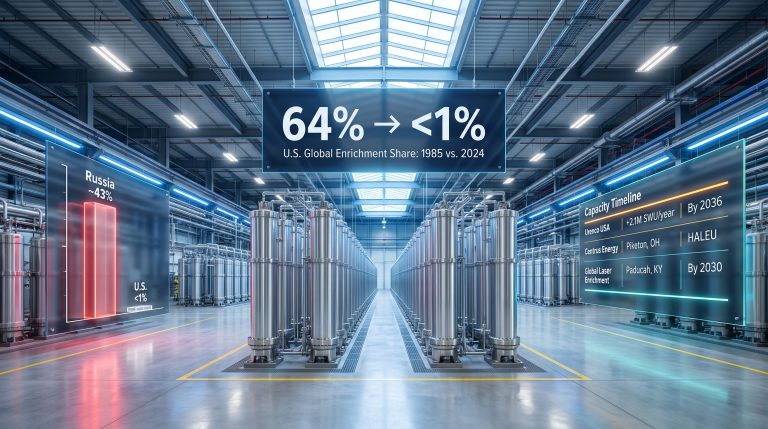
Russia is the dominant participant in both conversion and enrichment services globally. The price spike seen in these services following the invasion of Ukraine reflected utilities scrambling to secure alternative sources. The Russian uranium import ban, taking effect on January 1, 2028, creates a hard deadline for American utilities to complete their transition to Western supply chains.
Western enrichment capacity is expanding. Urenco is increasing capacity while replacing ageing infrastructure at its New Mexico facility. Orano is expanding French operations. Centrus is active in the US market. The most significant potential new entrant is Global Laser Enrichment, co-owned by Silex Systems and Cameco, which is targeting commercial production in the early 2030s using laser enrichment technology. Its initial commercial phase is expected to produce approximately 5 million pounds of uranium equivalent in UF6 by re-enriching depleted uranium tails material back to natural uranium grade, effectively functioning as both an enrichment and conversion capacity addition.
Europe's Nuclear Fleet and Climate-Driven Operational Challenges
River Cooling Dependency as a Seasonal Risk
A recurring operational challenge for Europe's inland nuclear fleet, particularly France's, involves reactor cooling systems that depend on river water. During periods of extreme heat and low river levels, regulators require capacity reductions or temporary shutdowns to avoid thermal impacts on river ecosystems. This phenomenon has recurred across multiple summers and intensified during recent heat waves.
The structural implication is not a reduction in uranium demand but a recognition that reactor siting decisions made decades ago carry environmental operating constraints that coastal facilities do not share. The longer-term solution proposed by some analysts involves pairing coastal nuclear plants with desalination infrastructure, simultaneously addressing water security concerns and eliminating river cooling dependencies. A small number of countries are already pursuing this model, though large-scale adoption remains a future pathway rather than current practice.
The Arrow Deposit and NextGen Energy's Global Significance
The World's Premier Undeveloped Uranium Asset
The Rook I project in Saskatchewan's Athabasca Basin, centred on the Arrow deposit controlled by NextGen Energy, is widely regarded as the highest-quality undeveloped uranium asset in the world by a substantial margin. The deposit's grade, scale, and jurisdictional positioning in one of the world's most established uranium mining regions make it unique.
NextGen has broken ground on the project, commencing construction after receiving its final permits. If development proceeds on the current schedule, first production is targeted for approximately 2031, placing the asset in production precisely during the window of maximum supply deficit. Reports indicate that BHP has been in discussions with NextGen as the company works to raise approximately one billion dollars in additional capital for the project.
BHP has also been staking ground near the Athabasca Basin in proximity to the Arrow deposit, a pattern that analysts interpret as strategic positioning for a longer commodity cycle rather than a purely opportunistic response to near-term price movements. Cameco's existing production assets face end-of-life timelines during the mid-to-late 2030s, creating a well-understood asset gap that Arrow's production could partially address.
The adjacent Patterson Corridor East discovery, still in early-stage delineation, has the potential to add multiple hundreds of millions of pounds of additional uranium resource to the broader Rook I project area, meaning Arrow's ultimate scale could be substantially larger than current resource estimates suggest.
Hyperscaler interest in offtake agreements from the Arrow project represents a genuinely new dynamic in uranium market structure. Technology companies with significant electricity demand and clean energy commitments are, for the first time, engaging directly with uranium production projects as potential fuel supply partners rather than simply purchasing electricity from nuclear plants.
Wyoming as a Uranium Jurisdiction
ISR Production and Social Licence Advantages
Wyoming hosts the majority of current and planned US in-situ recovery uranium production, with UR Energy and UEC both operating or developing ISR assets in the Wyoming Basin. The state's regulatory environment is consistently described as among the most supportive for uranium mining in the country, contrasting sharply with jurisdictions like New Mexico where legacy contamination from the 1970s and 1980s uranium boom has created lasting social licence challenges that complicate any new development effort.
New Mexico hosts some of the highest-grade conventional uranium deposits in the United States, yet the combination of environmental legacy issues and opposition from indigenous communities makes meaningful new production there highly unlikely without extraordinary incentive structures. Wyoming, by contrast, offers a streamlined regulatory pathway and broad community and state-level support.
The TerraPower Natrium reactor under construction in Kemmerer, replacing a former coal power plant, adds another dimension to Wyoming's emerging role as a nuclear energy state. First criticality is anticipated within three to four years, making it the only confirmed large reactor construction project in current US supply models.
How Investors Should Think About the Uranium Cycle
Focusing on the Right Time Horizon
The near-term supply deficit, while real, is less strategically important than the 2030 to 2035 delivery window that term market participants are actively pricing. Utilities are already substantially covered for uranium supply through 2028. The period where they face genuine exposure is precisely where the mine development timeline problem makes new supply mathematically impossible to deliver at scale.
Investor Framework: Uranium Market Signal Hierarchy
| Signal Type | What It Indicates | Investor Relevance |
|---|---|---|
| Long-term contract price | Utility forward coverage appetite | High – leads spot price |
| Spot price direction | Near-term physical availability | Medium – lags fundamentals |
| Trust/fund discount to NAV | Financial buyer sentiment | Medium – contrarian indicator |
| Utility contracting volume | Demand conviction for future periods | High – structural signal |
| New mine construction starts | Future supply pipeline | High – multi-year lead indicator |
The Seasonal Pattern and Cash Deployment Timing
Uranium equity markets historically exhibit a pattern of summer weakness followed by stronger performance in the autumn and early winter period. This seasonal pattern, while not guaranteed, provides a framework for understanding periods of elevated and reduced institutional activity. Building cash during periods of risk-off sentiment and deploying it ahead of typically stronger seasonal windows has historically been a disciplined approach for managing exposure in a cyclical commodity market.
The risk calculus for uranium investors is asymmetric in a specific way: being positioned too early carries the cost of waiting, while missing the price discovery moment that occurs when utilities begin finding the 2032 to 2035 supply cupboard genuinely empty carries the risk of being entirely on the wrong side of a structural repricing event. According to informed market participants, that discovery process is likely to play out within the next two to three years. Consequently, investors tracking the upcoming uranium supply crunch are already repositioning well ahead of that window.
Frequently Asked Questions: Uranium Supply Deficit in the Early 2030s
What Is Causing the Uranium Supply Deficit in the Early 2030s?
The uranium supply deficit in the early 2030s results from the intersection of accelerating reactor construction globally and the absence of sufficient new mine development to meet that demand. Because uranium mines require seven to twelve years to develop, projects not yet under construction today cannot contribute to supply before 2032 to 2035 at the earliest.
How Much Uranium Will the World Need by 2035?
The World Nuclear Association's reference case projects annual uranium demand approaching 197 million pounds by 2040, more than double current consumption. By 2035, demand is expected to be materially above current levels, driven primarily by the approximately 80 reactors currently under construction globally.
Which Countries Are Most Exposed to the Uranium Supply Shortage?
Countries with large and growing nuclear fleets but limited domestic uranium production face the greatest exposure. China, with 39 reactors under construction and minimal domestic uranium resources, is the most prominent example. The United States, with its 2028 ban on Russian uranium imports, faces a compressed timeline for diversifying its supply chain.
Will New Mines Be Built in Time to Prevent a Supply Crisis?
For mines to contribute to supply before 2033, construction would need to commence almost immediately. The number of projects globally at an advanced enough stage to meet this criterion is extremely limited. NextGen's Arrow deposit, targeting 2031 first production, is among the very few projects with a realistic pathway to supplying the critical early 2030s window.
Is the Uranium Market in Deficit Right Now in 2025?
Yes. Primary supply currently covers approximately 80% to 85% of annual demand, with the approximately 20-million-pound shortfall being met through inventory drawdowns and secondary supply sources. According to the World Nuclear Association, this structural shortfall is expected to persist and deepen without substantial new mine investment.
Key Takeaways: The Uranium Supply Deficit Timeline From 2025 to 2040
| Metric | Data Point |
|---|---|
| Current annual supply shortfall (2025) | ~20 million pounds |
| Long-term uranium price movement (past year) | $80 to $95.50/lb |
| Reactors currently under construction globally | ~80 |
| China reactors expected online within 5 years | ~39 |
| WNA projected annual demand by 2040 | ~197 million pounds |
| Projected nuclear capacity growth (next 5–6 years) | ~25% |
| US ban on Russian uranium imports effective date | January 1, 2028 |
| Primary supply coverage of current demand | ~74–90% |
The uranium market's structural story is not a short-term trade. It unfolds across three distinct phases: a tight market through the late 2020s where inventories are drawn down, a fragile balance in the early 2030s characterised by high execution risk and limited new supply, and a potential structural deficit in the mid-2030s if insufficient new mines are developed.
The next two to three years represent the critical window for price discovery, as utilities attempting to cover the early 2030s delivery period begin encountering the limits of what incumbent producers can offer. When that moment arrives, the price signal it generates is likely to be substantial.
This article contains forward-looking statements and projections based on publicly available data, industry forecasts, and market analysis. Uranium market conditions are subject to significant uncertainty. Readers should conduct their own due diligence and consult a qualified financial adviser before making any investment decisions. Past performance of commodity markets is not indicative of future results.
Readers seeking additional perspectives on uranium market mechanics and nuclear fuel cycle dynamics can explore VRIC Media's interview series on metals and mining via their YouTube channel, which covers physical market behaviour, utility contracting trends, and the investment implications of the developing supply deficit.
Want to Position Yourself Ahead of the Next Major Uranium Discovery?
Discovery Alert's proprietary Discovery IQ model delivers real-time alerts the moment significant mineral discoveries hit the ASX, cutting through complex data to surface actionable opportunities in uranium and beyond — precisely the kind of early intelligence that matters most when supply cycles are tightening. Explore how historic mineral discoveries have generated extraordinary returns and begin your 14-day free trial today to ensure you're positioned before the market catches up.