August 22, 2026
The Hidden Bottleneck That Could Define the Nuclear Renaissance
Before a single concrete pour begins on a new reactor, before grid operators pencil in baseload projections, and long before the first kilowatt-hour flows to an energy-hungry data centre, a quieter and far less glamorous problem must be solved: where does the fuel come from? The global nuclear industry stands at an inflection point driven by electrification, decarbonisation targets, and the insatiable power appetite of artificial intelligence infrastructure. Yet the conversation consistently gravitates toward reactor counts and construction timelines while the upstream fuel cycle receives a fraction of the strategic attention it deserves.
This gap between ambition and operational readiness is precisely the dynamic that makes Cameco AP1000 deployment and nuclear fuel supply such a consequential topic for investors, policymakers, and utilities navigating the next decade of energy infrastructure. Furthermore, understanding the uranium supply-demand volatility that underpins these decisions is increasingly essential for anyone with exposure to the sector.
When big ASX news breaks, our subscribers know first
Vertical Integration as a Strategic Moat
Why Owning the Reactor and the Fuel Cycle Changes the Calculus
Most energy companies operate within a defined segment of the value chain. Cameco's co-ownership of Westinghouse, secured alongside Brookfield Renewable Partners approximately two and a half years ago, represents something structurally different: a deliberate attempt to collapse the distance between reactor deployment and nuclear fuel supply into a single integrated commercial strategy.
The logic is straightforward but powerful. By participating in the construction and licensing of AP1000 reactors, Cameco effectively engineers its own long-term demand for uranium and uranium hexafluoride (UF₆) conversion services. Every new AP1000 unit that enters operation requires a continuous, decades-long supply of nuclear fuel. When the company building the reactor is also one of the world's largest uranium producers, the supply chain dynamic becomes fundamentally different from traditional arm's-length procurement relationships.
Industry observers note that this vertically integrated positioning is rare in the nuclear sector, where reactor vendors, uranium miners, and conversion facilities have historically operated as separate commercial entities with competing interests and fragmented contracting timelines.
The commercial rationale extends beyond simple volume. Long-term fuel contracts reduce revenue volatility, provide utilities with supply certainty, and give Cameco a defensible contracted backlog that insulates the business from short-term uranium spot price fluctuations. In addition, the broader uranium market dynamics at play in 2025 make this kind of integrated positioning increasingly attractive to institutional investors.
Cameco's Contracted Position: Scale That Matters
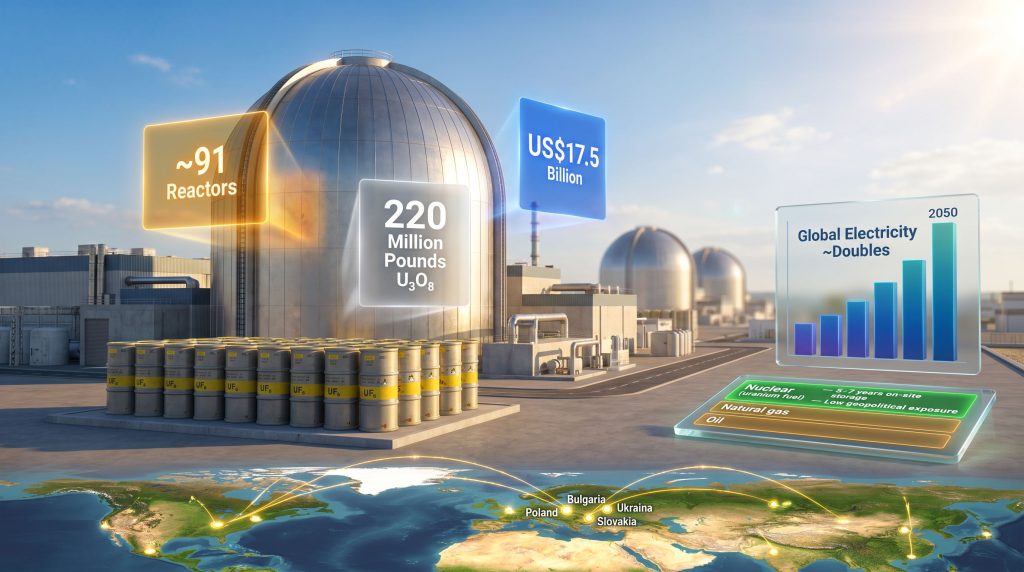
The depth of Cameco's current contracted position reflects the scale of this integrated strategy. The company holds executed supply agreements covering approximately 220 million pounds of U₃O₈ and roughly 85 million kilograms of UF₆ conversion services, with utility counterparties spanning 16 countries. Recent long-term agreements, including UF₆ supply arrangements with Slovakia through 2036 and Ukraine through 2035, illustrate how fuel-cycle contracting is increasingly being treated as a critical infrastructure decision rather than a commodity purchasing exercise.
These contracts matter for a reason that is often underappreciated outside specialist circles: uranium fuel procurement is not a spot-market activity that utilities can manage reactively. The enrichment, conversion, and fabrication steps that sit between raw uranium and reactor-ready fuel assemblies involve lead times measured in years, not weeks. Treating fuel supply as a long-lead capital decision, comparable in urgency to ordering long-lead reactor components, is the operating philosophy that Cameco is actively promoting across the utility sector.
The AP1000 Pipeline: Understanding the Scale of Westinghouse's Opportunity
A 91-Reactor Global Opportunity
Westinghouse's AP1000 is a Generation III+ pressurised water reactor design with a track record of operational deployment in China and a growing queue of prospective builds across multiple continents. The global pipeline of potential AP1000 deployments has been identified at approximately 91 reactors, a figure that encompasses projects at various stages of planning, feasibility, and regulatory engagement.
To contextualise that number: a single large AP1000 unit requires roughly 200 to 250 tonnes of uranium per year across its operational life, depending on fuel enrichment levels and capacity factors. A fleet of 91 units would represent annual uranium demand of approximately 18,000 to 22,000 tonnes, an increment that would meaningfully reshape global uranium supply-demand balances if realised over the next two to three decades.
The U.S. Federal Financing Architecture
In the United States, the Department of Energy has structured a conditional financing commitment of up to US$17.5 billion directed at supporting the construction of new AP1000 units. The financing model is structured through a Westinghouse Special Purpose Vehicle (SPV), with individual project vehicles designed around pairs of reactors. This pairing approach is not incidental. It is engineered to compress procurement timelines for long-lead components by aggregating demand, enabling bulk purchasing of forgings, pressure vessels, and other critical items that face global supply constraints.
The U.S. administration has set an ambitious near-term target: 10 new AP1000 units initiated within a compressed timeframe, alongside a longer-range ambition of 400 new reactors by 2050. Whether these figures represent firm commitments or aspirational targets, they signal a level of political prioritisation for nuclear energy not seen in the United States since the 1970s.
Separately, a framework agreement through the U.S. Department of Commerce has been structured around a US$80 billion partnership covering Westinghouse reactor deployment, supply chain development, and associated nuclear infrastructure. This framework spans multiple partner countries and is intended to support the commercial pipeline beyond U.S. borders.
Fleet Deployment vs. One-Off Projects: The Lessons of History
| Deployment Model | Cost Predictability | Construction Timeline | Supply Chain Efficiency |
|---|---|---|---|
| One-off bespoke projects | Low | Highly variable | Fragmented |
| Standardised fleet rollout | High | Compressed via learning curve | Consolidated and scalable |
| AP1000 fleet (Westinghouse model) | High (Gen III+ proven design) | Accelerated with SPV financing | Vertically integrated |
The nuclear industry's difficult history with cost overruns and schedule delays is almost entirely concentrated in one-off, bespoke projects built without supply chain continuity or construction learning curves. The fleet deployment concept is fundamentally different. By standardising the design, simplifying the regulatory and construction process, and sequencing builds so that each successive unit benefits from lessons learned on the prior one, the AP1000 model attempts to replicate the manufacturing discipline that made commercial aviation and semiconductor fabrication scalable industries.
Cameco's internal philosophy on this point is explicit: the successful formula for nuclear buildout requires standardisation, simplification, and sequencing, applied in that order and maintained consistently across every project in the fleet.
Where AP1000 Deployment Is Gaining Traction
North America: The Near-Term Epicentre
The North American pipeline for AP1000 deployment encompasses multiple jurisdictions at different stages of advancement:
- United States: Presidential-level targets calling for 10 new AP1000 units initiated within a near-term window, with a long-range ambition of 400 new reactors by 2050
- Ontario, Canada: Both Bruce Power and Ontario Power Generation (OPG) are actively advancing discussions around new nuclear capacity, with publicly stated commitments to expanding generation
- Saskatchewan, Canada: Cameco's home province is exploring new nuclear build programmes, adding a degree of domestic policy alignment to the company's supply chain strategy
- Alberta, Canada: The neighbouring province is similarly engaged in preliminary discussions around new nuclear generation as part of its long-term electricity planning
Eastern Europe: A Strategic Beachhead
Beyond North America, Eastern Europe represents one of the most strategically significant regions for AP1000 adoption. Countries including Poland and Bulgaria have entered into formal engagement with Westinghouse for new reactor construction. The broader Central-Eastern European region, historically dependent on Soviet-era VVER reactor technology and pipeline gas, is actively diversifying toward Western reactor designs as both an energy security measure and a geopolitical statement of alignment.
Poland's nuclear programme, in particular, represents one of the most advanced non-US AP1000 pipelines outside of Asia, with site selection, environmental assessment, and intergovernmental agreements progressing in parallel. Notably, the ban on Russian uranium imports has accelerated this shift across the region, prompting utilities to seek long-term supply relationships with Western producers. The associated Ukraine uranium strategy further illustrates how geopolitical realignment is reshaping nuclear fuel procurement at a sovereign level.
Nuclear Fuel Supply: The Bottleneck Nobody Is Talking About Loudly Enough
The Conversion and Enrichment Problem
Uranium mining is the most visible part of the nuclear fuel cycle, but it is not the only potential constraint. The fuel cycle involves a sequence of interdependent industrial steps:
- Mining and milling to produce uranium concentrate (U₃O₈)
- Conversion to uranium hexafluoride (UF₆)
- Enrichment to increase the concentration of fissile U-235
- Fuel fabrication into reactor-ready assemblies
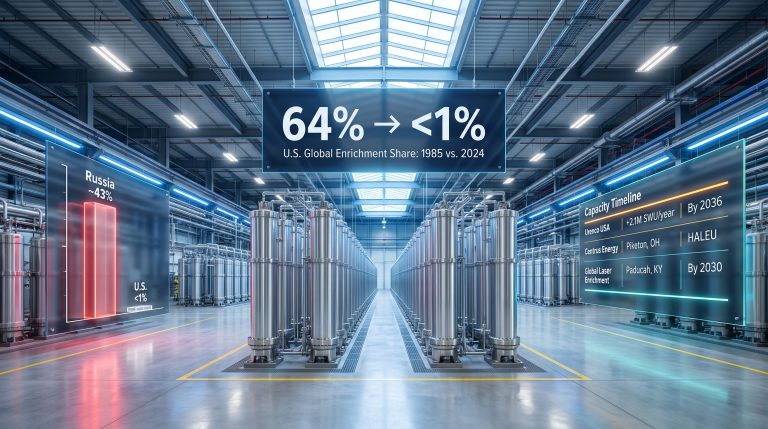
Global conversion capacity has been running at near-full utilisation for several years, and enrichment capacity, dominated by a small number of facilities in Europe, Russia, and the United States, represents a genuine chokepoint. Russia's Rosatom controls a significant share of global enrichment capacity, a dependency that Western utilities are only now beginning to address through long-term contracts with alternative suppliers and policy-driven investment in domestic enrichment infrastructure.
The oft-overlooked reality is that even if uranium mining capacity expands rapidly, conversion and enrichment bottlenecks could delay fuel availability for new reactors by years, making early contracting not just prudent but operationally necessary.
However, the uranium supply challenges extending into the mid-2030s suggest that the window for securing advantageous long-term contracts may be narrowing faster than many utilities appreciate.
The 2050 Electricity Doubling Scenario
Independent energy modelling projections consistently point toward a scenario where global electricity consumption must approximately double by 2050 to support the electrification of transport, industrial heat processes, and the exponentially growing power demands of AI-driven data infrastructure. Nuclear energy, as a firm, baseload, low-carbon generation source, is structurally well-positioned to serve this demand in ways that intermittent renewables cannot replicate without massive storage investment.
The uranium supply implications of this trajectory are significant. Current global uranium production sits well below the level required to fuel a materially expanded reactor fleet, meaning that new mine development, restarts of idled capacity, and long-term contracting must begin now to avoid supply gaps in the 2030s and beyond.
Energy Security: Nuclear's Underappreciated Strategic Advantage
The Five-to-Seven Year Fuel Stockpile Advantage
| Energy Source | Typical Supply Lead Time | On-Site Storage Capacity | Geopolitical Exposure |
|---|---|---|---|
| Natural gas | Continuous pipeline dependency | Minimal | High (pipeline/LNG routes) |
| Oil | Weeks to months | Limited | High (shipping lanes) |
| Nuclear (uranium fuel) | Years (long-term contracts) | 5 to 7 years on-site | Low (once contracted) |
One of nuclear energy's least-discussed strategic advantages is the physical nature of its fuel. Unlike natural gas, which must flow continuously through pipelines or arrive via LNG tankers navigating geopolitically sensitive shipping routes, nuclear fuel can be stockpiled at the reactor site. A typical nuclear plant can maintain five to seven years of operational fuel inventory on-site, creating a buffer against supply disruption that no fossil fuel technology can replicate.
This characteristic transforms nuclear energy from a purely economic decision into a national security asset, particularly for countries that have historically depended on imported gas or have geographic exposure to pipeline disruption. For Eastern European nations navigating post-2022 energy realities, this attribute alone is a compelling argument for new nuclear construction.
The next major ASX story will hit our subscribers first
From Ambition to Action: What Must Happen Next
The Three Structural Bottlenecks
Converting declared nuclear ambition into commissioned reactor capacity requires simultaneous progress across three structural constraints that cannot be resolved sequentially:
- Permitting and regulatory reform: Streamlining licensing timelines without compromising safety standards is essential for compressing the gap between project announcement and construction commencement
- Supply chain investment: Reactor component manufacturing, particularly pressure vessels, steam generators, and reactor coolant pumps, involves long fabrication timelines and a limited global supplier base that must expand ahead of demand
- Financing architecture: Nuclear projects require patient, long-duration capital that is not readily available from conventional project finance markets without government risk-sharing frameworks or credit enhancement mechanisms
No single lever is sufficient in isolation. The transition from nuclear ambition to operational capacity requires all three constraints to be addressed in parallel, with coordination across governments, utilities, reactor vendors, and fuel-cycle suppliers.
The Industry Leadership Imperative
The gap between policy declarations and shovel-ready projects in the nuclear sector is historically wide. Bridging that gap requires industry participants to move beyond symposium presentations and bilateral agreements into the harder work of long-term fuel contracting, supply chain investment commitments, and regulatory pre-engagement.
For Cameco, the message to the broader market is clear: Cameco AP1000 deployment and nuclear fuel supply must be treated as inseparable strategic priorities, not sequential commercial decisions. Utilities that fail to contract fuel supply early risk finding themselves in a tightening market competing for conversion and enrichment services that were not built in anticipation of their demand.
Frequently Asked Questions: Cameco, AP1000 Reactors, and Nuclear Fuel Supply
What is the AP1000 reactor and why is it considered construction-ready?
The AP1000 is a Generation III+ pressurised water reactor designed by Westinghouse with passive safety systems that rely on gravity and natural circulation rather than active pumping systems. It has been commercially deployed in China and has a standardised design that simplifies regulatory licensing in countries that have adopted it as a reference design.
How does Cameco's ownership stake in Westinghouse affect its uranium business?
Co-ownership of Westinghouse allows Cameco to participate in reactor deployment commercially while simultaneously creating long-term captive demand for its uranium and UF₆ conversion products. Each AP1000 unit built by Westinghouse represents decades of potential fuel supply demand.
What is the DOE's US$17.5 billion financing commitment and who qualifies?
The U.S. Department of Energy's conditional financing commitment of up to US$17.5 billion is structured to support the construction of up to 10 new AP1000 units in the United States. It operates through a Special Purpose Vehicle model, with individual financing vehicles designed around pairs of reactors.
How many AP1000 reactors are currently in Westinghouse's global deployment pipeline?
Westinghouse has identified approximately 91 potential AP1000 reactor deployments globally, spanning North America, Europe, and other regions at varying stages of planning and regulatory engagement.
Why is uranium fuel procurement described as a long-lead item for new nuclear projects?
The nuclear fuel cycle involves multiple industrial conversion steps, each with significant lead times. From uranium mining through conversion, enrichment, and fuel fabrication, the process from contracting to fuel delivery can span several years, making early procurement decisions operationally critical for new reactor projects.
Which countries are leading AP1000 adoption outside of the United States?
Poland and Bulgaria represent the most advanced European AP1000 programmes, alongside existing deployments in China. Canada, through Ontario and western provinces, also represents a significant near-term opportunity.
How does nuclear energy contribute to energy security compared to fossil fuel alternatives?
Nuclear plants can store five to seven years of operational fuel on-site, eliminating continuous pipeline or shipping dependencies. This structural characteristic provides a level of supply security that oil and gas cannot match, particularly in geopolitically exposed regions.
Key Takeaways: The Investment and Policy Significance of the AP1000 Buildout
| Theme | Key Metric or Insight |
|---|---|
| Global AP1000 pipeline | Approximately 91 potential reactors identified globally |
| U.S. DOE financing | Up to US$17.5B conditional commitment for up to 10 U.S. AP1000 units |
| Commerce Department partnership | US$80B+ framework for Westinghouse reactor deployment and supply chain |
| Cameco contracted U₃O₈ | Approximately 220 million pounds across 16 countries |
| Cameco contracted UF₆ | Approximately 85 million kg of conversion services |
| Electricity demand outlook | Global consumption projected to approximately double by 2050 |
| On-site fuel storage advantage | 5 to 7 years of fuel can be stored at nuclear plant sites |
| Key contracting examples | Slovakia through 2036, Ukraine through 2035 |
This article is intended for informational purposes only and does not constitute financial or investment advice. Forward-looking statements regarding reactor deployment timelines, uranium demand projections, and electricity consumption forecasts involve inherent uncertainty and should not be relied upon as guarantees of future outcomes. Readers should conduct independent research and consult qualified advisers before making investment decisions.
Further context on global nuclear energy expansion is available through the World Nuclear Association at world-nuclear.org and through proceedings from World Nuclear Symposium 2026, held in London from 9 to 11 September 2026 under the theme From Ambition to Action.
Want to Be First When the Next Major Uranium Discovery Hits the ASX?
Discovery Alert's proprietary Discovery IQ model scans ASX announcements in real time, delivering instant alerts on significant uranium and nuclear fuel discoveries so investors can act ahead of the broader market — explore historic mineral discovery returns to see what early positioning can mean, then start your 14-day free trial to secure your edge as the global nuclear buildout accelerates demand for Australian uranium assets.