August 21, 2026
The Quiet Revolution in American Uranium: Why Hub-and-Spoke ISR Is Rewriting the Production Playbook
For most of the past two decades, domestic uranium production in the United States has struggled to keep pace with the fuel demands of the country's commercial reactor fleet. The structural gap between what American mines produce and what American reactors consume has historically been filled by imports, often sourced from geopolitically sensitive regions. Against that backdrop, the Ur-Energy Shirley Basin uranium shipment completed on August 19, 2026, is one such milestone, and understanding its full implications requires looking past the headline and into the mechanics of modern ISR mining, multi-asset production strategy, and the structural economics of domestic uranium supply.
When big ASX news breaks, our subscribers know first
What ISR Mining Actually Involves and Why the Method Matters
How the Underground Chemistry Works
In-situ recovery, sometimes called in-situ leaching or ISL, is fundamentally different from conventional uranium mining. Rather than physically excavating rock or ore, ISR operators engineer a controlled chemical reaction underground. A leaching solution, typically a mildly alkaline or acidic fluid depending on the ore body chemistry, is injected into the uranium-bearing formation through a network of injection wells.
As the solution migrates through the permeable sandstone host rock, it dissolves uranium from the mineral matrix. The resulting uranium-laden fluid is then extracted via recovery wells drilled into the same formation, brought to the surface, and processed. The in-situ leaching benefits extend well beyond operational cost savings, encompassing measurable reductions in surface disturbance and waste generation.
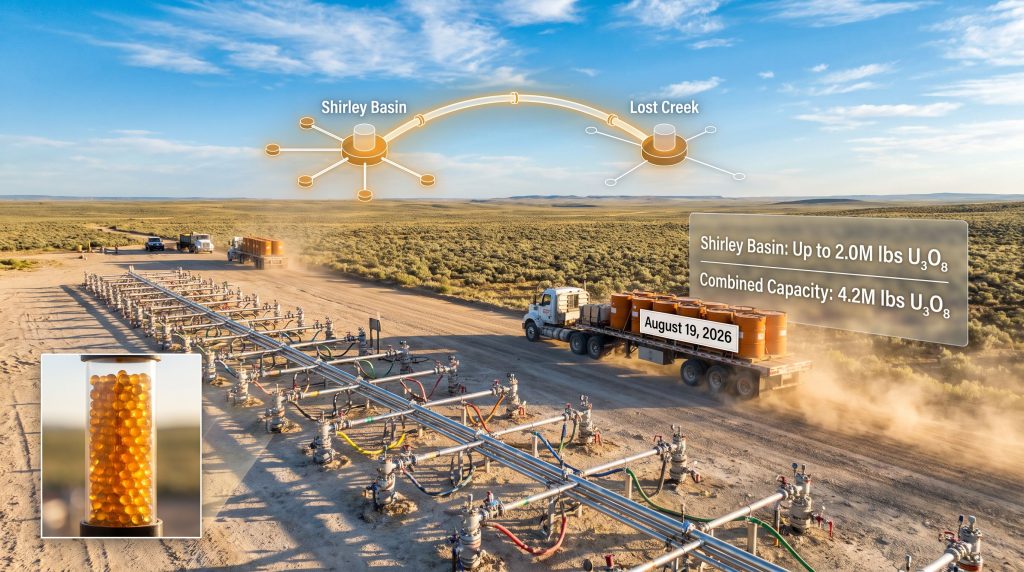
At Shirley Basin, the uranium is captured on ion exchange resin at the surface facility. This resin selectively binds uranium ions from the solution, concentrating the material before it is shipped to the Lost Creek processing hub for final drying and packaging into uranium oxide, commonly written as U₃O₈.
Why ISR Dominates U.S. Uranium Output
The geological conditions of Wyoming's uranium deposits, particularly the roll-front sandstone deposits that characterise the Shirley Basin and Lost Creek mineralisation, are well suited to ISR extraction. These ore bodies are porous, permeable, and typically hosted in aquifers that allow efficient fluid circulation. From an environmental and economic standpoint, ISR offers distinct advantages over open-pit or underground mining:
- No large-scale surface excavation or waste rock stockpiles
- Lower capital intensity for initial mine construction
- Smaller surface disturbance footprint
- Faster path from permitting to production relative to conventional methods
- Lower operating costs per pound of uranium recovered in favourable geology
Furthermore, these characteristics have made ISR the dominant production method for U.S. ISR uranium production, with Wyoming serving as one of the most prolific ISR uranium-producing states in the country.
The Hub-and-Spoke Architecture: Capital Efficiency as Competitive Moat
How the Model Redistributes Infrastructure Costs
The hub-and-spoke production framework that underpins Ur-Energy's Wyoming operations represents a meaningful evolution in how ISR uranium projects are developed and financed. Rather than constructing full processing infrastructure at every wellfield, the model concentrates the capital-intensive processing equipment at a single hub — in this case the Lost Creek facility — and uses satellite wellfield operations to feed uranium-loaded resin to that centralised plant.
Shirley Basin functions precisely as this type of satellite. Mining and ion exchange operations occur at the Shirley Basin site, but the resin containing captured uranium is transported by road to Lost Creek for the final processing stages. This arrangement eliminates the need to replicate dryers, packaging systems, and associated infrastructure at each new mine site, substantially reducing the capital required to bring each incremental wellfield into production.
| Feature | Traditional Standalone Mine | Hub-and-Spoke ISR Model |
|---|---|---|
| Processing Infrastructure | Required at each site | Centralised at hub (Lost Creek) |
| Capital Expenditure | High per site | Reduced through shared facilities |
| Scalability | Limited by site-specific build-out | Accelerated via satellite expansion |
| Regulatory Complexity | Full permitting per site | Streamlined for satellite operations |
| Operational Flexibility | Lower | Higher, multiple feed sources |
Scalability as a Strategic Asset
One of the less-discussed advantages of the hub-and-spoke structure is how it changes the growth calculus for uranium producers. Once the hub processing facility is built and its capacity established, adding production volume through satellite wellfields becomes proportionally cheaper. The fixed costs of processing infrastructure are spread across more pounds of uranium output, improving unit economics at scale.
For investors evaluating uranium producers, this means that a company operating this architecture has a structurally lower cost to grow than a comparable operator building standalone mines.
Satellite mine integration also reduces single-site operational risk. If one wellfield underperforms due to geological variability or requires maintenance, other feed sources can sustain hub throughput without catastrophic production loss.
Licensed Capacity, Regulatory Milestones, and the Shirley Basin Timeline
Understanding the Numbers Behind the Project
The licensed production figures attached to Shirley Basin and Lost Creek are worth examining carefully, as they define the theoretical upper boundary of what this combined operation can produce.
Capacity Snapshot:
- Shirley Basin licensed wellfield and toll processing capacity: Up to 2.0 million pounds U₃O₈ (approximately 769 tU) equivalent
- Combined Lost Creek and Shirley Basin annual licensed capacity: 4.2 million pounds U₃O₈
- Mining operations commenced at Shirley Basin: April 2026
- Wyoming DEQ final authorisation to advance to full operations: Late June 2026
- First uranium resin shipment to Lost Creek: August 19, 2026
- Current status: Ramping up toward full production
It is important to note that licensed capacity represents a regulatory ceiling, not a guaranteed production outcome. Actual output will depend on wellfield performance, uranium concentration in the formation, operational ramp-up pace, and prevailing market conditions influencing production decisions.
The Regulatory Role of Wyoming DEQ
The Wyoming Department of Environmental Quality plays a central role in authorising ISR uranium operations within the state. For Shirley Basin, the final DEQ authorisation to advance to full operations, issued in late June 2026, was a prerequisite before the first commercial shipment could occur. This milestone-based regulatory structure is characteristic of Wyoming's approach to uranium mining oversight.
This staged approval process, while adding lead time, also provides a degree of regulatory credibility to operations that successfully navigate it. The approximately two-and-a-half-year timeline from construction decision to first shipment reflects both the efficiency of the project team and the relative maturity of the ISR permitting framework in Wyoming compared to other mining methods and jurisdictions. World Nuclear News reported that mining operations at the Wyoming project marked a significant step forward for domestic supply.
Shirley Basin's Development Timeline at a Glance
- Construction decision made: Approximately early 2024
- Mining operations commenced: April 2026
- Wyoming DEQ final authorisation received: Late June 2026
- First uranium resin shipment to Lost Creek: August 19, 2026
- Current phase: Production ramp-up underway
What This Means for U.S. Domestic Uranium Supply Resilience
The Import Dependency Problem in Context
Total U.S. uranium consumption by the domestic reactor fleet has historically run well ahead of domestic mine production. American utilities have routinely sourced the majority of their uranium requirements from international suppliers, including producers in Kazakhstan, Canada, Australia, and Russia. The structural reliance on foreign uranium supply has become an increasingly scrutinised issue as nuclear energy's role in decarbonisation and energy security discussions has grown more prominent.
Against this backdrop, the U.S. uranium production rebound is gaining momentum as the operational activation of Shirley Basin and its integration into a multi-asset Wyoming production network carries weight beyond any single shipment. Each additional pound of domestically produced U₃O₈ that enters the supply chain represents a marginal reduction in import dependency.
| Metric | Significance |
|---|---|
| U.S. uranium import dependency | Historically, domestic production covers a fraction of reactor demand |
| ISR share of U.S. uranium output | Dominant production method for domestic in-situ operations |
| Wyoming's regulatory environment | State-level DEQ oversight enables milestone-based, structured approvals |
| Multi-asset producer advantage | Diversified production base reduces single-site operational risk |
Wyoming's Geological and Regulatory Advantages
Wyoming has long been the centre of gravity for U.S. uranium production, and for good reason. The state hosts extensive roll-front uranium deposits in Eocene-age sandstone formations, which represent some of the most amenable geology for ISR extraction in North America. The mineralisation at both Lost Creek and Shirley Basin is characteristic of these formation types, offering the permeability and grade profiles that make ISR operations economically viable.
From a regulatory standpoint, Wyoming has developed a mature framework for ISR uranium project oversight. State-level environmental authorities, including the DEQ, have accumulated substantial technical experience with these operations over multiple decades. This institutional knowledge creates a more predictable permitting environment compared to states or jurisdictions where ISR uranium mining is novel.
The Multi-Asset Transition: What Changes Operationally
Becoming a multi-asset uranium producer is not simply a matter of corporate branding. The operational implications are substantive. Running two wellfields feeding a single hub requires more sophisticated logistics management, more complex wellfield monitoring, and tighter coordination between site-level operations and central processing. At the same time, it creates redundancy that single-site operators lack entirely.
If Lost Creek's wellfields were to encounter geological heterogeneity or require workover, Shirley Basin resin could sustain hub throughput. Conversely, if Shirley Basin's ramp-up pace is slower than anticipated, Lost Creek's established production provides a baseline. This operational resilience is a meaningful qualitative improvement in the company's production risk profile.
Investor Considerations and Production Outlook
Ramp-Up Dynamics and What Full Production Actually Requires
The transition from first shipment to full production at Shirley Basin is not instantaneous. ISR wellfields typically undergo a ramp-up period during which operators expand the number of active wellfield patterns, optimise injection and recovery flow rates, and monitor uranium concentration in the pregnant leach solution. The pace of this ramp-up is influenced by:
- The number of wellfield header houses brought online sequentially
- Formation permeability and uranium grade distribution across the ore body
- Ion exchange resin cycling frequency and resin elution efficiency at the hub
- Regulatory compliance monitoring requirements during the ramp-up phase
For investors, the pace of Shirley Basin's ramp-up over the quarters following August 2026 will be a critical variable in assessing how quickly the combined 4.2 million pound annual licensed capacity translates into actual production guidance and, ultimately, revenue. Understanding broader uranium market dynamics is equally important when evaluating how this output will be absorbed by the market.
A Scenario Framework for Combined Capacity Utilisation
Scenario Analysis: If both Lost Creek and Shirley Basin were to operate at or near their combined licensed capacity of 4.2 million pounds U₃O₈ annually, the output would represent a material contribution to total U.S. domestic uranium supply. Given that U.S. uranium mine production has in recent years accounted for only a small fraction of the approximately 40 to 50 million pounds U₃O₈ annually consumed by domestic reactors, even partial utilisation of this combined capacity at sustained levels would be consequential.
Full utilisation would require stable wellfield performance, continued regulatory compliance, and uranium price conditions that support maximum production rates. This scenario analysis is speculative and should not be interpreted as production guidance.
The Hub-and-Spoke Model as a Blueprint for Future Growth
Perhaps the most strategically significant aspect of the Ur-Energy Shirley Basin uranium shipment is what it demonstrates about scalability. If additional Wyoming uranium deposits can be developed as future satellite wellfields connected to the Lost Creek hub, the incremental cost of each new pound of licensed capacity decreases relative to the original hub construction. This creates a compounding capital efficiency dynamic that could underpin a longer-term production growth trajectory extending well beyond the current two-site configuration.
The operational validation of the hub-and-spoke model at Shirley Basin effectively de-risks this blueprint for future satellite development. Furthermore, consideration of global uranium reserves distribution suggests that Wyoming's roll-front deposits remain among the most accessible and economically viable for ISR expansion, providing a tested framework that regulators, investors, and operators can evaluate with greater confidence.
The next major ASX story will hit our subscribers first
Frequently Asked Questions: Ur-Energy Shirley Basin Uranium Shipment
What is the Shirley Basin uranium project?
Shirley Basin is an in-situ recovery uranium mining operation located in Wyoming, USA. It functions as a satellite wellfield integrated with Ur-Energy's Lost Creek processing hub, where uranium captured on ion exchange resin is transported for final processing, drying, and packaging into U₃O₈.
When did the first shipment from Shirley Basin occur?
The first uranium resin shipment from Shirley Basin to the Lost Creek processing facility was completed on August 19, 2026, following final regulatory authorisation from the Wyoming Department of Environmental Quality in late June 2026.
What is Shirley Basin's licensed production capacity?
Shirley Basin holds a licensed wellfield and toll processing capacity of up to 2.0 million pounds U₃O₈ (approximately 769 tU) equivalent. Combined with Lost Creek, the two Wyoming operations carry a total annual licensed production and toll-processing capacity of 4.2 million pounds U₃O₈.
How long did it take Shirley Basin to move from construction decision to first production?
Shirley Basin progressed from construction decision to first resin shipment in approximately two and a half years, encompassing permitting, wellfield construction, regulatory authorisation milestones, and operational startup activities.
What does toll processing mean in this context?
Toll processing refers to the arrangement by which uranium from a third-party wellfield, or a satellite operation, is processed through an existing facility for a fee or under a shared ownership structure. In this case, Shirley Basin resin is processed through the Lost Creek plant, which holds the licensed capacity to handle material from both sites.
This article contains forward-looking information regarding production capacity, ramp-up timelines, and scenario analysis. Such information involves known and unknown risks, including geological variability, regulatory outcomes, and commodity price fluctuations. Nothing in this article constitutes financial advice. Readers should conduct their own due diligence and consult a qualified financial adviser before making investment decisions.
Want to Stay Ahead of Significant Uranium and Mineral Discoveries on the ASX?
Discovery Alert's proprietary Discovery IQ model delivers real-time alerts the moment significant ASX mineral discoveries are announced, instantly transforming complex data across 30+ commodities into clear, actionable investment insights — explore historic discovery returns on Discovery Alert's dedicated discoveries page to see what early positioning in major resource discoveries has meant for investors, and begin a 14-day free trial to secure your market-leading edge.