August 19, 2026
The Heap-Leach Advantage: Why Flowsheet Choice Shapes Everything at Muntanga
In uranium project development, the choice of processing flowsheet is rarely just a technical decision. It is a capital allocation decision, a financing decision, and ultimately a question of whether a project can survive the long journey from resource to production without exhausting its equity base. The distinction between heap-leach processing and conventional milling circuits is not cosmetic. It separates projects that can grow their resource base without proportional capital escalation from those that face punishing infrastructure demands at every incremental tonne of throughput. Understanding this dynamic is the starting point for any serious evaluation of the Atomic Eagle Muntanga Uranium Project in Zambia.
When big ASX news breaks, our subscribers know first
What the Muntanga Resource Base Actually Represents
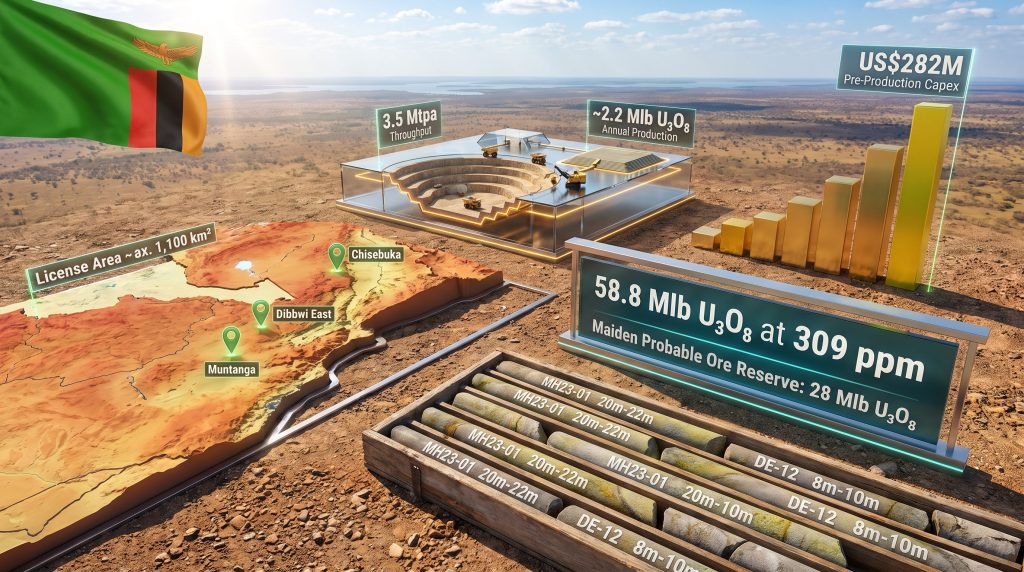
The Atomic Eagle Muntanga Uranium Project in Zambia covers approximately 1,100 to 1,136 square kilometres across the Siavonga and Chirundu districts, roughly 200 kilometres south of Lusaka near Lake Kariba. The project is 100% owned by Atomic Eagle Limited (ASX: AEU | OTCQX: AEUXF) and hosts multiple uranium deposits within Karoo sedimentary sandstone formations that extend into geological continuity with uranium systems across the regional border.
The March 2026 mineral resource estimate established the following resource position:
| Resource Category | Quantity | Grade |
|---|---|---|
| Measured + Indicated | 40.0 Mlb U₃O₈ | Included in total |
| Inferred | 18.8 Mlb U₃O₈ | Included in total |
| Total Resource | 58.8 Mlb U₃O₈ | 309 ppm average |
| Maiden Probable Ore Reserve | 39.6 Mt | 320 ppm (28 Mlb U₃O₈) |
What distinguishes this resource from many African-hosted uranium assets is its progression through formal study work. The 2025 Feasibility Study underpins a 12-year operating life at 3.5 million tonnes per annum throughput, targeting annual production of approximately 2.2 million pounds U₃O₈, with a pre-production capital cost of US$282 million. That capital figure is built around an open-pit truck-and-shovel mining operation feeding a heap-leach processing circuit, not a conventional mill.
The multi-deposit architecture spans several targets across the licence package:
| Deposit / Target | Mineralization Style | Status |
|---|---|---|
| Muntanga | Karoo sandstone-hosted | Resource defined, feasibility-level |
| Dibbwi East | Karoo sandstone-hosted | Resource defined |
| Chisebuka | Karoo sandstone-hosted | Active resource expansion (2026 RC program) |
| Muntanga North | Karoo sandstone-hosted | Exploration target |
| Namakande | Karoo sandstone-hosted | Exploration target |
| Sitwe | Basement-hosted (Athabasca-style analogue) | Early-stage, option structure |
Why Heap-Leach Processing Is a Structural Advantage, Not Just a Cost Saving
Heap-leach uranium processing eliminates the most capital-intensive components of conventional uranium milling: tank leaching circuits, solvent extraction plants, and the associated civil and electrical infrastructure. At Muntanga and Dibbwi East, metallurgical testwork completed ahead of the 2025 Feasibility Study demonstrated uranium recoveries exceeding 90%, with the additional advantage of low acid consumption. Both characteristics reinforce the economic logic of the chosen flowsheet.
Furthermore, the more strategically significant implication involves how heap-leach economics behave as resource scale increases. In conventional milling operations, throughput expansion typically requires near-linear capital additions. Heap-leach systems, by contrast, benefit from sub-linear capital scaling at greater throughput because pad infrastructure, solution management, and processing plant components can often be expanded incrementally rather than replaced wholesale.
Bannerman Energy Limited's Etango project in Namibia has been cited in this context as a reference case for what sub-linear capital scaling looks like in practice, with a project more than twice the production scale of the current Muntanga feasibility case carrying a capital cost only marginally higher on a per-pound basis. That comparison is management's own framing at this stage, not an independently modelled outcome for Muntanga specifically, and any updated capital estimate incorporating expanded resource inputs would require a formal study update to validate.
Investor caution: The capital intensity thesis for an expanded Muntanga operation remains unvalidated by independent study work. The logic of heap-leach sub-linear scaling is well-supported by industry precedent, but its application to Muntanga's specific geology, strip ratios, and infrastructure requirements has not yet been quantified in a formal pre-feasibility or feasibility context incorporating Chisebuka resource additions.
Chisebuka: Resource Growth With a Processing Question Still Open
Chisebuka is responsible for the majority of Atomic Eagle's 2026 resource growth and represents the most consequential near-term technical variable in the Muntanga story. The target sits within the same Karoo sandstone host units as the Muntanga and Dibbwi East deposits, which provides the geological basis for management's expectation that metallurgical performance will be comparable. Specifically, the shared host rock characteristics, including sandstone permeability, uranium mineralogy, and acid amenability, are the foundation for that expectation.
However, no metallurgical testwork has been conducted at Chisebuka as of mid-2026. The confidence in recovery performance rests on geological analogy rather than direct testwork data. A 12-hole reverse circulation program has commenced at the target, with diamond drilling and formal metallurgical sampling planned for a subsequent stage.
The early drilling results at Chisebuka have been notable. Of the first 15 holes completed, 13 intersected uranium mineralization outside the existing resource boundary. That hit rate, in the opening phase of a systematic program, is a function of targeting precision rather than broad reconnaissance drilling. It points directly to the quality of the geological knowledge base underpinning the drill program.
Key outstanding requirements at Chisebuka:
- Completion of the 12-hole RC program and initial assay results
- Commencement of diamond drilling for resource definition and metallurgical sampling
- Formal metallurgical testwork to confirm or challenge sandstone-analogy recovery assumptions
- Updated mineral resource estimate incorporating 2026 drilling results
- Scope definition for any updated feasibility or pre-feasibility study incorporating expanded resource inputs
The 15-Year Geological Team: An Underweighted Execution Asset
The early drilling success rate at Chisebuka does not emerge from airborne geophysics alone. Atomic Eagle's Zambian geological team has been conducting uranium exploration across this specific region for approximately 15 years, accumulating sub-surface data, structural interpretations, and historical drill records that pre-date the company's current corporate form. That institutional depth is a targeting advantage that cannot be replicated quickly by a team newly arrived to the licence area.
In frontier uranium exploration settings, this kind of long-tenure local knowledge functions as a compounding asset. Each drilling campaign adds to a proprietary database that informs subsequent targeting decisions, reducing the cost-per-discovery metric over time. The 13-from-15 hit rate at Chisebuka is plausibly explained, at least in part, by this accumulated geological memory. Historical data custodianship and pattern recognition across a known stratigraphic sequence are difficult to price into a standard resource-to-market-cap ratio, but they have material implications for exploration efficiency and capital deployment.
Capital Deployment Against Prospectus Commitments
Atomic Eagle's June 2026 quarterly report includes a Use of Funds disclosure required under ASX Listing Rule 5.3.4. The comparison tracks actual expenditure since the company's November 2025 re-admission against its prospectus estimates and provides a clear picture of where capital is and is not being deployed.
| Expenditure Category | Prospectus Estimate | Actual Spend to June 30, 2026 | Variance |
|---|---|---|---|
| Muntanga Project Development | A$3.88 million | A$0 | No construction decision made |
| Exploration Activities | A$12.89 million | A$3.37 million | Tracking below estimate |
| Madaouela Legal Costs | A$920,245 | A$1.09 million | Exceeded estimate |
| Change-of-Control / Termination Payment | Not budgeted | A$1.68 million | Legacy GoviEx integration cost |
| Total | A$25.25 million | A$10.08 million | Tracking close to plan overall |
Zero development expenditure against the A$3.88 million prospectus estimate is structurally consistent with a project still advancing through resource expansion and permitting rather than construction. The two categories that exceeded their prospectus estimates both trace to the GoviEx transaction integration, specifically Madaouela legal proceedings and a change-of-control termination payment. These are legacy costs rather than indicators of ongoing structural budget pressure. Core exploration spending is below its prospectus estimate in absolute terms, reflecting the phased nature of the 2026 drilling program rather than a programme slowdown.
The next major ASX story will hit our subscribers first
Sitwe: A Structurally Distinct Geological Bet
While Muntanga's entire resource sits within Karoo sedimentary sandstones, the Sitwe project introduces a different geological dimension to Atomic Eagle's portfolio. Located approximately 70 kilometres from the Kayelekera uranium project in Malawi, on the Zambian side of the border, Sitwe's historical drilling targeted basement-hosted uranium mineralisation rather than sandstone-hosted accumulations.
Basement-hosted uranium settings are associated, in analogous global systems such as Canada's Athabasca Basin, with higher-grade mineralisation than typical sediment-hosted deposits. The Sitwe licence package also contains upper and lower Karoo stratigraphy, providing dual geological exposure within a single tenure holding. This dual exposure means the target is not a pure basement-hosted bet; it carries sedimentary uranium potential alongside the higher-grade basement thesis.
Crucially, Atomic Eagle's own drilling has not yet confirmed the basement-hosted potential at Sitwe. The higher-grade thesis rests on historical data and regional geological analogy. The property has been structured as a capped-cost option, providing portfolio exposure to a large licence package without requiring immediate equity dilution at the project level. This structure limits downside capital risk while preserving upside optionality if drilling confirms the basement-hosted thesis.
Permitting, Regulatory Engagement, and Government Access
The Zambia Environmental Management Agency (ZEMA) represents the primary environmental regulatory interface for uranium development in Zambia. Atomic Eagle's management conducted in-person meetings with ZEMA regulators during site visits in the June 2026 quarter, reflecting active rather than passive engagement with the permitting process. Key environmental milestones have already been secured, with the formal pathway established ahead of any construction decision.
Board-level government relationships add a parallel dimension to the company's sovereign risk management approach. Non-Executive Director Muna Hantuba brings a career spanning approximately 40 years across Zambian finance, mining, and corporate governance, including a past Chairmanship of Zambia's Securities and Exchange Commission. This depth of institutional access operates alongside the formal regulatory permitting pathway rather than as a substitute for it. It is worth noting that board-level access does not constitute official government support for or endorsement of the Muntanga project; it represents a relationship capability that can inform engagement with the regulatory and governance environment.
Peer Comparison: Where Muntanga Sits in the African Uranium Development Landscape
| Metric | Muntanga (Atomic Eagle) | Kayelekera (Lotus Resources, Malawi) | Etango (Bannerman Energy, Namibia) |
|---|---|---|---|
| Total Resource | 58.8 Mlb U₃O₈ | ~113 Mlb U₃O₈ (historic) | ~430 Mlb U₃O₈ |
| Processing Method | Heap leach | Acid tank leach | Heap leach |
| Development Stage | Feasibility complete, resource expansion | Restart study | Pre-feasibility / DFS |
| Pre-Production Capex | US$282M (2025 FS) | ~US$261M (restart estimate) | ~US$905M |
| Annual Production Target | ~2.2 Mlb U₃O₈ | ~2.6 Mlb U₃O₈ | ~7.0 Mlb U₃O₈ |
Note: Peer figures are approximate and sourced from publicly available company disclosures. Comparisons should account for differences in study vintage, scope, methodology, and jurisdiction-specific cost structures.
Muntanga's capital cost per annual pound of production at current feasibility scale compares reasonably with regional peers. The more important comparison, if resource expansion proceeds at Chisebuka and adjacent targets, involves what the capital cost looks like at a materially higher throughput rate. That comparison requires updated study work and cannot be drawn from current publicly available data. Broader uranium market trends also suggest that well-capitalised, low-cost heap-leach operations are increasingly well-positioned to attract project finance.
Key Risks and Outstanding Proof Points
How Do Processing Method Choices Affect Long-Term Viability?
The various uranium processing methods available to developers have meaningfully different implications for capital intensity, environmental footprint, and scalability. Heap-leach processing, as employed at Muntanga, offers a compelling combination of lower upfront capital and incremental expandability, though it remains contingent on favourable metallurgical characteristics being confirmed across all resource areas.
In addition, ongoing uranium supply challenges globally continue to support the investment case for projects at or near the feasibility stage. Consequently, assets with defined resources, completed study work, and active permitting engagement occupy a structurally advantaged position relative to earlier-stage peers.
A definitive feasibility study incorporating expanded resource inputs from Chisebuka would be the single most important de-risking step available to Atomic Eagle at this stage of the project's development. Until that study is completed, the capital efficiency thesis for a scaled-up operation, however logically compelling, remains unvalidated by independent engineering work.
| Risk Category | Nature of Risk | Resolution Pathway | Timeline |
|---|---|---|---|
| Metallurgical | No testwork at Chisebuka; recovery assumptions based on geological analogy | Diamond drilling + formal metallurgical testwork | Post-RC program completion |
| Capital Estimate | No updated capex model for expanded operation | Updated feasibility or pre-feasibility study | Dependent on resource growth milestones |
| Construction Decision | Zero development spend; no construction timeline established | Board decision following updated study and financing | Undetermined |
| Sovereign / Permitting | Zambian regulatory environment; ZEMA approvals | Active regulatory engagement; board-level government access | Ongoing |
| Geological (Sitwe) | Basement-hosted potential unconfirmed by company drilling | Initial drilling program at Sitwe | Subject to option exercise and program design |
| Integration Costs | GoviEx transaction costs exceeded budget | Legacy costs; no ongoing structural concern | Largely resolved |
The metallurgical gap at Chisebuka is the most immediate technical risk because it sits between the current resource estimate and any future mine plan expansion. A resource that cannot be processed economically at its inferred recovery rates does not translate into mine-plan scale. The geological analogy argument is reasonable and well-supported by the shared host rock characteristics, but it is not a substitute for testwork data, and investors should weight that distinction accordingly. For further context on the project's strategic positioning, Atomic Eagle's corporate overview provides additional background on the company's approach to Zambian uranium development.
This article contains forward-looking statements and analysis that involve assumptions, estimates, and projections. Actual outcomes may differ materially from those discussed. Nothing in this article constitutes financial or investment advice. Investors should conduct their own due diligence and seek independent professional advice before making any investment decisions.
Want to Identify the Next Major Uranium Discovery Before the Market Does?
Discovery Alert's proprietary Discovery IQ model delivers real-time alerts on significant ASX mineral discoveries — including uranium — instantly translating complex geological and resource data into actionable investment insights for traders and long-term investors alike. Explore how historic mineral discoveries have generated substantial returns and begin your 14-day free trial today to position yourself ahead of the broader market.