August 14, 2026
The Enrichment Bottleneck: Understanding Why One Facility Shapes U.S. Nuclear Fuel Security
Few supply chain vulnerabilities are as quietly consequential as uranium enrichment. While public attention gravitates toward reactor construction timelines and uranium mining output, the enrichment stage sits at the centre of the nuclear fuel cycle as the most technically demanding and geopolitically sensitive chokepoint. Without enrichment capacity, raw uranium cannot become reactor fuel, regardless of how much ore is mined or how many gigawatts of installed nuclear capacity a country operates.
For the United States, that vulnerability has a specific shape: a single commercial enrichment facility serving approximately one-third of national demand, with the remaining two-thirds sourced from overseas providers. That structural exposure is now driving one of the most significant privately financed nuclear infrastructure commitments in American history. Understanding the uranium market dynamics underpinning this shift is essential context for evaluating the scale of what is now underway.
When big ASX news breaks, our subscribers know first
What Separative Work Units Actually Tell You About Enrichment Scale
Before examining the specifics of the Urenco USA new enrichment capacity groundbreaking, it is worth understanding the unit of measurement at the heart of this story. The separative work unit (SWU) is the enrichment industry's standard measure of productive capacity, and it is often misunderstood outside specialist circles.
Natural uranium contains approximately 0.7% uranium-235 (U-235), the fissile isotope capable of sustaining the nuclear fission reactions that generate electricity. The remainder is uranium-238, which does not readily undergo fission in conventional thermal reactors. To be usable in most commercial light-water reactors, uranium must be enriched to between 3.5% and 5% U-235, a product known as low-enriched uranium (LEU).
The SWU quantifies the separation effort required to achieve that concentration increase. It accounts for the feed material input, the enriched product output, and the depleted uranium "tails" left behind. Importantly, SWU output is not fixed; it depends on how operators set the tails assay, meaning facilities can modulate between producing more LEU per unit of uranium feed or conserving feed by accepting lower tails assays at the cost of more SWU capacity. This operational flexibility is a feature of modern gas-centrifuge plants that older gaseous diffusion facilities could not offer.
Enrichment operators can effectively trade between uranium feed consumption and SWU consumption depending on prevailing market prices for natural uranium versus enrichment services. When uranium is cheap relative to SWU, enrichers optimise toward lower tails assays, consuming more feed but less separative work. When SWU is cheap, they run higher tails, conserving uranium. This dynamic has real implications for how enrichment capacity and uranium mining demand interact across market cycles.
The National Enrichment Facility: America's Sole Commercial Enrichment Site
The Urenco USA National Enrichment Facility (NEF) in Eunice, New Mexico has operated since 2010 and holds the distinction of being the only commercial uranium enrichment plant currently operating in the United States. That singular status carries significant strategic weight.
The facility currently operates at 4.3 million SWU per year, sufficient to meet roughly one-third of U.S. commercial nuclear power plant demand for enriched uranium. A separate capacity addition of 700,000 SWU is already underway and expected to reach completion in 2027, with certain centrifuge cascades reported as coming online ahead of schedule during 2026, demonstrating the operational agility of gas-centrifuge technology relative to older enrichment methods.
The workforce footprint at the NEF is substantial. More than 500 staff and long-term contractors are currently employed at the site, and an independent economic assessment by Oxford Economics found that Urenco USA's existing operations contributed more than USD 360 million to the U.S. economy during the 2024-2025 period. That figure reflects not just direct employment but the broader regional economic activity generated by a large, technically complex industrial facility operating continuously in a rural part of New Mexico.
Breaking Down the Urenco USA New Enrichment Capacity Groundbreaking
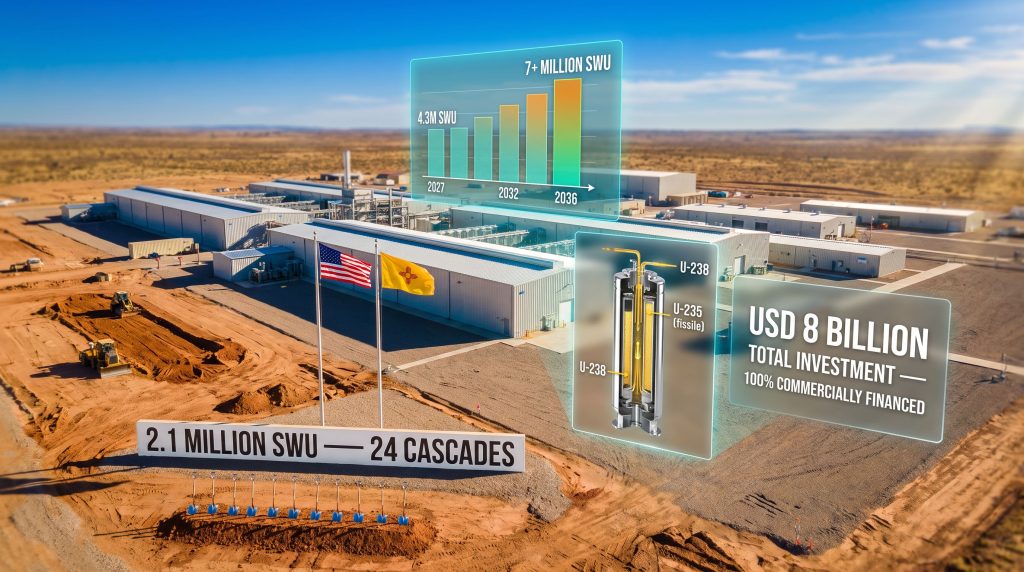
On 18 August 2026, Urenco USA held a formal groundbreaking ceremony at the NEF site in Eunice, New Mexico, marking the official launch of a construction program that will fundamentally reshape the U.S. enrichment landscape. U.S. Secretary of Energy Chris Wright attended the event alongside Urenco CEO Boris Schucht, a pairing that underscored the alignment between private sector investment and broader national energy considerations.
The scale of the commitment is substantial. The following table summarises the core parameters of the expansion:
| Metric | Detail |
|---|---|
| New enrichment capacity | 2.1 million SWU |
| Centrifuge cascades to be installed | 24 cascades |
| Technology platform | Proven gas-centrifuge enrichment |
| First cascades entering production | 2032 |
| Full build-out completion | 2036 |
| Projected total site capacity | More than 7 million SWU/year |
| Prior cumulative site investment | More than USD 5 billion |
| Total site investment post-expansion | More than USD 8 billion |
The expansion represents a capacity increase of approximately 49% relative to the existing 4.3 million SWU baseline, positioning the NEF to serve a substantially larger share of U.S. reactor demand once the build-out is complete.
Critically, this is an entirely commercially financed project, developed without public subsidy. Urenco's chief executive confirmed that the expansion was initiated at customers' request and is backed by long-term contracts, establishing a demand foundation that reduces revenue uncertainty for the investment. This commercial structure is significant: it demonstrates that the economic case for domestic enrichment infrastructure can stand on its own merits when policy frameworks create sufficient long-term demand visibility.
Why Gas-Centrifuge Technology Reduces Construction and Operational Risk
The technology choice underpinning this expansion is not incidental. Gas-centrifuge enrichment works by spinning uranium hexafluoride gas at extremely high rotational speeds, exploiting the slight mass difference between U-235 and U-238 molecules to achieve isotopic separation. Cascades of centrifuges are arranged in series to progressively increase the U-235 concentration toward the target enrichment level.
Compared to the gaseous diffusion method that dominated U.S. enrichment capacity through the twentieth century, centrifuge technology offers several material advantages:
-
Energy efficiency: Centrifuge plants consume roughly 50 times less electricity per SWU than gaseous diffusion facilities, dramatically improving operating economics.
-
Modularity: Centrifuge cascades can be installed and commissioned incrementally, allowing capacity to ramp in phases aligned with contracted demand rather than requiring large upfront capital deployment before any revenue is generated.
-
Proven operational track record: Urenco has operated centrifuge enrichment facilities across its European sites for decades, meaning the technology being deployed at Eunice carries a well-documented reliability profile rather than the execution risk associated with novel or first-of-kind processes.
-
Scalability: The cascade architecture allows output to be adjusted by bringing additional units online or offline, providing operational flexibility that rigid diffusion plants could not match.
The modular nature of the build-out, with initial cascades targeted for 2032 and the full 24-cascade installation completing through 2036, reflects a phased approach that matches capacity delivery to contracted demand schedules. According to reporting on the new enrichment plant, the project has been structured to align with long-term utility contracting requirements, reinforcing the commercial foundation of the investment.
The Russian Uranium Import Ban and Its Role as a Structural Demand Catalyst
The commercial logic underpinning the Urenco USA new enrichment capacity groundbreaking cannot be fully understood without accounting for a hard regulatory deadline. The U.S. ban on Russian uranium imports, effective January 2028, fundamentally reshapes the procurement landscape for U.S. utilities.
Russia's state nuclear corporation has historically been a significant supplier of enrichment services to U.S. and European utilities, offering competitive pricing that made it difficult for Western enrichers to displace. The import prohibition fundamentally alters that competitive dynamic by removing Russian supply from the procurement menu entirely, forcing utilities to redirect their enrichment contracting toward alternative providers.
For Urenco USA's customer base, this creates an urgent contracting imperative. Uranium fuel procurement operates on long lead times. Utilities typically contract enrichment services years in advance to ensure fuel availability, meaning the 2028 deadline was already prompting procurement decisions well before the groundbreaking ceremony. The fact that the Eunice expansion is contract-backed rather than speculative reflects this dynamic in action.
The capacity trajectory across the NEF's expansion phases illustrates how the facility's role evolves:
| Phase | Capacity Addition | Timeline |
|---|---|---|
| Current NEF operational capacity | 4.3 million SWU/year | Operational |
| Phase 1 capacity addition | 700,000 SWU | Completion: 2027 |
| Phase 2 first cascades (new plant) | Initial portion of 2.1 million SWU | From 2032 |
| Phase 2 full build-out | 2.1 million SWU across 24 cascades | Through 2036 |
| Projected total site capacity | 7+ million SWU/year | Post-2036 |
The next major ASX story will hit our subscribers first
Employment and Economic Impact: What the Expansion Delivers for New Mexico
Beyond its strategic significance for U.S. nuclear fuel supply, the Urenco USA expansion carries material economic consequences for the state of New Mexico and the broader domestic nuclear supply chain.
| Employment Category | Projected Figures |
|---|---|
| Peak construction workforce | 300 to 600 jobs |
| Permanent long-term operational roles | 70 jobs |
| Current NEF workforce (staff and contractors) | 500+ |
The incremental capital commitment that brings total site investment beyond USD 8 billion is expected to generate significant multiplier effects through construction procurement, equipment supply chains, professional services, and community spending by the expanded workforce. The Oxford Economics assessment of existing operations contributing more than USD 360 million annually to the U.S. economy provides a baseline against which the expansion's incremental contribution can be projected, though the precise multiplier effect of the new capital commitment will depend on domestic supply chain penetration across the construction program.
An investment exceeding USD 8 billion in a single nuclear fuel cycle facility, funded entirely without public subsidy, is a rare data point in the history of U.S. energy infrastructure. It reflects genuine commercial confidence rather than government-directed capital allocation.
The Tails Assay Dynamic: A Lesser-Known Lever in Enrichment Economics
One dimension of enrichment economics that receives limited coverage outside specialist circles is the tails assay decision and its implications for uranium demand. When an enrichment facility sets a higher tails assay, it depletes uranium at a lower concentration, meaning more uranium feed is required to produce the same quantity of LEU. A lower tails assay extracts more U-235 per unit of feed, reducing uranium consumption but increasing SWU requirements.
Furthermore, as Urenco USA's capacity expands from its current base toward 7+ million SWU post-2036, the facility's tails assay decisions will influence how much natural uranium U.S. utilities need to procure. The uranium supply-demand dynamics at play here are considerable: in periods where uranium prices are elevated relative to SWU costs, enrichers are incentivised to run lower tails assays, reducing uranium consumption and effectively softening upstream demand.
Conversely, when SWU capacity is tight and uranium is relatively cheap, higher tails assays make economic sense. This interplay between enrichment economics and uranium mining demand is a structural feature of the fuel cycle that investors in uranium equities and enrichment capacity alike should understand.
Frequently Asked Questions: Urenco USA New Enrichment Capacity
What was announced at the Urenco USA groundbreaking on 18 August 2026?
Urenco USA formally commenced the construction phase of a new enrichment plant at the National Enrichment Facility in Eunice, New Mexico. The project will add 2.1 million SWU of capacity across 24 centrifuge cascades, with first production from initial cascades targeted for 2032 and full installation completing through 2036.
Is the Urenco USA expansion receiving government funding?
No. The expansion is entirely commercially financed and was developed without public subsidy. It is supported by long-term contracts with existing customers, which underpin the commercial financing structure.
How does this expansion affect U.S. enrichment self-sufficiency?
The NEF currently satisfies around one-third of U.S. commercial reactor enrichment demand. A post-expansion capacity exceeding 7 million SWU annually positions the facility to serve a materially larger domestic share, though the precise coverage ratio will depend on how U.S. nuclear generation capacity evolves over the same period.
Why does the 2028 Russian uranium import ban matter for this investment?
The ban removes a previously significant source of enrichment services from U.S. utility procurement options, creating structural demand for alternative supply. This regulatory change is a key driver of the long-term contracts that make the Urenco USA new enrichment capacity groundbreaking commercially viable.
What is the significance of the tails assay in enrichment operations?
The tails assay is the concentration of U-235 remaining in the depleted uranium stream after enrichment. Operators adjust this setting to optimise between uranium feed consumption and SWU usage based on prevailing market prices. This lever means enrichment capacity and uranium mining demand are not independent variables but are linked through ongoing commercial decisions made at the facility level.
What This Expansion Signals for U.S. Nuclear Energy's Long-Term Trajectory
The Urenco USA new enrichment capacity groundbreaking is not simply a construction milestone for a single company. It is a data point in a larger transition occurring across the U.S. nuclear fuel cycle, where years of under-investment in domestic infrastructure are beginning to be addressed through commercially driven capital allocation. However, it is also worth considering broader U.S. uranium market disruption pressures that continue to shape the policy environment surrounding these investments.
Several structural forces converge to support the long-term demand outlook for enrichment services:
-
Growing U.S. reactor utilisation rates and the prospect of life extensions for existing plants will sustain baseline LEU demand.
-
New reactor construction, including both large conventional designs and emerging small modular reactor programs, will add incremental enrichment requirements over the coming decade.
-
Data centre power demand and corporate clean energy commitments are creating new pathways for nuclear capacity additions that were not prominent in previous planning cycles.
-
The Russian import ban creates a structural floor under domestic enrichment demand that persists regardless of short-term commodity price movements.
For the NEF, the combination of these demand drivers with a contract-backed expansion program and a commercially proven technology base creates a relatively de-risked investment profile compared to most energy infrastructure projects of comparable scale. In addition, shifts in uranium spot-term pricing continue to influence how utilities approach long-term contracting decisions, further reinforcing the strategic rationale for expanding domestic enrichment capacity.
The presence of the U.S. Secretary of Energy at the groundbreaking ceremony is worth noting in this context. While the expansion itself is privately financed, the visibility of senior federal engagement reflects the degree to which domestic enrichment capacity has moved from a peripheral supply chain concern to a recognised component of national energy strategy. That alignment between private capital commitment and policy-level prioritisation is likely to reinforce institutional confidence in the long-term commercial viability of U.S. enrichment infrastructure investment.
This article contains forward-looking statements and projections based on publicly available information as of August 2026. Capacity timelines, employment figures, and economic impact estimates are subject to change. This content does not constitute financial or investment advice. Readers should conduct independent research before making investment decisions related to any companies or sectors mentioned.
Further information on uranium enrichment and the U.S. nuclear fuel cycle is available through World Nuclear News at world-nuclear-news.org.
Want to Track the Next Major Mineral Discovery Before the Market Does?
Discovery Alert's proprietary Discovery IQ model delivers real-time alerts on significant ASX mineral discoveries — including uranium and nuclear fuel commodities — instantly translating complex data into actionable investment insights for both short-term traders and long-term investors. Explore Discovery Alert's dedicated discoveries page to understand how historic mineral discoveries have generated substantial returns, and begin your 14-day free trial today to position yourself ahead of the broader market.