August 19, 2026
The Structural Fragility That Makes One South Dakota Uranium Project Matter So Much
There is a peculiar vulnerability embedded in the economics of the U.S. nuclear sector that rarely surfaces in mainstream energy coverage. The country operates the world's largest fleet of commercial nuclear reactors, generates roughly 20% of its electricity from nuclear power, and has positioned atomic energy as a cornerstone of its long-term clean energy and national security strategy. Yet the uranium that fuels this entire infrastructure is sourced predominantly from abroad, with a significant concentration in geopolitically sensitive regions spanning Russia, Kazakhstan, and Uzbekistan.
This is not a recent development. For decades, the U.S. nuclear industry systematically shifted procurement toward lower-cost foreign suppliers, hollowing out the domestic uranium mining sector in the process. The structural consequences of that shift are now becoming impossible to ignore, and they form the essential backdrop against which the EnCore Dewey Burdock uranium project approval must be understood.
When big ASX news breaks, our subscribers know first
How the U.S. Uranium Supply Chain Reached Its Current Vulnerability
The numbers tell a stark story. The U.S. nuclear sector consumes approximately 40 to 50 million pounds of uranium annually, yet domestic production has historically satisfied only a fraction of that demand. According to the U.S. Energy Information Administration, domestic uranium production had fallen to levels that covered less than 10% of national reactor requirements in recent years, a figure that underscores just how exposed the fuel supply chain had become.
The Geopolitical Concentration Problem
The dominant sourcing geography for U.S. uranium imports creates compounding risk. Kazakhstan, through state-owned producer Kazatomprom, has become the single largest uranium supplier globally, accounting for roughly 45% of world mine production as of recent years, according to the World Nuclear Association. Combined with Russian-linked enrichment capacity and Central Asian conversion services, a significant portion of the U.S. nuclear fuel cycle flows through supply chains that are increasingly viewed through a national security lens.
The Prohibiting Russian Uranium Imports Act, signed into law in 2024, formalised these concerns at a legislative level. The Russian uranium import ban restricted the use of Russian-origin uranium in U.S. reactors, and while waivers and transition provisions were built into the legislation, the structural intent was clear: Congress signalled that the era of unrestricted foreign uranium dependence needed to end. This legislative backdrop, rather than any single project approval, is what elevated in situ recovery mining operations like Dewey Burdock from niche extraction projects to assets with genuine strategic relevance.
Why ISR Has Become the Dominant U.S. Mining Method
In situ recovery, commonly abbreviated as ISR, has displaced conventional open-pit and underground uranium mining as the preferred extraction technique in the United States for a combination of economic and environmental reasons. The in situ leaching benefits are considerable — ISR operations are less capital-intensive than hard rock mining, require minimal surface disturbance, and generate no tailings or waste rock piles. These characteristics make ISR projects significantly more permittable, faster to construct, and more cost-competitive at current uranium price levels.
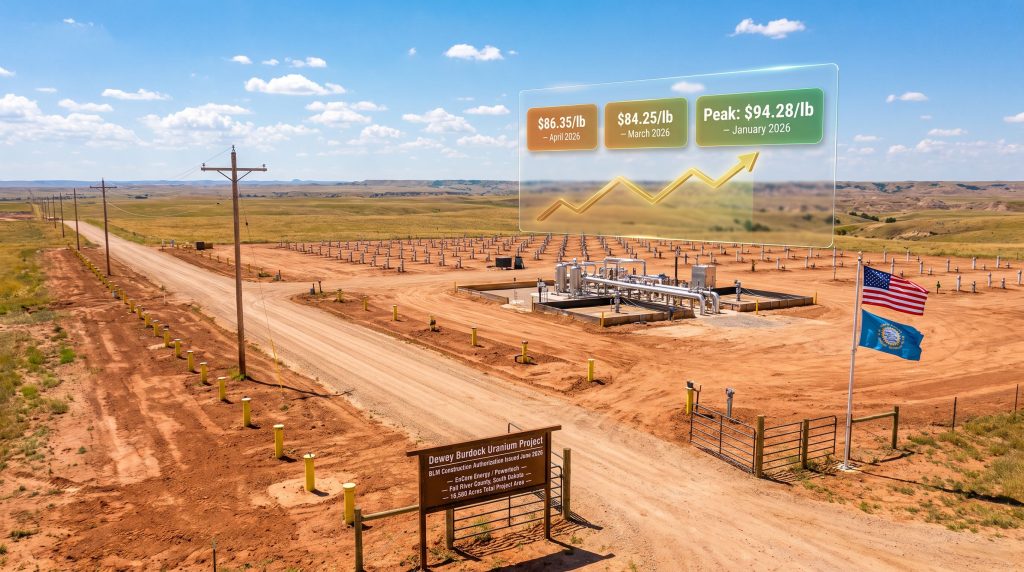
The uranium spot price trajectory through early 2026 illustrates the market context for this revival. According to Cameco, the spot price reached $94.28 per pound at the end of January 2026, before moderating to $84.25 per pound at the end of March 2026 and recovering slightly to $86.35 per pound by end of April 2026. Furthermore, while prices have pulled back from the January peak, they remain at levels that support the economics of domestic ISR production, where all-in sustaining costs at well-managed operations can sit materially below prevailing spot prices.
Where the EnCore Dewey Burdock Uranium Project Fits in the Domestic Revival
The EnCore Dewey Burdock uranium project approval represents one node in an accelerating network of domestic ISR project activations. To understand its relative position, it helps to benchmark it against peer projects that were simultaneously advancing through late 2025 and into 2026.
| Project | Operator | State | Method | Status (2026) |
|---|---|---|---|---|
| Dewey Burdock | EnCore Energy (Powertech) | South Dakota | ISR | BLM construction authorization issued June 2026 |
| Shirley Basin | Ur-Energy | Wyoming | ISR | ISR operations commenced April 2026 |
| Burke Hollow | Uranium Energy Corp. | Texas | ISR | Production commenced April 2026 |
| Lost Creek | Ur-Energy | Wyoming | ISR | Operational |
| Aurora Uranium | Eagle Nuclear Energy | Oregon/Nevada | Conventional | Investigative drill program commencing July 2026 |
What the table reveals is that Dewey Burdock, while representing a meaningful regulatory milestone, is still at an earlier operational stage than Shirley Basin or Burke Hollow. The project's significance is consequently less about its immediate production contribution and more about what it signals: that even the most legally contested, jurisdictionally complex ISR projects in the United States can ultimately clear the permitting gauntlet.
A Technical Profile of the Dewey Burdock Project
Project Fundamentals: Location, Scale, and Geology
Dewey Burdock is located in Fall River County in southwestern South Dakota, within the southern Black Hills region. The project covers a total footprint of 10,580 acres, making it one of the larger ISR project areas in the country. The uranium mineralisation occurs within the Edgemont uranium district, which was historically mined by conventional methods during the mid-20th century boom period.
The June 2026 Bureau of Land Management authorization covers approximately 240 acres of federally managed land within the larger project footprint. The remainder of the project sits on private and state-managed land, each subject to its own regulatory frameworks. This jurisdictional patchwork is one of the defining features of Dewey Burdock's complexity relative to purely private-land ISR projects in Wyoming or Texas.
The operating entity is Powertech, a subsidiary of EnCore Energy, which has been advancing the Dewey Burdock uranium project through successive regulatory stages since the early 2010s.
How ISR Mining Works at a Technical Level
For readers unfamiliar with the mechanics of in situ recovery, the process differs fundamentally from any conventional mining imagery. There is no open pit, no blasting, and no ore truck. Instead, ISR operates more like a controlled chemical engineering process conducted underground.
The operational sequence unfolds across six distinct phases:
-
Baseline groundwater characterisation involves establishing detailed pre-mining aquifer chemistry across multiple parameters, creating the regulatory benchmark against which post-mining restoration will be judged.
-
Well field installation requires drilling a pattern of injection wells, recovery wells, and monitoring wells directly into the uranium-bearing sandstone formation.
-
Lixiviant circulation is the core extraction mechanism. An oxygenated groundwater solution, sometimes supplemented with carbon dioxide or bicarbonate, is pumped through the injection wells into the ore zone, where it chemically dissolves uranium minerals in place.
-
Recovery and processing brings the uranium-laden solution to the surface through recovery wells, where it passes through ion exchange columns that capture uranium from the solution stream.
-
Groundwater restoration is the post-mining phase that regulators scrutinise most intensely. The operator must return the aquifer chemistry to baseline or background conditions using a combination of freshwater flushing, reverse osmosis treatment, and groundwater monitoring.
-
Regulatory monitoring continues throughout and after operations, with ongoing compliance obligations to the NRC, EPA, and state agencies.
ISR's environmental risk profile is fundamentally different from conventional mining, but it is not without complexity. The aquifer exemption process, groundwater restoration obligations, and multi-agency oversight requirements mean that ISR projects face a distinct and often underappreciated regulatory burden before and after production.
Deconstructing the June 2026 BLM Authorization
What Was Actually Approved, and What Was Not?
One of the most consequential misunderstandings in public coverage of uranium project milestones is conflating a construction authorization with a production licence. The June 18, 2026 BLM final decision for Dewey Burdock does not open the mine. It authorises a specific, bounded set of surface construction activities on the federal land component of the project.
Activities specifically authorised by the BLM decision:
- Construction of access roads across BLM-managed acreage
- Installation of groundwater monitoring wells for pre-operational baseline characterisation
- Construction of overhead power line infrastructure to supply the project
- Broader surface disturbance activities within the approved ~240-acre federal land boundary
Activities not covered by the BLM authorization:
- Full-scale uranium recovery operations at any part of the project
- Any activities on private or state-land portions of the 10,580-acre project area
- Replacement or completion of the ongoing NRC licence renewal review
The BLM decision is best understood as one regulatory layer in a multi-agency architecture. It neither supersedes the NRC process nor completes it. It operates in parallel, and investors or observers who assess Dewey Burdock's production timeline based solely on this approval will materially underestimate the remaining pathway.
The Multi-Agency Permitting Architecture in Full
| Regulatory Body | Authorisation Type | Year Issued | Status as of June 2026 |
|---|---|---|---|
| NRC | Source and Byproduct Materials Licence | 2014 | 20-year renewal application submitted March 2024; environmental review completed June 2026 |
| EPA | Class III and V UIC Permits + Aquifer Exemption | 2020 | In effect |
| BLM | Construction Authorisation (~240-acre federal land) | June 2026 | Final decision issued |
| Fast-41 Programme | Federal Permitting Coordination | September 2025 | Active |
The EPA's Underground Injection Control permits and aquifer exemption, granted in 2020, were a critical prerequisite for BLM action. The aquifer exemption, in particular, represents one of the most contentious regulatory instruments in ISR uranium permitting because it formally designates the affected aquifer as unsuitable for drinking water, thereby permitting chemical injection into the formation. These exemptions have historically attracted significant legal challenge from environmental and Indigenous advocacy organisations, and Dewey Burdock's permitting history reflects exactly this dynamic.
The Fast-41 Enrollment and What It Signals
Federal Permitting Coordination as a Policy Instrument
Dewey Burdock was enrolled in the Fast-41 federal permitting programme in September 2025. Fast-41, established under Title 41 of the Fixing America's Surface Transportation Act, was originally designed to streamline environmental review processes for major infrastructure projects. Its application to uranium projects reflects the broader reclassification of uranium as a critical mineral requiring prioritised permitting treatment.
The practical effects of Fast-41 enrolment include:
- Establishment of a public permitting dashboard with trackable milestones and accountability mechanisms
- Mandatory synchronisation of review timelines across all participating federal agencies
- A designated Federal Permitting Improvement Steering Council (FPISC) point of contact responsible for inter-agency coordination
- Reduced risk of review delays caused by asynchronous agency timelines
It is important to note that Fast-41 enrolment does not guarantee approval of any specific permit or authorisation, nor does it constitute a formal statement of government support for the project. It is a coordination mechanism rather than an endorsement. The distinction matters for accurate interpretation of what enrolment actually means for Dewey Burdock's trajectory.
This enrolment reflects a broader policy shift toward treating domestic uranium production as a supply chain security issue rather than purely an environmental regulatory question. The DOE's Defense Production Act Nuclear Fuel Cycle Consortium, launched in April 2026, operates on a parallel philosophy, using federal coordination authority to address gaps across the entire nuclear fuel supply chain rather than at individual project level.
A Decade in the Making: The Regulatory Timeline
Key Milestones from 2014 to June 2026
| Year | Milestone | Regulatory Body |
|---|---|---|
| 2014 | Source and Byproduct Materials Licence granted | NRC |
| 2014–2023 | Legal challenges to NRC licence; D.C. Circuit Court upholds licence | Federal Courts / NRC |
| 2020 | Class III and V UIC permits and aquifer exemption granted | EPA |
| March 2024 | 20-year NRC licence renewal application submitted | NRC |
| September 2025 | Project enrolled in Fast-41 federal permitting programme | FPISC / Federal |
| June 2026 | NRC environmental review for licence renewal completed | NRC |
| June 18, 2026 | BLM final decision issued, construction authorisation granted | BLM |
Why Did It Take More Than a Decade?
The duration of Dewey Burdock's permitting journey is not exceptional by the standards of contested U.S. resource projects on federal and mixed-jurisdiction land, but it is instructive. Several compounding factors extended the timeline:
- Multi-jurisdictional complexity across BLM federal land, private parcels, and state-administered acreage required sequential rather than fully parallel regulatory processes
- Sustained legal challenges from environmental advocacy organisations and Oglala Sioux Tribe representatives, who raised concerns about potential impacts to drinking water aquifers and sacred cultural sites, required judicial resolution before certain agency processes could advance
- EPA's independent aquifer exemption review ran on its own timeline and required a separate environmental impact assessment process
- NRC licence renewal added a second comprehensive multi-year review cycle on top of the original 2014 licensing process
- BLM's NEPA obligations for the federal land surface disturbance component required an independent environmental review process
Each of these processes is designed to be independent, which means delays in one do not automatically accelerate others. The cumulative effect is a permitting timeline that reflects genuine regulatory thoroughness rather than bureaucratic dysfunction, though the distinction is cold comfort for project developers managing capital through extended pre-production periods.
The next major ASX story will hit our subscribers first
What Regulatory Hurdles Remain Before Production Can Begin
Despite the landmark nature of the June 2026 BLM authorisation, a candid assessment of the remaining pathway to uranium production at Dewey Burdock requires acknowledging several outstanding steps:
-
NRC licence renewal finalisation is the most significant outstanding regulatory requirement. The 20-year renewal application was submitted in March 2024, and while the NRC completed its environmental review in June 2026, the full licence renewal decision has not yet been issued. The environmental review completion is a milestone within the process, not the conclusion of it.
-
Well field construction and commissioning must follow authorisation. Physical infrastructure including injection wells, recovery wells, monitoring wells, and the central processing facility must be built, tested, and validated before any uranium-laden solution can be processed.
-
Pre-operational groundwater baseline confirmation is required by regulators to be formally accepted before injection operations can commence.
-
State-level regulatory coordination with South Dakota environmental and water quality agencies remains an ongoing obligation independent of federal approvals.
-
Potential further legal proceedings remain a realistic possibility given the history of opposition to the project. Environmental and Indigenous advocacy groups have challenged each major approval stage, and the pattern suggests future approvals may face similar scrutiny.
Disclaimer: The timeline for Dewey Burdock reaching active uranium production involves multiple regulatory, legal, and operational variables that cannot be predicted with certainty. Nothing in this article constitutes investment advice. Readers should conduct their own due diligence and consult qualified financial advisors before making investment decisions related to uranium sector equities.
How Dewey Burdock Compares to Active U.S. ISR Projects
| Metric | Dewey Burdock (Powertech/EnCore) | Shirley Basin (Ur-Energy) | Burke Hollow (UEC) | Lost Creek (Ur-Energy) |
|---|---|---|---|---|
| State | South Dakota | Wyoming | Texas | Wyoming |
| Regulatory Stage (2026) | Construction authorisation | Active ISR operations | Active ISR production | Operational |
| Federal Land Component | Yes (BLM, ~240 acres) | Partial | No (state/private) | No (state/private) |
| Processing Model | Standalone plant (planned) | Standalone | Hub-and-spoke (Hobson CPF) | Standalone |
| Fast-41 Enrolled | Yes | Not confirmed | Not confirmed | Not confirmed |
| Combined Licensed Capacity | TBD | 4.2M lbs U₃O₈ (combined with Lost Creek) | Hub model capacity | 4.2M lbs U₃O₈ (combined with Shirley Basin) |
A notable feature of the UEC Burke Hollow model is its hub-and-spoke processing architecture, where uranium-bearing solution from Burke Hollow and other satellite ISR sites feeds into the centralised Hobson Central Processing Plant. This model has economic advantages at scale, distributing processing infrastructure costs across multiple producing wellfields. Dewey Burdock's planned standalone processing model carries higher upfront capital requirements but greater operational independence.
The Broader Nuclear Fuel Cycle Investment Wave
Upstream Mining Meets Downstream Enrichment Expansion
The EnCore Dewey Burdock uranium project approval does not exist in a policy or market vacuum. It is arriving at precisely the moment when U.S. enrichment and fuel fabrication capacity is expanding at a pace not seen in decades, creating a downstream pull for domestic uranium that strengthens the strategic case for every ISR project currently advancing through the permitting system. Understanding the broader uranium market dynamics is consequently essential for contextualising why this approval carries weight beyond its immediate regulatory scope.
Key parallel developments in the U.S. nuclear fuel cycle as of mid-2026:
-
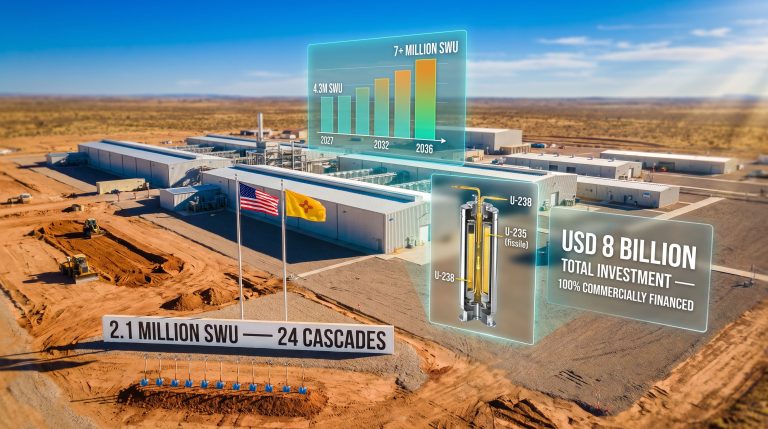
Urenco USA announced a capacity expansion of approximately 50% at its National Enrichment Facility in Eunice, New Mexico, adding 2.1 million separative work units (SWU) of enrichment capacity. SWU is the standard industry measure of enrichment effort required to produce a given quantity of enriched uranium product.
-
Orano's Project Ike, a proposed $5 billion centrifuge enrichment facility near Oak Ridge, Tennessee, is under active NRC review. The NRC committed to completing that review within 12 months of the application submission, an accelerated timeline by historical standards. The facility would represent a significant addition to U.S.-based enrichment capacity.
-
Framatome's Richland, Washington facility received NRC approval in May 2026 to manufacture LEU+ fuel, meaning nuclear fuel with uranium-235 enrichment levels above the conventional 5% threshold. Manufacturing is scheduled to begin in 2027, targeting fuel requirements for advanced reactor designs that cannot use standard low-enriched uranium.
-
The NNSA received 1.7 metric tons of high-assay low-enriched uranium (HALEU) transferred from Japan in May 2026, described as the largest such international HALEU transfer on record. This material will support advanced reactor fuel development programmes requiring enrichment levels between 5% and 20% U-235.
Understanding the Supply Chain Logic
The strategic interdependence between mine-level production and downstream enrichment investment is a feature of the nuclear fuel cycle that is poorly understood outside specialist circles. Uranium oxide concentrate — often referred to as yellowcake, the product of ISR processing — must undergo conversion to uranium hexafluoride before it can be fed into centrifuge enrichment cascades. Enriched uranium hexafluoride then undergoes reconversion and fuel fabrication before reaching a reactor. Each stage requires its own licensed facilities, and bottlenecks at any point constrain the entire system.
This is precisely why the DOE's Defense Production Act Nuclear Fuel Cycle Consortium, launched in April 2026, frames the supply chain challenge as an integrated problem requiring coordinated solutions across mining, conversion, enrichment, and fabrication simultaneously. Expanding Urenco's enrichment capacity generates its full strategic value only if domestic uranium feedstock is also available. Furthermore, the U.S. uranium production rebound now underway across multiple ISR projects signals that the supply side is beginning to respond to this demand pull. The EnCore Dewey Burdock uranium project approval, viewed through this lens, is one piece of a deliberately coordinated puzzle rather than an isolated permitting outcome.
Frequently Asked Questions
What Exactly Did the BLM Approve for the Dewey Burdock Project in June 2026?
The Bureau of Land Management issued a final decision authorising Powertech, EnCore Energy's subsidiary, to begin specific construction activities on approximately 240 acres of federally managed land within the broader 10,580-acre Dewey Burdock project area in southwestern South Dakota. Authorised activities include access road construction, groundwater monitoring well installation, and overhead power line infrastructure.
Does the BLM Authorization Mean Dewey Burdock Can Now Mine Uranium?
No. The BLM authorisation covers defined surface construction activities on the federal land component of the project only. Full uranium recovery operations require finalisation of the NRC's 20-year licence renewal process and satisfaction of all remaining regulatory conditions across multiple agencies.
How Long Has the Dewey Burdock Project Been in the Permitting Process?
The project's original NRC Source and Byproduct Materials Licence was granted in 2014, placing the regulatory journey at more than a decade by the time the June 2026 BLM construction authorisation was issued. The process has involved NRC licensing, sustained legal challenges, EPA aquifer exemption review, and a separate BLM NEPA process.
What Is ISR Uranium Mining and Why Does It Matter for Permitting?
In situ recovery is a uranium extraction technique that circulates chemically treated groundwater through underground uranium-bearing formations to dissolve and recover uranium without any conventional excavation. Its lower environmental disturbance profile makes it more permittable than open-pit or underground mining. However, ISR projects still face a multi-agency review process involving the NRC, EPA, BLM where federal land is involved, and state regulators.
What Is the Fast-41 Programme and Why Was Dewey Burdock Enrolled?
Fast-41 is a federal permitting coordination framework established under the Fixing America's Surface Transportation Act. Dewey Burdock was enrolled in September 2025, requiring coordinated review timelines and designated accountability across all relevant federal agencies. Enrolment does not constitute project approval or a guarantee of favourable regulatory outcomes.
What Remains Before Dewey Burdock Can Begin Uranium Production?
Key outstanding steps include finalisation of the NRC 20-year licence renewal, completion of well field and processing facility construction, formal acceptance of pre-operational groundwater baseline data, ongoing state-level regulatory coordination, and potential resolution of further legal challenges from opposition groups.
Key Takeaways: What This Approval Signals for U.S. Uranium Policy
The June 2026 BLM authorisation for the EnCore Dewey Burdock uranium project is best understood as a regulatory inflection point rather than a production start. Its significance is layered, and the divergence between spot and term uranium prices through this period further illustrates the complex market environment in which domestic producers are now operating.
- It demonstrates that long-contested, multi-jurisdictionally complex ISR projects on federal land can advance through the full permitting architecture, even under sustained legal pressure
- It arrives at a moment when downstream nuclear fuel cycle investment — from Urenco's enrichment expansion to Framatome's LEU+ fuel manufacturing approval — is creating genuine demand pull for domestic uranium feedstock
- The Fast-41 enrolment and NRC environmental review completion signal accelerating federal coordination around uranium supply chain security
- Uranium spot prices in the $84 to $94 per pound range observed across the first quarter of 2026 maintain the economic logic for domestic ISR project development
- The remaining regulatory pathway to production, particularly the NRC licence renewal finalisation, means that market participants should assess timelines against the full multi-step process rather than any single authorisation
The Dewey Burdock authorisation is not the end of a regulatory journey. It is a milestone within one that must still clear several more gates before the first pound of uranium is recovered from Fall River County. Understanding that distinction is fundamental to any accurate assessment of the project's near-term production contribution to U.S. domestic supply.
For ongoing coverage of U.S. nuclear fuel cycle developments, the American Nuclear Society's Nuclear Newswire at ans.org/news provides detailed reporting across uranium mining, enrichment, fuel fabrication, and advanced reactor fuel programmes.
Want to Position Yourself Ahead of the Next Major Uranium Discovery?
Discovery Alert's proprietary Discovery IQ model delivers real-time alerts on significant ASX mineral discoveries — including uranium — instantly translating complex sector developments into actionable investment insights for both short-term traders and long-term investors. Explore why historic mineral discoveries have generated extraordinary returns by visiting Discovery Alert's dedicated discoveries page, and begin your 14-day free trial today to secure your market-leading edge.