August 21, 2026
The Fuel Cycle Bottleneck Quietly Reshaping Nuclear's Future
Before a single electron flows from a nuclear power station, before concrete is poured for a reactor foundation, and before any advanced reactor design leaves the drawing board, one industrial process stands as the indispensable gateway: uranium enrichment. It is the most technically demanding and capital-intensive stage of the entire nuclear fuel cycle, and for most of the past four decades, the United States has steadily ceded control of this capability to foreign state-owned enterprises. Understanding why this happened, what it means for energy security, and how domestic uranium enrichment expansion is now being pursued across multiple technological fronts is essential context for anyone tracking nuclear energy's resurgence.
When big ASX news breaks, our subscribers know first
From Global Dominance to Near-Irrelevance: Four Decades of Decline
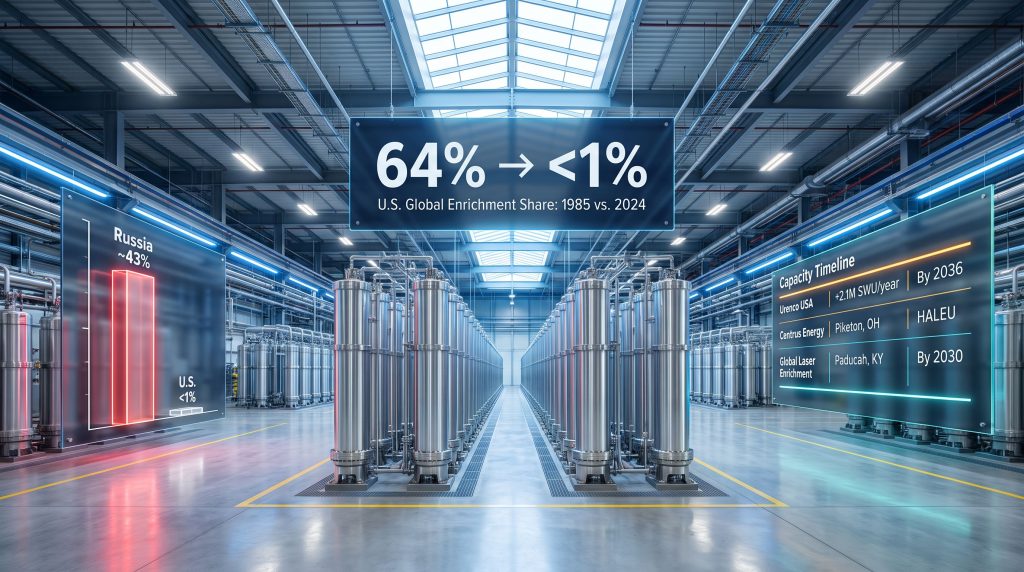
The scale of America's retreat from enrichment is striking when viewed across a long timeframe. In 1985, the United States controlled approximately 64% of global uranium enrichment capacity. By 2024, that share had collapsed to less than 1% of global output. Over the same period, Russia's state-controlled enrichment operations expanded to capture roughly 43% of the global market, positioning Rosatom's commercial arm as the world's dominant supplier of enrichment services.
This is not simply a market share statistic. Enrichment capacity is the kind of industrial infrastructure that takes years to construct, requires highly specialised technical expertise, and cannot be rapidly reconstituted once lost. The commercial logic that drove Western utilities toward cheaper foreign enrichment services during the post-Cold War period created a structural dependency that has now become a national security liability.
What makes enrichment uniquely consequential is that it sits at the irreplaceable centre of the nuclear fuel cycle. Natural uranium contains only about 0.7% of the fissile isotope U-235, far below the concentrations needed to sustain a controlled chain reaction in most reactor designs. Furthermore, the concentration of this capability in foreign, state-controlled entities — compounded by the ban on Russian uranium imports — represents a foundational vulnerability for any country seeking to operate or expand nuclear power generation.
Understanding Enrichment: SWU, LEU, and the HALEU Challenge
The economics and logistics of enrichment are measured using a unit called the Separative Work Unit (SWU), which quantifies the effort required to achieve a given level of uranium enrichment. This metric determines facility capacity, contract pricing, and supply chain planning across the entire industry. For a broader understanding of uranium enrichment processes, the World Nuclear Association provides comprehensive technical context.
| Fuel Type | U-235 Concentration | Primary Application |
|---|---|---|
| Natural Uranium | ~0.7% | Mining output, enrichment feedstock |
| LEU (Low-Enriched Uranium) | Up to 5% | Conventional light water reactors |
| LEU+ | 5-10% | Advanced fuel designs, some reactor types |
| HALEU (High-Assay Low-Enriched Uranium) | 10-20% | Next-generation and advanced reactors |
The distinction between these fuel categories is not merely technical. It has profound implications for supply chain architecture. Conventional light water reactors, which constitute the majority of the existing U.S. reactor fleet, run on standard LEU. However, most advanced reactor designs currently in development — including microreactors, fast spectrum reactors, and high-temperature gas-cooled reactors — require HALEU to operate.
Here lies a critical and underappreciated bottleneck: there is currently no commercial-scale domestic HALEU production capacity in the United States. The only domestic source is a demonstration-scale facility in Piketon, Ohio, which has produced approximately 900 kg of HALEU to date. Commercial advanced reactor deployment, which is central to virtually every long-term U.S. energy and defence strategy, depends on solving this supply gap before reactor fleets are ready to operate.
A further complication is that the exact HALEU volumes required by different advanced reactor designs remain incompletely defined across the industry, making investment planning for enrichment capacity genuinely difficult. Operators must commit capital years before demand materialises at commercial scale, creating a classic chicken-and-egg problem that the DOE contracting architecture is specifically designed to break. The shifting uranium supply and demand dynamics make this planning challenge even more pronounced.
The Federal Contracting Framework: $2.7 Billion to Rebuild a Supply Chain
Recognising that private capital alone would struggle to justify the risk profile of enrichment infrastructure investment without demand certainty, the Department of Energy has structured a $2.7 billion contracting programme over a 10-year horizon to support domestic enrichment infrastructure for both LEU and HALEU production. This approach mirrors industrial policy frameworks used in semiconductor manufacturing and battery supply chains, using government procurement commitments to de-risk private investment in strategically critical capabilities.
Six companies have been designated as eligible to compete for task orders under this framework. Awards have been deliberately distributed across multiple operators to avoid creating new single-point-of-failure vulnerabilities in the reconstituted domestic supply chain. Executive-level direction has further instructed the DOE to develop comprehensive capacity expansion plans covering LEU, HEU, and HALEU to address both civilian power generation and defence fuel requirements simultaneously.
The dual-use nature of enrichment infrastructure — serving both commercial reactors and defence applications — elevates the strategic priority of this rebuild well beyond conventional energy policy. The domestic uranium supply chain investment framework is detailed further by the Department of Energy's Office of Nuclear Energy.
Four Operators, Four Approaches: How Domestic Enrichment Is Being Rebuilt
Urenco USA: Scaling the Only Operational Commercial Plant
The most immediately operational component of America's domestic uranium enrichment expansion is Urenco USA's facility in Eunice, New Mexico, which currently represents the sole large-scale commercial enrichment operation on U.S. soil. Present capacity sits in the range of 4.8 to 5 million SWU per year.
In a milestone moment for the rebuild effort, DOE Secretary Chris Wright attended a groundbreaking ceremony in Eunice marking the launch of a major long-term expansion programme. This programme will install 2.1 million SWU of new gas centrifuge enrichment capacity, growing total site output to more than 7 million SWU per year by 2036, representing a capacity increase of nearly 50% relative to current operational levels. An incremental expansion of approximately 700,000 SWU/year is targeted for completion earlier, by 2027.
Critically, Urenco USA's existing NRC licence permits capacity of up to 10 million SWU, meaning the current expansion programme does not exhaust the regulatory ceiling. There is headroom for additional capacity additions beyond 2036 if market demand and financing support further investment.
Globally, Urenco operates at 17.2 million SWU per year across its international portfolio, providing deep operational and technology expertise that underpins the U.S. expansion. On the advanced fuels front, Urenco is developing a HALEU advanced fuels facility at its Capenhurst, England site, targeted for operational readiness by 2031.
Industry participants have flagged workforce recruitment and retention as a genuine operational constraint, noting that enrichment facilities require highly specialised technical staff at a time when the nuclear sector competes with technology, defence, and energy industries for the same talent pool.
Centrus Energy: HALEU Leadership at Piketon
Centrus Energy operates the American Centrifuge Plant in Piketon, Ohio, which holds a unique distinction as the only current domestic U.S. source of HALEU production. However, the Piketon facility currently operates at demonstration rather than commercial scale. The approximately 900 kg of HALEU produced to date establishes technical proof-of-concept but represents a fraction of the volumes that commercial advanced reactor operations would require.
Two significant agreements are accelerating Centrus's path to scale. A $900 million DOE task order has been secured to support expanded HALEU production capacity at Piketon. Separately, a commercial contract with X-energy, a leading advanced reactor developer, directly links Centrus's enrichment programme to a specific customer's fuel requirements. The Centrus-X-energy arrangement signals an emerging model of vertically integrated fuel cycle partnerships, where enrichers and reactor developers align their investment timelines and fuel specifications years in advance.
Centrus has articulated the scale of the challenge with notable clarity, describing the entire global enrichment supply chain as one that the United States used to dominate but that is now almost entirely controlled by foreign, state-owned enterprises. The company characterises the collective task facing domestic enrichers as filling a very large hole.
General Matter: Greenfield Development at a Historic Site
General Matter, a California-based startup, has secured a lease with DOE's Office of Environmental Management for a 100-acre parcel at the former Paducah Gaseous Diffusion Plant in Kentucky. This site has significant historical weight: from 1952 to 2013, the Paducah facility operated as a government uranium enrichment plant and was the last federally operated enrichment facility in U.S. history before closure. Reactivating it for private-sector enrichment leverages existing nuclear infrastructure and decades of community familiarity with enrichment operations.
General Matter's leadership has advanced a demand logic framework that reframes the strategic importance of enrichment beyond conventional energy policy. The chain of reasoning runs as follows:
- Enriched uranium fuel is the bottleneck to nuclear power generation.
- Nuclear power is the bottleneck to reliable, scalable clean electricity.
- Electricity is the bottleneck to AI infrastructure expansion.
- Therefore, domestic enrichment capacity is a foundational enabler of the digital economy.
This framing connects fuel cycle sovereignty directly to the technology sector's power requirements, creating a demand narrative that extends well beyond traditional nuclear industry audiences. General Matter and DOE-EM are also jointly evaluating the potential use of the Fuel and Materials Examination Facility at the Hanford site in Washington State, which could extend the company's operational footprint across multiple federal legacy sites.
Global Laser Enrichment: The Silex Technology Differentiator
Global Laser Enrichment (GLE) is advancing a fundamentally different technological approach to enrichment. The Silex laser-based uranium enrichment process uses laser energy to separate uranium isotopes rather than the mechanical centrifuge action used by all other commercial enrichers. GLE submitted its NRC licence application for the Paducah Laser Enrichment Facility in July 2025, with significant construction activity anticipated from 2027 and facility completion targeted for 2030.
The commercial logic underpinning GLE's Paducah project is particularly sophisticated. Rather than competing directly for natural uranium feedstock, the facility is specifically designed to re-enrich depleted uranium hexafluoride (DUF6) tails stored at the Paducah site. These are the residual byproducts of previous enrichment operations — material that still contains recoverable U-235 but that conventional economics previously made uneconomical to process.
The market has shifted significantly, and the economics of recovering fissile material from legacy tails have materially improved as uranium prices and enrichment service costs have risen. What was once a stranded asset is now a commercially viable feedstock.
GLE's leadership has noted that the Paducah project was at one stage described as the largest private investment in western Kentucky history, a distinction subsequently surpassed by a data centre development in the region. The co-location of both GLE and General Matter at Paducah creates potential for complementary operations, with GLE processing legacy tails and General Matter producing fresh LEU, reducing feedstock competition and maximising site utilisation.
Projected U.S. Enrichment Capacity: The Path to 2036
| Operator | Technology | Location | Capacity Addition | Target Timeline |
|---|---|---|---|---|
| Urenco USA | Gas Centrifuge | Eunice, NM | +700K SWU/year (incremental) | By 2027 |
| Urenco USA | Gas Centrifuge | Eunice, NM | +2.1M SWU/year (to >7M total) | By 2036 |
| Centrus Energy | Gas Centrifuge | Piketon, OH | HALEU commercial scale (volume TBD) | Post-2026 |
| Global Laser Enrichment | Laser (Silex) | Paducah, KY | DUF6 re-enrichment capacity | By 2030 |
| General Matter | Gas Centrifuge | Paducah, KY | Greenfield LEU plant (scale TBD) | TBD |
The next major ASX story will hit our subscribers first
Key Risks That Could Derail the Rebuild
Workforce Scarcity
Enrichment facilities require physicists, engineers, and specialised tradespeople that cannot be rapidly recruited or trained. The nuclear sector is competing for this talent against well-funded technology, defence, and conventional energy employers. Even where capital and regulatory approvals are secured, workforce gaps could delay capacity additions on timelines that matter for advanced reactor deployment schedules.
Demand Uncertainty for Advanced Fuels
The exact HALEU volumes needed across different advanced reactor designs remain incompletely defined. Reactor developers are still specifying fuel requirements, and commercial fleet sizes are uncertain. This creates genuine planning challenges for enrichment operators who must commit capital years ahead of when demand materialises. Consequently, understanding the broader uranium market dynamics is increasingly important for operators navigating these uncertainties.
Capital Intensity and Long Construction Cycles
Enrichment infrastructure ranks among the most capital-intensive projects in the energy sector. Multi-year construction timelines, extensive regulatory compliance requirements, and the need for sustained policy commitment over decade-long horizons create execution risk that persists even after initial investment decisions are made.
Regulatory Coordination
NRC licensing processes for new enrichment facilities involve environmental reviews, security assessments, and public comment periods that must be coordinated with construction and operational readiness timelines. Any slippage in regulatory milestones cascades through project schedules in ways that are difficult to recover from.
The Competitive Reality: Where the U.S. Stands Globally
| Country/Entity | Estimated Global Share | Primary Technology |
|---|---|---|
| Russia (TENEX/Rosatom) | ~43% | Gas Centrifuge |
| Europe (Urenco/Orano combined) | ~35% | Gas Centrifuge |
| China (CNNC) | ~15% | Gas Centrifuge |
| United States | Under 1% (current) | Gas Centrifuge / Laser (emerging) |
Rebuilding to even a 10 to 15% share of global enrichment capacity would require sustained investment, favourable regulatory timelines, successful workforce development, and commercial offtake commitments maintained over a 10 to 15-year horizon. The multi-operator, multi-technology strategy currently being pursued reduces concentration risk and introduces competitive dynamics that may accelerate both innovation and cost reduction across the domestic industry. In addition, tracking uranium market trends remains essential for assessing how these investments will perform over time.
Frequently Asked Questions
What is driving the urgency behind domestic uranium enrichment expansion?
The convergence of three forces is creating urgency: the accelerating shift away from Russian-origin enriched uranium across both the U.S. and Europe, the approaching deployment of advanced reactors that require HALEU fuel with no current commercial domestic source, and the growing electricity demand from data centres and AI infrastructure that positions nuclear as a preferred baseload solution. Furthermore, the broader uranium investment trends reflect this growing strategic momentum across the sector.
Why is HALEU so difficult to produce commercially?
Producing uranium enriched to between 10% and 20% U-235 requires enrichment infrastructure capable of higher separation work than conventional LEU production, combined with additional handling and security protocols given the elevated U-235 content. No Western country currently produces HALEU at commercial scale, making it the single most critical bottleneck for next-generation reactor deployment.
What makes the Silex laser enrichment process technically different?
Unlike gas centrifuge enrichment, which uses mechanical rotation at high speeds to separate uranium isotopes by mass, the Silex process uses precisely tuned laser energy to selectively excite U-235 atoms and facilitate separation. This approach potentially offers energy efficiency advantages and, critically for GLE's Paducah application, can economically process lower-grade tails material that centrifuge economics would not support.
Is Paducah, Kentucky becoming the centre of U.S. enrichment activity?
The site is positioning itself that way. With both Global Laser Enrichment and General Matter establishing operations at the former Gaseous Diffusion Plant, the location benefits from existing nuclear infrastructure, DOE land availability through environmental management lease arrangements, community acceptance of enrichment activity built over six decades, and large inventories of stored depleted uranium tails that serve as ready feedstock for re-enrichment.
This article contains forward-looking statements and projections based on publicly available information, company announcements, and industry analysis. Capacity timelines, investment figures, and market projections are subject to change based on regulatory decisions, financing conditions, and commercial developments. This content does not constitute investment advice.
Further Reading: For ongoing coverage of nuclear fuel cycle policy, enrichment industry developments, and regulatory updates, the American Nuclear Society's Nuclear Newswire at ans.org/news provides detailed reporting on industry conference proceedings including Global 2026.
Want to Track the ASX Companies Positioned to Benefit From the Uranium Supply Chain Rebuild?
Discovery Alert's proprietary Discovery IQ model scans ASX announcements in real time, delivering instant alerts on significant uranium and nuclear fuel cycle-related discoveries — from junior explorers to emerging producers — so investors can act on opportunities before the broader market catches on. Explore historic discovery returns on Discovery Alert's discoveries page and begin a 14-day free trial to secure a market-leading edge as the global enrichment landscape reshapes itself.