August 24, 2026

Why the Atomic Eagle Madaouela Uranium Project in Niger Could Transform a Junior Developer's Strategic Footprint
The Atomic Eagle Madaouela uranium project in Niger is re-emerging at a time when uranium markets are tightening. For most of the past decade, utilities relied on legacy contracts, excess inventories, and secondary supply. However, that backdrop is shifting as reactor demand grows and mine supply struggles to keep pace, reinforcing broader uranium supply-demand volatility.
It is within this structural change that large, advanced uranium assets are attracting renewed attention. In addition, projects with established studies, major historical expenditure and district credibility can command scarcity value far beyond a simple per-pound comparison.
Understanding Why Portfolio Architecture Matters More Than Asset Count
Many junior mining investors prefer a simple story: one asset, one jurisdiction, one development path. Nevertheless, that simplicity can also create concentration risk. A single operational setback can trigger a sharp re-rating if there is no second project to balance geological, regulatory or financing uncertainty.
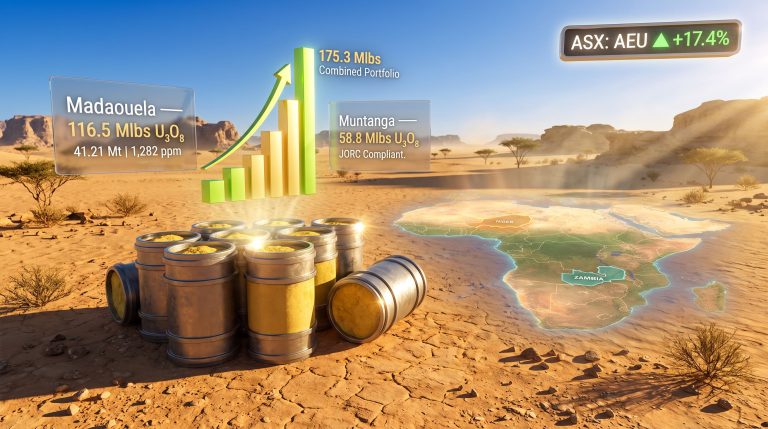
Atomic Eagle has moved away from that model. Through its ASX listing and inherited project base, the company controls both the Muntanga project in Zambia and an option on Madaouela in Niger. As a result, each asset serves a distinct strategic role.
- Muntanga (Zambia): approaching 60 million pounds of U₃O₈ and positioned as the near-term development platform
- Madaouela (Niger): a larger resource of 116.5 million pounds of U₃O₈ at 1,282ppm, aimed at strategic capital focused on long-term supply
That distinction matters because capital sources are not all motivated by the same objective. For instance, conventional investors may focus on Muntanga’s relative simplicity, while strategic groups concerned with uranium supply security may be drawn to Madaouela’s scale and grade.
What Makes Madaouela's Resource Base Genuinely Significant
Breaking Down 116.5 Million Pounds at 1,282ppm
Madaouela sits in Niger’s Arlit district, one of Africa’s best-known uranium corridors. Orano has mined in the district for decades, while Chinese-linked groups hold nearby ground. Consequently, the geological setting is supported by strong regional precedent rather than speculative theory.
The resource rests on more than 600,000 metres of historical drilling and over US$160 million in prior exploration and development spending. That work was completed before Atomic Eagle’s involvement, which means the company inherits a substantial technical foundation without carrying the original risk cost.
- Measured + Indicated: 96.9Mlb
- Inferred: 19.6Mlb
- Total: 116.5Mlb
A key feature is that the resource was estimated using a uranium price assumption of only US$70/lb. Today’s stronger pricing environment therefore offers additional context, especially as investors reassess uranium market dynamics across advanced development assets.
The excluded 19.6 million inferred pounds could become especially important. If future drilling upgrades that material into higher-confidence categories, an updated study may improve economics without requiring a brand-new discovery.
The Mining Method Optimisation Opportunity
Another underappreciated factor is optimisation potential. The prior mine plan combined open-pit mining with underground room-and-pillar methods. While common in sediment-hosted uranium systems, room-and-pillar leaves some mineralisation behind as structural support.
Accordingly, a future feasibility update could examine whether alternative underground methods improve ore recovery. Management has indicated that at a US$95/lb long-term uranium price, project NPV could sit near US$650 million, with about US$100 million of sensitivity for every US$5/lb move.
- US$90/lb: ~US$550M
- US$95/lb: ~US$650M
- US$100/lb: ~US$750M
- US$105/lb: ~US$850M
Disclaimer: these NPV figures are management estimates and are not audited projections.
How the Mining Convention Was Secured
From Permit Withdrawal to Commercial Resolution
Niger withdrew the Madaouela mining permit in July 2024 when the asset was still held by GoviEx. Arbitration followed as a protective measure. However, the tone shifted after a ministerial meeting at the Future Minerals Forum in Riyadh in January 2026, where the government signalled a preference for a commercial outcome.
The resolution process took roughly seven months, which is notably fast for a frontier mining jurisdiction. Furthermore, that pace suggests the government approached the matter with a practical objective rather than simply delaying.
This changes how risk may be interpreted. Instead of pure sovereign uncertainty, the emphasis now shifts more towards operational execution. In other words, if the agreed framework is honoured, investors may increasingly focus on studies, funding and timelines instead of permit restoration alone.
The Three-Document Governance Architecture
Atomic Eagle structured the new arrangement across three aligned legal instruments:
- The Nigerien entity’s constitutional documents
- The mining convention
- A shareholders’ agreement
This type of legal alignment matters because many mining disputes start with inconsistencies between documents. Here, management aimed to remove ambiguity at the outset. Notably, Atomic Eagle remains in operational control of budgets and work programmes, which improves day-to-day flexibility.
Decoding the Ownership Terms and Offtake Rights
The 60/40 Split
Under the convention, Atomic Eagle owns 60% of the Niger operating entity and the government holds 40%. That state interest has two layers:
- 15% free-carried and non-dilutable
- Up to 25% contributory and dilutable if unfunded
Atomic Eagle has also offered to carry up to US$40 million of the government’s future equity contribution through a non-cash structure. In addition, the staged cash payment looks modest relative to the scale of the asset:
- US$5 million within one month of signing
- US$5 million at the start of construction
Why Offtake Matters So Much
Offtake rights are one of the most important, yet least discussed, components of project bankability. Niger’s legislation contains provisions that could have complicated control over future production. The new convention substantially clarifies that issue.
Atomic Eagle keeps commercial rights over its 60% share, subject to standard review. Meanwhile, the government’s rights over its 40% share are constrained by a pre-emption structure on equivalent commercial terms. Consequently, the project is better positioned for future financing and offtake talks.
Financing Strategy for a Frontier Jurisdiction
Traditional project finance often struggles in higher-risk jurisdictions. Banks and institutional lenders tend to focus on strict return thresholds, permitting precedent and jurisdictional consistency. However, uranium is not a conventional commodity in strategic terms.
Atomic Eagle appears to be pursuing capital from groups motivated by long-term supply access rather than only headline IRR. That includes export credit agencies, development finance institutions and state-linked buyers. This is particularly relevant given current uranium market trends and the industry’s focus on securing future pounds.
The company has publicly outlined its broader asset strategy through its corporate presentation. Meanwhile, the company’s Muntanga uranium project provides an operational counterbalance to Niger-specific risk.
Zambia's Muntanga Project: The Operational Anchor
Madaouela’s return does not displace Muntanga. Instead, Muntanga continues advancing in parallel and remains vital to portfolio balance. During the June 2026 quarter, the project secured two valuable milestones:
- ESIA approval from Zambia’s Environmental Management Agency
- No-objection approval for the Resettlement Action Plan
Exploration also expanded the higher-grade footprint at Chisebuka. As a result, the resource continues moving towards 60 million pounds, while the asset progresses along its own permitting and development pathway.
The company also secured a binding option over the Sitwe Uranium Project, a 429 square kilometre licence in north-eastern Zambia. The initial commitment is only US$200,000, with an exercise price of US$400,000, expanding the Zambian footprint by 38%.
Market Valuation Framework: What Is Madaouela Worth?
African uranium developers are currently trading at around US$3/lb of attributable resource. Applying that benchmark to Atomic Eagle’s 60% share of Madaouela implies roughly A$210 million of incremental attributable value before accounting for strategic premium, grade or infrastructure setting.
At a high level, management argues that the Atomic Eagle Madaouela uranium project in Niger should not be viewed purely on a per-pound basis. Instead, it is better seen as a binary value driver: either the project meaningfully progresses under the new framework or it does not.
That lens matters because the resource is large, advanced and already substantially de-risked from a technical history standpoint. Moreover, with concern rising around a future uranium market deficit, assets capable of supporting meaningful long-term production may command increasing strategic relevance.
Key Catalysts and Risk Monitoring Framework
Near-Term Catalysts
- Formal signing of the Madaouela mining convention
- JORC-compliant resource estimate targeted for H2 2026
- Continued Muntanga drilling results
- Environmental approval reapplication for Madaouela
- Potential exercise of about 50 million options and warrants
Medium-Term Inflection Points
- Updated feasibility study with mining optimisation
- Strategic funding engagement becoming formal
- Muntanga pre-construction activity
- Progress on offtake agreements
The Atomic Eagle Madaouela uranium project in Niger now sits at the intersection of strategic geology, legal restructuring and market timing. If execution matches the new framework, the company could move from junior developer status towards a much broader strategic footprint.
For investors, the core question is increasingly straightforward. The Atomic Eagle Madaouela uranium project in Niger is no longer just about resource scale; it is about whether restored legal certainty, improved financing pathways and sustained uranium demand can combine to unlock value already embedded in the ground.
Want to Track the Next Major Uranium Discovery Before the Broader Market Does?
Discovery Alert's proprietary Discovery IQ model delivers real-time alerts on significant ASX mineral discoveries — including uranium — instantly translating complex resource data into actionable insights for both short-term traders and long-term investors. Explore historic examples of major mineral discoveries and their returns, then start your 14-day free trial at Discovery Alert to position yourself ahead of the market.