July 10, 2026
The McDermott Caldera and the Science of Caldera-Hosted Uranium Deposits
Uranium deposits are not created equal. Beneath the surface geology of the western United States lies a patchwork of formation types, each demanding a fundamentally different approach to exploration, extraction, and processing. Sandstone roll-front deposits, common across Wyoming and Texas, form through the oxidation-reduction chemistry of groundwater moving through permeable sedimentary sequences. Unconformity-type deposits, like those buried in Canada's Athabasca Basin, concentrate at geological boundaries between ancient basement rocks and younger sedimentary cover.
Then there are caldera-hosted deposits, a structurally distinct category that receives comparatively little attention in mainstream uranium commentary, yet represents some of the most volumetrically significant accumulations found on American soil.
The McDermott Caldera, straddling the Oregon-Nevada border near Malheur County in southeastern Oregon, belongs to this third category. Caldera-hosted uranium systems form within the collapsed remnants of ancient volcanic structures, where hydrothermal fluids circulating through fractured volcanic rock concentrate uranium in thick, laterally extensive zones. These systems tend to produce large-tonnage, lower-grade deposits rather than the narrow, ultra-high-grade intercepts associated with unconformity systems.
The trade-off is one of scale versus grade: caldera deposits are amenable to conventional open-pit or underground mining methods precisely because their mineralisation is distributed across large, geometrically predictable volumes rather than confined to narrow structural corridors that demand selective and expensive extraction techniques.
This geological character is central to understanding why the Eagle Nuclear Energy Oregon uranium site drilling program, scheduled for July 2026 at the Aurora Uranium Project, is structured the way it is, and why its outcomes carry weight well beyond a single company's balance sheet.
When big ASX news breaks, our subscribers know first
Why Aurora's Resource Scale Changes the Conversation About U.S. Uranium Supply
The United States currently sources the majority of its uranium from overseas suppliers, with Kazakhstan, Canada, Australia, Russia, and Uzbekistan collectively accounting for the bulk of imports that feed the country's approximately 90 operating commercial reactors. Furthermore, understanding uranium supply and demand helps illustrate just how structurally inadequate domestic production has remained relative to reactor demand for years.
Against this backdrop, the Aurora Uranium Project holds a distinction that is rarely highlighted with sufficient precision: it is recognised as the largest conventional, measured, and indicated uranium deposit currently identified within the continental United States, carrying a total indicated resource of 32.75 million pounds of uranium. This is not exploration-phase speculation.
The resource category of indicated requires sufficient geological data, including drill hole spacing, assay results, and geological modelling, to establish reasonable confidence in the continuity and grade of mineralisation. For context, most operating U.S. in situ leaching uranium facilities are drawing down deposits measured in the low single-digit millions of pounds, making Aurora's scale a genuinely exceptional data point in the domestic resource inventory.
What makes this more nuanced is that caldera-hosted deposits like Aurora cannot be developed using ISR methods. ISR works by circulating oxygenated leaching solutions through permeable sandstone aquifers containing uranium mineralisation, recovering uranium-laden fluid at the surface without physically disturbing the host rock. The volcanic geology of the McDermott Caldera is fundamentally incompatible with this approach. Aurora requires conventional processing, meaning physical ore extraction followed by crushing, leaching, and chemical recovery circuits at a surface processing plant.
Breaking Down the 2026 Investigative Drilling Program at the Eagle Nuclear Energy Oregon Uranium Site
The investigative drilling program announced for the Eagle Nuclear Energy Oregon uranium site is not exploratory work. The deposit's existence and approximate scale are already established through more than 600 historical drill holes accumulated since the deposit was first identified during the uranium exploration surge of the late 1970s. What the program is designed to do is fundamentally different: generate the engineering-grade datasets that no amount of historical exploration drilling can substitute for when it comes to designing a mine, a processing plant, and a regulatory compliance framework.
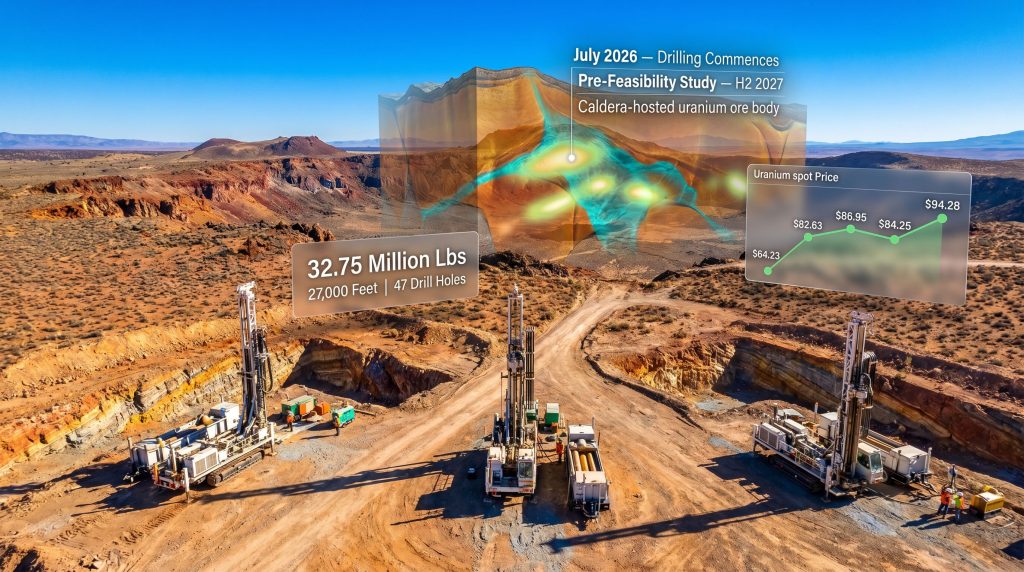
The program's physical parameters are substantial for a pre-feasibility stage campaign. According to mining technology coverage of the Aurora project, the full scope is as follows:
| Program Parameter | Specification |
|---|---|
| Total Drill Holes | 47 diamond drill holes |
| Total Footage | 27,000 feet |
| Drill Rigs Deployed | Up to 3 track-mounted rigs |
| Program Duration | 3 to 4 months (July to October 2026) |
| Estimated Cost | $4.7 million |
| Funding Source | Existing $30 million cash position |
| Drilling Contractor | Harris Exploration Drilling & Associates |
Nevada-based contractor Harris Exploration Drilling & Associates will deploy up to three track-mounted drill rigs simultaneously, each configured with above-ground mud systems. The choice of diamond core drilling over rotary percussion methods is deliberate and technically significant. Diamond drilling produces continuous cylindrical core samples that preserve the physical and chemical integrity of the rock column, enabling metallurgical testing, geomechanical analysis, and accurate downhole geophysical logging. Rotary methods, while faster and cheaper, produce rock chips that are far less suited to the laboratory work this program demands.
Every drill hole in the campaign will be surveyed using a gamma probe, an instrument that measures naturally occurring radioactivity in the borehole wall as it is lowered through the drill hole. Gamma probe logging produces a continuous radiometric profile of the drill hole that serves two purposes: it provides a real-time indicator of uranium concentration, and it enables cross-validation against the laboratory chemical assays that will be performed on the physical core.
The Five Engineering Objectives Behind the Drill Holes
The program is organised around five distinct technical objectives, each addressing a knowledge gap that must be closed before mine design work can meaningfully proceed:
-
Metallurgical sampling — Core samples will be submitted for testwork to determine how effectively uranium can be extracted from Aurora's ore through standard leaching circuits. Metallurgical recovery rates directly determine processing plant throughput assumptions and operating cost models in any feasibility study. Without this data, capital cost estimates carry accuracy errors that make them unsuitable for project financing.
-
Hydrogeological characterisation — Six drill holes within the program are specifically designated to measure groundwater elevation, flow rates, and aquifer characteristics. This information drives mine dewatering design, a major operational cost consideration in open-pit mining, and provides the baseline data required by environmental regulators to assess groundwater impacts.
-
Rock mechanics and geotechnical sampling — Core samples from strategic locations will be tested for physical properties including compressive strength, shear behaviour, and structural discontinuities. These results directly determine the safe angle at which pit walls can be designed. Underestimating pit slope stability requirements can lead to dangerous wall failures; overestimating them produces unnecessarily conservative designs that significantly increase strip ratios and operational costs.
-
Resource expansion through infill and step-out drilling — Some holes target areas within the known deposit boundary to upgrade inferred resources to the indicated or measured classification. Others will test lateral and depth extensions of the known mineralisation envelope, with the potential to grow the already substantial 32.75 million pound indicated resource base.
-
Integrated downhole data logging — Systematic gamma probe surveys across all 47 holes will produce a continuous subsurface radiometric dataset that, when merged with assay results, significantly tightens the geological model between drill holes and reduces interpolation uncertainty in resource estimation.
Navigating Oregon's Dual Permitting Framework Before Drilling Can Begin
The July 2026 commencement target for the Eagle Nuclear Energy Oregon uranium site drilling program is explicitly conditional on receiving regulatory approvals that, as of the program announcement, had not yet been granted. Two separate regulatory bodies govern exploration activities at Aurora, and both must sign off before a drill rig can be mobilised:
-
Oregon Department of Geology and Mineral Industries (DOGAMI): The state agency responsible for regulating mineral exploration and mining activities in Oregon. State-level approval must be obtained before surface disturbance activities can commence.
-
Bureau of Land Management (BLM): The federal agency with jurisdiction over public lands within the project area. At the scale of a 47-hole program, the BLM typically requires a formal Plan of Operations rather than a simpler notice-level permit, which introduces additional procedural steps and review timelines.
Permit applications to both agencies were submitted in early 2026. Running in parallel with this process, comprehensive environmental baseline data collection commenced in May 2026, encompassing wetlands delineation and assessment as well as cultural and heritage resource surveys across the project area.
Regulatory sequencing matters enormously in western U.S. uranium development. Baseline environmental data collected before any ground disturbance occurs is significantly more credible and defensible during permitting reviews than data gathered after exploration activity has already altered site conditions. Starting this work in May 2026, ahead of drilling, reflects sound regulatory strategy.
From Drill Results to Pre-Feasibility: The Engineering Roadmap to 2027
The 2026 drilling campaign is one step in a clearly defined engineering progression. Understanding where it sits within the broader development sequence helps contextualise why the $4.7 million program expenditure, drawn from a $30 million existing cash position, is strategically proportionate rather than speculative:
-
Investigative Drilling Program (July to October 2026): Generate engineering, metallurgical, hydrogeological, and geotechnical datasets from 47 diamond core holes.
-
Laboratory Analysis and Model Integration (Q4 2026 to Q1 2027): Process all core samples, complete metallurgical testwork, update the 3D geological resource model with new assay and gamma log data.
-
Pre-Feasibility Study (PFS) (Target: second half of 2027): Integrate all datasets into a formal techno-economic assessment of Aurora's viability, including capital cost estimation at approximately ±25% accuracy, operating cost modelling, mine plan scenarios, and economic sensitivity analysis across uranium price assumptions.
-
Feasibility Study: Contingent on PFS outcomes and market conditions, this phase refines cost estimates to bankable accuracy and supports project financing.
-
Permitting for Mine Construction: Full environmental impact assessment and mine plan regulatory approval.
-
Construction and Commissioning: Subject to final investment decision and capital markets conditions at that time.
Uranium Spot Price Dynamics and Their Relevance to Aurora's Economic Threshold
The economic sensitivity analysis within any future Pre-Feasibility Study for Aurora will be heavily influenced by uranium spot price assumptions. The broader uranium market dynamics at play illustrate just how consequential these fluctuations can be for project economics. Spot price data from uranium fuel provider Cameco illustrates the volatility that characterises this market:
| Period | Uranium Spot Price (per lb U₃O₈) |
|---|---|
| End of March 2025 (2025 low) | $64.23 |
| End of September 2025 (2025 high) | $82.63 |
| End of January 2026 (two-year high) | $94.28 |
| End of February 2026 | $86.95 |
| End of March 2026 | $84.25 |
Source: Cameco uranium price tracker, as reported by ANS Nuclear Newswire, April 2026.
The January 2026 price of $94.28 per pound represented the highest level recorded since February 2024, when Cameco listed $95.00 per pound. This elevated price environment provides a favourable backdrop for advancing engineering work at large conventional deposits, where the economics of scale provide meaningful insulation against short-term price softness.
It is worth noting that the divergence between spot versus term pricing is significant, and utilities typically negotiate long-term contracts directly with producers over multi-year terms that provide far more relevant input assumptions for project feasibility modelling. Most uranium sold globally changes hands through long-term contracts rather than spot transactions, and the contract market in 2026 reflects the tightening supply outlook that is driving domestic development activity across the U.S. uranium sector.
The next major ASX story will hit our subscribers first
How Aurora Fits Within the Rapidly Restructuring U.S. Nuclear Fuel Supply Chain
The broader U.S. nuclear fuel supply chain is undergoing its most significant structural reconstruction in decades. The recent Russian uranium import ban has further accelerated the push towards domestic supply alternatives, and several concurrent developments illustrate the scale of activity:
-
Uranium Energy Corp. commenced production at its Burke Hollow ISR operation in southern Texas in April 2026, processing ore through the Hobson Central Processing Plant in a hub-and-spoke configuration that serves five satellite ISR projects across the Texas Uranium Belt.
-
Centrus Energy Corp. engaged Fluor Corporation as the engineering, procurement, and construction contractor for the expansion of its American Centrifuge Plant uranium enrichment facility in Piketon, Ohio.
-
BWXT Technologies opened its Centrifuge Manufacturing Development Facility in Oak Ridge, Tennessee, targeting the reestablishment of domestic uranium enrichment capacity for national security purposes.
-
FluxPoint Energy unveiled plans to develop what it describes as the first new U.S. uranium conversion facility in more than 70 years, targeting the conversion of uranium oxide to uranium hexafluoride (UF₆), a critical intermediate step in producing reactor fuel.
-
The NRC granted X-energy subsidiary TRISO-X a special nuclear material licence for high-assay low-enriched uranium (HALEU) fuel fabrication, the first new nuclear fuel fabrication plants to be licensed by the NRC in over 50 years.
Aurora sits at the upstream origin point of this supply chain, as a primary uranium resource. All downstream processing, enrichment, conversion, and fuel fabrication capacity under construction or development ultimately requires a feedstock of uranium concentrate. A domestic deposit of Aurora's scale represents a potential long-term anchor supply source for this infrastructure, particularly as next-generation small modular reactors (SMRs) add incremental demand to a market that is already structurally undersupplied from domestic sources.
Conventional Mining at Aurora vs. ISR Operations: A Technical Comparison
| Factor | Conventional Open-Pit (Aurora) | In Situ Recovery (ISR) |
|---|---|---|
| Geological Suitability | Caldera-hosted volcanic host rock | Permeable sandstone aquifer |
| Surface Disturbance | Significant | Minimal |
| Processing Method | Physical ore extraction plus leaching plant | Direct aquifer leaching, surface recovery |
| Capital Intensity | Higher | Lower |
| Environmental Footprint | Larger but well-established regulatory framework | Smaller surface footprint, aquifer risk |
| Applicability to Aurora | Yes | No, geology is unsuitable |
Frequently Asked Questions: Eagle Nuclear Energy Aurora Uranium Project
What is the Aurora Uranium Project?
Aurora is a caldera-hosted uranium deposit located in Malheur County, southeastern Oregon, near the Oregon-Nevada border west of McDermitt, Nevada. It holds an indicated resource of 32.75 million pounds of uranium and is recognised as the largest conventional, measured, and indicated uranium deposit identified in the United States. The project is owned by Nevada-based Eagle Nuclear Energy.
When will Eagle Nuclear Energy start drilling at the Aurora site?
The program is targeted to commence in July 2026, subject to receipt of state-level approvals from Oregon DOGAMI and federal approval from the Bureau of Land Management.
How large is the 2026 drilling program?
The program comprises 47 diamond drill holes across a cumulative 27,000 feet of drilling, deployed across up to three simultaneous track-mounted drill rigs over an estimated three to four months.
How much will the program cost and how is it funded?
The program is budgeted at $4.7 million, fully funded from Eagle Nuclear Energy's existing $30 million cash position, requiring no additional capital raising.
What is the primary purpose of this drilling?
This is engineering-phase investigative drilling, not exploration. The five core objectives are metallurgical sampling, hydrogeological assessment, rock mechanics testing for pit slope design, resource expansion drilling, and comprehensive downhole radiometric logging integrated with laboratory assay results.
What comes after the drilling program?
Results from the program will feed into a Pre-Feasibility Study targeted for the second half of 2027. This study will represent the first formal techno-economic assessment of Aurora's viability as a producing uranium mine.
Why can't Aurora use in situ recovery mining methods?
Aurora's volcanic caldera host geology lacks the permeability characteristics of sandstone aquifer systems that ISR methods require. Consequently, conventional open-pit or underground extraction is the appropriate method for this deposit type.
Disclaimer: This article is intended for informational and educational purposes only and does not constitute financial or investment advice. Forward-looking statements regarding project timelines, resource estimates, permitting outcomes, and feasibility study results involve risks and uncertainties and should not be relied upon as guarantees of future outcomes. Readers should conduct their own due diligence and consult qualified advisors before making investment decisions. Uranium spot price data cited is sourced from Cameco's publicly available uranium price tracker as reported by ANS Nuclear Newswire.
For further reading on U.S. uranium fuel supply chain developments, the American Nuclear Society's Nuclear Newswire publishes regular coverage at ans.org/news.
Want to Be First When the Next Major Uranium Discovery Hits the ASX?
Discovery Alert's proprietary Discovery IQ model scans ASX announcements in real time, delivering instant alerts on significant mineral discoveries — including uranium — so subscribers can identify actionable opportunities well ahead of the broader market. Explore why historic mineral discoveries have generated extraordinary returns and start your 14-day free trial at Discovery Alert to position yourself at the front of the market.