July 10, 2026
The Nuclear Fuel Economy Is Reshaping Indo-Pacific Alliances
A quiet but profound restructuring of global energy geopolitics is underway. As nations reckon with the twin pressures of decarbonisation and energy sovereignty, nuclear power is experiencing a renaissance not seen since the 1970s. Demand for uranium is climbing, long-term fuel supply agreements are being competed over with unusual urgency, and the countries that control the world's largest reserves are finding themselves at the centre of a new kind of strategic leverage. Within this context, the Australia India uranium deal formalised in July 2026 is far more consequential than a bilateral commodity arrangement. It is an early signal of how the Indo-Pacific's energy architecture is being rebuilt from the ground up.
When big ASX news breaks, our subscribers know first
From Legal Scaffold to Operational Reality: A Decade in the Making
The pathway to this agreement was neither swift nor straightforward. A civil nuclear cooperation pact between Australia and India was first established in 2014, followed by the 2015 Australia-India Nuclear Cooperation Agreement, which created the legal framework required for uranium exports to proceed. Yet the arrangement remained largely dormant for over a decade, stalled partly by tensions surrounding India's status outside the Nuclear Non-Proliferation Treaty (NPT).
India is one of only a small number of nuclear-armed states that never signed the NPT, a fact that historically complicated its ability to access civilian uranium fuel from countries bound by international non-proliferation norms. The resolution came through a carefully constructed safeguards architecture administered by the International Atomic Energy Agency (IAEA), which provides independent verification that Australian uranium is directed exclusively toward civilian power generation.
A meaningful precedent for this approach was set in 2008, when the United States signed its own civil nuclear cooperation agreement with India, commonly referred to as the 123 Agreement, demonstrating that NPT non-signatory status need not be a permanent barrier to civilian fuel access where robust safeguards exist.
The administrative agreement activating uranium exports was formalised during Indian Prime Minister Narendra Modi's visit to Melbourne on 9 July 2026, converting a decade-old legal scaffold into an operational export pathway.
Why India Needs Australian Uranium More Than Most Realise
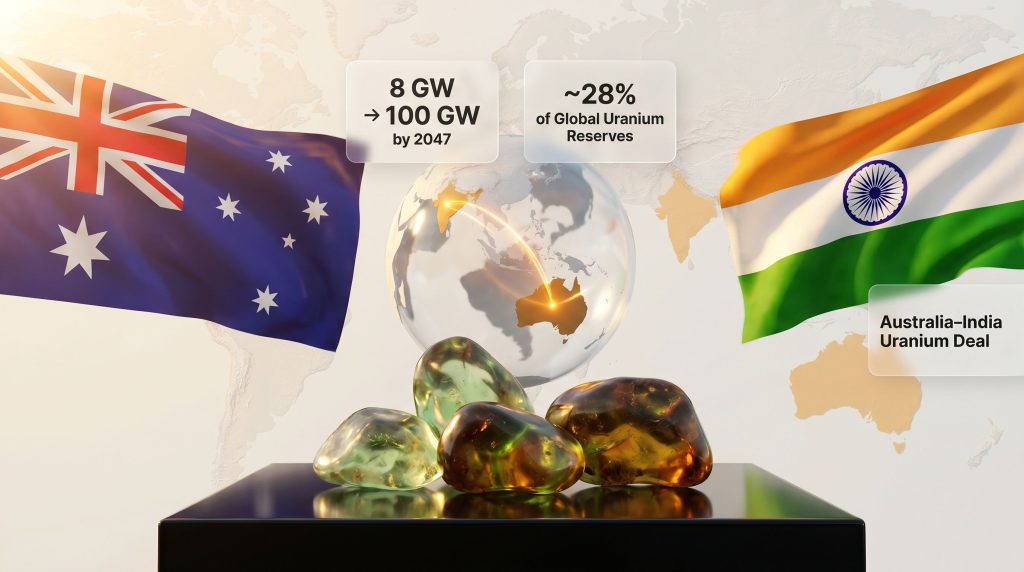
India's domestic uranium endowment is modest relative to its ambitions. The country operates 22 nuclear reactors generating approximately 8 gigawatts (GW) of electricity, a figure that represents a small fraction of its total power mix. The stated national target is to reach 100 GW of nuclear-generated electricity by 2047, a more than twelvefold increase over roughly two decades.
What Does the Fuel Arithmetic Actually Look Like?
To appreciate the scale of what that expansion requires, consider the fuel arithmetic. Each gigawatt of nuclear generating capacity requires roughly 150 to 200 tonnes of uranium per year. At 100 GW of installed capacity, India's annual uranium fuel demand could reach somewhere between 15,000 and 20,000 tonnes of uranium oxide per year.
That is a volume large enough to represent a material share of current global mine production. Furthermore, Australia, holding approximately 28% of the world's known uranium reserves, is among the very few nations with the geological endowment to reliably supply at that scale over multiple decades. Understanding the global uranium reserves picture makes clear why Australia is such a critical partner in this arrangement.
The demand drivers behind India's expansion are also worth examining carefully. Beyond the country's long-standing goal of reducing fossil fuel dependence and meeting net-zero transition commitments, a newer and faster-growing pressure is emerging from power-intensive digital infrastructure. The explosion in data centre construction, artificial intelligence compute demand, and industrial electrification is placing enormous strain on India's electricity grid. Nuclear baseload power, which delivers consistent and dispatchable electricity unlike intermittent renewables, is increasingly seen as the backbone that can support this next phase of economic growth.
Why Does India Need Australian Uranium?
India is targeting an expansion of its nuclear power capacity from approximately 8 GW today to 100 GW by 2047, a more than twelvefold increase. To achieve this, India requires a reliable, long-term supply of uranium from trusted partners. Australia, holding roughly 28% of the world's uranium reserves, offers both the geological scale and geopolitical reliability India needs to underpin this expansion.
The Full Scope of the Energy Security Package
The uranium arrangement sits within a broader bilateral architecture signed alongside the agreement. Understanding the full package is important for appreciating why this deal is structurally significant rather than merely symbolic.
| Agreement Component | Purpose | Key Mechanism |
|---|---|---|
| Uranium Export Administrative Agreement | Enable civilian nuclear fuel supply | IAEA safeguards verification |
| Joint Defence and Security Declaration | Deepen strategic alignment | Bilateral defence cooperation framework |
| Maritime Collaboration Roadmap | Secure Indo-Pacific sea lanes | Joint naval and logistics planning |
| Critical Minerals Partnership | Secure clean tech supply chains | Science exchange: Geoscience Australia and Geological Survey of India |
| Cyber and Emerging Technologies Pact | Protect digital infrastructure | Joint research and intelligence sharing |
| Renewable Energy Partnership | Accelerate clean energy deployment | Rooftop Solar Training Academy, Gujarat |
The critical minerals science-exchange framework between Geoscience Australia and the Geological Survey of India deserves particular attention. Joint geological mapping and resource assessment activities could identify co-investment opportunities across lithium, cobalt, and rare earth elements, positioning both nations to participate more competitively in global battery and clean technology supply chains. This moves Australia's role beyond that of a raw commodity exporter toward something more strategically embedded: a knowledge and technical partner.
The Rooftop Solar Training Academy established in Gujarat is another indicator of this shift. Gujarat is one of India's fastest-growing renewable energy states, and the transfer of Australian technical expertise in solar installation and workforce development represents a new dimension in bilateral engagement that complements rather than competes with the uranium arrangement.
Australia's Domestic Constraint: Reserves Without Production
One of the less-discussed but critically important dimensions of the Australia India uranium deal is the gap between Australia's geological wealth and its actual production capacity. The country's reserve base is world-class, yet output has been constrained for decades by state-level legislative bans on uranium mining that apply across several jurisdictions.
| State | Uranium Mining Status | Key Known Deposits |
|---|---|---|
| South Australia | Permitted | Olympic Dam, Honeymoon, Four Mile |
| Northern Territory | Permitted | Ranger (closed), Angela Pamela |
| Queensland | Banned | Ben Lomond, Maureen |
| Western Australia | Banned | Yeelirrie, Kintyre, Mulga Rock |
| New South Wales | Banned | Toongi |
Is Western Australia Leaving Value on the Table?
Western Australia and Queensland collectively host some of Australia's most significant undeveloped uranium deposits. Yeelirrie in Western Australia, for example, is among the largest undeveloped uranium projects in the country by resource size, yet it remains inaccessible to commercial development under existing state law. The current WA uranium mining status highlights precisely how much potential supply remains locked away by policy rather than geology.
The economic cost of these bans is not abstract. With India now representing a confirmed long-term demand signal of extraordinary scale, the opportunity cost of keeping these resources locked away is becoming increasingly difficult to justify on strategic grounds.
The Association of Mining and Exploration Companies (AMEC) has been unambiguous in its response. AMEC CEO Warren Pearce described the deal as an important reminder to jurisdictions that maintain uranium mining prohibitions that reassessing those policies is now an urgent national interest question. The industry body's position is that Australia possesses world-class uranium resources backed by strong safeguards and a proven mining sector, and that its producers should be embedded within the responsible, long-term supply chains that trusted trading partners are actively seeking to build.
How Does the Competitive Landscape Affect Australia?
The competitive risk dimension is worth examining through a scenario lens. Nuclear fuel supply agreements are not transactional spot-market purchases. They are typically structured as long-term contracts spanning 10 to 20 years, reflecting the capital intensity of reactor construction and the operational planning horizons of utility companies.
In addition, the uranium supply-demand volatility affecting global markets makes securing reliable long-term contracts even more critical for both buyers and sellers. If Australian state-level bans delay the development of new supply, India may lock in equivalent volumes from Kazakhstan, Canada, or Namibia, the three dominant uranium producing nations at present. Once those contracts are signed and infrastructure is aligned, the window for Australian producers to capture this generational market opportunity narrows considerably.
Three Scenarios for How This Plays Out
The trajectory of the Australia India uranium deal is not predetermined. Several plausible pathways exist, each with distinct implications for Australian industry and the broader Indo-Pacific energy order.
Scenario 1: Incremental Integration
Uranium exports begin modestly, supplementing existing coal and LNG trade flows. State-level mining bans remain in place, limiting new supply development. Critical minerals cooperation advances slowly through scientific exchange without progressing to commercial investment. This scenario delivers moderate trade diversification but limited strategic uplift.
Scenario 2: Accelerated Strategic Coupling
Supply agreements scale in line with India's 100 GW nuclear target, driving new project development in South Australia and the Northern Territory. Critical minerals supply chains are formalised under government-to-government frameworks, and renewable energy technology transfer adds new trade dimensions. Australia becomes India's primary energy security partner across fossil, nuclear, and clean energy domains simultaneously.
Scenario 3: Geopolitical Catalysis
The defence and maritime agreements deepen into formal alliance structures. Energy interdependence creates mutual deterrence against supply chain coercion from third parties. Joint critical minerals processing facilities are established across both countries. An integrated Indo-Pacific energy and security bloc anchored by Australia-India bilateralism begins to take shape.
Strategic note for investors: The difference between Scenario 1 and Scenario 3 is largely determined by domestic policy decisions within Australia, particularly whether state-level uranium mining bans are reviewed. The international demand signal is already confirmed. The constraint is on the supply side.
The next major ASX story will hit our subscribers first
The Global Nuclear Renaissance Provides the Backdrop
The Australia India uranium deal does not exist in isolation. It is part of a worldwide reassessment of nuclear energy's role in the electricity mix, accelerated by the 2022 energy crisis and the subsequent surge in demand from AI and data centre infrastructure. Consequently, the broader uranium market dynamics shaping investment decisions globally are directly relevant to understanding the long-term value of this bilateral agreement.
Countries that had previously signalled intentions to phase out nuclear are reconsidering. The United Kingdom, France, Japan, South Korea, Poland, and the United States are all advancing nuclear expansion programmes in various forms. This collective shift is creating a structural uplift in uranium demand that extends well beyond India's requirements alone, tightening the global supply-demand balance and increasing the long-term strategic value of uranium reserves.
However, geopolitical tensions are also reshaping supply chains. The Russian uranium import ban introduced by the US Senate has further accelerated the search for reliable alternative supply sources, making Australian uranium even more strategically attractive to allied nations seeking fuel security from trusted partners.
Australia's position within this environment is unusual. It holds the world's largest uranium reserve base yet generates none of its own nuclear electricity. As export demand accelerates, the domestic policy debate around whether Australia should consider nuclear power generation is likely to intensify, with the India deal providing fresh economic and strategic arguments across the political spectrum.
Key Facts at a Glance
| Dimension | Detail |
|---|---|
| Agreement Type | Administrative uranium export agreement |
| Legal Foundation | 2014 Civil Nuclear Cooperation Pact and 2015 Nuclear Cooperation Agreement |
| Safeguard Framework | IAEA civilian-use verification |
| India's Nuclear Target | 8 GW to 100 GW by 2047 |
| Australia's Uranium Reserve Share | Approximately 28% of global reserves |
| Export Volumes Disclosed | None at this stage |
| Complementary Agreements | Defence, maritime, critical minerals, cyber, renewables |
| Industry Response | AMEC calls for removal of state uranium mining bans |
| Strategic Context | Part of broader Indo-Pacific alliance deepening |
| Estimated First Shipment Timeline | Industry analysts suggest 2 to 4 years pending commercial negotiations |
Frequently Asked Questions
Is It Safe to Export Uranium to India Given Its Nuclear Weapons Programme?
India is not a signatory to the NPT, which historically created barriers to civilian uranium access. The Australia India uranium deal resolves this through a safeguards architecture administered by the IAEA, which independently verifies that all Australian uranium is directed exclusively to civilian power generation. This approach follows the precedent established by the United States-India 123 Agreement signed in 2008, which demonstrated that civilian nuclear cooperation with NPT non-signatories is achievable through robust verification frameworks.
When Will Uranium Exports to India Actually Begin?
The administrative agreement establishes the legal pathway, but commercial contracts between Australian producers and Indian utilities must still be negotiated. Regulatory approvals, export licensing, and logistics frameworks also require finalisation. Industry observers suggest initial shipments could potentially commence within two to four years, depending on the pace of commercial negotiations and project development decisions by Australian producers.
What Are the Key Risks to the Agreement's Success?
Several risk categories warrant monitoring:
- Political risk: Future government changes in either country could alter policy settings or prioritisation.
- Regulatory risk: State-level uranium mining bans in Australia could limit the supply available for export contracts.
- Geopolitical risk: Deterioration in India-Pakistan tensions could invite international scrutiny of nuclear fuel transfers.
- Commercial risk: Delays in India's reactor construction programme could reduce near-term demand relative to projections.
- Competition risk: Rival uranium-producing nations may lock in long-term contracts with India before Australian production capacity scales sufficiently.
This article contains forward-looking statements, projections, and scenario analysis. These are provided for informational and educational purposes only and do not constitute financial advice. Readers should conduct independent research and seek professional guidance before making investment decisions.
Want to Capitalise on the Uranium Sector's Strategic Realignment?
Discovery Alert's proprietary Discovery IQ model delivers real-time notifications on significant ASX mineral discoveries — including uranium and critical minerals plays — turning complex market data into actionable investment insights the moment they hit the exchange. Explore historic discoveries and their exceptional returns, then begin your 14-day free trial at Discovery Alert to position yourself ahead of the market as the global nuclear renaissance accelerates.