July 10, 2026
The Race for Uranium Ownership: Why India's Nuclear Ambitions Are Reshaping Global Supply Competition
The global uranium market has quietly entered one of its most consequential periods in decades. For most of the post-Fukushima era, uranium demand forecasts were subdued, spot prices languished, and investment in new mining capacity stalled. That calculus has now reversed sharply. A convergence of net-zero commitments, energy security concerns, and the limitations of intermittent renewables has placed nuclear power back at the centre of long-term electricity planning across Asia, Europe, and North America. Into this tightening supply environment steps India, with one of the most ambitious nuclear construction programmes ever announced by a state-owned utility.
Understanding why NTPC seeks overseas uranium assets requires looking beyond headline policy announcements and examining the structural forces, geological constraints, and uranium market volatility that make fuel security the single most critical enabler of India's nuclear future.
When big ASX news breaks, our subscribers know first
India's Coal Dependency and the Baseload Problem Nuclear Must Solve
India's electricity grid is among the most coal-intensive of any major economy. Fossil fuels, principally coal, continue to drive the overwhelming majority of electricity generation, and while solar and wind capacity is expanding at impressive pace, neither technology solves the baseload problem. Renewable energy generation is inherently intermittent, dependent on weather conditions and daylight hours, and cannot be dispatched on demand to meet industrial or urban load requirements around the clock.
Nuclear power occupies a fundamentally different position in the generation mix. It delivers firm, continuous, zero-carbon output regardless of weather, season, or time of day. For a grid that needs to phase out coal without sacrificing reliability, nuclear is not simply one option among many; it is the only proven baseload-capable low-carbon technology available at the scale India requires.
This is the structural logic underpinning NTPC's nuclear push. As India's dominant power generation utility, the company is not pursuing nuclear capacity as a speculative diversification. It is responding to a national energy transition challenge that demands coal replacement at industrial scale, and nuclear is the only technology capable of filling that role.
NTPC's 30 GW Target: Scale, Subsidiary, and Legislative Foundation
A Target That Exceeds Most Nations' Entire Nuclear Fleet
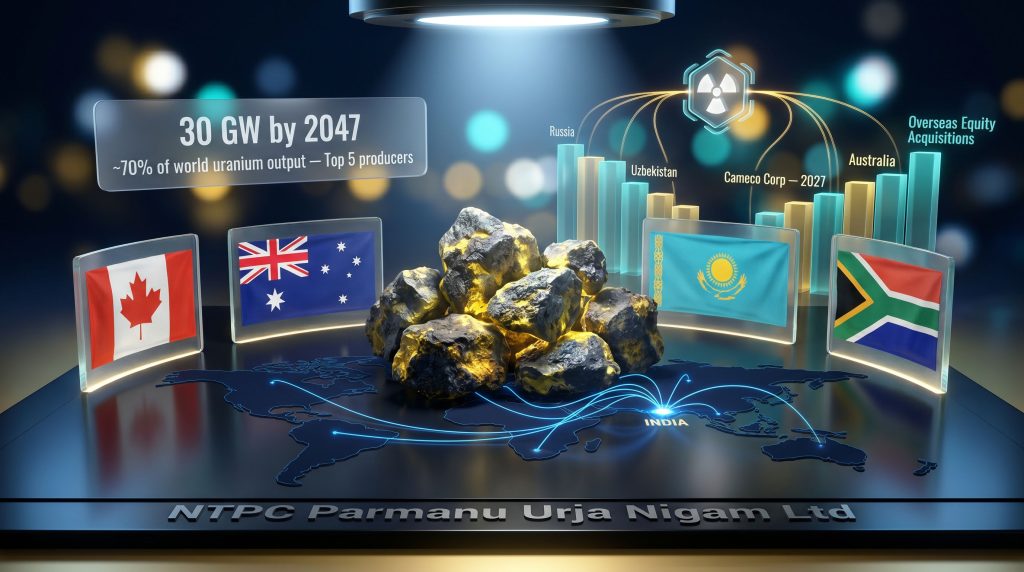
NTPC has formalised a target of 30 gigawatts of nuclear capacity to be operational by 2047, representing approximately 30% of India's national goal of 100 GW of nuclear generation. Individual project units are expected to range between 700 MW and 1,600 MW in installed capacity, with site identification processes currently underway.
To put this in perspective, 30 GW of nuclear capacity would exceed the total installed nuclear fleet of most countries currently operating reactors. Achieving this target within a two-decade window would require NTPC to become one of the fastest-moving nuclear developers in the world, a pace that is only feasible if fuel supply is secured well in advance of reactor commissioning.
NTPC Parmanu Urja Nigam Ltd: Building the Institutional Architecture
In January 2025, NTPC established a dedicated nuclear subsidiary, NTPC Parmanu Urja Nigam Ltd (NPUNL), to independently manage its atomic energy portfolio. The subsidiary structure serves multiple purposes:
- It ring-fences nuclear liability and regulatory risk from NTPC's conventional power business
- It creates a dedicated organisational unit capable of pursuing specialised nuclear partnerships, technology agreements, and fuel supply arrangements
- It signals to domestic and international counterparties that NTPC's nuclear ambitions have formal institutional backing, not merely aspirational targets
This mirrors approaches taken by other large state-owned utilities globally when entering the nuclear sector, where the complexity of regulatory compliance, liability management, and long-cycle project development requires dedicated governance structures.
The December 2024 Legislative Breakthrough
India's parliament passed landmark legislation in December 2024 that formally ended the decades-old state monopoly over nuclear power generation. This regulatory shift carries two dimensions of significance:
- Private sector participation is now legally permissible, creating a competitive landscape where early movers with established fuel supply chains hold a meaningful structural advantage
- Nuclear liability reform removes provisions that had historically deterred foreign technology suppliers and investors from committing capital to Indian nuclear projects, opening the door to international reactor technology partnerships and equipment supply agreements
For NTPC, the legislative change transforms NPUNL from a government utility subsidiary into a genuine market participant capable of competing for partnerships, technology licences, and fuel supply equity with international counterparties. Furthermore, these uranium investment strategies increasingly reflect the importance of early positioning in a tightening market.
Why Domestic Uranium Supply Cannot Support a 100 GW Programme
India's sole domestic uranium producer, the Uranium Corporation of India Ltd (UCIL), operates mines primarily concentrated in the states of Jharkhand and Andhra Pradesh. While UCIL provides a foundation for India's existing reactor fleet, the reserves accessible through its current operations are structurally insufficient to fuel a programme of the scale India has committed to.
The scale of planned capacity addition necessitates securing a sustainable fuel supply of uranium. Considering the limitations of domestic fuel and mining reserves, overseas exploration and the acquisition of uranium mines are required. – NTPC bid document, as reported by Bloomberg, July 2026
This is not simply a volume problem. India's domestic uranium deposits are generally of lower grade compared to the high-grade Athabasca Basin deposits in Canada, where ore grades can exceed 20% U3O8 in some zones, compared to typical Indian deposits that operate at substantially lower concentrations. Grade matters enormously in uranium economics: higher-grade ore requires less material to be processed per unit of uranium recovered, which directly reduces operating costs and environmental footprint per kilogram of output.
A parallel Memorandum of Understanding (MoU) with UCIL has been drafted to enable joint techno-commercial due diligence on overseas acquisition targets, combining NTPC's financial capacity with UCIL's operational expertise in uranium mining and processing.
The Four Target Jurisdictions: Why These Countries?
NTPC's consultant tender identifies four priority jurisdictions for overseas uranium asset acquisition. Each represents a distinct strategic rationale within a broader diversification framework.
| Jurisdiction | Key Producer | Strategic Rationale |
|---|---|---|
| Canada | Cameco Corp | Highest-grade deposits globally; existing supply relationship |
| Australia | Multiple operators | Bilateral agreement formalised July 2026; large reserve base |
| Kazakhstan | NAC Kazatomprom | World's largest producer; low-cost ISR mining model |
| South Africa | Various | Uranium byproduct recovery; diversification beyond dominant producers |
Canada: Grade, Scale, and an Existing Relationship
Canada's Athabasca Basin in Saskatchewan hosts some of the highest-grade uranium deposits on Earth. The basin's unconformity-type deposits are geologically unique: uranium mineralisation concentrated at the interface between basement rocks and overlying sandstone creates ore bodies with grades that can be orders of magnitude higher than conventional deposits elsewhere. This geological characteristic underpins the economic advantage Canadian uranium production holds over much of the global supply base.
Cameco Corp, the world's second-largest uranium producer in 2024 according to the World Nuclear Association, is already a confirmed future supplier to India, with shipments scheduled to commence in 2027. That existing commercial relationship provides a natural platform for NTPC to explore equity participation in Canadian assets, moving from a buyer position to a partial owner.
Kazakhstan: The World's Largest Producer and In-Situ Recovery Economics
NAC Kazatomprom ranked as the single largest uranium producer globally in 2024. Kazakhstan's dominance of global uranium production is built on its widespread adoption of in-situ recovery (ISR) mining, a technique that extracts uranium from underground ore bodies by circulating a leaching solution through the deposit without physically excavating the rock.
ISR offers several cost and operational advantages over conventional open-pit or underground mining:
- Significantly lower capital expenditure per unit of production capacity
- Reduced surface disturbance and lower rehabilitation liability
- Faster ramp-up timelines compared to conventional mine development
- Lower operating costs per kilogram of uranium recovered in appropriate geological settings
For NTPC, equity participation in Kazakh ISR operations could provide access to large uranium volumes at competitive cost, making Kazakhstan perhaps the most operationally attractive of the four target jurisdictions. In addition, the environmental benefits of ISR align well with India's broader sustainability commitments.
Australia: Diplomacy Translating into Asset Opportunity
A bilateral uranium supply agreement between India and Australia was formalised during Prime Minister Narendra Modi's visit to Melbourne in July 2026. Australia holds some of the world's largest uranium reserves and has an established, transparent export framework for nuclear fuel governed by strict safeguards agreements.
The diplomatic formalisation of supply creates a legal and political foundation for NTPC to pursue deeper engagement, potentially including equity stakes in Australian uranium projects. Australia's regulatory environment, while rigorous, provides investment certainty that emerging-market uranium jurisdictions cannot always match.
South Africa: The Byproduct Dimension
South Africa's inclusion in NTPC's target list reflects a less immediately obvious but strategically significant dynamic. Much of South Africa's uranium is recovered as a byproduct of gold mining operations, where uranium occurs naturally in gold-bearing reef formations. This byproduct recovery model means uranium production economics are partially insulated from pure uranium price cycles, since gold revenue offsets processing costs.
For NTPC, participating in South African uranium recovery could provide access to meaningful volumes at economics partially decoupled from uranium spot price volatility, adding a diversification dimension beyond the dominant Central Asian and North American producers.
India's Layered Uranium Supply Architecture
NTPC's overseas mine acquisition strategy sits within a broader, multi-layered approach to uranium fuel security that India has been constructing over several years.
| Supply Source | Mechanism | Timeline |
|---|---|---|
| UCIL (domestic) | State production | Active |
| Russia | Bilateral agreement | Active imports |
| Uzbekistan | Bilateral agreement | Active imports |
| Cameco Corp (Canada) | Commercial supply contract | Commencing 2027 |
| Australia | Bilateral agreement | Confirmed July 2026 |
| Overseas mine equity | Acquisition programme | Tender bids due July 16, 2026 |
The layering is deliberate. Bilateral supply agreements provide near-term volume certainty but expose India to counterparty risk and price renegotiation over time. Equity ownership of mines transforms uranium from a procurement input into a controlled asset, providing both cost visibility and supply security across the multi-decade operating life of nuclear reactors.
The next major ASX story will hit our subscribers first
Advanced Fuel Technology: The Thorium Dimension
Beyond conventional uranium acquisition, NTPC is engaged in discussions with US-based Clean Core Thorium Energy (CCTE) regarding the potential deployment of ANEEL (Advanced Nuclear Energy for Enriched Life) fuel technology. ANEEL represents a hybrid approach combining thorium and enriched uranium that could, over the long term, reduce India's dependence on imported uranium by leveraging India's substantial domestic thorium reserves.
India holds some of the world's largest thorium deposits, concentrated in coastal mineral sands. The country has long pursued a three-stage nuclear programme with thorium utilisation as its ultimate objective. Consequently, understanding global thorium reserves becomes increasingly relevant as India maps its long-term energy independence pathway.
This technology pathway is complementary to, rather than a substitute for, the near-term uranium acquisition strategy. Thorium fuel cycles are not yet commercially mature at scale, and India's reactor construction programme over the next two decades will predominantly rely on conventional uranium fuel. Securing overseas uranium assets remains the critical near-term priority.
The Global Uranium Competition NTPC Is Entering
NTPC's overseas acquisition drive does not occur in a vacuum. The global nuclear renaissance has created intensifying competition for long-term uranium supply and developable mine assets, with state-backed entities from China, South Korea, and now India all pursuing the same finite pool of opportunities.
The top five global uranium producers collectively accounted for approximately 70% of world output in 2024, according to the World Nuclear Association, meaning supply is heavily concentrated in a small number of jurisdictions and operators.
This concentration creates a strategic imperative for early positioning. Once the highest-quality assets in the Athabasca Basin, Kazakhstan's ISR fields, and Australia's major uranium deposits are under long-term supply or equity arrangements, late movers face a significantly less attractive residual opportunity set.
Uranium spot prices have experienced significant volatility in recent years, reinforcing the strategic logic of equity ownership over pure contract purchasing. As reported by the Economic Times, NTPC seeks overseas uranium assets precisely because owning a share of production insulates a buyer from price spikes while providing the optionality to sell surplus volumes into the market during periods of oversupply. For a utility planning 30 GW of nuclear capacity over 20 years, that price risk management dimension alone justifies the complexity of overseas asset ownership.
Disclaimer: This article contains forward-looking statements and projections based on publicly available information and reported targets. Nuclear capacity development timelines, uranium acquisition outcomes, and fuel supply arrangements are subject to regulatory, geological, financial, and geopolitical risks. Nothing in this article constitutes financial or investment advice. Readers should conduct independent research and consult qualified advisers before making investment decisions.
Want to Capitalise on the Uranium Supply Race Before the Market Moves?
Discovery Alert's proprietary Discovery IQ model delivers real-time alerts on significant ASX uranium and mineral discoveries, instantly translating complex data into actionable investment insights — explore historic discoveries and their returns to understand what early positioning can mean for a portfolio, then begin a 14-day free trial at Discovery Alert to stay ahead of the intensifying global competition for uranium assets.